
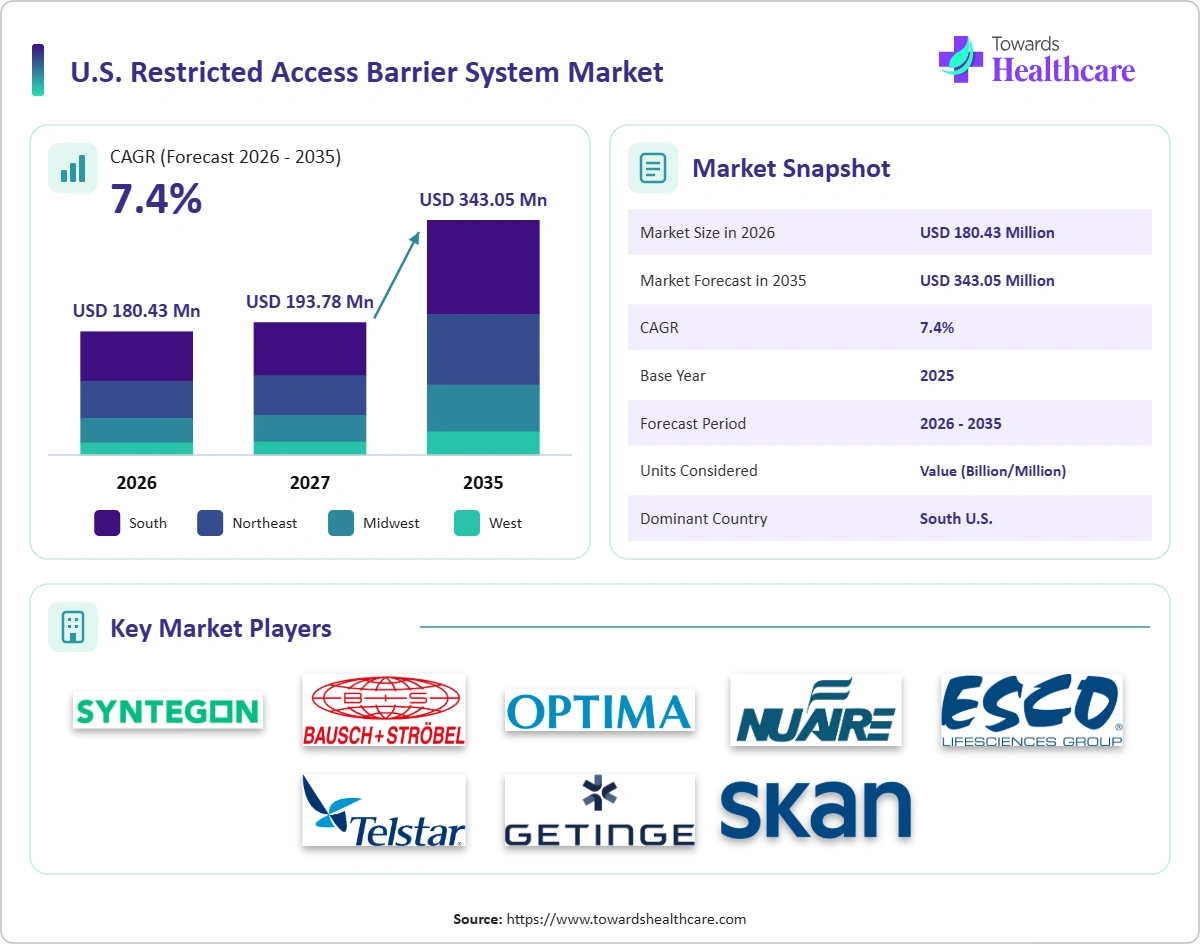
The U.S. restricted access barrier system market is projected to grow from USD 168.00 million in 2025 to USD 343.05 million by 2035 because aseptic manufacturing of injectables in the United States depends on barrier technology to protect sterile products from operators. Injectable growth, onshoring, CDMO fill-finish expansion, and tighter contamination control support solid growth, lifting the market to USD 240.07 million by 2030 and sustaining a CAGR of 7.40% from 2026 to 2035. RABS sit alongside each biological safety cabinet and isolator in cell therapy and cell-based vaccine facilities.
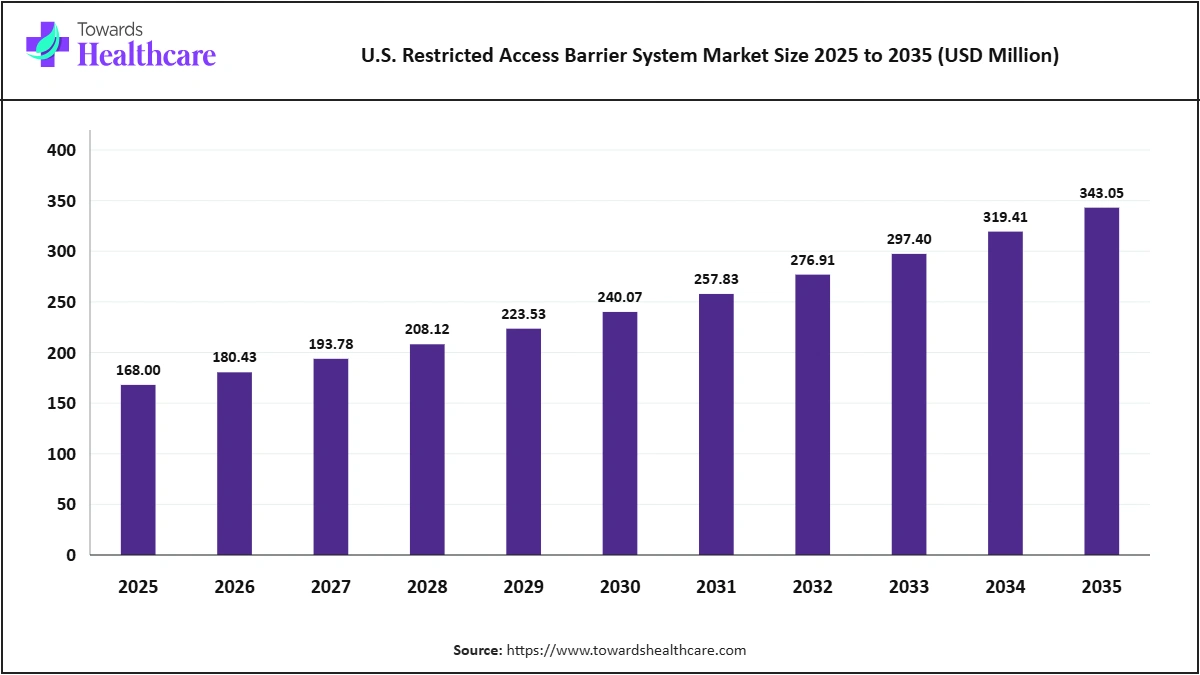
Analyst View: We developed the estimate using the number of aseptic lines across the U.S., new installations and retrofit projects, and average RABS system prices. We also cross-checked the figures against activity among barrier system suppliers. Since published data for this specific U.S. market is limited, our estimate is based on available industry evidence and supporting market indicators.
| Driver | Impact | ≈ CAGR Contribution | Time Horizon | Key Regions |
| Injectable and biologic output grows | High | +2.89 pp | Short to long term | U.S.-wide, strongest in South |
| Contamination control rules tighten | Medium | +2.44 pp | Medium to long term | U.S.-wide, fastest uptake in West |
| Onshoring adds fill-finish lines | Medium | +2.08 pp | Short to medium term | U.S.-wide |
| CDMOs expand | Low | +1.63 pp | Long term | South and West |
Note: Contributions are indicative estimates of each factor's effect on annual growth.
Sources: Expert interviews, secondary sources, Towards Healthcare database, and Towards Healthcare analysts.
Taken together, these drivers add about 9.03 percentage points to the annual growth of the U.S. restricted access barrier system market, with injectable and biologic output growth having the largest effect. Their influence is strongest in the South, while uptake grows fastest in the West.
| Restraint | Impact | ≈ Negative CAGR Contribution | Time Horizon | Key Regions |
| Competition from isolators | High | -0.73 pp | Short to medium term | U.S.-wide |
| High validation costs | High | -0.54 pp | Medium term | Smaller and price-sensitive markets |
| Long project timelines | Medium | -0.36 pp | Short term | South and other mature markets |
Note: Contributions are indicative estimates of each factor's effect on annual growth.
Sources: Expert interviews, secondary sources, Towards Healthcare database, and Towards Healthcare analysts.
These restraints are expected to reduce annual growth of the U.S. restricted access barrier system market by about 1.63 percentage points, led by competition from isolators. Their effect eases over the forecast period as suppliers, buyers, and regulators adapt, leaving a net CAGR of 7.40% from 2026 to 2035.
Growth opportunities are emerging from the modernization of older production lines, the development of cell therapy suites, and the expansion of compounding pharmacies. Increasing adoption of robotic filling systems and the need for small-batch, personalized medicines are also creating new demand for advanced contamination control solutions.
Note: 2025 is the base year; 2035 shares and CAGRs are forecasts.
Sources: Expert interviews, secondary sources, Towards Healthcare database, and Towards Healthcare analysts.
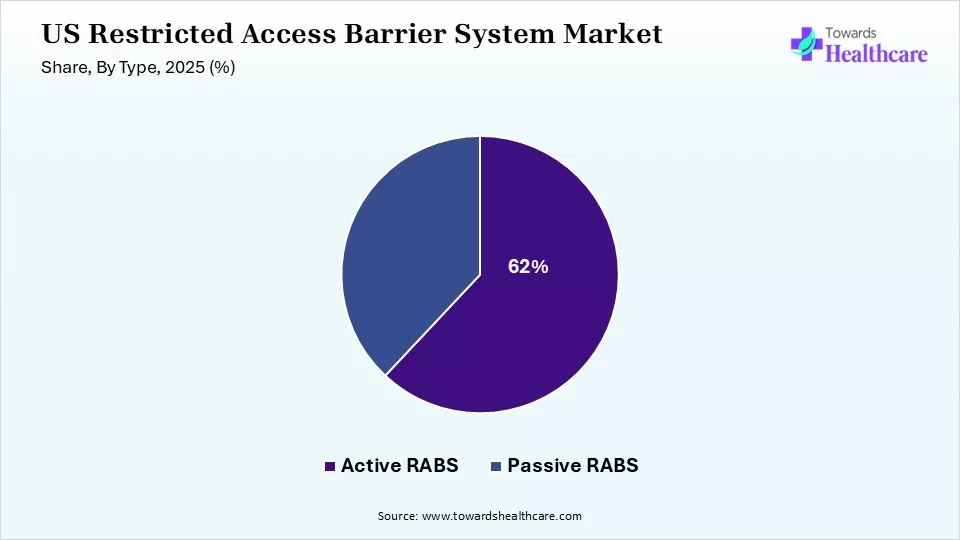
Active RABS: This segment held the largest share of the U.S. restricted access barrier system market in 2025, accounting for 62.00% of revenue, and is projected to grow at a CAGR of 7.62% from 2026 to 2035. Active RABS lead the segment due to their built-in HEPA airflow units, which provide better contamination control during aseptic filling operations. The segment is expected to grow at a pace broadly in line with the overall market over the forecast period.
Passive RABS use the cleanroom's ceiling airflow and suits smaller or older lines. The passive RABS segment is expected to grow slower than the overall market over the forecast period.
t is also projected to record the fastest growth, with a CAGR of 7.62% from 2026 to 2035, further strengthening its position in the U.S. restricted access barrier system market.
Note: 2025 is the base year; 2035 shares and CAGRs are forecasts.
Sources: Expert interviews, secondary sources, Towards Healthcare database, and Towards Healthcare analysts.
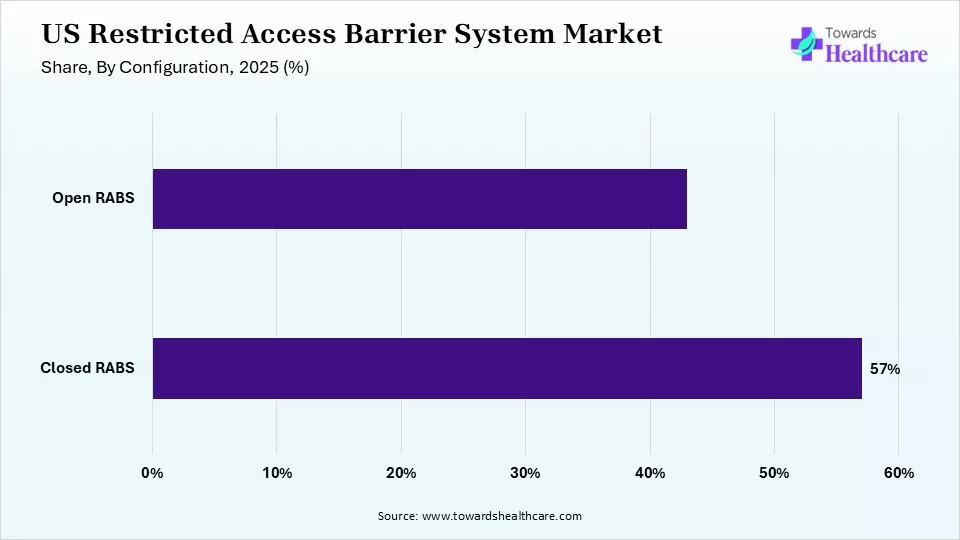
Closed RABS: This segment held a 57.00% share of the U.S. restricted access barrier system market in 2025 and is projected to grow at a CAGR of 7.82% from 2026 to 2035. Closed RABS lead the segment and are expected to grow faster than the overall market because they keep access doors closed during production, helping maintain a controlled environment. Their adoption is also supported by stricter contamination control expectations under EU GMP Annex 1, which are influencing manufacturing practices worldwide.
Open RABS allow doors to open under controlled conditions and suit older facilities. The open RABS segment is expected to grow slower than the overall market over the forecast period.
Note: 2025 is the base year; 2035 shares and CAGRs are forecasts.
Sources: Expert interviews, secondary sources, Towards Healthcare database, and Towards Healthcare analysts.
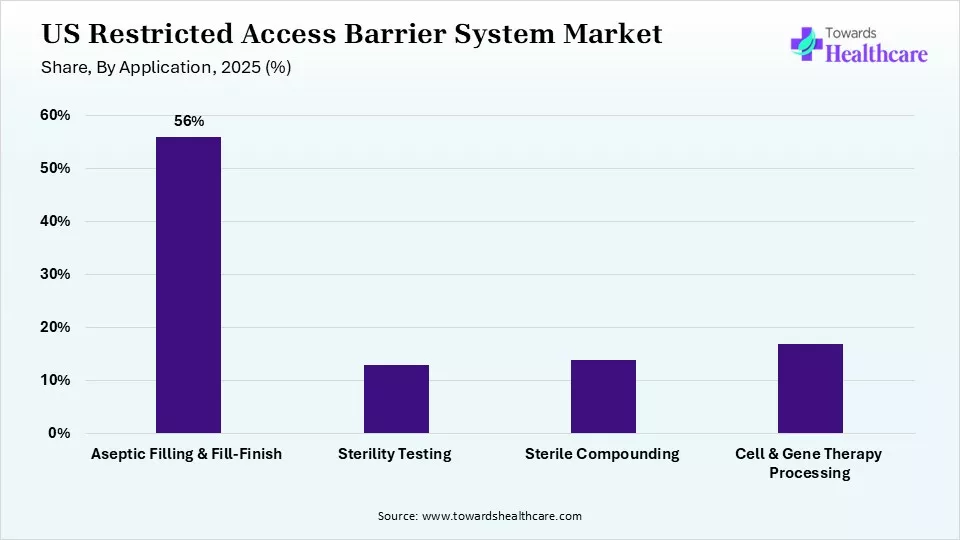
Aseptic Filling & Fill-Finish: This segment represented 56.00% of the U.S. restricted access barrier system market in 2025 and is projected to grow at a CAGR of 6.85% from 2026 to 2035. Aseptic filling and fill-finish operations dominate demand because injectable products, including vials, syringes, and cartridges, must be filled under Grade A conditions to maintain sterility. However, the segment is expected to grow at a slower pace than the overall market during the forecast period.
Sterility testing uses barrier systems to prevent false positives. The sterility testing segment is expected to grow broadly in line with the overall market over the forecast period.
Sterile compounding applications use RABS in pharmacies and outsourcing facilities to maintain controlled environments during the preparation of sterile products. The segment is expected to grow at a pace broadly in line with the overall market over the forecast period.
Cell and gene therapy processing grows fastest as manual open steps need protection. The cell & gene therapy processing segment is expected to grow faster than the overall market over the forecast period.
Meanwhile, Cell & Gene Therapy Processing is projected to grow the fastest, with a CAGR of 9.25% from 2026 to 2035, driven by increasing demand for advanced therapy manufacturing. Sterility Testing is expected to retain the smallest market share, reflecting its more specialised role in the U.S. restricted access barrier system market.
Note: 2025 is the base year; 2035 shares and CAGRs are forecasts.
Sources: Expert interviews, secondary sources, Towards Healthcare database, and Towards Healthcare analysts.
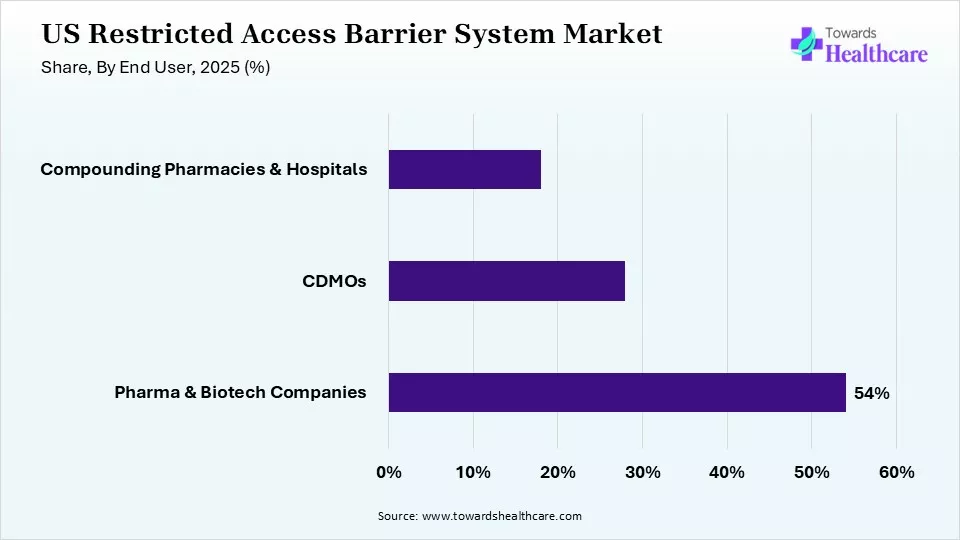
Pharma & Biotech Companies: This segment held the largest share of the U.S. restricted access barrier system market in 2025, accounting for 54.00% of revenue, and is projected to grow at a CAGR of 6.77% from 2026 to 2035. Pharmaceutical and https://www.towardshealthcare.com/insights/biotechnology-market lines and require reliable contamination control during production. However, the segment is expected to grow at a slower pace than the overall market over the forecast period.
CDMOs grow fastest as fill-finish is outsourced. The CDMOs segment is expected to grow faster than the overall market over the forecast period.
Compounding pharmacies and hospitals use smaller RABS units to support sterile preparation in controlled environments. The segment is expected to grow at a pace broadly in line with the overall market over the forecast period.
Compounding Pharmacies & Hospitals holds the smallest share today and serves more specialised needs within the U.S. restricted access barrier system market.
Analyst View: Segment shares were estimated based on demand patterns, product portfolios, and pricing across each category. Active RABS, Closed RABS, Aseptic Filling & Fill-Finish, and Pharma & Biotech Companies lead their respective segments because they address the main requirements of current buyers. Going forward, Cell & Gene Therapy Processing and CDMOs are expected to gain market share as demand for newer technologies and specialised manufacturing applications increases.
| Region | 2025 Share | 2035 Share | CAGR 2026-2035 |
| South | 36.00% | 34.49% | 6.94% |
| Northeast | 29.00% | 28.84% | 7.34% |
| Midwest | 19.00% | 18.89% | 7.34% |
| West | 16.00% | 17.78% | 8.54% |
Note: 2025 is the base year; 2035 shares and CAGRs are forecasts.
Sources: Expert interviews, secondary sources, Towards Healthcare database, and Towards Healthcare analysts.
South: The South held the largest regional share of the U.S. restricted access barrier system market in 2025, accounting for 36.00% of revenue, and is projected to grow at a CAGR of 6.94% from 2026 to 2035. Its leading position is supported by major fill-finish, vaccine, and CDMO facilities across North Carolina's Research Triangle, Texas, and Florida. However, the region is expected to grow at a slower pace than the overall market during the forecast period.
Northeast: The Northeast accounted for 29.00% of the U.S. restricted access barrier system market in 2025 and is projected to grow at a CAGR of 7.34% from 2026 to 2035. The region benefits from a strong pharmaceutical manufacturing base, with major facilities across New Jersey, Pennsylvania, and Massachusetts. The Northeast is expected to grow at a pace broadly in line with the overall market during the forecast period.
Midwest: This region is valued at 19.00% of the U.S. restricted access barrier system market in 2025 and is projected to expand at a CAGR of 7.34% from 2026 to 2035. The Midwest has injectable plants in Indiana, Illinois, and Michigan. Midwest is expected to grow broadly in line with the overall market between 2026 and 2035.
West: This region accounted for 16.00% of the U.S. restricted access barrier system market in 2025 and is projected to expand at a CAGR of 8.54% from 2026 to 2035. The West grows fastest, with biotech and cell therapy facilities in California and new sterile capacity. West is expected to grow faster than the overall market between 2026 and 2035.
Analyst View: Regional market shares were estimated based on demand, installed capacity, spending patterns, and supplier presence across each region. The South leads due to its established demand base and strong supplier network. Meanwhile, the West is expected to record the fastest growth, supported by rising investments, wider adoption, and expanding manufacturing capacity.
| Rank | Company Name | 2025 Share (%) | Key Products / Business | Headquarters |
| 1 | SKAN | 8.33% | Isolators and RABS for aseptic processing | Switzerland |
| 2 | Syntegon | 7.74% | Filling lines with RABS and isolators | Germany |
| 3 | Getinge | 5.95% | Isolators and barrier systems | Sweden |
| 4 | Bausch+Ströbel | 4.76% | Filling machines with barrier systems | Germany |
| 5 | Optima Packaging Group | 4.17% | Pharma filling lines and RABS | Germany |
| 6 | Telstar (Azbil) | 3.57% | RABS, isolators and containment | Spain |
| 7 | NuAire | 3.57% | Compounding isolators and biosafety equipment | United States |
| 8 | Esco Lifesciences | 2.98% | Pharmacy and containment barrier systems | Singapore |
| 9 | Comecer (ATS) | 2.38% | Isolators and RABS for aseptic and radiopharma | Italy |
| 10 | Fedegari | 1.79% | Barrier and sterilisation systems | Italy |
Note: Company shares are 2025 estimates.
Sources: Company press releases, expert interviews, secondary sources, Towards Healthcare database and Towards Healthcare analysts.
SKAN led the U.S. restricted access barrier system market in 2025, with an estimated revenue share of 8.33%, followed by Syntegon at 7.74% and Getinge at 5.95%. SKAN maintains its leading position through its range of isolators and RABS for aseptic processing. Syntegon competes with integrated filling lines equipped with RABS and isolators, while Getinge offers isolators and other barrier systems. Other key players include Bausch+Ströbel, Optima Packaging Group, Telstar (Azbil), NuAire, Esco Lifesciences, Comecer (ATS), and Fedegari. These companies compete through pharmaceutical filling lines, barrier systems, RABS, isolators, containment solutions, compounding equipment, biosafety products, and sterilisation systems, serving a range of aseptic manufacturing and specialised pharmaceutical applications.
The top 10 companies accounted for an estimated 45.24% of 2025 revenue, while the remaining 54.76% was shared among several U.S. fabricators, cleanroom integrators and service firms. The U.S. restricted access barrier system market is moderately concentrated, and competition centres on GMP compliance, airflow validation, integration with filling lines, ergonomics, delivery time, qualification support and service.
SKAN: SKAN is headquartered in Switzerland. It held an estimated 8.33% share of the U.S. restricted access barrier system market in 2025. Its offering centres on Isolators and RABS for aseptic processing. In the Towards Healthcare Companies Quadrant, it is positioned as a Leader.
Syntegon: Syntegon is headquartered in Germany. It held an estimated 7.74% share of the U.S. restricted access barrier system market in 2025. Its offering centres on Filling lines with RABS and isolators. In the Towards Healthcare Companies Quadrant, it is positioned as a Leader.
Getinge: Getinge, headquartered in Sweden, held an estimated 5.95% share of the U.S. restricted access barrier system market in 2025. Its portfolio focuses on isolators and barrier systems, supporting its position as a key market player. In the Towards Healthcare Companies Quadrant, the company is classified as a Leader.
Bausch+Ströbel: Headquartered in Germany, Bausch+Ströbel accounted for an estimated 4.76% of the U.S. restricted access barrier system market in 2025. The company focuses on filling machines equipped with barrier systems, strengthening its presence in the market. In the Towards Healthcare Companies Quadrant, it is positioned as a Leader.
Optima Packaging Group: Optima Packaging Group is headquartered in Germany. It held an estimated 4.17% share of the U.S. restricted access barrier system market in 2025. Its offering centres on Pharma filling lines and RABS. In the Towards Healthcare Companies Quadrant, it is positioned as a Leader.
Telstar (Azbil): Telstar (Azbil) is headquartered in Spain. It held an estimated 3.57% share of the U.S. restricted access barrier system market in 2025. Its offering centres on RABS, isolators and containment. In the Towards Healthcare Companies Quadrant, it is positioned as a Leader.
NuAire: Headquartered in the United States, NuAire held an estimated 3.57% share of the U.S. restricted access barrier system market in 2025. Its portfolio focuses on compounding isolators and biosafety equipment, supporting its presence in the market. In the Towards Healthcare Companies Quadrant, the company is positioned as an Innovator.
Esco Lifesciences: Esco Lifesciences is headquartered in Singapore. It held an estimated 2.98% share of the U.S. restricted access barrier system market in 2025. Its offering centres on Pharmacy and containment barrier systems. In the Towards Healthcare Companies Quadrant it is positioned as an Innovator.
Comecer (ATS): Comecer (ATS) is headquartered in Italy. It held an estimated 2.38% share of the U.S. restricted access barrier system market in 2025. Its offering centres on Isolators and RABS for aseptic and radiopharma. In the Towards Healthcare Companies Quadrant, it is positioned as an Innovator.
Fedegari: Fedegari is headquartered in Italy. It held an estimated 1.79% share of the U.S. restricted access barrier system market in 2025. Its offering centres on Barrier and sterilisation systems. In the Towards Healthcare Companies Quadrant, it is positioned as an Innovator.
The U.S. restricted access barrier system ecosystem links component suppliers, barrier system makers, filling line integrators, users and regulators, with each stage adding value before products reach end users.
| Ecosystem Stage | Role in the Market | Key Companies |
| Component Suppliers | Supply HEPA units, gloves, and panels | Filter, glove, and stainless steel suppliers |
| Barrier System Makers | Design and build RABS | SKAN, Getinge, Telstar, NuAire |
| Filling Line Integrators | Combine RABS with fillers | Syntegon, Bausch+Ströbel, Optima |
| Users | Run aseptic operations | Pharma, CDMOs, compounding pharmacies |
| Regulators | Set aseptic rules | FDA, USP <797>, EU GMP Annex 1 |
Sources: Company press releases, expert interviews, secondary sources, Towards Healthcare database and Towards Healthcare analysts.
Component Suppliers: Supply HEPA units, gloves and panels. Key participants include Filter, glove and stainless steel suppliers.
Barrier System Makers: Design and build RABS. Key participants include SKAN, Getinge, Telstar, NuAire.
Filling Line Integrators: Combine RABS with fillers. Key participants include Syntegon, Bausch+Ströbel, Optima.
Users: Run aseptic operations. Key participants include Pharma, CDMOs, compounding pharmacies.
Regulators: Set aseptic rules. Key participants include FDA, USP <797>, EU GMP Annex 1.
Value in the U.S. restricted access barrier system market flows from upstream material and technology suppliers to manufacturers and service providers, then through distribution partners to end users. Companies that integrate several stages or build long-term relationships with end users capture a larger share of this value.
The Towards Healthcare Companies Quadrant positions key participants in the U.S. restricted access barrier system market by market strength, reflecting revenue scale, market share and geographic reach, and by innovation and growth strategy, reflecting product portfolio breadth, R&D intensity and partnerships. Positions reflect each company's estimated 2025 share of the U.S. restricted access barrier system market and our assessment of its product innovation, portfolio breadth and partnerships.
Sources: Company press releases, expert interviews, secondary sources, Towards Healthcare database and Towards Healthcare analysts.
Leaders: SKAN, Syntegon, Getinge, Bausch+Ströbel, Optima Packaging Group and Telstar (Azbil) combine high market share with broad portfolios and strong innovation.
Innovators: NuAire, Esco Lifesciences, Comecer (ATS) and Fedegari bring newer technologies and specialised products.
By Type
By Configuration
By Application
By End User
By Region
The U.S. restricted access barrier system market was defined as restricted access barrier systems (RABS) used in the United States to separate operators from critical aseptic zones, including active and passive RABS in open and closed configurations, with glove ports, airflow units, and decontamination features, used for aseptic filling and fill-finish, sterility testing, sterile compounding, and cell and gene therapy processing by pharmaceutical and biotechnology companies, CDMOs, compounding pharmacies, and hospitals.
The 2025 base year was built bottom-up from demand volumes and average prices by type, configuration, application, end user, and region, and checked top-down against the market-specific revenues of leading companies and published estimates.
Segment, regional and company-level values were estimated based on demand across different types, configurations, applications, end users and regions. Key estimates were cross-checked against company disclosures, regulatory and industry data, and published third-party sources. Any inputs that could not be consistently verified were excluded. All figures were aligned to the 2025 base year, while the 2026-2035 forecasts were recalculated using a consistent CAGR from the 2025 baseline and validated for accuracy.
Analyst View: The U.S. restricted access barrier system market is set for steady expansion as injectable growth and related demand keep growing. Our estimate links value to underlying demand, installed base, and pricing, so the forecast follows real adoption rather than headline hype. The main upside comes from retrofits and cell therapy suites, while the main risks are competition from isolators and high validation costs.