Pipeline Programs

CGT Companies Tracked

Manufacturing Facilities


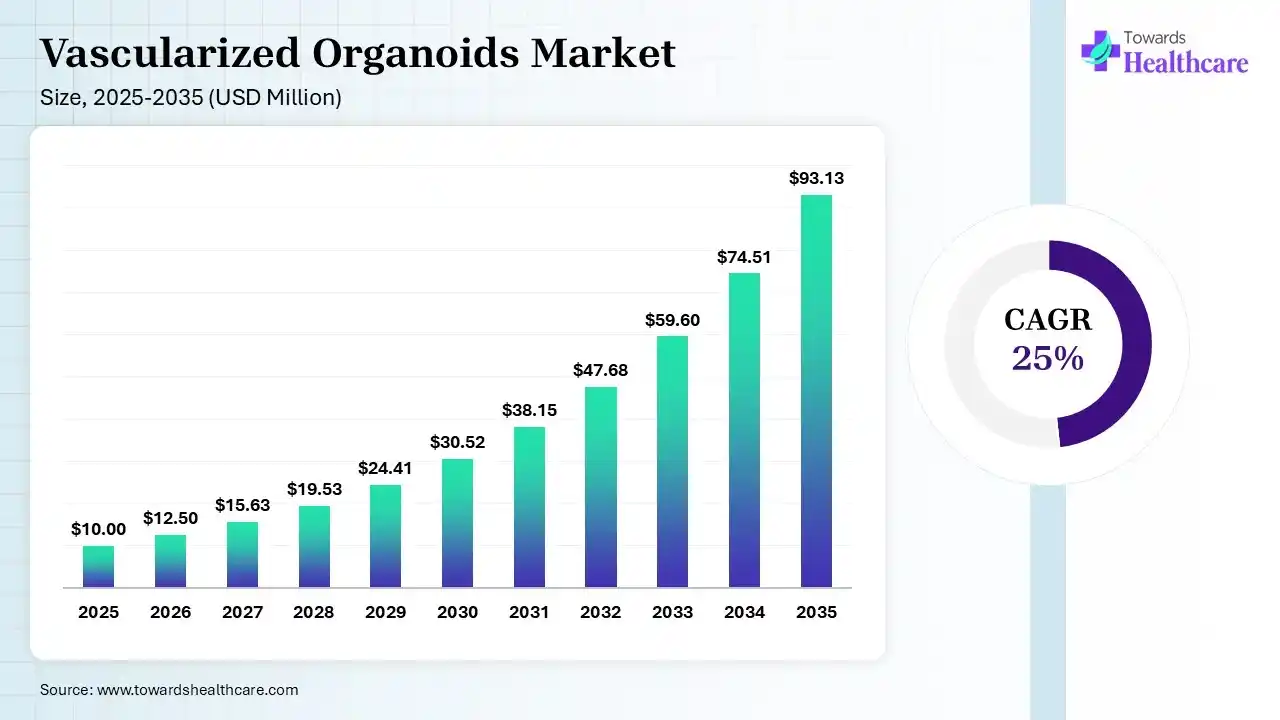
The vascularized organoids market is valued at USD 12.5 million in 2026 and is projected to reach USD 93.13 million by 2035. The commercial opportunity extends beyond the production of organoids themselves. Vascularized models require specialized cells, extracellular matrices, growth factors, culture media, microfluidic systems, perfusion equipment, analytical tools, and model-development services. Recurring consumables create a different revenue profile from capital-intensive instruments, while contract research and customized tissue models offer service-based revenue opportunities.
The central technical challenge is establishing vascular networks that are not merely present but functionally connected, sufficiently mature, and capable of supporting meaningful transport. This distinction separates vascularized organoids from conventional organoids and spheroids that may contain limited or no functional vasculature.
Vascularized organoids are three-dimensional tissue models incorporating vascular structures or endothelial networks to improve tissue viability, maturation, and physiological relevance. They can be developed using stem-cell differentiation, endothelial co-culture, self-organization, extracellular matrices, microfluidic perfusion, or bioprinting.
Their commercial relevance arises from a persistent limitation of conventional three-dimensional culture: as tissue structures become larger and more complex, the absence of adequate nutrient and oxygen transport can contribute to necrosis, restricted maturation, and inconsistent experimental outcomes.
Vascularization can help address these limitations, although successful implementation depends on network connectivity, endothelial stability, tissue-specific functionality, and compatibility with the intended application.
The market includes consumables, instruments, and associated development and testing services. It excludes unrelated conventional cell culture products unless they are specifically used in vascularized organoid workflows. General organ-on-chip systems and regenerative therapies are included only where vascularized organoid technology is a direct component of the product or service.
| Segment | 2025 estimated share | Commercial interpretation |
| Kits, reagents and media | 48% | Recurring revenue across research workflows |
| Drug discovery | 36% | Largest identified application pool |
| Pharmaceutical and biotechnology companies | 51% | Largest identified end-user group |
| North America | 43% | Largest identified regional market |
By vascularization approach, the market includes static in-vitro methods, endothelial co-culture, self-organizing vascular networks, perfused systems, microfluidic platforms, and bioprinted vascular structures. Static approaches can be easier to implement, while perfused systems offer greater control over flow and transport conditions.
By organoid type, liver, brain, cardiac, intestinal, kidney, pancreatic, tumor, and other tissue models address different research requirements. The commercial value of each depends on disease relevance, tissue maturity, reproducibility, and the availability of validated experimental endpoints.
Growth drivers: Pharmaceutical companies need human-relevant models for compound screening, disease modeling, and safety assessment. Vascularized structures can improve transport and tissue maturation, potentially extending the usefulness of organoids in experiments where conventional culture systems have limitations.
Restraints: Complex differentiation protocols, inconsistent vascular networks, variability between cell lines, high development costs, and limited standardization constrain adoption. Researchers must also distinguish genuine improvements in physiological performance from structural complexity that does not improve experimental outcomes.
Opportunities: Standardized ready-to-use kits, tissue-specific vascularization protocols, automated culture, perfusion systems, and contract research services can broaden access. Patient-derived models offer additional potential in precision medicine, particularly where vascular interactions influence disease behavior or therapeutic response.
Threats: Competing technologies including conventional organoids, spheroids, organ-on-chip systems, and animal models remain established alternatives for different research questions. Adoption will depend on evidence of incremental value rather than vascularization alone.
Pricing depends on model complexity, experimental conditions, cell source, culture duration, vascularization technique, perfusion requirements and technical support. Standard culture kits are typically priced per kit or consumable, while microfluidic platforms and integrated instruments involve higher upfront equipment costs. Custom vascularized tissue development and outsourced testing are priced per project based on the scope and experimental requirements.
A single average selling price does not accurately represent this market. Pricing analysis covers kits, models, chips, experiments and custom projects separately. It should also distinguish one-time capital equipment sales from recurring revenue generated by consumables.
Demand comes primarily from pharmaceutical and biotechnology companies seeking physiologically relevant human tissue models for drug discovery and preclinical testing. Academic laboratories, contract research organizations (CROs) and specialized biotechnology developers also drive demand through research, model development and technology validation.
Supply comes from life-science consumable manufacturers, specialist platform developers, stem-cell technology providers and research-service companies. Vascularized organoid products require compatibility across cells, matrices, culture media, growth conditions and measurement systems, making product integration a key factor in supplier capabilities.
Capacity assessment separate consumable manufacturing output from the ability to produce functional vascularized organoid models and complete contracted experiments. Laboratory infrastructure alone does not establish commercial capacity; actual throughput depends on model reproducibility, production timelines, technical expertise and the ability to deliver consistent results at scale.
The value chain extends from stem-cell sourcing and vascularization research to cell differentiation, matrix formulation, culture-system development, quality assessment, distribution, and experimental use.
Upstream participants provide stem cells, endothelial cells, growth factors, extracellular matrices, and specialized reagents. Midstream participants combine these inputs into kits, tissue models, instruments, and integrated workflows. Downstream customers use these products for drug screening, disease research, safety assessment, and experimental therapeutic development.
Value capture is distributed across recurring consumables, specialized instruments, proprietary protocols, and services that reduce the time and technical expertise needed to produce reliable models. Differentiation is strongest when a supplier can demonstrate reproducible vascular functionality, validated application performance, and compatibility with customer workflows.
The technology landscape covers self-organizing vascular networks, endothelial co-culture, stem-cell differentiation, microfluidic perfusion, three-dimensional bioprinting and techniques to improve vascular maturation. Each approach differs in technical complexity, throughput, reproducibility and physiological relevance.
Microfluidic systems provide greater control over fluid flow and nutrient delivery. Bioprinting enables precise control over tissue architecture, while self-organizing methods allow vascular networks to develop through biological processes. The choice of technology depends on the target tissue, research objective and required level of vascular functionality.
Technology benchmarking focuses on the ability to produce stable and functional vascular networks that improve model viability, tissue maturity, experimental reproducibility and predictive performance. The presence of vascular structures alone is insufficient to establish functional performance or commercial value.
Vascularized organoids used for laboratory research are subject to different requirements from products intended for administration to patients. Research-use products must meet relevant quality, safety, labeling, and laboratory requirements, while therapeutic applications may require more extensive evidence on manufacturing consistency, biological safety, efficacy, and clinical outcomes.
Additional considerations arise when products use human-derived cells, gene-edited materials, or induced pluripotent stem cells. Ethical oversight, donor consent, biological-material traceability, and data governance can influence development and commercialization.
Regulatory acceptance of alternative preclinical testing methods may support adoption, but it does not establish automatic acceptance of every vascularized organoid model. Application-specific validation remains essential.
Key Coverage
Drug discovery is the largest identified application, accounting for an estimated 36% of 2025 market revenue. Vascularized models can support studies of tissue response, disease mechanisms, compound efficacy, and interactions between vascular and non-vascular cell populations.
Other applications include toxicity assessment, disease modeling, precision medicine. Patient-derived vascularized models may support personalized treatment research, although clinical utility depends on turnaround time, reproducibility, and evidence that experimental results can inform treatment decisions.
Customer purchasing criteria include model reliability, biological relevance, workflow compatibility, throughput, price, and technical support. Switching costs can increase when a model is embedded in established research protocols and generates longitudinal datasets that are difficult to reproduce using another platform.
The competitive landscape includes established life-science suppliers, vascularization specialists, organ-on-chip developers, advanced tissue-model companies and emerging biotechnology firms. Competitive positioning depends on product range, vascular functionality, model reproducibility, application validation, customer reach and compatibility with laboratory workflows, rather than market share alone.
Established suppliers benefit from broad distribution networks and established relationships with research laboratories. Specialized developers compete through differentiated tissue models, perfusion technologies, proprietary workflows and customized research services. Smaller companies often focus on specific applications but face challenges in securing funding, scaling production and expanding commercial reach.
Competition depends on the ability to deliver functional vascularized models consistently at a cost that supports repeated experiments. Standardizing complex research protocols into reproducible commercial products remains a key barrier to entry and a source of competitive differentiation.
| Company | Headquarters | Market position | Core strength |
| Thermo Fisher Scientific | United States | Established supplier | Cell culture and life-science tools |
| Corning Incorporated | United States | Established supplier | Cell cultureware and matrices |
| STEMCELL Technologies | Canada | Specialist supplier | Stem-cell media and differentiation kits |
| Merck KGaA | Germany | Established supplier | Life-science reagents and cell culture |
| Emulate | United States | Platform specialist | Organ-on-chip systems |
| CN Bio | United Kingdom | Platform specialist | Microphysiological systems |
| MIMETAS | Netherlands | Platform specialist | Microfluidic tissue models |
| InSphero | Switzerland | Tissue-model specialist | Three-dimensional assay platforms |
| TissUse | Germany | Platform specialist | Multi-organ chip systems |
| AIM Biotech | Singapore | Vascularization specialist | Microfluidic vascularized models |
| Vivodyne | United States | Emerging specialist | Automated human tissue testing |
| Advanced BioMatrix | United States | Enabling supplier | Extracellular matrices and hydrogels |
| ReproCELL | Japan | Cell-model specialist | Stem-cell and organoid technologies |
| Crown Bioscience | United States | Research-service specialist | Translational models and testing |
| Cellink | Sweden | Bioprinting specialist | Three-dimensional bioprinting |
| Inventia Life Science | Australia | Bioprinting specialist | Automated 3D cell culture |
| Nortis | United States | Microfluidics specialist | Organ-on-chip technology |
| Tissue Dynamics | United States | Emerging specialist | Human tissue models and analytics |
| Hesperos | United States | Research-service specialist | Human-on-a-chip testing |
Technology benchmarking compares vascular-network formation, endothelial integration, perfusion control, tissue maturation, experimental throughput, automation, and reproducibility.
Platform claims must be distinguished from demonstrated performance. A model with visible vascular structures does not necessarily possess a stable, perfusable network or reproduce the physiological behavior required for a particular application.
The analysis compares published performance claims, available commercial specifications, development partnerships, and validation evidence without assuming that all technologies are directly interchangeable.
North America represented an estimated 43% of market revenue in 2025. Its commercial position reflects established biotechnology research, pharmaceutical development activity, specialized platform providers, and access to advanced research infrastructure.
Europe remains important for organoid science, microphysiological systems, and biotechnology research. Asia Pacific offers opportunities through expanding life-science investment, stem-cell research, and demand for advanced laboratory technologies. Country-level rankings and 2035 regional shares require further validation.
Capacity assessment consider reagent production, cell sourcing, instrument manufacturing, quality-control processes, and the throughput of specialized model-development laboratories.
For consumables, relevant measures include production capacity, batch consistency, and supply reliability. For instruments, relevant measures include manufacturing scale, installation base, utilization, and service support. For research services, the primary measures include experiments completed, turnaround time, model success rates, and available laboratory capacity.
Research customers require more than product availability. They need protocols, troubleshooting, training, data interpretation, and consistent supply of compatible biological materials. Suppliers with integrated workflows may reduce the time needed to establish an assay, while modular providers appeal to laboratories with established in-house expertise.
Customer benchmarking assesses direct sales, distributor coverage, application specialists, collaborative research agreements, technical support, and repeat purchasing.
Strategic developments in the vascularized organoids market include advances in vascularization technology, expansion of organoid platforms, integration of microfluidic systems, broader cell culture portfolios and the addition of specialized research services.
The competitive review covers product launches, research partnerships, platform integration, funding, acquisitions and geographic expansion. Transaction values and expected revenue synergies are included only when publicly disclosed and directly relevant to the market.
The analysis separates transactions involving vascularized organoid technologies from broader biotechnology deals with only indirect market relevance. This distinction keeps the assessment focused on developments that directly affect product capabilities, competitive positioning and commercial growth.
The strongest opportunities are concentrated in areas where vascularization solves a defined experimental problem and customers can measure the resulting benefit.
| Force | Assessment | Market-specific rationale |
| Supplier power | Medium to high | Specialized cells, matrices, and growth factors can limit sourcing flexibility. |
| Buyer power | Medium to high | Large pharmaceutical customers can compare platforms and negotiate research contracts. |
| Threat of new entrants | Medium | Technical expertise, validation, and intellectual property create barriers, while research-stage entry remains possible. |
| Threat of substitutes | High | Conventional organoids, spheroids, animal models, and other microphysiological systems address overlapping needs. |
| Competitive rivalry | High | Suppliers compete on reproducibility, biological relevance, workflow integration, and price. |
Through 2035, the market's development is likely to follow three broad stages.
By Product and Service
By Vascularization Approach
By Organoid Type
By Application
By End User
By Region


Principal Consultant
Payal Rabde is a Healthcare Market Research Analyst at Towards Healthcare Research & Consulting with 4+ years of experience in pharmaceuticals, biotechnology, medical devices, and life sciences.
Learn more about Payal Rabde

Reviewed By
Aditi Shivarkar is a seasoned professional with over 14 years of experience in healthcare market research. As a content reviewer, Aditi ensures the quality and accuracy of all market insights and data presented by the research team.
Learn more about Aditi Shivarkar