


 Request Consultation
At a Glance
As compared with the transportation of conventional pharmaceuticals, shipping or transferring a cell or gene therapy is a basically diverse logistics concern. In such a case, a patient’s own cells may be delivered out for manufacturing & returned after weeks as a finished treatment. These products may need to be kept below -150°C in vapor-phase liquid nitrogen, and every step of the process must secure a uniform chain of identity connecting the material back to a single named patient. Hence, no one can compromise or lose reshipping of autologous cell therapy.
So to overcome these issues, the competitive framework of leaders has taken steps, including from Cryoport, a standalone pure-play established completely around cryogenic logistics, to Marken, World Courier, DHL, and FedEx, each a specialized division inserted inside a much huge parent company. This also covers the expansive ecosystem beyond these five, such as contract manufacturers unifying logistics into production, cold-chain technology and packaging makers, and a novel category of digital orchestration platforms that synchronize the whole journey instead of moving a single package.
As per analyst efforts, the market was estimated at $2.19 billion in 2025, but is forecasted to more than quadruple to $9.37 billion by 2035 as cell and gene therapies shift from a limited number of specialized treatment centers into mainstream commercial medicine. The glimpse is completely developed on Towards Healthcare's published research and analysis, cross-referenced against independent industry coverage.
Before Reaching the Patient, A Single Cell Therapy Can Pass Through Twice Supply Chains
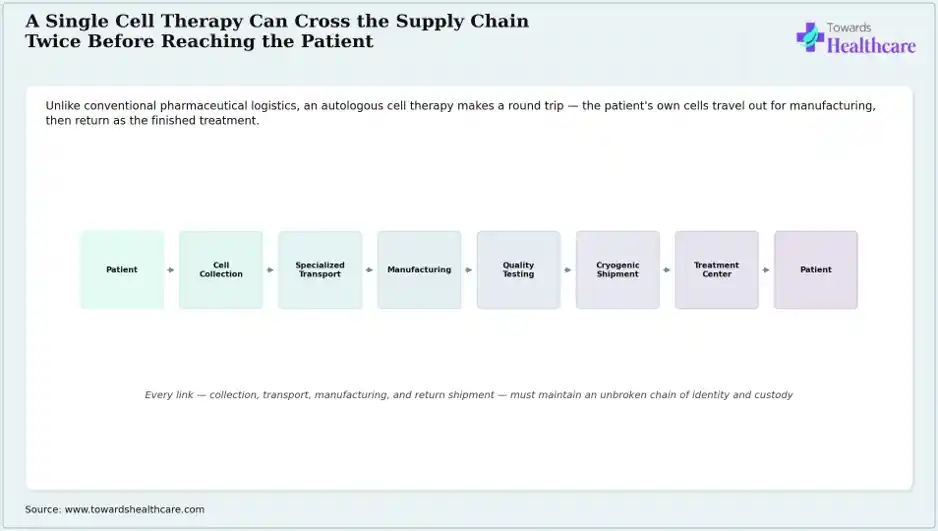
This value-chain description shows the full round-trip journey of an autologous cell therapy, i.e. from the patient, through collection, transport, manufacturing, quality testing, cryogenic shipment, and back to the treatment center.
Key Insight: Specifically, the round-trip framework of autologous cell therapy logistics covers patient material leaves, gets produced, and returns as the finished product. This creates uncertainty in conventional pharmaceutical distribution, which is why generalist logistics firms without dedicated cell and gene therapy infrastructure are competing for this business.
Source: Pharma Geek/Towards Healthcare, “Who Are the Top Courier Companies for Cell and Gene Logistics?,” August 18, 2026.
Prospective Ideas: The Cell and Gene Therapy Cold Chain Market Will Achieve More Than Quadruple by 2035
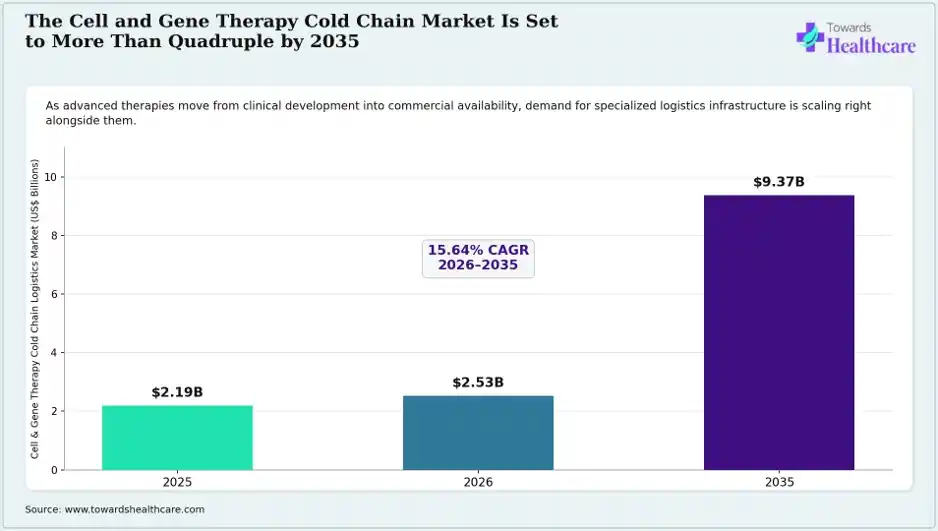
The graph displays the predicted growth of the global cell and gene therapy cold chain logistics market from 2025 through 2035.
Key Insight: According to the analyst, the global market was estimated at $2.19 billion in 2025, while it is projected to reach $2.53 billion in 2026 and will reach $9.37 billion by 2035. Alongside, a 15.64% CAGR sustained over a full decade would be termed outstanding in most any logistics sub-sector. This further represents not just natural market growth but a structural transition as cell and gene therapies shift from limited specialized centers into expansive commercial availability.
Source: Towards Healthcare Database
Companies' Involvement: Five Key Players Host the Cell and Gene Therapy Courier Sector
Regardless of specialized cryogenic logistics pure-plays to global courier largest firms with devoted life science divisions, these major providers are following genuinely various trajectories to the same market.
- Cryoport: Specialized life-science cold chain and cryogenic logistics pure-play
- Marken: Clinical trial & cell or gene therapy logistics arm of UPS Healthcare
- World Courier: Specialty pharmaceutical & biologics logistics & part of Cencora
- DHL Life Sciences & Healthcare: Global logistics giant with dedicated life-science division
- FedEx: Custom Critical Healthcare Solutions for time-sensitive shipments
The above ranking indicates the existence of both a dedicated pure-play (Cryoport) and four divisions of giant global logistics or distribution companies at the top of this ranking, showing there is no single prosperous business model so far. Whereas specialization and scale are both feasible competitive paths in this market.
Source: Towards Healthcare Database.
As #1: Cryoport Developed Its Business Completely Around the Cold Chain Concern
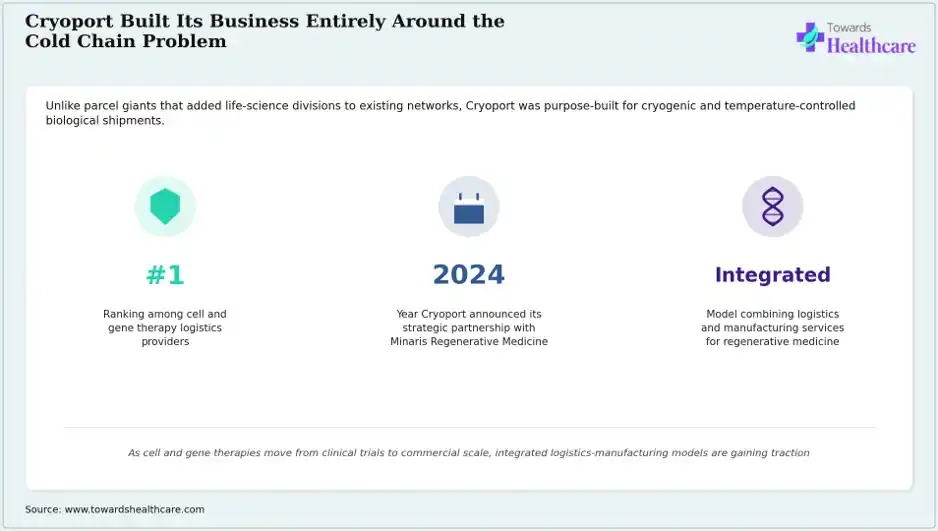
This panel dictates Cryoport’s position as the top-ranked cell and gene therapy logistics provider & its 2024 strategic alliance with Minaris Regenerative Medicine. Moreover, Cryoport’s efforts are shifting towards integrating logistics directly with manufacturing services through its Minaris partnership, which indicates the premium competitive reach in this market. This may not be point-to-point shipping alone, but end-to-end synchronization that exceeds both production & distribution.
Source: Towards Healthcare Database.
Marken’s Execution of Each Step Involved in Therapy’s Life, Not Only at Shipping
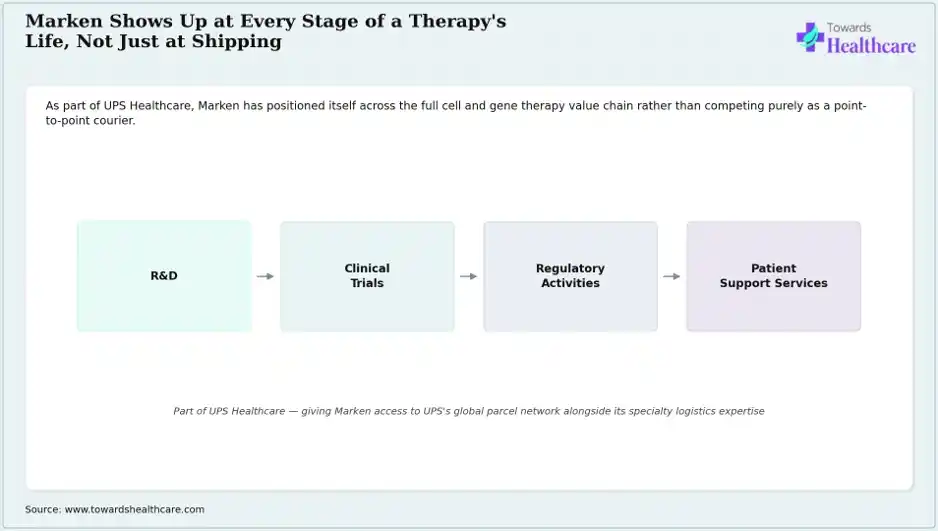
This value chain describes Marken's presence across four distinct stages of a cell and gene therapy's development, such as R&D, clinical trials, regulatory activities, and patient support services.
Key Insight: Marken is addressed as part of UPS Healthcare and relies on the parent company’s global parcel infrastructure. They still rival on the specialty expertise that a therapy sponsor needs at every stage, a hybrid highlighting that pure specialty leaders and pure global carriers each face barriers to replicate alone.
Source: Towards Healthcare.
DHL’s Stacking of €2 Billion That Life Sciences Logistics Is Beneficial to Construct
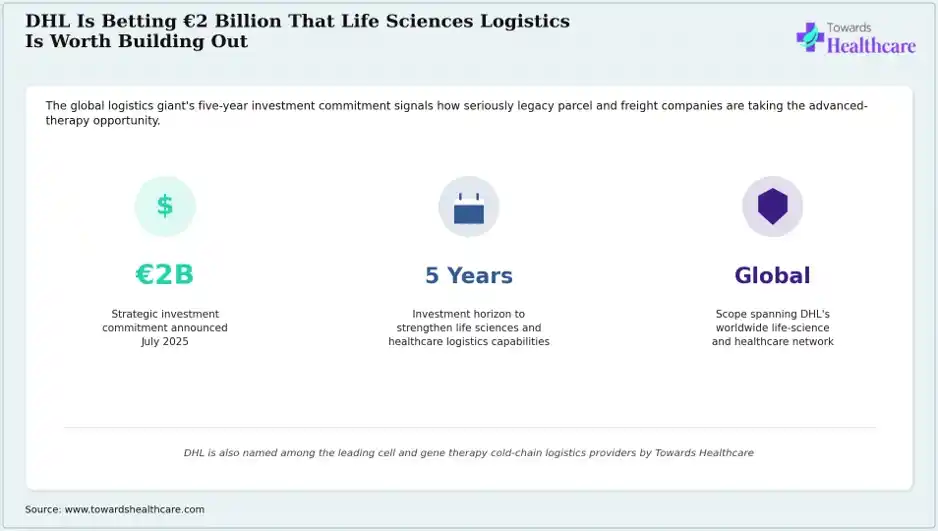
These statistics reflect the scale, timeline, and scope of DHL Group's July 2025 investment commitment to empower its life sciences and healthcare logistics capabilities.
Key Insight: A company size of DHL committed a five-year, €2 billion investment shows that global logistics incumbents see cell and gene therapy and expansive life-science logistics as a durable, strategically substantial expansion category instead of a niche service line.
Source: Towards Healthcare Database.
Three of the Top Five Couriers Are Specialty Divisions Inside Vast Players
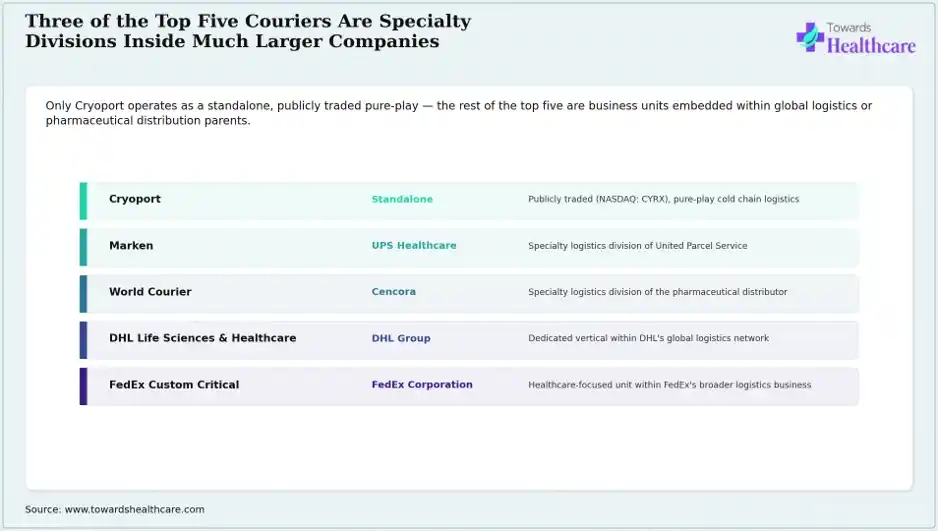
This majorly reflects each of the top five courier leaders against its ownership structure, differentiating standalone pure-plays from divisions of huge parent companies.
Key Insight: Among four of the top five key couriers serving as parts within giant logistics or pharmaceutical distribution firms, the cell and gene therapy logistics market has efficiently become a proving base for whether specialty life-science expertise or global network scale impacts more, and yet, both approaches are developing top-tier competitors.
Source: IntuitionLabs, “Top 10 Best Pharma Cold Chain Logistics Companies (2026 Ranked),” August 2026; Opendock, “Top Pharma Cold Chain Logistics Companies,” 2026 Edition.
Selecting a Cell and Gene Courier Pivots on Five Non-Negotiable Capabilities
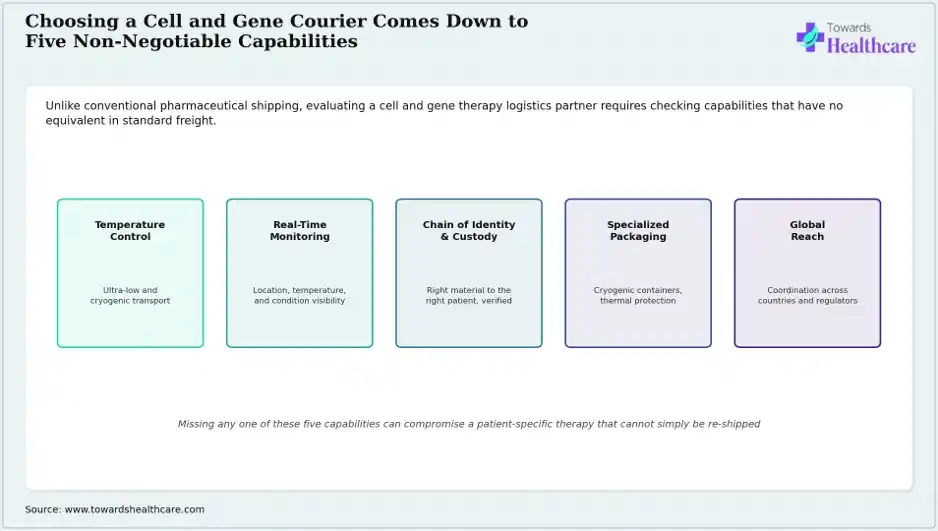
The five capabilities Towards Healthcare determines as necessary when assessing a cell and gene therapy logistics partner, such as temperature control, real-time monitoring, chain of identity and custody, specialized packaging, and global reach.
Key Insight: Specifically, chain of identity and chain of custody represent the other four necessities as they have essentially no equal in conventional pharmaceutical logistics. Besides this, a mislabeled delivery of a mass-produced drug is a quality issue, but an incompatible autologous cell therapy shipment is a direct patient-safety failure with no substitute product available.
Source: Towards Healthcare Database.
Physical Shipping Registers Dominance, While Software Is The Rapidly Growing Sector
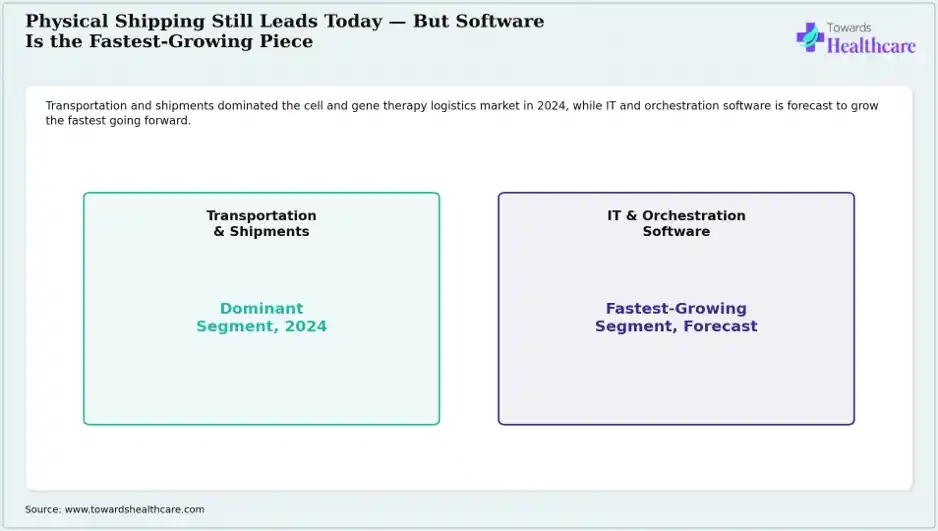
This indicates a comparison of the market's current dominant segment, such as transportation and shipments, against its fastest-growing forecast segment, i.e. IT and orchestration software.
Key Insight: Current’s respective difference between a dominant revenue segment and future’s rapid expansion recommends the underlying competition in cell and gene logistics transits from physical capability to cryogenic shipment. Whereas the software layer that synchronizes and documents the complete chain is developing as the upcoming real differentiator.
Source: Towards Healthcare Database.
Another Level of Firms Are Competing on Software Rather Than Trucks & Planes
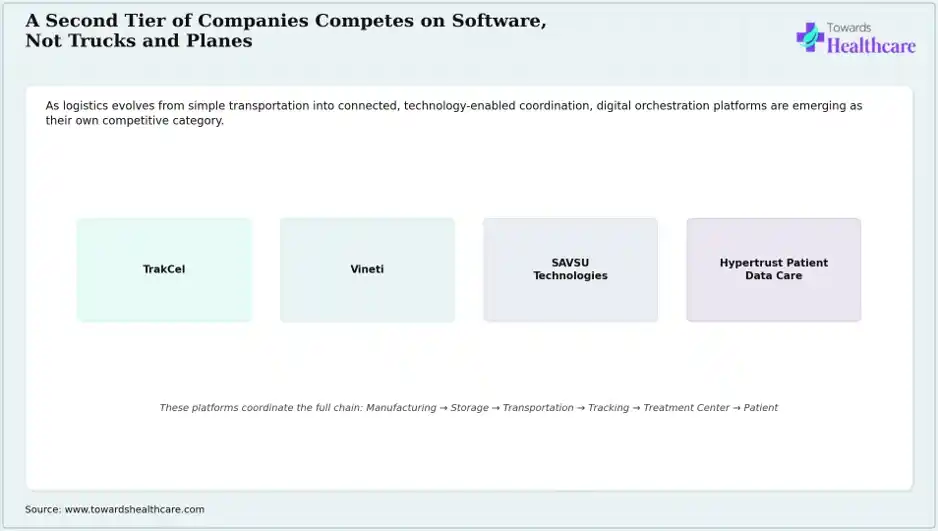
These four major companies, such as TrakCel, Vineti, SAVSU Technologies, and Hypertrust Patient Data Care, are showcasing Towards Healthcare finds as digital orchestration platforms within the widespread logistics ecosystem.
Key Insight: These four companies mainly offer trucks, planes, or cryogenic containers, and their competitive advantage depends completely on aligning and documenting a therapy's life across every physical logistics provider it reaches. This further declares a genuinely different business model from the couriers themselves.
Source: Towards Healthcare Database.
Because of Biotech’s Hub, North America Stands as the Default Center for This Market
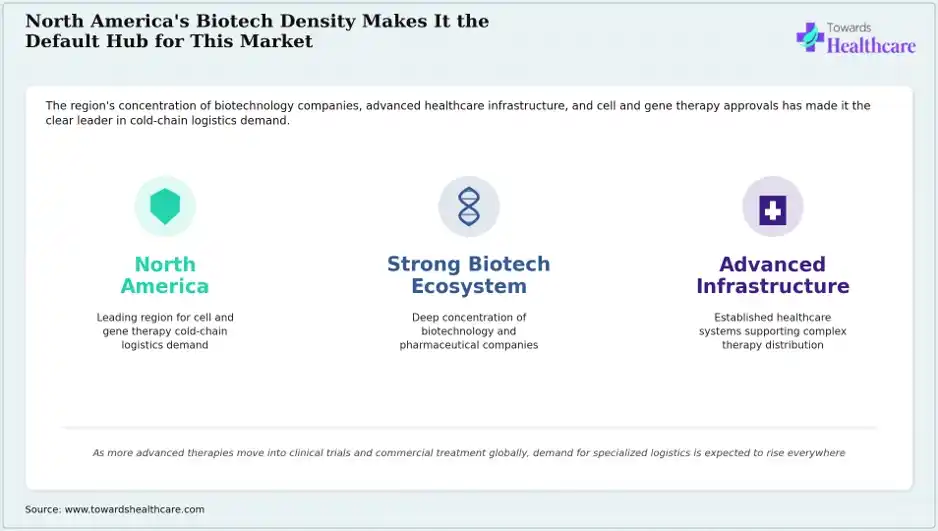
This panel indicates today’s foundational factors involved in North America’s leadership status in cell and gene therapy cold-chain logistics, including biotech ecosystem density, advanced healthcare infrastructure, and approval concentration.
Key Insight: By considering North America's leadership status, describe where cell and gene therapies are now being created and approved. Day by day, as more therapies receive approval in other geographies, logistics providers with genuinely worldwide infrastructure may account for a structural advantage.
Source: Towards Healthcare Database
The Competitive Landscape Spans More than the Five Best-Known Couriers
Along with robust couriers, contract manufacturers, cold-chain technology producers, and specialty distributors are all participating in the cell and gene therapy logistics framework. This prominently spotlights;
- CDMOs & Manufacturing Logistics: Thermo Fisher/Patheon, Catalent, & Loza.
- Cold Chain Technology & Packaging: BioLife Solutions, Brooks Life Sciences, Peli BioThermal, and SAVSu Technologies.
- Specialty Distribution & Support Services: QuickSTAT, Biocair, McKesson Specialty Health, & Aramex Life Science Logistics.
This ensures that there is no dominant company that manages the full cell and gene therapy logistics value chain. However, therapy sponsors generally consolidate many of these providers into a single coordinated supply chain.
Source: Towards Healthcare Database.
Emergence of Three Forces Will Transform Cell and Gene Logistics Competition by 2027
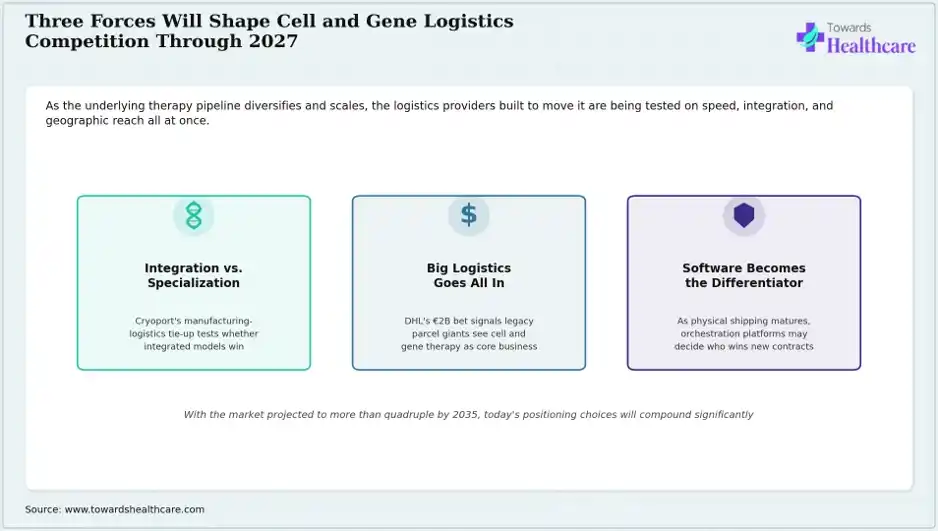
This dictates that each will compound notably, provided the market's projected quadrupling by 2035. Alongside, the competitive positioning prefers couriers, technology providers, and orchestration platforms to explore the coming two years will similarly find which companies capture a durable advantage as the market situates massive scale importantly.
Source: Synthesis of evidence presented in Sections 1-12 of this briefing.
Key Companies & Organizations
| Company | Category | Role in Cell and Gene Therapy Logistics |
| Cryoport, Inc. | Standalone Cold Chain Pure-Play | A firm ranked #1 across courier and publicly traded & executed an alliance with Minaris Regenerative Medicine on unified logistics-manufacturing in 2024. |
| Marken (UPS Healthcare) | Specialty Logistics Division | This company has a major role in R&D, clinical trials, regulatory activities, and patient support services for cell and gene therapies. |
| World Courier (Cencora) | Specialty Logistics Division | A leader is actively involved in temperature-sensitive pharmaceutical and clinical-trial shipments. |
| DHL Life Sciences & Healthcare | Global Logistics Division | In July 2025, this player invested €2 billion for five years in life sciences and healthcare logistics. |
| FedEx Custom Critical Healthcare Solutions | Healthcare-Focused Unit | They widely assist time-sensitive, specialized healthcare shipments within FedEx's expansive network. |
| Thermo Fisher Scientific/Patheon, Catalent, Lonza | CDMOs/Manufacturing Logistics | These CDMOs are fostering integration of logistics into cell and gene therapy production workflows. |
| BioLife Solutions, Brooks Life Sciences, Peli BioThermal, SAVSU Technologies | Cold Chain Technology & Packaging | They are involved in supplying cryogenic containers, thermal packaging, and monitoring systems leveraged across the courier ecosystem. |
| TrakCel, Vineti, Hypertrust Patient Data Care | Digital Orchestration Platforms | These companies coordinate chain-of-identity, chain-of-custody, and end-to-end shipment tracking software. |
| QuickSTAT, Biocair, McKesson Specialty Health, Aramex Life Science Logistics | Specialty Distribution & Support | They broadly facilitate regional and specialized distribution capacity across the widespread logistics ecosystem. |
Strategic Business & Research Questions
- Which specific therapy sponsors have switched primary logistics providers in the past 24 months, and what specific service failures or capability gaps drove those decisions?
- How does Cryoport's integrated logistics-manufacturing model with Minaris compare in cost and timeline to a sponsor employing separately contracted CDMO and courier services?
- What proportion of DHL's announced €2 billion investment is particularly allocated to cell and gene therapy capabilities vs. broader life sciences and healthcare logistics?
- Which digital orchestration platforms, like TrakCel, Vineti, SAVSU, & Hypertrust, have robust unification partnerships with the top five physical couriers, and does that create switching costs for sponsors?
- How do temperature-excursion and chain-of-custody failure rates compare across the top five courier companies, based on available regulatory and sponsor-reported data?
- What is the realistic timeline for regional specialty distributors (Biocair, QuickSTAT, Aramex Life Science Logistics) to expand into direct competition with the top five global couriers?
- Which specific emerging markets outside North America are seeing the fastest growth in cell and gene therapy logistics demand, and which couriers have the strongest early infrastructure there?
- How does the cost structure of shipping an autologous cell therapy compare to an allogeneic (off-the-shelf) cell therapy, and how does that affect courier selection criteria?
- What is the realistic probability that a major courier company experiences a significant chain-of-custody failure serious enough to trigger new regulatory oversight of the sector?
- Which specific packaging and cold-chain technology providers (BioLife Solutions, Brooks Life Sciences, Peli BioThermal, SAVSU) have the strongest patent positions in next-generation cryogenic shipping systems?
- How does courier selection differ between clinical-trial-stage cell and gene therapy programs versus commercial-stage programs with established patient volumes?
- What proportion of cell and gene therapy sponsors use a single integrated logistics provider versus assembling multiple specialized vendors across the supply chain?
- Which specific CDMOs (Thermo Fisher/Patheon, Catalent, Lonza) are most likely to expand further into direct logistics ownership, following Cryoport's integrated model?
- How does the actual realized cost per shipment compare across the top five couriers when normalized for distance, temperature requirement, and shipment volume?
- What is the realistic addressable market opportunity for IT and orchestration software specifically, given its identification as the fastest-growing segment of the broader market?
- Which specific regulatory requirements differ most significantly between the US, EU, and Asia-Pacific for cell and gene therapy chain-of-custody documentation, and how do couriers navigate that variation?
- How concentrated is courier market share among the top five companies specifically for commercial-stage (vs. clinical-trial-stage) cell and gene therapy shipments?
- What is the realistic timeline for broader adoption of real-time IoT-based temperature and location monitoring across the full courier landscape, beyond the current leaders?
- Which specific factors most influence a hospital or treatment centre's preference for one courier over another when receiving a patient-specific cell therapy shipment?
- How does M&A activity among mid-tier logistics and packaging companies in this space compare to the consolidation patterns seen in the broader cell and gene therapy manufacturing sector?
Data & Intelligence Pointer
- The global cell and gene therapy cold-chain logistics market is projected to grow from $2.19 billion in 2025 to nearly $9.37 billion by 2035, a 15.64% CAGR from 2026 to 2035.
- Towards Healthcare identifies five leading courier companies for cell and gene therapy logistics, i.e. Cryoport, Marken (UPS Healthcare), World Courier (Cencora), DHL Life Sciences & Healthcare, and FedEx Custom Critical Healthcare Solutions.
- Cryoport is the only standalone, publicly traded pure-play among the top five leading couriers; the other four operate as specialty divisions within much larger parent companies.
- In July 2025, DHL Group announced a €2 billion strategic investment over five years to reinforce its life sciences and healthcare logistics capabilities.
- Cryoport announced a strategic partnership with Minaris Regenerative Medicine in 2024 to facilitate integrated logistics and manufacturing services for regenerative medicine products.
- Marken operates across the full cell and gene therapy value chain, such as R&D, clinical trials, regulatory activities, and patient support services.
- The transportation and shipments segment was dominant in the cell and gene therapy logistics market in 2024, whereas IT and orchestration software is forecasted to be the fastest-growing component through the projected period.
- North America currently accounts for the leading regional position in cell and gene therapy cold-chain logistics, led by its biotechnology ecosystem, healthcare infrastructure, and concentration of therapy approvals.
- Digital orchestration platforms identified within the ecosystem include TrakCel, Vineti, SAVSU Technologies, and Hypertrust Patient Data Care.
- The expansive competitive ecosystem consists of CDMOs (Thermo Fisher Scientific/Patheon, Catalent, Lonza), cold-chain technology and packaging companies (BioLife Solutions, Brooks Life Sciences, Peli BioThermal), and specialty distributors (QuickSTAT, Biocair, McKesson Specialty Health, Aramex Life Science Logistics).
- An autologous cell therapy's supply chain journey spans at least eight distinct stages: patient, cell collection, specialized transportation, manufacturing, quality testing, cryogenic shipment, treatment center, and back to the patient.
- The pharmaceutical cold chain logistics market broadly (comprising vaccines, biologics, and cell and gene therapies) was estimated at $30.59 billion in 2024, predicted to reach $74.46 billion by 2033.
References
- Pharma Geek (Towards Healthcare). “Who Are the Top Courier Companies for Cell and Gene Logistics?” August 18, 2026. Used for: top five courier ranking, five requirements framework, supply chain journey, market size and CAGR figures, extended ecosystem company list. https://www.pharma-geek.com/who-are-the-top-courier-companies-for-cell-and-gene-logistics/
- Towards Healthcare. “Cell and Gene Therapy Cold Chain Logistics Companies, Business & Management Outlook.” Used for: market sizing figures and key player identification. https://www.towardshealthcare.com/companies/cell-and-gene-therapy-cold-chain-logistics-companies
- IntuitionLabs. “Top 10 Best Pharma Cold Chain Logistics Companies (2026 Ranked).” August 2026. Used for: broader pharma cold chain market sizing, independent courier cross-reference. https://intuitionlabs.ai/articles/top-pharma-cold-chain-logistics-companies
- Opendock. “Top Pharma Cold Chain Logistics Companies.” 2026 Edition. June 4, 2026. Used for: World Courier, Marken, and Kuehne+Nagel positioning descriptions.
- Diligent Pharma. “12 Clinical Supply Logistics Companies for Clinical Trials in 2026.” Used for: Cryoport Systems corporate structure and ISO 21973 validation standard reference.
- EIN Presswire/Pharmaceutical Industry Today. “Cell And Gene Therapy Supply Chain/Logistics Market Key Competitors, Growth Drivers, and Strategic Market Outlook.” June 21-22, 2026. Used for: broader competitive landscape and market driver analysis.
- The National Law Review. “Cell And Gene Therapy Supply Chain/Logistics Market Key Competitors, Growth Drivers, and Strategic Market Outlook.” Used for: cross-referenced company list.