




 Request Consultation
Immersive adoption of at-home screening packages is enabling the collection of a saliva or cheek swab sample & send it to a laboratory for genetic analysis, which is known as DNA testing kits. Furthermore, these kits are widely employed in the exploration of global ancestry, tracing biological family trees, or discovering genetic predispositions toward specific health traits.
Major catalysts are fostering the ongoing developments of DNA testing kits, including:
- Surging curiosity regarding family history & ethnic origins is fueling the higher retail sales of DNA testing kits. In this case, AncestryDNA and MyHeritage have familiarized lineage tracing.
- Ongoing technological breakthroughs in bioinformatics & DNA sequencing are emerging with more accurate, complete & cost-effective test results.
- Gradually, a substantial consumer population is highly using genetic profiles for preventive care, which drives brands like CircleDNA to facilitate comprehensive fitness, nutritional, & disease-risk profiling.
- Consistent huge government initiatives, like funding from the NIH All of Us Research Program, support subsidizing & popularizing population-wide genetic screening programs, which ultimately raise demand for DNA testing kits.
According to Towards Healthcare DNA Test Kits Market Size, Top Key Players and Trends, the global DNA test kits market size is calculated at USD 1.61 billion in 2024, grew to USD 1.88 billion in 2025, and is projected to reach around USD 7.78 billion by 2034. The market is expanding at a CAGR of 17.04% between 2025 and 2034.
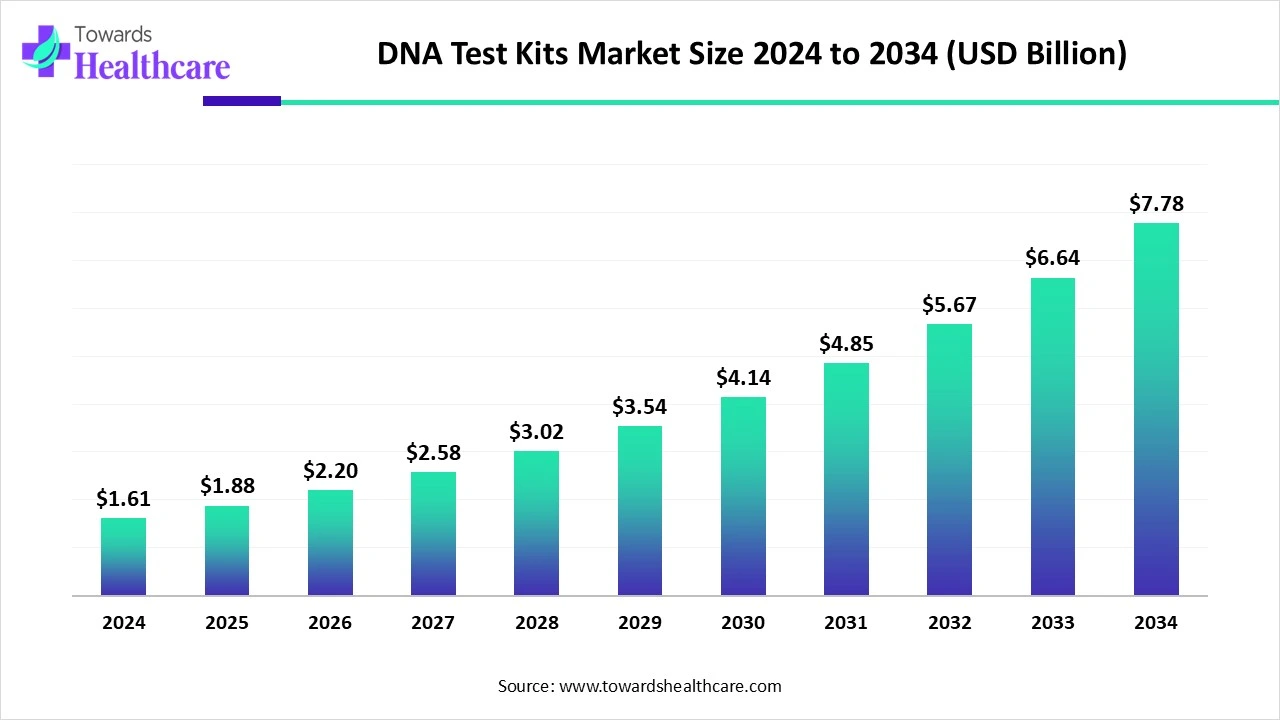
Furthermore, the global expansion is propelled by increasing cases of chronic illnesses, higher demand for ancestry & wellness, along with wider roll-outs of government initiatives to raise awareness regarding screening & early diagnosis. Alongside, companies are increasingly demonstrating advances in AI integrations & diagnostics to enhance accuracy.
Moreover, these advances & demands will support the prospective opportunities in diverse areas, such as
- Pharmacogenomics: In this sector, advanced DNA testing kits will assist in the analysis of the metabolism of medication by specific DNA, mainly lowering adverse drug reactions & confirming more efficacious treatments prescribed by doctors.
- Preventive & Precision Healthcare: Eventually, the latest kits will push the identification of genetic predispositions to chronic issues, especially cancer & cardiovascular disease. Early screening reinforces patients to take preemptive measures, coupled with clinical professionals.
- Hyper-Personalized Wellness: A coming era will unveil kits that provide granular, day-to-day lifestyle enhancement by mapping out exactly necessary vitamins, optimal macronutrient breakdown, & finding how the body responds to specific kinds of physical training.
- AI & Deep Data Integration: Future opportunities will spur companies to unify Next-Generation Sequencing (NGS) with AI, which enables more comprehensive disease risk models & detailed ancestry tracing without relying solely on large, static databases.
Top companies involved in the DNA testing kits, with their offerings & annual sales in 2025
| Company Name | Headquarters | Offerings |
| Ancestry |
|
A firm widely facilitates specialized, direct-to-consumer genetic testing kits, with an emphasis on genealogy, historical tracking, & personal traits. |
| 23andMe |
|
This primarily offers direct-to-consumer genetic testing services that leverage a simple saliva collection kit. Also, their offerings are divided into distinct tiers ranging from basic ancestry tracking to complete, subscription-based health & pharmacogenomic insights. |
| MyHeritage |
|
A company offers services, including a simple at-home cheek swab, followed by the use of Whole Genome Sequencing to map 3 billion base pairs of your DNA. |
| FamilyTreeDNA | Global Corporate: 1445 North Loop W, Suite 820, Houston, Texas, 77008, United States. | This player specializes in genetic genealogy, with three main testing kits to trace specific lineages, such as autosomal, Y-DNA for paternal lines, & mtDNA for maternal lines. |
| Nebula Genomics |
|
Its offerings cover three prominent WGS kits, which vary in sequencing depth, report frequency, & price. |
Pivotal Technological Breakthroughs in DNA Testing Kits in 2025, Includes:
The global companies are focusing on the integration of AI platforms into consumer genetics, which offer accurate, actionable health insights. Also, further enable the analysis of large-volume datasets, with the estimation of predisposition risks expeditiously.
Moreover, major technological advances cover miniaturized testing devices that leverage microfluidics to automate DNA extraction in under an hour, & make testing much more accurate & minimal susceptible to human contamination.
Continuous research efforts are exploring next-generation sequencing (NGS) platforms, such as Illumina's NovaSeq X Plus, which have declined genome sequencing expenditures & broadened testing capabilities. Nowadays, kits highly facilitate exhaustive whole-exome sequencing, scanning for rare disease indicators instead of just targeted single nucleotide polymorphisms (SNPs).
Although in the area of forensic & paternity testing, many technologies are unifying Massively Parallel Sequencing (MPS), which enables the extraction of highly degraded DNA. Also, they assist through reliable estimation of physical appearance & multi-regional ancestry from crime scene samples.
Recent Developments in the DNA Testing Kits Industry in 2025
- In August 2025, Shed, a wellness solutions company, unveiled a novel line of at-home genetic testing kits to offer customized health insights based on individual DNA analysis.
- In May 2025, Hydreight Technologies Inc. launched a new direct-to-consumer genetic testing & tailored wellness solution via its VSDHOne platform.
Future Outlook: The Next Frontier of DNA Testing Kits
The future of DNA testing kits is poised for remarkable transformation as artificial intelligence, next-generation sequencing, and precision healthcare continue to advance. Companies will increasingly deliver personalized wellness, pharmacogenomic, and disease-risk insights through affordable at-home kits. Integration with digital health platforms and preventive care programs will further expand adoption. Enhanced data analytics, stronger privacy frameworks, and broader government-supported screening initiatives are expected to accelerate market growth, making genetic testing a routine component of everyday healthcare decisions worldwide.
Conclusion
Globally surging instances of chronic diseases, immersive government initiatives to foster awareness, and ongoing technological advances, like IA integration, are driving the overall demand & adoption of DNA testing kits. Whereas in the upcoming era, accelerating sales of these kits is coupled with substantial opportunities, such as pharmacogenomics, hyper-personalized wellness, and precision healthcare approaches.