




 Request Consultation
Imaging is referred to as a specialized branch of medical radiology that uses different technologies, specifically magnetic resonance imaging (MRI), computed tomography (CT), & X-rays. This also encompasses globally needed spinal imaging to develop detailed, multiplanar images of the spinal column, spinal cord, nerve roots, & surrounding soft tissues.
Surging Instances & Strengthening Breakthroughs Fuel the Spinal Imaging
Specific rise in cases, innovations, and impactful acceptances is driving the spinal imaging progression gradually.
- In several regions, especially the Asia Pacific, and major countries like China and India, are experiencing a massive growth in the geriatric population. This population is highly prone to degenerative disc disease, spinal stenosis, herniated discs, and tumors, which drives demand for diagnostics.
- On the other side, leading firms are extensively innovating AI-powered, high-resolution 3D, & 4D imaging, such as Dynamic Digital Radiography, which improves diagnostic accuracy & workflow effectiveness.
- The worldwide patients and providers are highly prioritizing non-invasive, low-risk imaging, i.e., MRI, CT, ultrasound, rather than traditional, invasive options.
Physical & Industrial Challenges Across the Spine Imaging Industry
Because of the implantations and other procedures, patients face severe risks, like
- The incorporation of pedicle screws, metal cages, or artificial discs leads to magnetic susceptibility distortions, & also causes signal loss and geometric distortion in MRI, which creates difficulties in postoperative evaluation.
- The presence of the small cross-section of the spinal cord, integrated with the inhomogeneous magnetic field led by the surrounding bone, develops low signal-to-noise ratios.
Arising economic & expertise limitations are impacting the projected innovations.
- Companies are experiencing the need for higher spending on purchasing, installing, and maintaining advanced imaging systems (MRI/CT), which restricts access, especially in low-income regions.
- Alongside, a notable shortage of well-trained professionals to perform and understand complex imaging systems is also limiting diagnostic throughput and efficient use of advanced technologies.
Accelerating SCI Prevalence Spurs the Adoption of Advanced Imaging Diagnostics
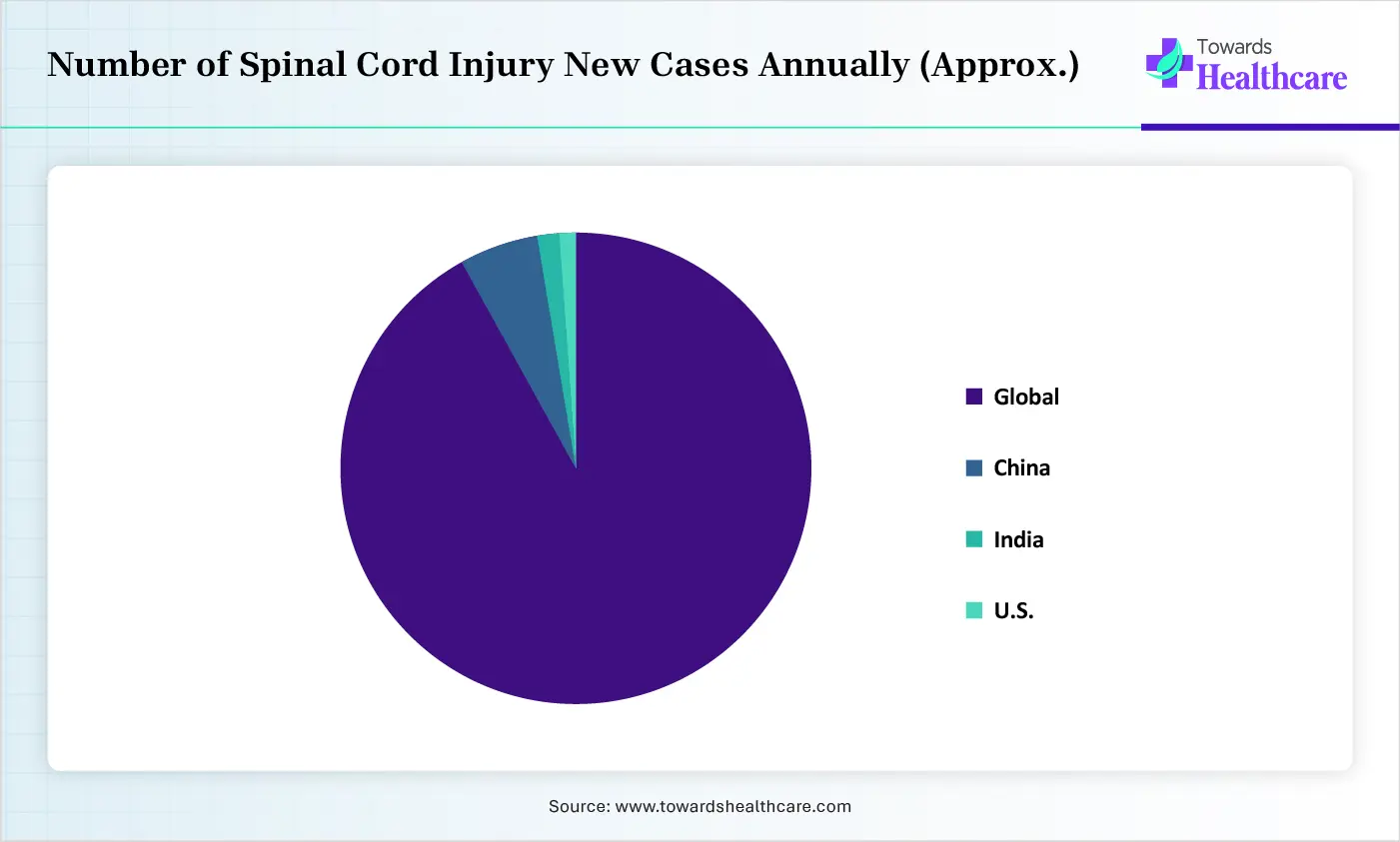
Global SCI incidences are mainly propelled by the increasing number of road traffic accidents, falls, and violence, where advanced imaging tools, including MRI and CT, are necessary for reducing long-term disability through prompt & precise diagnosis. For this, surgeons are boosting the use of computed tomography (CT), which acts as a prominent, high-speed imaging modality for evaluating bony anatomy, with an approximate 100% sensitivity for finding vertebral fractures, dislocations, & bone fragments. This can be coupled with MRI, which is a gold standard to visualize soft-tissue, ligamentous injuries, and the native status of the spinal cord, like edema, hemorrhage, or compression.
Revolutionary AI: Executing Pivotal Role & Immersive Evolution in Spinal Imaging
The overall AI adoption is raising image quality by eliminating background disturbances. Also, AI is actively promoting surgical planning, with robust diagnostic support, etc.
- Image Improvement & Procurement- The emergence of AI assisting in improving MRI/CT image quality, which minimises noise, and surges acquisition times, which can finally reduce radiation doses.
- Surgical Strategy & Navigation- Another key role of the AI is coupling with segmentation of anatomy, calculation of parameters, including the Cobb angle, and facilitating intraoperative, real-time support with increased precision.
- Diagnostic Assistance- Many AI-driven automated tools push the identification and categorization of vertebral fractures, disc degeneration, such as Pfirrmann grading, and nerve compression, which will lower radiologist workload.
- Predictive Analytics- AI can efficiently combine imaging with patient data to project treatment results and risks, which ultimately allows for customized care.
Emerging AI Refinements: Broadening Spinal Imaging Applications
In 2026, significant players have been putting efforts into implementing or evolving AI models, which can find spinal pathologies to boost confidence in radiologists. A more particular example has been explored by the FDA approval, i.e., universal fracture detectors, which are broadly employed, gaining approximately 90% accuracy for compression fractures & nearly 98% for cervical spine fractures on CT scans.
Besides this, by leveraging AI algorithms, certain systems, like SpineNet, have been developed, which can automatically record complex spinopelvic characteristics in seconds. However, surgeons are widely utilizing Augmented Reality (AR) headsets to cover 3D AI-driven spinal models directly onto the patient during surgery, which suggests accurate pedicle screw placement.
Prospective Other Opportunities Impel the Global Expansion of Spinal Imaging
Day by day, the healthcare providers, including hospitals and clinics, are substantially spurring Ambulatory Surgical Centers (ASCs), which further raises investments in portable imaging and 3D navigation systems for day-care surgeries. Apart from this, eventually developing deep learning models can establish synthetic CT-like images directly from MRI data, which will probably abolish the requirement for separate, radiation-heavy CT scans for bone evaluation.
A subsidiary opportunity comprises the demand for specialized medical imaging technologists & radiologists, who are conversant with AI-assisted tools, and this will encourage growing diagnostic centers across the globe.
In Emergencies & High-Priority Clinical Frameworks, Spinal Imaging Needed
Certain instantaneous concerns require sophisticated imaging technologies, including
- Any kind of developing symptoms, like new onset of bowel/bladder incontinence, saddle anesthesia, i.e., numbness in the groin/buttocks, or expeditiously growing weakness in the legs, need immediate imaging.
- Few susceptible concerns, such as epidural abscess, discitis, or osteomyelitis, with increased suspicion occur with fever, severe back pain, & risk points, such as intravenous drug use, recent spinal procedures, or immunosuppression, also demand advanced imaging solutions.
- Different kinds of pain associated with clinical procedures are further developing the adoption of rigorous imaging in spine conditions.
- Primarily, cases in which severe pain has not improved after 4-6 weeks of conservative, non-surgical treatment, especially physical therapy, & pain drugs, foster the requirement of imaging to find the prominent reason. Arising severe spinal stenosis or radiculopathy, with any new or worsening back pain incidence with a history of cancer, also supports the advanced measures.
International Research Efforts into Spinal Imaging Incline Towards Raised Robustness�
Underlining Sophisticated Tools in the Strong Research Areas
First of all, well-developed and powerful regions and countries, such as North America & the U.S., respectively, are emphasizing notable research steps in AI-enhanced lumbar spine measurement, which significantly spotlights DeepTek's �DeepSpine� tool, with a strong application of 3T MRI systems in optimizing diagnostic promise in musculoskeletal instances as compared to 1.5T. Moreover, several studies are widely encouraging weight-bearing and upright MRI to assess spinal stenosis & spondylolisthesis under natural and loaded settings.
Ongoing Integrations in Studies are Pushing Anatomical Plausibility
Highlighting European research studies, they are heavily preferring smart orthopedic implants with embedded sensors to record load & track spinal fusion proliferation in real-time. Alongside, EU researchers have taken steps towards groundbreakings in blind image quality assessment (BIQA) by employing Vision Transformer-based methods to optimize the anatomical viability of MRI segmentations.
Empowering Regional Innovations Coupled with Consistent Growth in Spine Surgeries
Specifically, in the Asia Pacific, a few developing countries, like Japan, China, and India, are facing the highest demand for advanced diagnostics due to the growing rates of spine surgeries. This further supports research activities to explore AI solutions in identifying cervical ossification of the posterior longitudinal ligament, often exceeding the performance of human physicians. Little but rigorous efforts are taken by Australian researchers in strengthening the implementation of novel hybrid, real-time imaging approaches, like the IR-MACS suite, which integrates MRI, CT, & surgical tools in one room for precise, real-time intervention of spinal tumors.
Present Launches & Prospective Developments in Spinal Imaging
- In September 2025, SpineNet & Aidoc deployed as AI platforms, which automate the BrainlabS Pine Mixed Reality Navigation directly onto the surgical area and enable surgeons to allocate pedicle screws with improved ergonomic visibility.
- In October 2025, SyncAR Apine received the FDA 510(k) clearance, which leverages AI algorithms to explore patient MRI and CT data directly into the operating room via XR, with broadened surgical clarity.
- In November 2025, Philips BlueSeal Horizon established the industry�s foremost helium-free 3.0T MRI platform, especially for spine and whole-body imaging, focused on lowering operational expenditures and environmental impact.
- In February 2027, St.Paul�s Hospital (UBC Radiology), a state-of-the-art facility, is programmed to open on False Creek. This will emphasize featuring a latest radiology department with a smart imaging set across all modalities, such as advanced spinal imaging equipment.
Leading Players & Their Significant Products in Spine Imaging
- Medtronic- It has unveiled the O-arm imaging platform, an intraoperative imaging system, & the Mazor X Stealth Edition robotic guidance system, as well as UNiD ASI (Adaptive Spine Intelligence) software for surgical planning.
- Globus Medical- This firm is popular for its ExcelsiusGPS robotic navigation system & Excelsius3D intraoperative imaging platform.
- Siemens Healthineers- This is a key company in spine MRI and CT, which offers the MAGNETOM scanners (MRI), SOMATOM scanners (CT), & Multitom Rax robotic radiography system.
- GE Healthcare- It specifically provides SIGNA MRI scanners and the Revolution CT series.
- Koninklijke Philips N.V.- This player developed ClarifEye Augmented Reality Surgical Navigation and different MRI/CT systems personalized for spinal care.
- Stryker- Its offerings include the Q Guidance System for spine surgery and Airo TruCT, a mobile, 32-slice CT scanner.
- Augmedics- A firm that specializes in the Xvision Spine System, an augmented reality (AR) headset.
- ATEC (Alphatec Spine)- This has explored EOS imaging systems (EOSedge), known for low-dose 3D modeling.
- Brainlab- A company actively facilitates Curve Navigation and Cirq Robotics for spine surgery.
Conclusion
The worldwide growth in the ageing population, with a lucrative rise in incidence of degenerative disc disease, spinal stenosis, herniated discs, and tumors, is impelling the development and adoption of innovative imaging or diagnostic solutions, like CT and MRI. In the case of regional evolution, North America captured the largest share, while the Asia Pacific will expand rapidly in the spine imaging industry. Besides this, continuous research activities are expected to emphasize evolving AI-powered approaches, including Augmented Reality, 3D models, and predictive analytics.
Expert Insights
According to a recent report on the Spinal Imaging Market, published on Towards Healthcare, experts observe that rising cases of spinal disorders, traumatic injuries, and age-related degenerative conditions are accelerating demand for advanced diagnostic imaging solutions. Specialists highlight the growing adoption of MRI, CT, and AI-enabled imaging platforms that enhance diagnostic precision and clinical workflow efficiency. Increasing investments in healthcare infrastructure and expanding access to radiology services in emerging economies are also supporting market growth. Experts further emphasize that integration of cloud-based data management and image analytics will strengthen early disease detection and personalized treatment planning across hospitals and diagnostic centers.