The global spinal imaging market size was estimated at USD 54.39 billion in 2025 and is predicted to increase from USD 56.53 billion in 2026 to approximately USD 80.05 billion by 2035, expanding at a CAGR of 3.94% from 2026 to 2035.
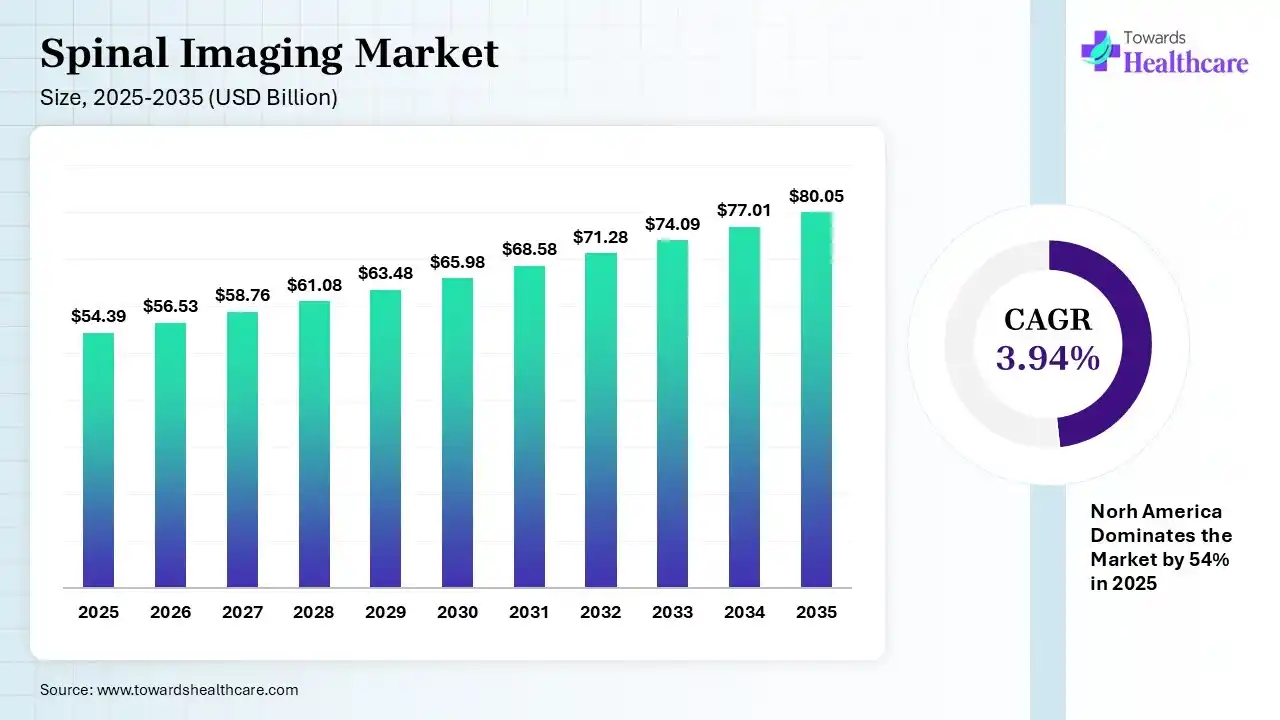
The worldwide accelerating prevalence of various spinal disorders and the geriatric population is boosting demand for non-invasive, advanced, rapid spinal imaging solutions like MRI & CT. Alongside, leading firms are encouraging the development of AI-powered solutions, image-guided navigation, etc.
The overall progression of the spinal imaging market is propelled by the gradual rise in the geriatric population with spondylolisthesis and herniated discs, specifically in the Asia Pacific region. Additionally, the globe is facing a massive growth in instances of degenerative disc disease, spinal stenosis, and spinal cord injuries, which surges the demand for diagnostic imaging. To resolve the arising concerns, leading companies are innovating integrated AI solutions for image analysis, with more sophisticated CT, MRI and 3d/4D imaging.
Spinal imaging refers to the use of advanced diagnostic imaging techniques, including magnetic resonance imaging (MRI), computed tomography, X-ray, and other modalities to visualize the spine for detecting abnormalities, injuries, degenerative disorders, and neurological conditions. The spinal imaging market is growing due to the rising prevalence of spinal disorders, increasing incidence of sports injuries and trauma, and growing demand for accurate, early diagnosis.
Technological advancements such as AI-powered image analysis, high-resolution. 3D imaging, cloud-integrated imaging, cloud-integrated imaging platforms, and image-guided surgical navigation are improving diagnostic precision and clinical decision-making. Emerging trends include portable imaging systems, digital radiology trends include portable imaging systems, digital radiology workflows, and minimally invasive spine procedures. Future opportunities lie in personalized spine care, predictive imaging analytics, smart diagnostic platforms, and expanding access to advanced imaging technologies across hospitals, specialty clinics, and ambulatory surgical centers.
AI algorithms are assisting in the broadening imaging capabilities by enhancing image quality and lowering the need for longer, more invasive scans. Moreover, deep learning reconstruction is actively reducing scan times by up to 70–86% for spinal MRIs while maintaining or optimizing image quality. Besides this, AI has a pivotal role in segmentation & labeling, where it enables automated, faster, and more precise segmentation of vertebral bodies, discs, and the spinal canal.
Developing Synthetic CT Scans
Researchers are implementing novel AI techniques that can generate synthetic CT images from MRI data, & enables doctors to diagnose bone detail without exposing the patient to ionizing radiation.
Inclining Towards Robotic-Assisted Surgery
Hospitals are leveraging novel systems that unite 3D imaging with robotic arms to bolster the accuracy of implants, reaching success rates of over 92% compared to conventional freehand approaches.
Spurring Image-Guided Navigation
The market has been putting efforts into optimizing intraoperative navigation tools employing 2D-3D fusion and AI for enhanced pedicle screw placement.
| Table | Scope |
| Market Size in 2026 | USD 56.53 Billion |
| Projected Market Size in 2035 | USD 80.05 Billion |
| CAGR (2026 - 2035) | 3.94% |
| Leading Region | North America by 54% |
| Key Applications | Degenerative spine disorders, spinal trauma, scoliosis assessment, spinal tumors, disc herniation diagnosis, spinal stenosis evaluation, surgical planning, image-guided interventions |
| Primary End Users | Hospitals, diagnostic imaging centers, orthopedic clinics, neurosurgery centers, ambulatory surgical centers, academic medical centers |
| Key Challenges | High equipment costs, reimbursement pressures, shortage of radiologists, imaging accessibility disparities, radiation exposure concerns in some modalities |
| Measurable Values | USD Millions/Units/Volume |
| Market Segmentation | By Product, By Spinal Region, By Application, By End-use, By Region |
| Top Key Players | GE HealthCare, Koninklijke Philips N.V., Siemens Healthineers AG, Canon Medical Systems Corporation, Bruker, Mediso Ltd., Shimadzu Corporation, FUJIFILM, Hitachi, Ltd., Toshiba Medical Systems, Inc. |
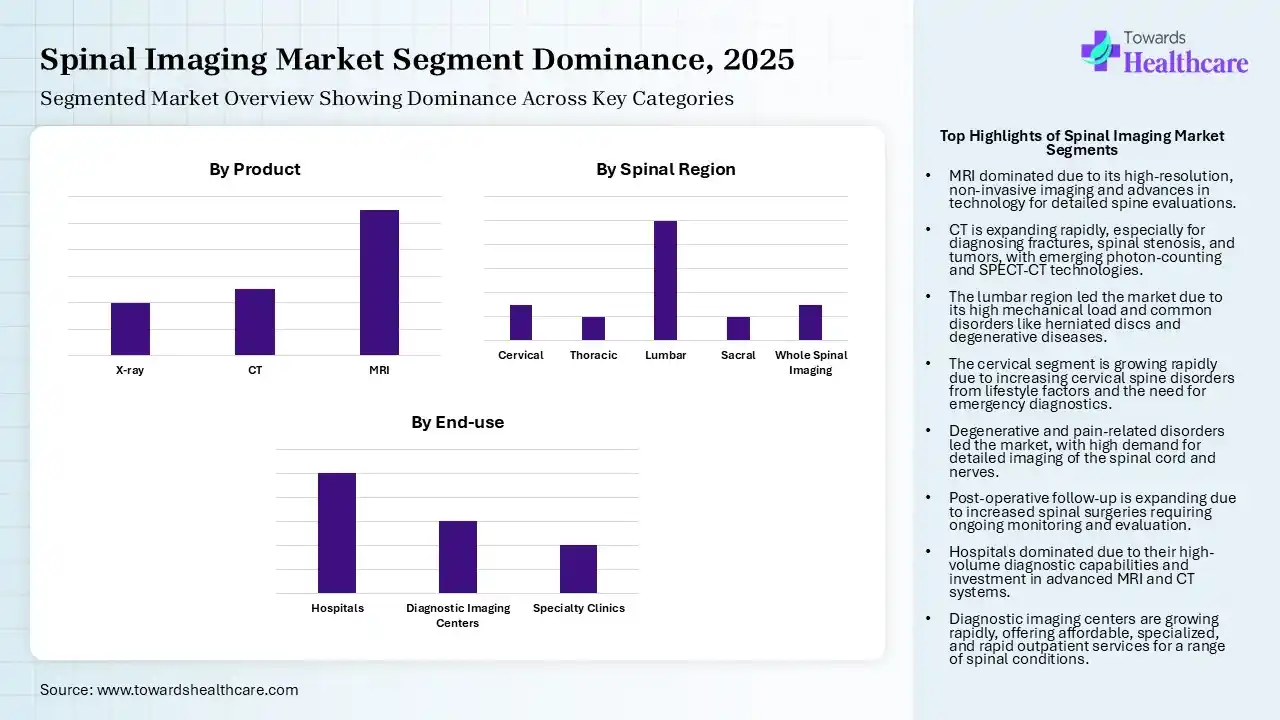
Why did the MRI Segment Lead the Spinal Imaging Market in 2025?
In 2025, the MRI segment captured the dominating share of the market by 20%. It is considered a gold standard for non-invasive, radiation-free spinal imaging, which offers high-resolution, multiplanar images of soft tissues, nerves, & discs. Ongoing technological advances are moving towards high-field MRI systems that facilitate increased resolution & rapid imaging, which is significant for detailed spine evaluations. Trends are emphasized diffusion tensor imaging (DTI), magnetization transfer, & water-fat imaging to effectively find cord injuries, MS pathology, & tumors.
CT
On the other hand, the CT segment is anticipated to register significant expansion. It is highly suitable for diagnosing fractures, spinal stenosis, and tumors, specifically in emergencies, and is accessible for patients with implants. Arising diagnosis cases are coupling photon-counting CT, which facilitates higher resolution, with enhanced tissue contrast. Another impressive technology is SPECT-CT, employed to detect specific pain generators in the spine by uniting functional and structural information.
Which Spinal Region Dominated the Spinal Imaging Market in 2025?
The lumbar segment registered dominance with a major share of the market by 15% in 2025. This region possesses the highest mechanical load, which results in accelerated cases of spondylosis, herniated discs, and degenerative disc disease. The emergence of imaging supports surgeons in assessing the spinal canal structure, visualizing vascular anatomy, & planning interventions to minimize risks, like during anterior lumbar approaches.
Cervical
Moreover, the cervical segment is estimated to show notable growth. Globally rising screen time, poor posture, and sedentary lifestyles have increased the prevalence of cervical spine disorders across all age groups. Alongside, cervical spine imaging is highly needed in emergency settings to diagnose fractures & dislocations caused by high-speed vehicle accidents & sports injuries. Advanced imaging has a pivotal role in assessing cervical spondylotic myelopathy (CSM), spinal stenosis, infections, & pre-surgical planning.
Which Application Led the Spinal Imaging Market in 2025?
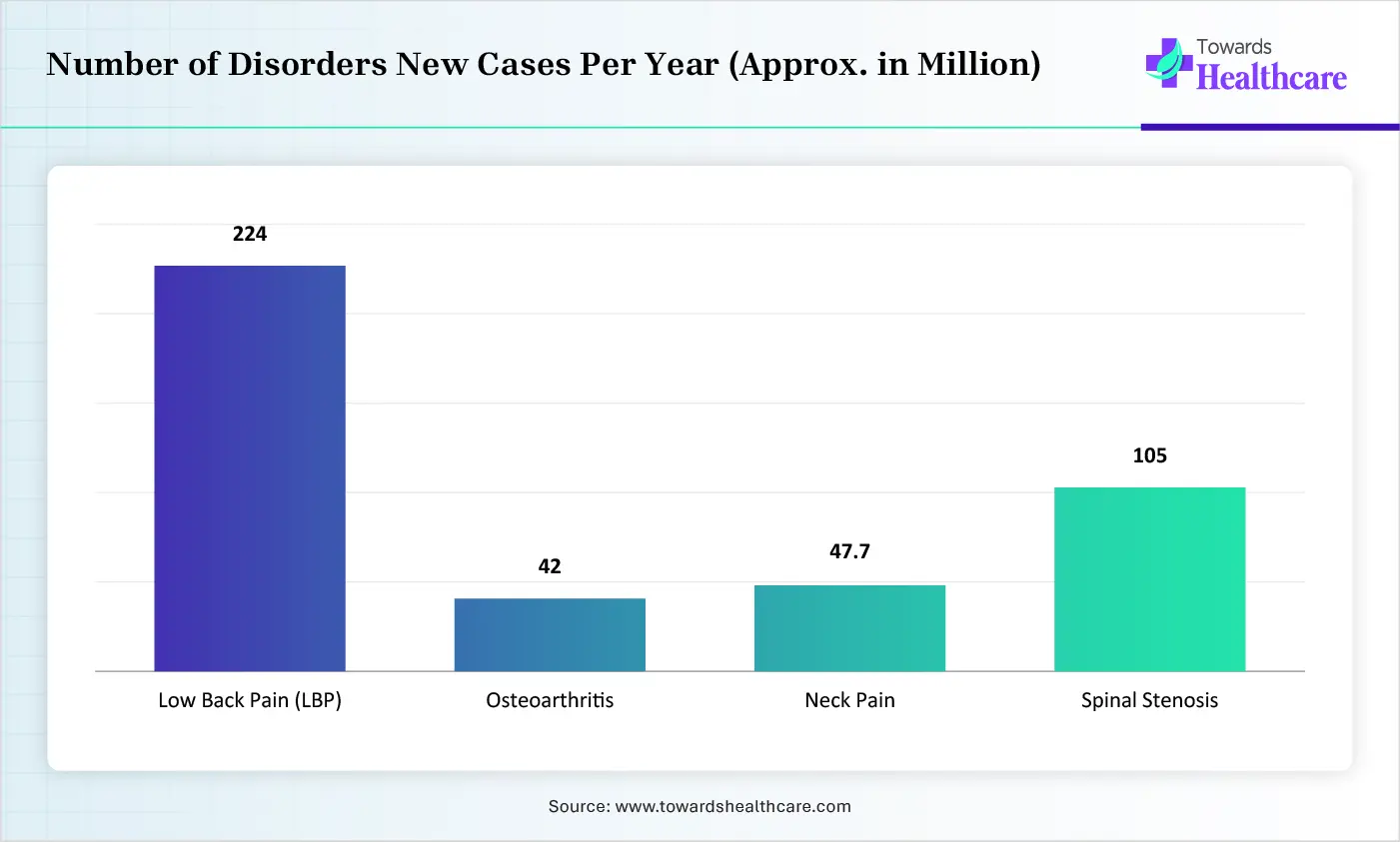
In 2025, the degenerative & pain-related disorders segment held the largest share of the market by 10%. As shown in the graph, the worldwide growth of different cases is demanding high-resolution images of nerves, the spinal cord, and ligaments, revealing issues, including annular tears or spinal stenosis, by using MRI. However, CT is employed to visualise bone, like facet hypertrophy, osteophytes, & to identify calcification in discs.
Post-Operative Follow-Up
Although the post-operative follow-up segment is predicted to show rapid growth. Diverse spinal procedures, such as fusion, deformity correction, and disk replacement, are fueling the demand for post-operative follow-up imaging to study surgical success. Protocols are allowing follow-up within the first 2-3 weeks, i.e., wound assessment, 3-6 months, like bony healing, and up to one year to track long-term implant integrity.
Why did the Hospitals Segment Dominate the Spinal Imaging Market in 2025?
The hospitals segment led with a dominant share of the market by 50% in 2025. Its dominance is driven by high-volume, multi-modality, & expert diagnostic capabilities, with heavy investments in advanced MRI/CT systems. The use of extensive, sophisticated imaging can often facilitate a definitive diagnosis, which lowers the need for exploratory surgery.
Diagnostic Imaging Centers
Moreover, the diagnostic imaging centers segment is estimated to expand rapidly. Their expansion is fueled by the growing need for affordable, specialized, & rapid outpatient services. These centers are using a multimodal approach, integrating anatomical imaging (MRI, CT) with functional and molecular techniques to assess degenerative diseases, trauma, tumors, and infections.
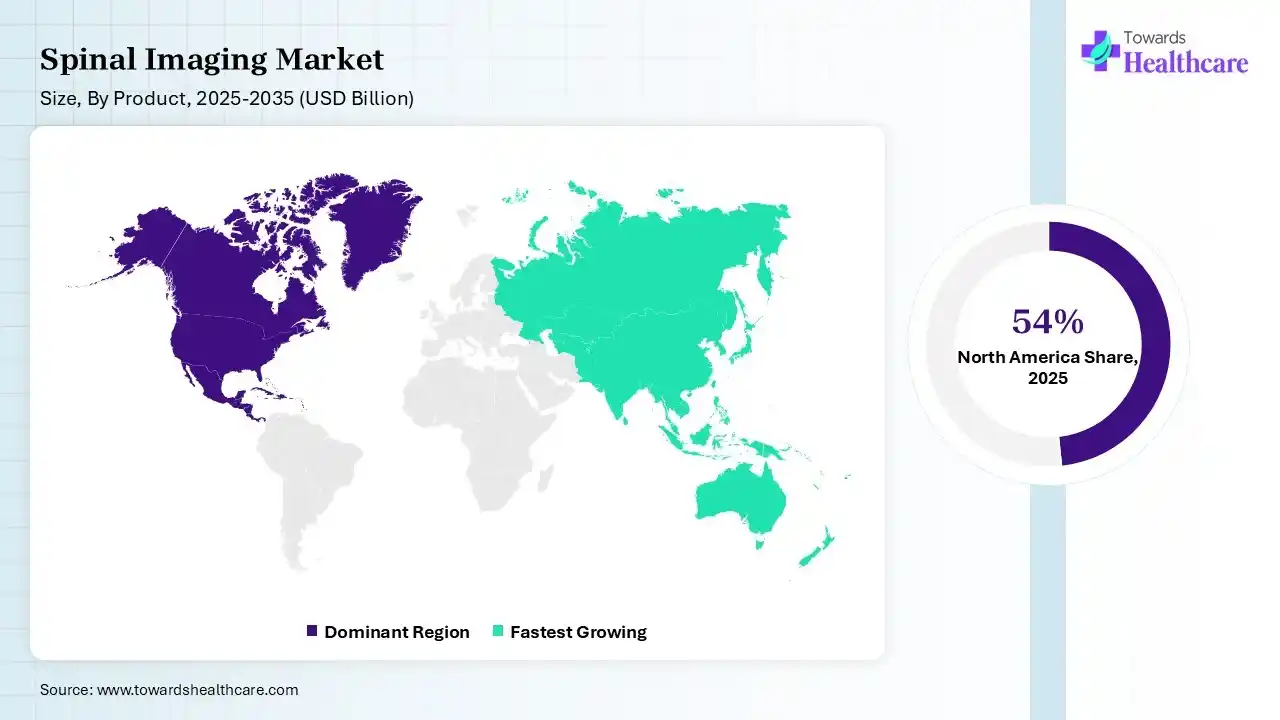
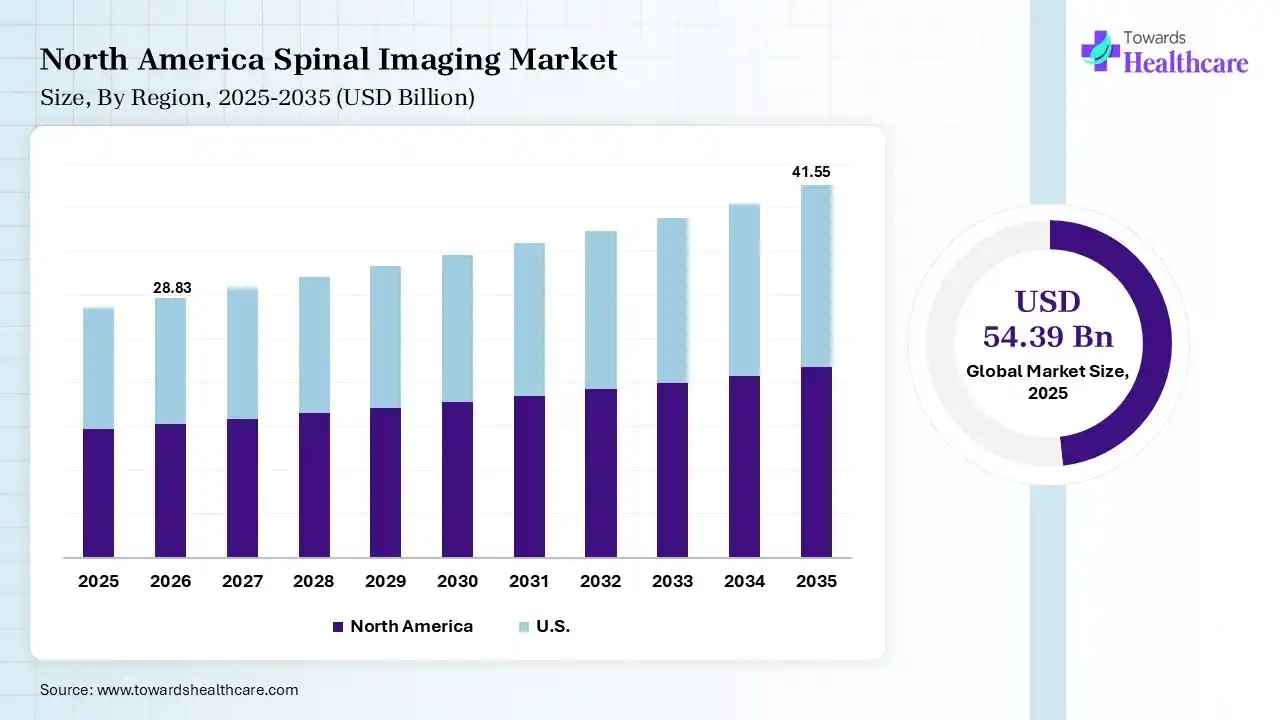
In 2025, North America led the market by 54% due to the increasing number of spinal disorders cases and widespread adoption of advanced modalities, like high-resolution 3T and 7T MRI scanners, multi-slice CT, and 3D imaging. The region is also promoting AI-assisted analysis, quantitative MRI techniques, and specialized imaging for spinal cord injuries (SCI).
For instance,
U.S. Market Trends
The U.S. was a major contributor to the market, and it is actively leveraging FDA-cleared software platforms, such as SpineNet and Aidoc, to support radiologists in determining herniations, stenosis, & fractures with higher accuracy. Researchers have found that 7T scanners offer unprecedented resolution of the spinal cord's grey & white matter.
Canada Spinal Imaging Market Grows Through Advanced Diagnostic Adoption
The Canada spinal imaging market is growing due to increasing prevalence of spinal disorders, a rising aging population, and expanding demand for early and accurate diagnosis. Strong healthcare infrastructure, growing investments in diagnostic imaging technologies, and increasing adoption of MRI, CT, and AI-powered imaging solutions are driving market growth. Continuous advancement in image-guided diagnostics and minimally invasive spine care is further supporting expansion.
Asia Pacific is anticipated to show the fastest growth in the spinal imaging market. This region’s population is highly prioritizing less invasive spinal procedures, which give quicker recovery, minimal pain, and shorter hospital stays. Also, the APAC is investing in hospital infrastructure, integrated with the progression of private hospitals & diagnostic centers in Tier-2 Indian cities & similar areas across China.
For instance,
India Market Trends
India is widely exploring advanced technology called O-arm O2 imaging, which offers real-time 2D and 3D imaging during surgery, also enabling precise implant placement, like pedicle screws, & minimizing risks in complex procedures. They are also implementing the LOOPX Imaging Robot & the Mazor X Stealth for computerized planning and execution, raising accuracy to 98–99%.
China Spinal Imaging Market Expands Through Healthcare Innovation
The China spinal imaging market is growing due to the rising burden of spinal disorders, increasing populations, and expanding access to advanced diagnostic services. Strong government investments in healthcare infrastructure, rapid adoption of MRI, CT, and AI-powered imaging technologies, and growing demand for early disease detection are accelerating market growth. Expanding orthopedic and neurosurgical care is further supporting widespread adoption.
| Ecosystem Category | Key Participants | Role in Market |
| Technology Providers | Siemens Healthineers, GE HealthCare, Philips, Canon Medical Systems | Develop MRI, CT, X-ray, and advanced imaging technologies for spinal diagnostics |
| Product Manufacturers | Siemens Healthineers, GE HealthCare, Philips, Canon Medical Systems, Fujifilm Healthcare, EOS Imaging | Manufacture spinal imaging equipment and associated hardware |
| Service Providers | RadNet, Akumin, SimonMed Imaging, InHealth Group | Provide spinal imaging services and diagnostic interpretation |
| Platform Providers | GE HealthCare, Siemens Healthineers, Philips, Fujifilm Healthcare | Imaging workflow, PACS, cloud imaging, enterprise radiology platforms |
| CROs/CDMOs (Limited Relevance) | ICON plc, IQVIA, Medpace | Conduct imaging-related clinical studies for spinal diagnostics and device validation |
| Software Vendors | Brainlab, Sectra, Fujifilm Healthcare, Aidoc, Gleamer | AI-assisted image analysis, surgical planning, PACS, visualization software |
| Research Institutions | Mayo Clinic, Cleveland Clinic, Stanford University, Johns Hopkins University | Clinical research, imaging innovation, AI algorithm development |
| End-User Industries | Hospitals, Diagnostic Imaging Networks, Orthopedic Centers, Neurosurgical Centers | Utilize spinal imaging technologies for diagnosis and treatment planning |
| Tier 1 | Tier 2 | Tier 3 | |
| Typical Market Influence | 72% | 20% | 8% |
| Tier 1 | ||||
| Company Name | Headquarters | Country | Why Relevant to This Market | Key Products/Services |
| Siemens Healthineers | Erlangen, Bavaria | Germany | Leading supplier of MRI, CT, and X-ray systems heavily used in spinal imaging | MAGNETOM MRI, SOMATOM CT, Cios fluoroscopy |
| GE HealthCare | Chicago, Illinois | USA | Strong global presence in advanced spinal MRI and CT imaging | SIGNA MRI, Revolution CT, OEC imaging systems |
| Philips | Amsterdam | Netherlands | Comprehensive spinal diagnostic imaging portfolio | Ingenia MRI, Incisive CT, image-guided therapy systems |
| Tier 2 | ||||
| Company Name | Headquarters | Country | Why Relevant to This Market | Key Products/Services |
| EOS imaging | Paris | France | Specialized low-dose spinal and orthopedic imaging leader | EOSedge, EOS imaging platform |
| Carestream Health | Rochester, New York | USA | Digital radiography solutions used in spinal diagnostics | DRX systems, imaging software |
| Hologic | Marlborough, Massachusetts | USA | Provides imaging technologies applicable to musculoskeletal and spine assessment | Digital radiography and imaging solutions |
| Tier 3 | ||||
| Company Name | Headquarters | Country | Why Relevant to This Market | Key Products/Services |
| Brainlab | Munich, Bavaria | Germany | Advanced spinal surgical planning and image-guided navigation | Spine & Trauma Navigation, Elements software |
| Sectra | Linköping | Sweden | Leading radiology and spine imaging management software | Sectra PACS, imaging workflow platforms |
| Aidoc | Tel Aviv | Israel | AI-assisted image interpretation for musculoskeletal and spinal imaging workflows | Radiology AI platform |
In June 2026,“We built CBeam to help transform existing C-arm systems into accessible, efficient, and cost-effective 3D imaging solutions for hospitals, ASCs, and surgeons. This achievement validates our vision to bring advanced imaging directly into the operating room without requiring hospitals to invest in entirely new imaging infrastructure”, Kevin McGann, CEO of Pulmera
Strengths
Weaknesses
Opportunities
Threats
By Product
By Spinal Region
By Application
By End-use
By Region








Principal Consultant
Shivani Zoting is a dedicated research analyst specializing in the healthcare industry. With a strong academic foundation, a B.Sc. in Biotechnology and an MBA in Pharmabiotechnology, she brings a unique blend of scientific understanding and strategy.
Learn more about Shivani Zoting
Reviewed By
Aditi Shivarkar is a seasoned professional with over 14 years of experience in healthcare market research. As a content reviewer, Aditi ensures the quality and accuracy of all market insights and data presented by the research team.
Learn more about Aditi Shivarkar