


 Request Consultation
At a Glance:
Globally raised thousands of questions regarding Phase III trials & their respective companies, such as ‘which company conducts the most Phase III trials? Or how many of a company’s own drug entities have positioned the most expansive & highest-stakes stage of development?’. To answer questions like these, this will be a complete transition towards contract research organizations that physically conduct trials for numerous sponsors simultaneously. Alongside, stronger CROs uncover data regarding regulatory frameworks and regional strategies, which play a major role in trial-site capacity.Meanwhile, company disclosures, CRO financial filings, & independent trial-tracking data describe who is usually driving Phase III activity in 2025-2026. Specifically, companies including Eli Lilly, Merck, AstraZeneca, Roche, Novartis, GSK, and J&J are rapidly expanding as key late-stage development firms.
Let’s have a look at the answer for ‘Who runs the most Phase III trials annually?
Basically, the meaning of running a trial is the company that sponsors & owns the drug, or the CRO that systematically implements it & extensively depends on your mean.
The above ecosystem diagram indicates the three-party structure of each Phase III trial, i.e., the sponsor who owns the drug, while the CRO conducts the study, & the sites that register patients, & each is claiming to be running the trial. But the key answer majorly necessitates describing whether you mean sponsorship, operational implementation, or site-level delivery, as the leading company modifies entirely based on which lens you apply.
Eminent Leaders Running the Most Phase III Trials Per Year
Merck Developed as One of the Most Confident Phase III Beginners
Data from Merck FY2025 results shows that in 2025, Merck had 21 new Phase III studies entering enrollment, with 18 positive Phase III late-stage results, & nearly 80 Phase III studies ongoing. With its ability to consistently restock & operationalize, at the J.P. Morgan Healthcare Conference, Merck Chairman & CEO Robert Davis commented that the company ‘now has 80 Phase III studies underway,’ and also predicted 20+ new rollouts and > $70 billion in revenue opportunity through the mid-2030s. So, upon this most particular, greatest, & latest disclosed Phase III trial count at the public stage by any pharma CRO in the ongoing cycle, it makes Merck the lucid publicly qualified player on the sponsor edge of the equation.
Source: Merck FY2025 results and PharmaLive, “2026 Pipelines to Watch.”
Pfizer’s Revolution Fostering Pipeline Channel that Includes 30 Candidates Under Phase III Trial
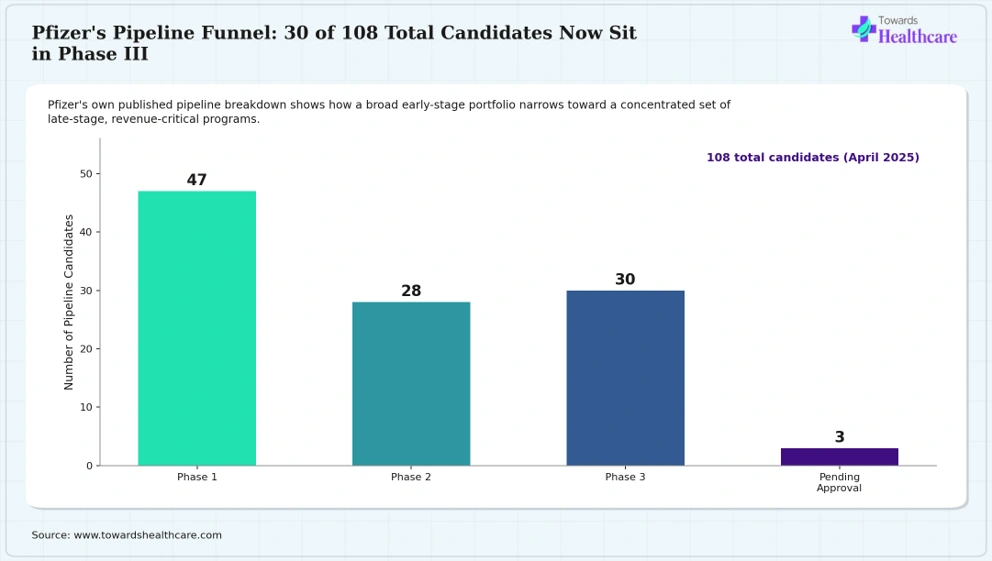
The infographic derived from Pfizer’s own published pipeline breakdown in April 2025 indicates 108 total drug candidates across all stages, such as 47 in Phase I, 28 in Phase II, 30 in Phase III, & 3 pending regulatory approvals. So, mainly an approximate 28% of Pfizer’s comprehensive pipeline is currently in Phase III, which represents both years of notable breakthroughs & Pfizer’s described strategy of broadening across therapeutic areas instead of focusing on risk in a smattering of programs.
Source: Pfizer official pipeline disclosure, April 2025, as compiled and cited in SyneticX, “Pfizer 2026 Competitive Outlook Report.
Growth of Merck’s 80-Trial Phase III, Driving Equivocate Against the 2028 Keytruda Patent Cliff
The overall period links Keytruda’s 2024 financial dominance, which covers 46% of total Merck sales, $29.5 billion in revenue, to its 2028 patent expiration, & further moves to Merck’s 2026 disclosure of 80 concurrent Phase III studies.
Not only with simply R&D ambition, but Merck’s Phase III explanation directly shows quantifiable response to the single giant patent-cliff exposure of any significant pharma company. Alongside Keytruda’s loss of exclusivity evolving existential stress to substitute roughly half the company’s revenue base.
Source: PharmaLive, “2026 Pipelines to Watch,” Jan. 2026.
IQVIA is Playing as the Execution Core Driving Substantially Greater Trials Than Any Other Single Pharma Sponsor
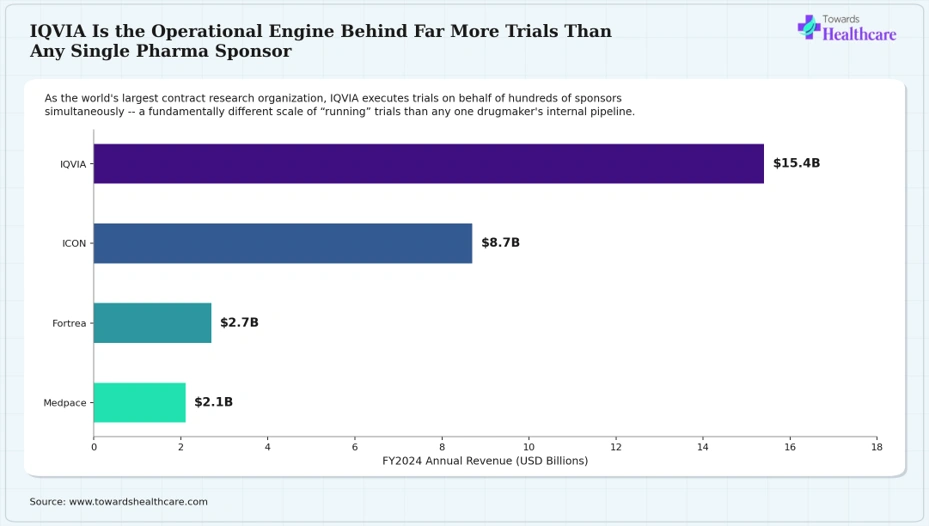
The respective chart reflects a comparison of FY2024 annual revenue across the eminent CROs that physically demonstrate clinical trials on behalf of sponsors, i.e. IQVIA ($15.4B), ICON (~$8.7B), Fortrea ($2.7B), and Medpace ($2.1B). Among all these, IQVIA holds the dominant revenue scale, which is approximately double the next-largest CRO & >7x Medpace. This further indicates its reach in running trial operations throughout numerous sponsor relationships at the same time & makes it defensibly the single company most literally running the massive number of trials globally, although it owns none of the basic drugs.
Source: Company FY2024 financial reports (IQVIA, ICON, Fortrea, Medpace); industry compilation via The PBC Group, 2025.
Moreover, mid-size CRO Medpace is surging approximately 4 times faster than industry giant called IQVIA.
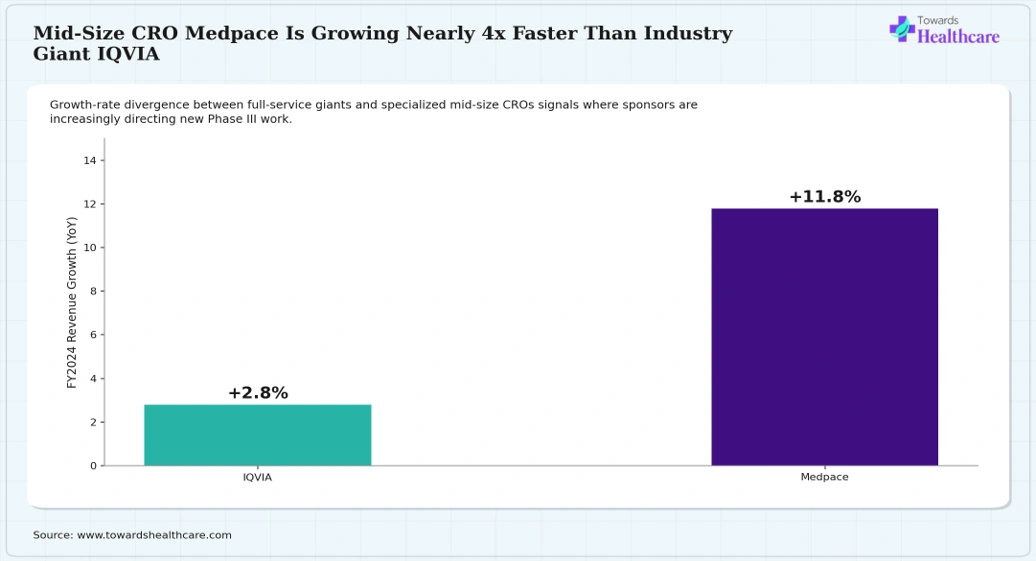
These digits demonstrate that, in 2024, Medpace's revenue grew 11.8% year-over-year, as compared to IQVIA's 2.8% growth over the same year, which is a more than fourfold difference in growth rate between the two companies. Hence, the expedited expansion at a mid-size, biotech-centric CRO relative to a huge full-service incumbent guides sponsors, especially smaller & mid-cap biotechs, that are highly operating new Phase III trials towards specialized leaders.
Source: Company FY2024 earnings reports; Clinical Outsourcing Group CRO revenue analysis, 2025.
Fortrea’s Spin-off from Labcorp Transformed the CRO Ecosystem Sponsors Depend on in 2023
In July 2026, Fortrea led as an independently publicly traded company after separating from Labcorp, & instantly becoming one of the industry’s largest full-service CROs with Phase I-IV clinical development capabilities. So, this development of a novel, independently capitalized, multi-billion-dollar CRO in 2023 significantly altered the competitive set that pharmaceutical sponsors select from for late-stage trial demonstration, as a systemic market event.
Source: Pharmaboardroom, “Top 10 CROs in 2024”; IntuitionLabs, “CRO Market Share 2026,” 2026.
Eli Lilly Is Fostering the Conversion of Pipeline Pace into Phase III Volume
Lilly's late-stage unit is broadly varying beyond a single obesity franchise, with Phase III activity ranging across cardiometabolic disease, oncology and other therapeutic areas. From the sources, in 2025, the company initiated 12 new Phase III programs and 25+ Phase III trials obtained positive topline outcomes in 2025. Furthermore, in April 2026, Eli Lilly announced 42 Phase III pipeline projects.
Source: Eli Lilly 2025 Year in Review; Lilly pipeline, April 30, 2026
Lilly Introduced its Obesity Franchise as a Phase III Trial Factory
Retatrutide: Employed in obesity, type 2 diabetes, CVD, knee osteoarthritis, with multiple Phase III trials.
Orforglipron: Used in type 2 diabetes, obesity, & cardiometabolic outcomes.
Across the franchise, Lilly is leveraging the same core assets around multiple populations & applications, which creates a network of substantial trials. Alongside, its strategy is stepping from one drug > pivotal trial toward one platform asset> multiple Phase III evidence packages.
Source: Eli Lilly clinical-development disclosures
Roche Inclined Towards Late-Stage Strategy that is Designed Around Pipeline Acceleration
By following the comprehensive drug development process, Roche’s 10 drugs shifted into final clinical phase in 2025. It also stated that 2025 was the foremost year in its history, with 10 medicines moved into the final clinical phase. Its overall strategy is not rotating around maintenance of a massive late-stage portfolio but promoting stronger assets towards pivotal development.
Source: Roche Annual Report 2025.
GSK is Knowingly Advancing Its Phase III Scope
According to analysis, in 2028, GSK has started 7 pivotal trials and 17 Phase III/registration assets. For 2026, GSK is seeking 20 Phase III medicines by year-end. With this ambition, GSK is considering late-stage pipeline progression as a strategic growth lever.
Source: GSK Annual Report 2025; 2026 company strategy reporting.
AstraZeneca is Describing the Frequency of Phase III Readouts as its Competitive Cutting-Edge
In 2026, AstraZeneca CEO Pascal Soriot said that the company had achieved a positive Phase III trial, either an innovative or novel indication, every month over the previous three years.
Source: AstraZeneca CEO remarks reported by The Times, June 2026.
Overview of 2024: Global Phase I-III Trial Begins Recovered to 10,503 in 2024
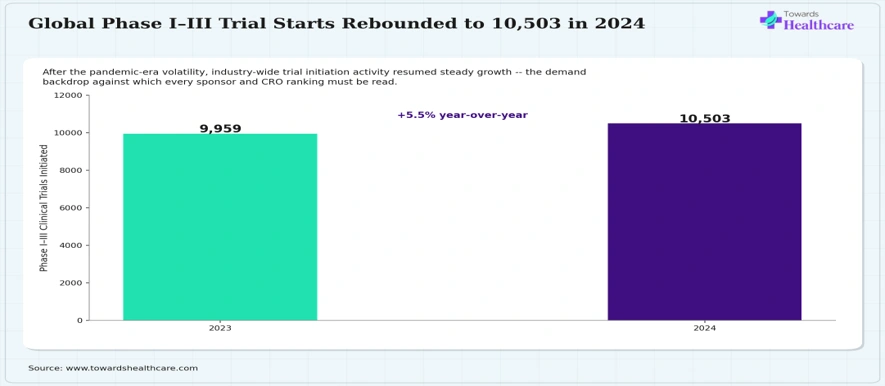
From the source, the graph reflects that in 2024, 10,503 Phase I-III clinical trials began across the globe, which indicates a 5.5% rise over the 9,959 reported in 2023, coupled with industry-sponsored studies increasing 3.6%. Finally, the competitive landscape for trial-site & patient-recruitment capacity is escalating industry-led, not just among the giant companies.
Source: Citeline, “The Annual Clinical Trials Roundup, 2025 Edition,” 2025 (analyzing 2024 trial-start data).
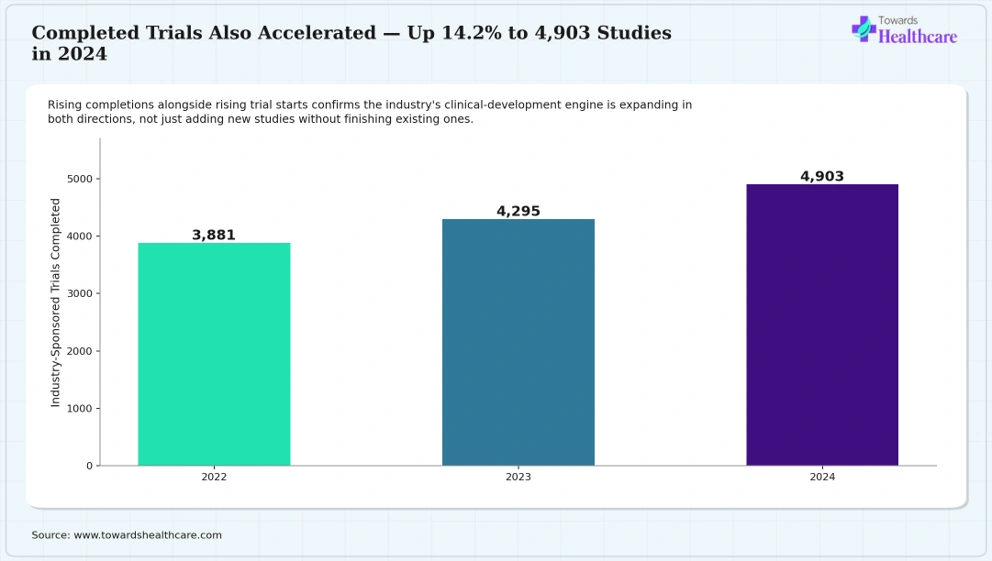
This infographic represents that source reported 4,295 in 2023 & 3,881 in 2022, & further 4,903 industry-sponsored clinical studies & reaching completed status in 2024, i.e. higher from 2022 & 2023 numbers. Upon the two subsequent years of advancing trial completions, 2024 is a massive hike in 8 years, ensuring that the clinical progression engine is actually broadening results, not only collecting a backlog of trials that initiate but don’t complete.
Source: Citeline, “Infographic: Annual Completed Clinical Trials,” 2025 (2024 data) and 2024 edition (2023 data).
Regional Strategy: China Has Resolved the Clinical-Trial Volume Discrepancy with the US Since 2015
According to Citeline’s Analysis, China, fueled by a regulatory revolution & increasing pharmaceutical R&D investment since 2015, has met the United States in total clinical trial volume by 2023, especially dominant in oncology & biologics with a rapid pace. Answering who runs the most Phase III trials that avoid China is now structurally inconsistent, while trial-site & sponsor activity has become actually a two-region story instead of a US/EU-oriented one within less than a decade.
Source: Citeline (In Vivo), “By The Numbers: Phase III Trials In China Skyrocket While Phase I Falls To Earth,” Aug. 14, 2025.
Exploring Oncology as Dominant Stream of Global Late-Stage Drug Development
Specifically, IQVIA Institute analysis of the last few years of clinical trial-start data revealed clinical development emphasis has structurally transitioned toward oncology, rare diseases, and innovative modalities, like cell, gene, and biologic therapies, over the past ten years. The worldwide ranking of Phase III sponsors that omits therapeutic-area mix can be deceptive, & oncology-led firms organically develop more important trial activity due to the breadth of applications & combination opportunities.
Source: IQVIA Institute, 2026
Eventually, Big Pharma is Stepping into Phase III & Aiming at Three Multi-Billion-Dollar Late-Stage Acquisitions
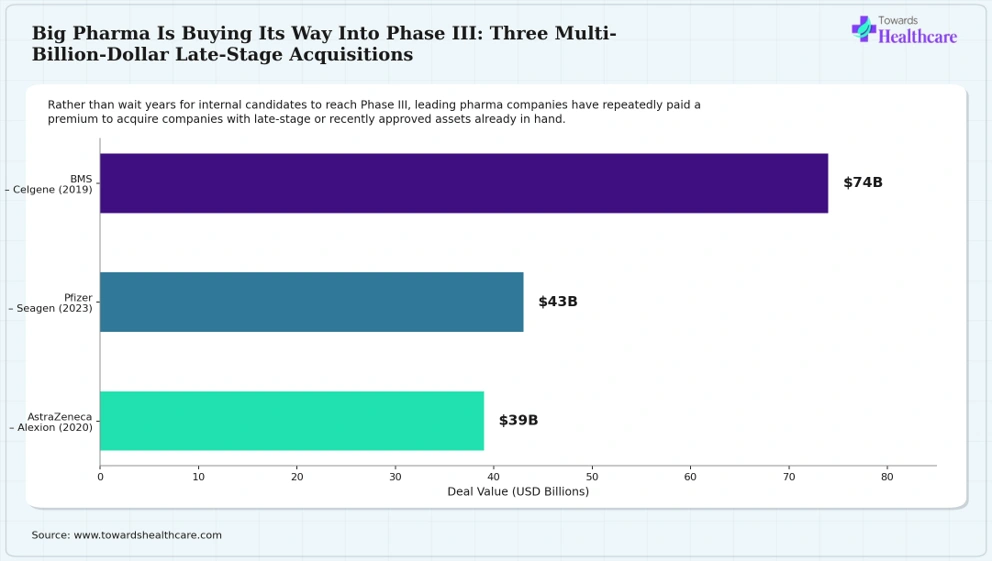
The above chart represents three key pharma acquisitions clearly focused on receiving late-stage or recently approved pipeline assets, such as AstraZeneca–Alexion reported $39B in 2020, Pfizer–Seagen recorded $43B in 2023, & Bristol Myers Squibb–Celgene reached $74B in 2019. To overcome waiting for years for internal molecules to reach Phase III naturally, companies are seeking the acquisition of a player that already possesses late-stage assets in hand, which has become a proven, often leveraged, optional solution to the same end focus, i.e. a vast disclosed Phase III count.
Source: DrugPatentWatch, “Reviving a Pharmaceutical R&D Pipeline,” 2026 (deal value compilation, sourced to public M&A announcements).
Three Units Involved in Deciding Who Runs the Most Phase III Trials in Any Given Year
Robust framework mainly covers three interacting drivers, such as patent-cliff pressure on sponsors, execution capacity emphasized among global CROs, and the regional growth of trial-site capacity beyond the US & EU. Independent shift & on diverse timelines of these three units, including a patent cliff, can be discussed in a single earnings call, while CRO capacity & geographic capacity move in the coming years. Whereas any top Phase III sponsor ranking should be considered as a summary of a specific moment, not a stable, permanent tier.
Source: Synthesis of evidence presented in Sections 1–12 of this briefing.
What are the Recent Developments Across Phase III Trials of Leading Companies?
- In July 2026, Lilly recorded additional positive Phase III retatrutide results, i.e. TRIUMPH-2 and TRIUMPH-3. They have widened the clinical evidence base for retatrutide across obesity, diabetes and cardiovascular-risk populations. This strengthens Lilly’s position across a quickly developing incretin/obesity competitive framework.
- In July 2026, AstraZeneca experienced a Phase III setback for Wainua regardless of an expansive record of frequent positive late-stage results. High Phase III volume elevates the number of potential value-creating events, but also increases binary clinical risk.
- In July 2026, GSK announced an intense plan to double its number of Phase III medicines to 20 by year-end. This will specifically support late-stage pipeline expansion to its prospective growth strategy.
- In June 2026, Boehringer Ingelheim began three Phase III trials across SCLC, extrapulmonary neuroendocrine carcinoma and HER2-mutant NSCLC. It demonstrates how specialist pharmaceutical players can rapidly increase late-stage activity in targeted therapeutic areas.
- In June 2026, Merck discontinued a Phase III oncology study called KEYNOTE-D46/EVOKE-03, after the previously specified final PFS analysis did not illustrate statistically significant improvement. So, even among players with very vast Phase III portfolios, individual late-stage failures remain material portfolio events.
- In June 2026, Novartis started another Phase III study of pelabresib with ruxolitinib in myelofibrosis, with a planned enrollment of 460 participants. This further shows constant progression of Novartis’s late-stage haematology pipeline.
- In May 2026, Exelixis, Inc. made a clinical development partnership with Merck to supply KEYTRUDA QLEX (pembrolizumab and berahyaluronidase alfa-pmph) injection for subcutaneous administration in combination with zanzalintinib in STELLAR-316, a planned phase 3 pivotal trial in patients with resected stage II/III colorectal cancer (CRC).
Key Firms & Organizations
| Company | Category | Relevance to Phase III Trial Activity |
| Merck & Co. | Pharma Sponsor | Unlocked 80 concurrent Phase III studies as the huge publicly quantified sponsor-side load in Jan. 2026. |
| Pfizer Inc. | Pharma Sponsor | In April 2025, they unveiled 30 of 108 pipeline molecules in Phase III active quarterly late-stage readout cadence. |
| Roche/Genetech | Pharma Sponsor | It has an extensive late-stage oncology & neurology pipeline, like inavolisib and trontinemab. |
| AstraZeneca | Pharma Sponsor | This executes an active late-stage radioligand and oncology pipeline, with vast acquisitions focused on late-stage assets. |
| Novartis | Pharma Sponsor | The company executes late-stage programs throughout cardiometabolic, oncology, & immunology, such as ianalumab and pelacarsen. |
| Bristol Myers Squibb | Pharma Sponsor | It made the $78B Celgene acquisition for a late-stage myeloma pipeline, with active 2026 pivotal readout support. |
| Eli Lilly Company | Pharma Sponsor | This offers a wide range of late-stage cardiometabolic & neurology pipeline, like retatrutide and imlunestrant. |
| Novo Nordisk | Pharma Sponsor | A company running Phase III EVOKE/EVOKE Plus trials in Alzheimer’s disease, with a cardiometabolic pipeline. |
| IQVIA Holdings | Global CRO | As a giant CRO by revenue of $15.4B in 2024, it further implements trials across numerous sponsors worldwide. |
| ICON plc | Global CRO | This a second-largest CRO by revenue of nearly $8.7B, and it is the first to execute Medidata Clinical Data Studio industry-wide. |
| Fortrea | Global CRO | Since July 2023, it has been recognised as independent from Labcorp & expands as a Full-service Phase I-IV CRO. |
| Medpace Holdings | Mid-Size CRO | It is the fastest-growing prominent CRO & rolled out as a biotech-focused model. |
| Parexel International | Global CRO | It executed AI-powered site selection and monitoring via a 2025 Paradigm Health partnership. |
| Citeline (Norstella) | Data & Intelligence Provider | They have a source of Trialrove clinical trial-start & completion data employed across this briefing. |
| IQVIA Institute for Human Data Science | Data & Intelligence Provider | This prominently publishes annual Global Trends in R&D reports via evaluating trial-start patterns by therapeutic area. |
Strategic Business & Research Questions
- Which specific therapeutic-area sub-segments within Merck's 80 Phase III studies carry the highest probability-adjusted revenue replacement value for the 2028 Keytruda cliff?
- How does Pfizer's 28% late-stage pipeline concentration compare to a probability-weighted benchmark across the top 15 pharma companies by R&D spend?
- What is the average cost-per-patient and cycle-time differential between IQVIA, ICON, Fortrea, and Medpace for oncology Phase III trials specifically?
- Which sponsors have shifted the major share of new Phase III outsourcing volume toward mid-size CROs like Medpace in the past 24 months, and why?
- What is the probability-adjusted success rate for Phase III trials sponsored by companies facing an imminent patent cliff versus those without one?
- How many of China's Phase III trials initiated since 2020 are multinational/global trials versus domestic-only studies, and what does that imply for Western sponsor partnership models?
- Which CRO has the robust site-network density in the specific indications driving oncology's decade-long share gain in Phase III starts?
- What is the realistic timeline and cost delta between acquiring late-stage pipeline via M&A (as AstraZeneca, Pfizer, and BMS did) versus building it internally?
- Which mid-cap biotech sponsors are most likely to become the next major Phase III volume driver, based on current Phase II pipeline depth and cash runway?
- How does Fortrea's post-spin-off capital structure compare to ICON's and IQVIA's in terms of capacity to bid competitively on large multinational Phase III programs?
- What proportion of the 10,503 Phase I–III trials initiated in 2024 were decentralized or hybrid-design trials, and how does that vary by sponsor size?
- Which specific FDA and EMA regulatory pathway changes are most likely to accelerate or bottleneck Phase III trial-site capacity over the next 24 months?
- How concentrated is Phase III trial-site capacity among the top 20 global investigator networks, and what switching costs exist for sponsors seeking alternatives?
- What is the actual realized cost-per-completed-patient trend at IQVIA versus Medpace when controlling for therapeutic area and trial complexity?
- Which companies among the emerging Chinese biopharma cohort (e.g., those named in Citeline's China trial-volume coverage) have credible near-term paths to global multinational Phase III sponsorship?
- How does the growth-rate divergence between IQVIA and Medpace correlate with client mix (large pharma vs. small/mid biotech) across the broader CRO industry?
- What is the realistic probability that AstraZeneca and Bristol Myers Squibb complete a $400 billion merger, and how would combined late-stage pipeline overlap affect total industry Phase III capacity?
- Which therapeutic areas are most exposed to a simultaneous, industry-wide patent-cliff wave in 2027–2030, and which sponsors are best positioned to respond with Merck-style Phase III surges?
- What is the current unmet demand gap between global Phase III trial-site capacity and the pipeline volume projected by the top 20 pharma companies through 2030?
- How do CRO pricing models differ between full-service (IQVIA, ICON) and functional-service-provider engagements for sponsors running 50+ concurrent Phase III studies like Merck?
Data & Intelligence Pointers
- Merck disclosed 80 concurrent Phase III studies ongoing as of January 2026, which was the most specific, current late-stage trial count made public by any pharma CEO in this cycle.
- Keytruda accounted for roughly 46% of Merck's total 2024 revenue, i.e. $29.5B of $64.17B, directly dictating the urgency behind its 80-trial Phase III surge ahead of 2028 patent expiration.
- Pfizer's April 2025 pipeline disclosure presented 30 of 108 total candidates, i.e. approximately 28%, in Phase III, alongside 47 in Phase 1, 28 in Phase 2, and 3 pending approval.
- IQVIA is the world's largest CRO by revenue at $15.4 billion (FY2024), approximately double the second-largest CRO, ICON, i.e. ~$8.7 billion.
- Medpace's FY2024 revenue grew 11.8% year-over-year, more than four times IQVIA's 2.8% growth rate over the same period.
- Fortrea became an independently traded public company in July 2023 after separating from Labcorp, immediately becoming one of the industry's largest full-service CROs.
- Global Phase I–III clinical trial initiations reached 10,503 in 2024, a 5.5% increase over 2023's 9,959, with industry-sponsored studies up 3.6%.
- Industry-sponsored trial completions rose 14.2% to 4,903 studies in 2024, the largest single-year rise in completed-trial volume in eight years.
- China's clinical trial volume met that of the United States by 2023, following a period of expedited regulatory reform and R&D investment expansion beginning in 2015.
- Three of the largest pharma acquisitions of the past six years, i.e. AstraZeneca-Alexion ($39B), Pfizer-Seagen ($43B), and BMS-Celgene ($74B), were subtly emphasized by acquiring late-stage or recently approved pipeline assets.
- Pfizer reported seven positive Phase 3 readouts and nine key pivotal program starts across 2025, ensuring late-stage activity is a continuous quarterly process rather than a single static count.
- ICON became the first significant CRO to implement Medidata Clinical Data Studio across all clinical workflows in March 2025, a signal of rapid technology standardization among top-tier CROs.