


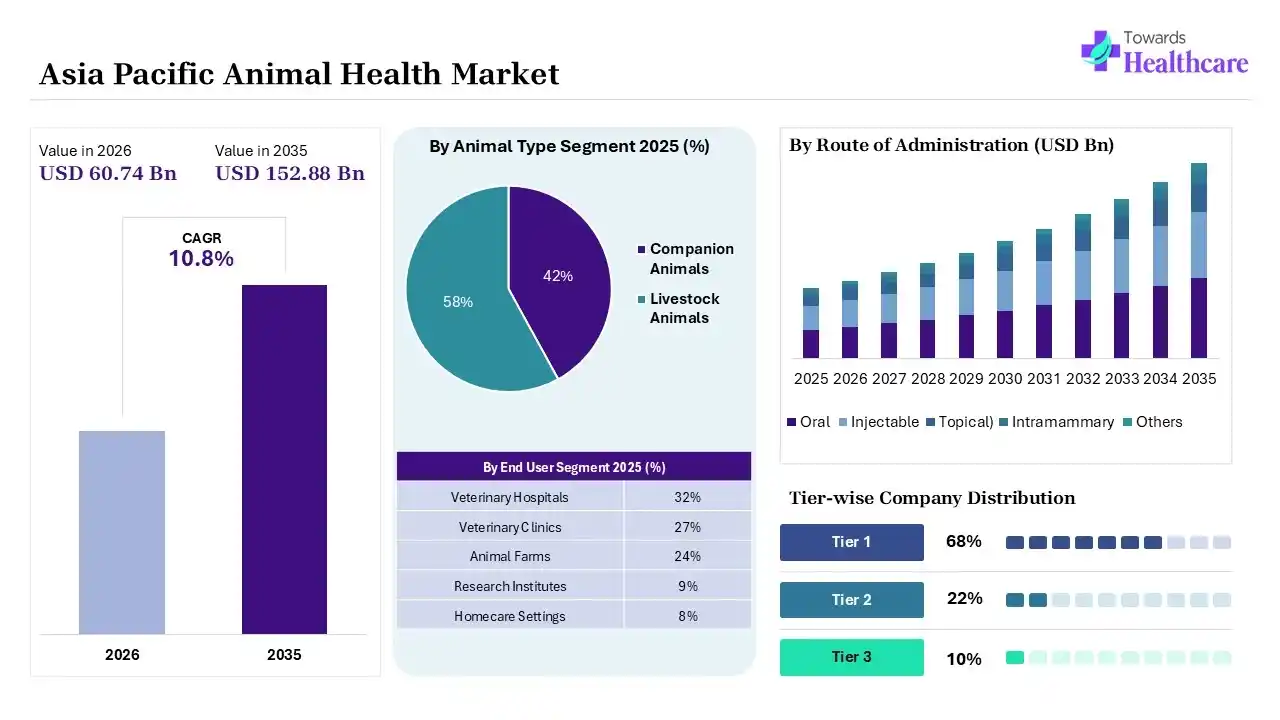
The Asia Pacific animal health market size accounted for USD 54.82 billion in 2025 and is predicted to increase from USD 60.74 billion in 2026 to approximately USD 152.88 billion by 2035, expanding at a CAGR of 10.8% from 2026 to 2035. Enforcement of government surveillance, rapid urbanization, and focus on advanced disease prevention, diagnostics & management, drive the overall market growth.
The emergence of rigorous management, monitoring, & mitigation of diseases in terrestrial & aquatic animals across the APAC is known as the Asia Pacific animal health market. The market mainly covers veterinary care, pharmaceutical development, & government surveillance to safeguard livestock productivity, companion animal welfare, & geographical food security. Nowadays, the globe is increasingly moving towards the use of AI-enhanced diagnostics & real-time monitoring to control disease outbreaks. Also, governments are enforcing stringent regulations about antibiotics, resulting in a huge demand for vaccines, probiotics, & nutritional feed additives, supporting the market expansion.
Gradually, urbanisation & increasing disposable income are impacting the progression in premium pet nutrition, pet insurance, & smart veterinary care. Moreover, the globe is increasingly demanding meat & dairy, which raises opportunities for smart ear tags, IoT-enabled automated feeding, & digital health tracking systems to eliminate disease-related losses. Ongoing breakthroughs in telemedicine & AI-enabled diagnostic tools are overcoming the distance between remote, rural livestock farmers & urban pet owners, establishing high potential for digital health startups.
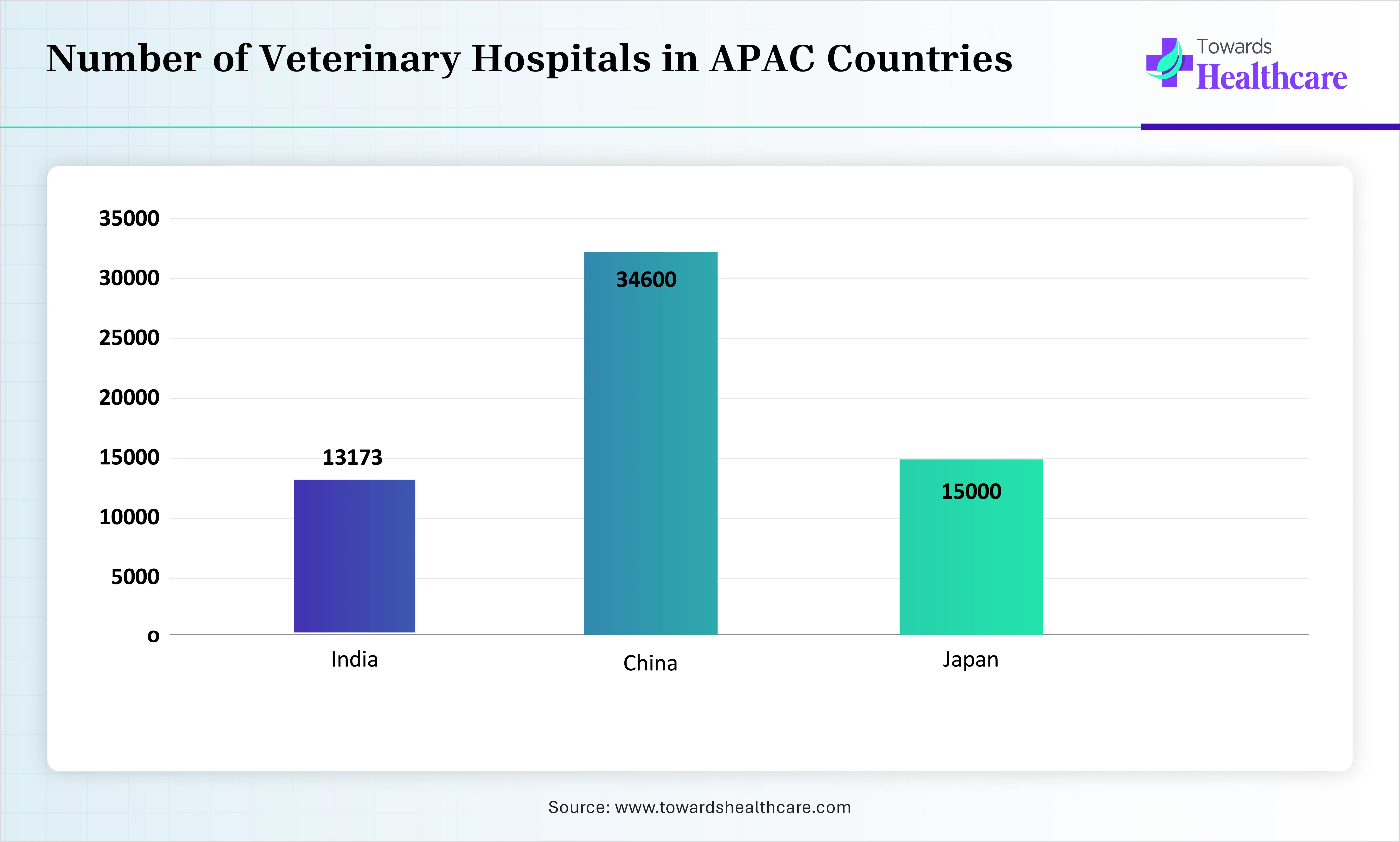
Asia Pacific has a higher population of livestock animals, where these hospitals & diagnostic centres assist in monitoring, diagnosing, & managing outbreaks of diseases, including avian influenza, swine fever, & rabies. Indian hospitals are making efforts in preventive care, disease surveillance, & herd immunity to help rural livelihoods & national food security, while China is widely reinforcing animal biotechnology, pharmaceutical manufacturing, & modernizing agriculture. Japan’s healthcare systems are highly facilitating premium wellness subscription plans, AI-enabled diagnostics, & broader pet insurance coverage.
By product type, the pharmaceuticals segment led with a 39.00% share of the Asia Pacific animal health market in 2025. A massive rise in cases of zoonotic diseases is driving a huge demand for pharmaceuticals across livestock & companion animals. Alongside the globally surging progression of veterinary drug approvals, treatment availability is being fostered. Subsidy, large-scale vaccination, and therapeutic programs accelerate the adoption of pharmaceuticals.
By animal type, the livestock animals segment captured a dominant share of 58.00% of the market in 2025. Growing meat & dairy consumption is propelling demand for livestock animal healthcare. Whereas disease prevention programs are empowering veterinary investments. In addition, export-focused animal farming supports market growth.
By indication, the infectious diseases segment dominated with a 29.00% share of the Asia Pacific animal health market in 2025. A key driver is a complex interaction of faster environmental, agricultural, & socioeconomic modifications. As well as large-scale deforestation & habitat fragmentation, propel the occurrence of these instances. Besides this, improper biosecurity & gaps in vaccination programs are further raising the vulnerability of farmed animals to diseases, such as Japanese Encephalitis & Highly Pathogenic Avian Influenza.
By route of administration, the oral segment held a major share of 41.00% of the market in 2025. Dominance is fueled by its ease of administration, which enhances compliance across livestock & pets. Also, this offers affordable formulations, coupled with medicated feed products, which also promote oral therapy adoption.
By distribution channel, the veterinary hospitals & clinics segment captured a 38.00% share of the Asia Pacific animal health market in 2025. A substantially increasing number of clinical visits is directly strengthening veterinary product sales. Alongside, they offer integrated treatment & dispensing that optimizes convenience. Besides this, the growth of specialty hospitals is fostering channel dominance.
By end user, the veterinary hospitals segment led with a 32.00% share in 2025, due to a well-developed treatment infrastructure that assists in higher patient volumes. Also, their advanced surgical & diagnostic capabilities are improving service demand. Many specialty care providers are pursuing revenue expansion.
The market has Charoen Pokphand Group (CP Group), New Hope Liuhe, Haid Group, & Muyuan Foodstuff as four leading players, & pursuing their major presence in the animal nutrition, agriculture, & protein production sectors. Muyuan Foodstuff is a dominant leader in APAC that has unveiled a vertically integrated, automated ‘Intelligent Pig Farming' ecosystem.
By Product Type
By Animal Type
By Indication
By Route of Administration
By Distribution Channel
By End User
By region


