


The Germany AI in healthcare market size accounted for USD 2.46 billion in 2025 and is predicted to increase from USD 3.34 billion in 2026 to approximately USD 52.47 billion by 2035, expanding at a CAGR of 35.8% from 2026 to 2035. Growing geriatric population, shortage of skilled professionals, increasing government funding, expanding healthcare digitalization, growing health awareness, increasing clinical trials, expanding innovations, rising R&D activities, growing workload, and increasing investments are promoting the market growth.
The Germany AI in healthcare encompasses AI-based software, devices, platforms, and services used in the healthcare sector of Germany. These solutions help in accurate disease detection, drug candidate identification, drug effectiveness predictions, customized treatment planning, and automating administrative tasks. They are also offering virtual health assistants and wearable devices for chronic disease management.
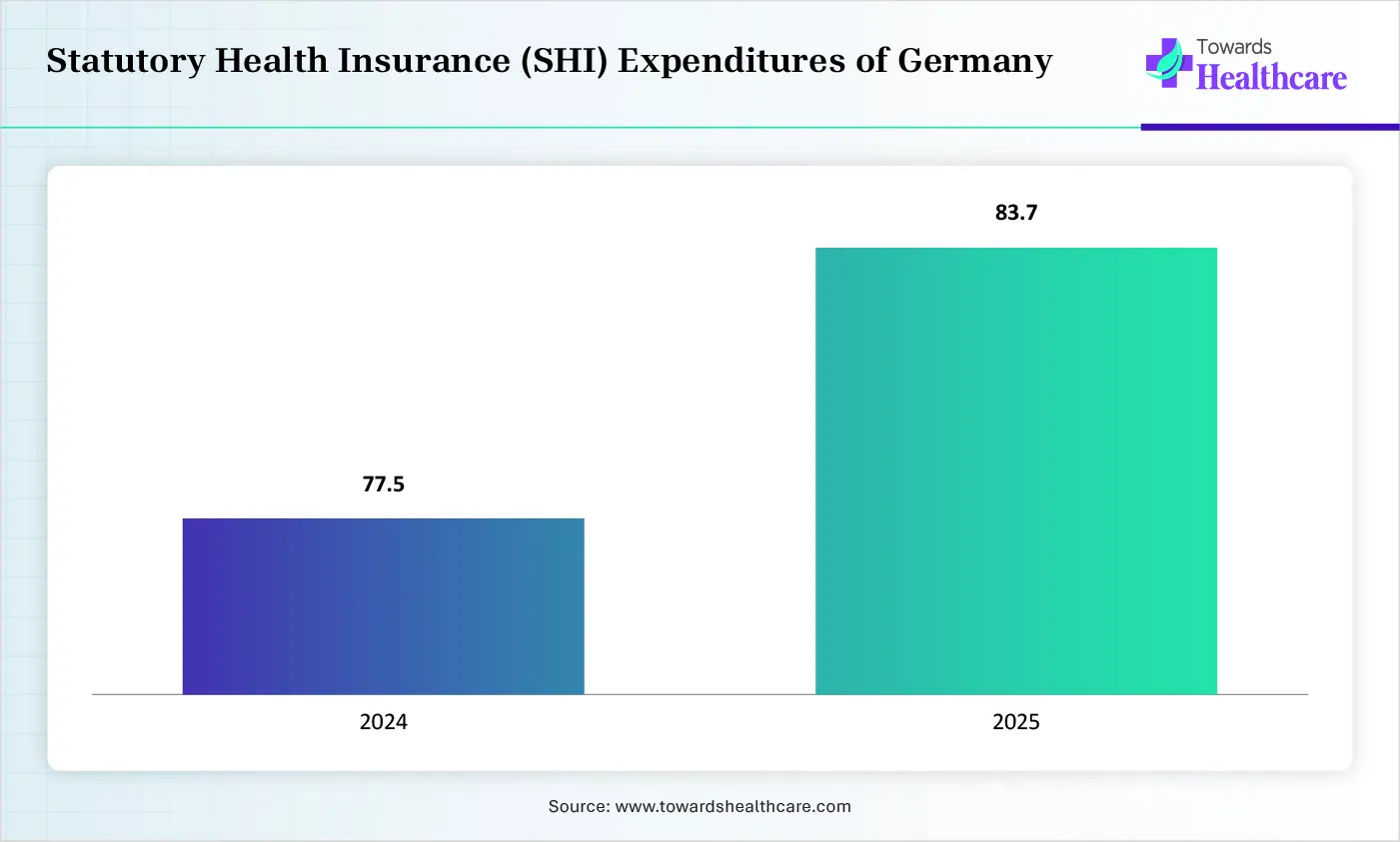
The graph represents a comparison between the statutory health insurance expenditures in Germany for the years 2024 and 2025. It indicates that there will be a rise in SHI expenditures, which will drive the adoption of advanced AI solutions. Their adoption will enhance workflow efficiency and reduce the administrative burden, which will ultimately promote market growth.
By component type, the software solutions segment accounted for the highest revenue share of 58% of the Germany AI in healthcare market in 2025, due to their easy integration and affordability. They were also used for medical imaging, patient monitoring, and workflow automation. Their frequent updates and predictive analytics also increased their use.
By technology type, the machine learning segment held a major revenue share of 31% of the Germany AI in healthcare market in 2025, due to its accurate disease diagnosis and chronic disease management. Large datasets were also analysed effectively with improved clinical decision support. Their easy integration also fueled their adoption.
By application type, the medical imaging & diagnostics segment contributed the biggest revenue share of 29% of the Germany AI in healthcare market in 2025, due to high demand for early disease diagnosis. The enhanced accuracy and faster disease detection of AI tools also increased their use. Their smart diagnostic technologies also enhanced efficacy and reduced diagnostic errors.
By end user, the hospitals & healthcare providers segment held the largest revenue share of 41% of the Germany AI in healthcare market in 2025, due to high adoption of AI-based diagnostic tools. Large patient volume and strong investments also increased their adoption. The shift towards personalized and remote healthcare has also increased its demand.
By function type, the clinical decision support segment led the Germany AI in healthcare market with 34% share in 2025, due to growth in the demand for accurate disease detection. AI solutions were also used to reduce medical errors. They also enhanced patient safety and workflow efficiency.
The Germany AI in healthcare market held a notable share and is expected to grow significantly during the predicted time, due to rapid healthcare digitalization. Advanced healthcare infrastructure and industries are also increasing AI adoption rates. Growing investments, AI startups, government support, and collaboration are also increasing their use and innovation, enhancing the market growth.
Siemens Healthineers registered dominance over the market with its AI-Rad Companion solution, where Ada Health was its closest competitor, which provided the Ada App and the Enterprise platform. Merantix/Vara also maintained its position by offering AI software for breast cancer screening, where Aignostics also contributed to the market growth with its AI-driven Pathology Solutions.
By Component
By Technology
By Application
By End User
By Function
By Deployment Mode


