


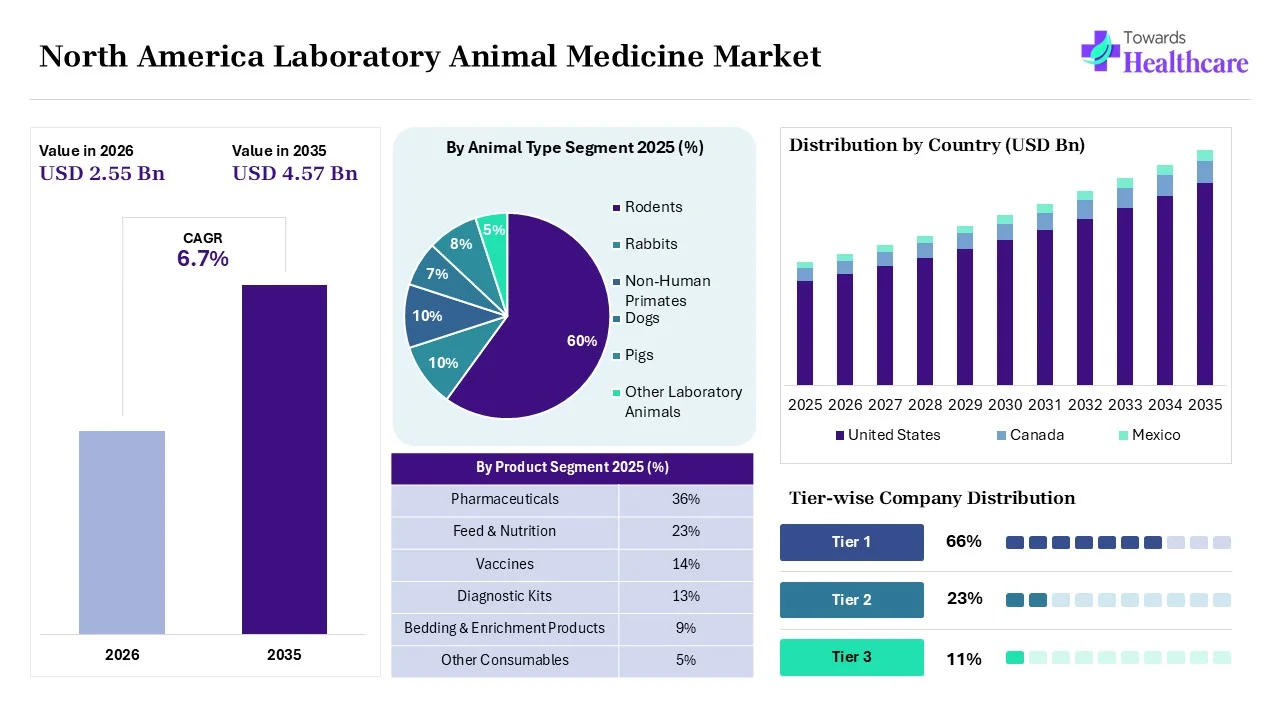
The North America laboratory animal medicine market size was estimated at USD 2.39 billion in 2025 and is predicted to increase from USD 2.55 billion in 2026 to approximately USD 4.57 billion by 2035, expanding at a CAGR of 6.7% from 2026 to 2035. Laboratory animal medicine is an increasing sector of veterinary practice that highlights animal welfare and modification of research animal care, which drives the growth of the market.
Laboratory animal medicine is a thrilling discipline that encompasses various sectors that relate to the application of animals in research, testing, and teaching, involving ethology, genetics, biology, biosafety, welfare, physiology, regulatory affairs, toxicology, animal model development, pathology, husbandry, diagnostics, training, education, experimental design, anesthesia, surgery, and medicine. Laboratory animal medicine is a significant sector of veterinary practice that emphasizes animal welfare and modification of research animal care. The application of animals as new models will continue to be an important tool in the near future, allowing novel and increasingly molecular detections of basic science to be translated into enhancements in health care for humans and animals. It offers significant biological information, an introduction to major diseases, and therapy for common conditions in laboratory animals.
| Animal Type | Totals of Animals Used for Testing |
| Dogs | 42,880 |
| Cats | 12,004 |
| Hamsters | 72,443 |
| Rabbits | 115,043 |
| Guinea Pigs | 134,086 |
| Nonhuman Primates | 104,808 |
| Sheep | 11,656 |
Recent advancements in genetically modified experimental animal models remain significant to biomedical innovation, providing unsurpassed precision in reducing human diseases and assessing novel therapies. Recent advances in genetically modified pig organs for human transplantation, in which injurious animal genes are removed, and human ones are added to organs such as the heart, kidney, and liver, are a significant step toward tackling donor limitations and supporting patients with last-stage diseases.
Applying genetically modified animal models has intensely improved information on gene function and disease pathophysiology. Molecular equipment to create more exact genetic modifications in the genomes of animal models. These new technologies address some of the shortcomings of significant methodologies pertaining to efficiency, reproducibility, and specificity.
By animal type, the rodents segment contributed the largest North America laboratory animal medicine market share of 60% in 2025, as rodents have long been the preferred class of lab animals in healthcare research, with regular experiments. Rodents share significant biological, physiological, and genetic features with humans. Around 95% of mouse genes have a human counterpart, allowing investigators to research how particular genes affect health and disease.
By product, the pharmaceuticals segment contributed the largest market share of 36%, as animal research is an important component of each field of healthcare research, and it is significant for the partnership of basic knowledge in biology. They provide significant insights into the human disease mechanisms, avoidance and therapeutic targets, and treatment approaches, making them indispensable devices for translational research.
By service, the veterinary care services segment held a major share of 34% in the North America laboratory animal medicine market, as regular visits do far more than address diseases. They support preventing problems, catching challenges early, and supporting pets’ overall healthcare. Regular wellness visits enable the veterinary clinic to monitor a pet’s health over time. These tests support detecting subtle changes that signal early disease, enabling treatment to start before the condition becomes severe.
By application, the drug discovery and development segment contributed the largest market share of 40%, as veterinary drug delivery balances effectiveness, simplicity of administration, and animal welfare. Traditional methods, like oral and injectable routes, pose complexities due to species-driven variations, stress during administration, and the requirement for repeated dosing.
By end user, the pharmaceutical & biotechnology companies segment contributed the largest North America laboratory animal medicine market share of 44%, as pharmaceutical involvement contributes to enhanced reproductive health and advanced growth rates, further improving the effectiveness. Veterinary pharmaceuticals support farmers in maintaining a disease-free herd, resulting in increased productivity and increased quality of meat, milk, and various products.
By country, the United States contributed the largest market share of 44%, as the US Government Principles for the applications of animals in research are a momentous statement of moral values and leadership for the biomedical research community. It offers animal husbandry support, which involves breeding and colony maintenance for aquatic animals, rodents, and USDA-covered classes.
Leading companies in the North American animal health market include Zoetis Inc., IDEXX Laboratories, Merck Animal Health, and Elanco Animal Health. Meanwhile, Zoetis Inc., an animal health company offering vaccines, parasiticides, and diagnostic devices for both livestock and companion animals, and IDEXX Laboratories, specializing in veterinary diagnostics, software, and water testing applications. Merck Animal Health, it offers an inclusive portfolio that tackles respiratory diseases in animals, also parasiticides and vaccines, and Merck Animal Health offers pharmaceutical services, vaccines, and medical management programs for livestock and companion animals.
By Animal Type
By Product
By Service
By Application
By End User
By Region


