


The U.S. biological indicators market size was estimated at USD 185 million in 2025 and is predicted to increase from USD 426.06 million in 2026 to approximately USD 426.06 million by 2035, expanding at a CAGR of 8.7% from 2026 to 2035. The market is driven by stringent sterilization regulations, advanced healthcare infrastructure, and growing demand for infection prevention across hospitals, pharmaceutical companies, and medical device manufacturers. Increasing adoption of rapid-readout biological indicators and expanding biopharmaceutical production continue to support market growth and innovation.
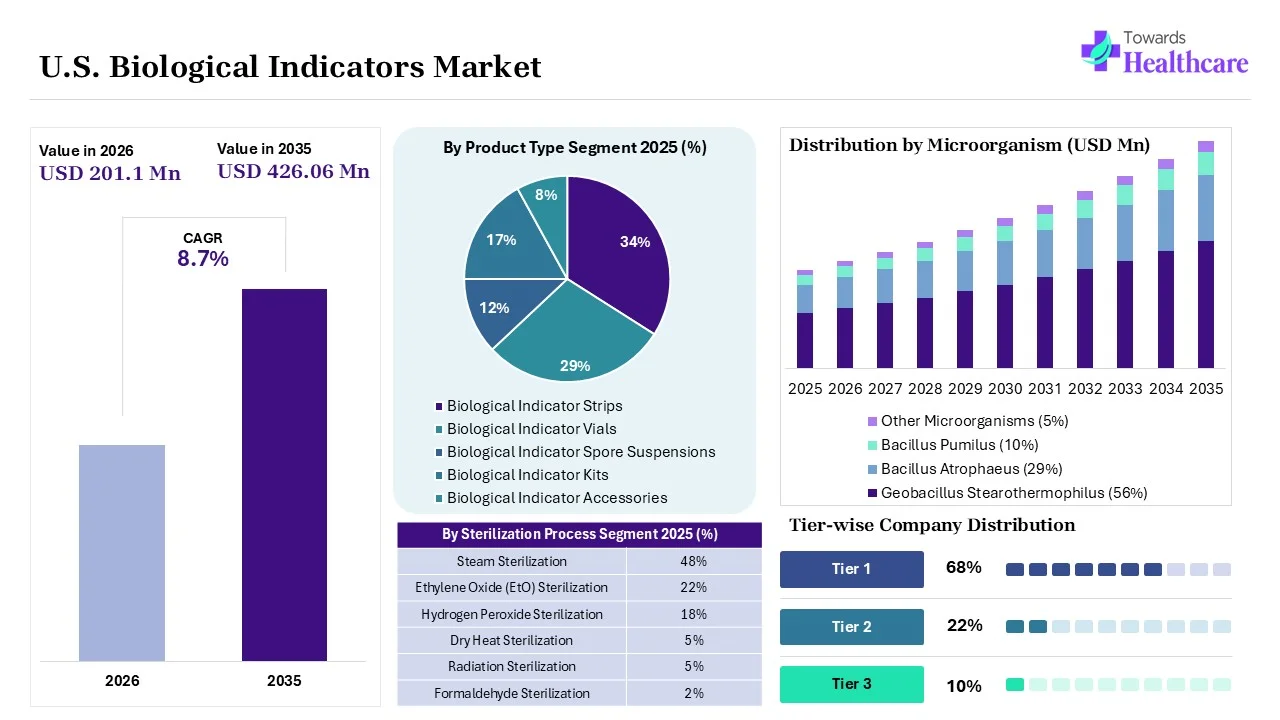
Biological indicators are a test system containing highly resistant microorganisms used to verify the effectiveness of the sterilization process and ensure that harmful microbes have been successfully eliminated. The U.S. biological indicators market is growing due to increasing demand for reliable sterilization monitoring across healthcare, pharmaceutical, and medical device industries. Stringent regulatory requirements, rising surgical procedures, expanding biopharmaceutical manufacturing, and heightened focus on infection are driving adoption. Additionally, advancements in rapid-readout biological indicators and growing investments in quality assurance and sterility validation continue to support market expansion.
The U.S. biological indicator market is expected to witness steady growth, driven by increasing adoption of rapid-readout technologies, digital sterilization monitoring, and stricter regulatory requirements. Growing investments in healthcare infrastructure, biopharmaceutical manufacturing, and infection prevention programs will further boost demand. The integration of automation and data-driven sterility assurance solutions is expected to enhance efficiency, compliance, and patient safety across healthcare and life science sectors.
| Parameter | Value |
| Steam sterilization temperature range | 121°C-134°C |
| Dry heat sterilization temperature range | 160°C-180°C |
| Hydrogen peroxide sterilization temperature | 40°C-60°C |
| BI incubation temperature | 55°C-60°C |
| BI microbial resistance level | 105-106 spores |
| Standards incubation time | 24-48 hours |
| Rapid BI result time | 1-4 hours |
These numerical standards are defined by U.S. regulatory bodies such as the CDC and FDA, which establish strict requirements for sterilization validation using biological indicators. They ensure consistent monitoring of microbial inactivation across healthcare and pharmaceutical environments. Parameters like temperature range, incubation times, and spore resistance levels help maintain reliable sterility assurance, regulatory compliance, and patient safety in critical medical and laboratory applications.
The biological indicator strips segment held a dominant share of 34% in 2025 due to their wide adoption in routine sterilization monitoring across hospitals, laboratories, and pharmaceutical facilities. Strips are cost-effective, easy to handle, and provide consistent results for steam and gas sterilization processes. Their compatibility with multiple sterilization methods and strong regulatory acceptance for validation purposes further strengthened their demand in the healthcare and medical device industries.
The steam sterilization segment dominated the U.S. biological indicators market with a share of 48% in 2025 due to its high effectiveness in eliminating a wide range of microorganisms and its extensive use in hospitals, laboratories, and pharmaceutical manufacturing. It is cost-efficient, easy to operate, and regulatory preference for steam sterilization validation using biological indicators further strengthened its dominance across healthcare and life science industries.
The Geobacillus stearothermophilus segment held a dominant share of 56% in 2025 and is expected to grow at the fastest CAGR of 9.00% in the U.S. biological indicators market during the forecast period due to its strong resistance to high-temperature steam sterilization processes, making it the standard biological indicator organism for validating autoclave efficiency. Its consistent performance, reliability in detecting sterilization failure, and widespread acceptance in regulatory guidelines across healthcare and pharmaceutical industries have strengthened its dominant position. It is widely used in hospitals, labs, and medical device sterilization monitoring systems.
The hospitals segment led the U.S. biological indicators market with a share of 38% in 2025 due to the high volume of surgical procedures and the critical need for strict infection control and sterilization validation. Hospitals extensively use biological indicators to ensure the effectiveness of autoclaves and other sterilization systems. Increasing healthcare-associated infection concerns, strong regulatory compliance requirements, and continuous demand for patient safety have further strengthened biological indicator adoption across hospital settings.
The sterilization monitoring segment held a dominant share of 51% in 2025 due to its essential role in ensuring effective microbial elimination across healthcare and pharmaceutical environments. Biological indicators are widely used to verify sterilization cycle performance and prevent infection risks. Increasing surgical procedures, strict regulatory compliance requirements, and rising focus on patient safety have further driven strong adoption of sterilization monitoring applications in hospitals, labs, and manufacturing facilities.
The direct sales segment held a dominant share of the U.S. biological indicators market of 46% in 2025 due to strong relationships between manufacturers and end users such as hospitals, pharmaceutical companies, and medical device firms. This channel ensures customized solutions, faster technical support, and reliable product supply for critical sterilization monitoring needs. Increasing demand for compliance-driven procedures and high-quality biological indicators from manufacturers, strengthening these distribution channels’ dominance.
Leading companies in the U.S. biological indicators market include 3M Health Care, Mesa Laboratories, STERIS, Crosstex International, Getinge, Propper Manufacturing, and Terragene North America. These players are driving market growth through continuous innovation in rapid-readout biological indicators, advanced sterilization monitoring systems, and integrated sterility assurance solutions. Strong investments in regulatory-compliant products, expansion of healthcare and pharmaceutical portfolios, and development of digital validation technologies are further strengthening their position across hospitals, laboratories, and medical device manufacturing facilities in the U.S. market.
By Product Type
By Sterilization Process
By Microorganism
By End User
By Distribution Channel


