Recent advancements in nanotechnology, rising demand for targeted therapies, and growing medical care requirements related to cancer, neurological disorders, and chronic diseases drive the growth of the market.
What are Drug Delivery Nanoparticles Formulation?
Nanoparticle drug delivery systems are engineered technologies that use nanoparticles for the targeted delivery and controlled release of pharmaceutical agents. Nanoparticles enhance the chemical stability of some medicines and control the release kinetics of medicines. Nanoparticles have advanced to overcome the limits of free therapeutics and navigate biological challenges. Nanoparticles have aroused attention because of their potential application for efficient drug delivery. Nanoparticles designed with surface ligands to target diseased cells exactly, reducing adverse effects and increasing drug concentration at the site. Nanoparticles enable the precise targeting of drugs to particular cells or tissues, reducing side effects and improving therapeutic results.
Global Market Growth
The global drug delivery nanoparticles formulation market size was estimated at USD 92.6 billion in 2025 and is predicted to increase from USD 105.38 billion in 2026 to approximately USD 337.31 billion by 2035, expanding at a CAGR of 13.8% from 2026 to 2035.
Innovative Stimuli-Responsive Hybrid Nanoparticles:
Recent advances in innovative stimuli-responsive hybrid nanoparticles have been synthesized using silica/natural polysaccharides, encapsulating 5-alpha-reductase enzyme inhibitors derived from the plant Stryphnodendron adstringens. Stimuli-responsive drug delivery systems (SRDDS) provide a novel strategy to address the limits of conventional DDS by responding to particular biological or external stimuli. These systems leverage ecological cues like pH, temperature, enzymes, light, and magnetic fields to activate the release of therapeutic agents in a controlled manner. These target the microenvironment of diseases, such as the low pH acidic or high redox potential glutathione found in cancer cells or inflammatory tissues.
Nanoparticle Development
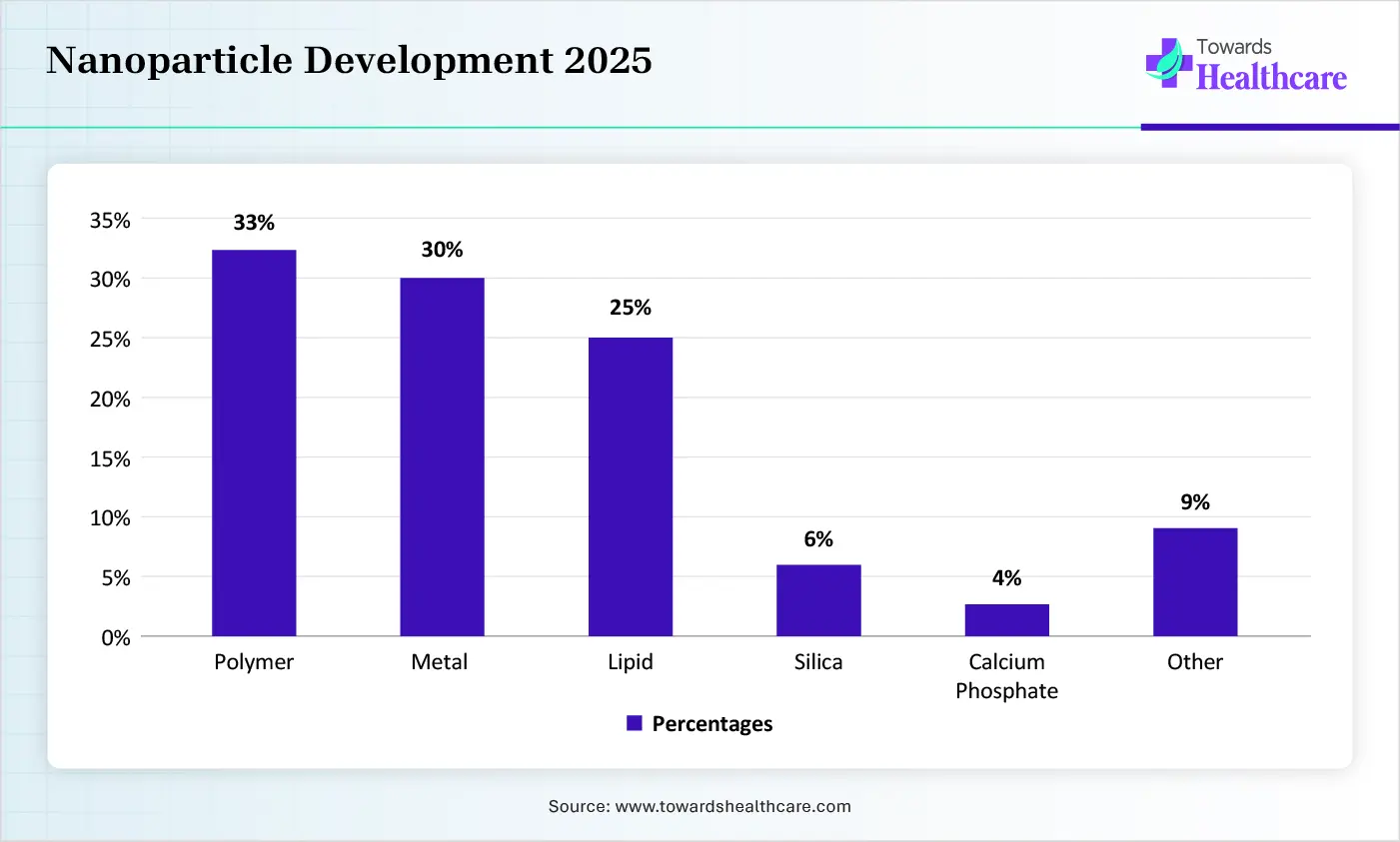
| Nanoparticles |
Percentages |
| Polymer |
32% |
| Metal |
29% |
| Lipid |
24% |
| Silica |
5% |
| Calcium Phosphate |
2% |
| Other |
8% |
Market Segmentation Overview
- By nanoparticle type, lipid-based nanoparticles segment contributed the largest U.S. drug delivery nanoparticles formulation market share of 42% in 2025, as LBNPs b include high temporal and thermal stability, high loading capacity, simplicity of preparation, low production expenses, and large-scale industrial production since they are prepared from natural sources. Lipid nanoparticles show a relatively novel colloidal drug delivery system. Lipid nanoparticles substantially enhance the bioavailability, solubility, and pharmacokinetic limits.
- By drug type, the small molecules segment contributed the largest market share of 38%, as small molecules are simple to synthesize, and their synthesis is simply completed by chemical interaction among different organic and inorganic compounds. Nanoparticles enhance the solubility of hydrophobic small molecules, enabling efficient delivery of drugs that would otherwise have limited bioavailability.
- By application, the oncology segment contributed the largest U.S. drug delivery nanoparticles formulation market share of 46%, as nanoparticles (NPs) provide precise drug delivery mechanisms that lower systemic toxicity. Smart nanoparticles, which respond to biological cues or are guided by them, are evolving as a hopeful drug delivery platform for precise cancer treatment. These nanoparticles generate singlet oxygen under ultrasound irradiation, effectively suppressing oncology growth in superficial and deep lesions.
- By route of administration, the intravenous segment contributed the largest market share of 44%, as intravenous injection is the most common parental route of medication administration and bypasses the liver's first-pass metabolism. Intravenous medications deliver an immediate, fast-acting adverse effect, which is significant in developing situations, like cardiac arrest or narcotic overdose. They are valuable for managing pain and nausea by rapidly achieving therapeutic levels.
Top Companies in the U.S. Drug Delivery Nanoparticles Formulation Market
The top five organizations in this group dominate the U.S. drug delivery nanoparticles formulation market. Meanwhile, Pfizer Inc. provides an extensive portfolio of sterile injectable therapeutics. Moderna, Inc, utilizes exclusive nanoparticle technology for its COVID-19 vaccine, Spikevax. Bristol Myers Squibb, a leader in patent filings for nanoparticle delivery, is famous for Abraxane. Merck & Co., Inc. expanded its capabilities in LNP formulation via the acquisition of Exelead. Alnylam Pharmaceuticals announced FDA approval of AMVUTTRA, the first RNAi curative for lowering cardiovascular death.
Segments Covered in the Report
By Nanoparticle Type
- Lipid-Based Nanoparticles
- Liposomes
- Solid Lipid Nanoparticles (SLNs)
- Nanostructured Lipid Carriers (NLCs)
- Polymeric Nanoparticles
- Natural Polymers
- Synthetic Polymers
- Inorganic Nanoparticles
- Gold Nanoparticle
- Silver Nanoparticles
- Silica Nanoparticles
- Magnetic Nanoparticles
- Dendrimers
- Carbon-Based Nanoparticles
- Carbon Nanotubes
- Graphene Oxide
By Drug Type
- Small Molecules
- Biologics
- Monoclonal Antibodies
- Proteins & Peptides
- Nucleic Acid-Based Drugs
By Application
- Oncology
- Solid Tumors
- Hematological Cancers
- Infectious Diseases
- Viral Infections
- Bacterial Infections
- Cardiovascular Diseases
- Neurological Disorders
- Respiratory Diseases
- Others
- Autoimmune Diseases
- Metabolic Disorders
By Route of Administration
- Intravenous
- Oral
- Pulmonary
- Transdermal
- Ocular
By End User
- Pharmaceutical & Biotechnology Companies
- Research Institutes
- Hospitals & Clinics
- Contract Research Organizations (CROs)




