


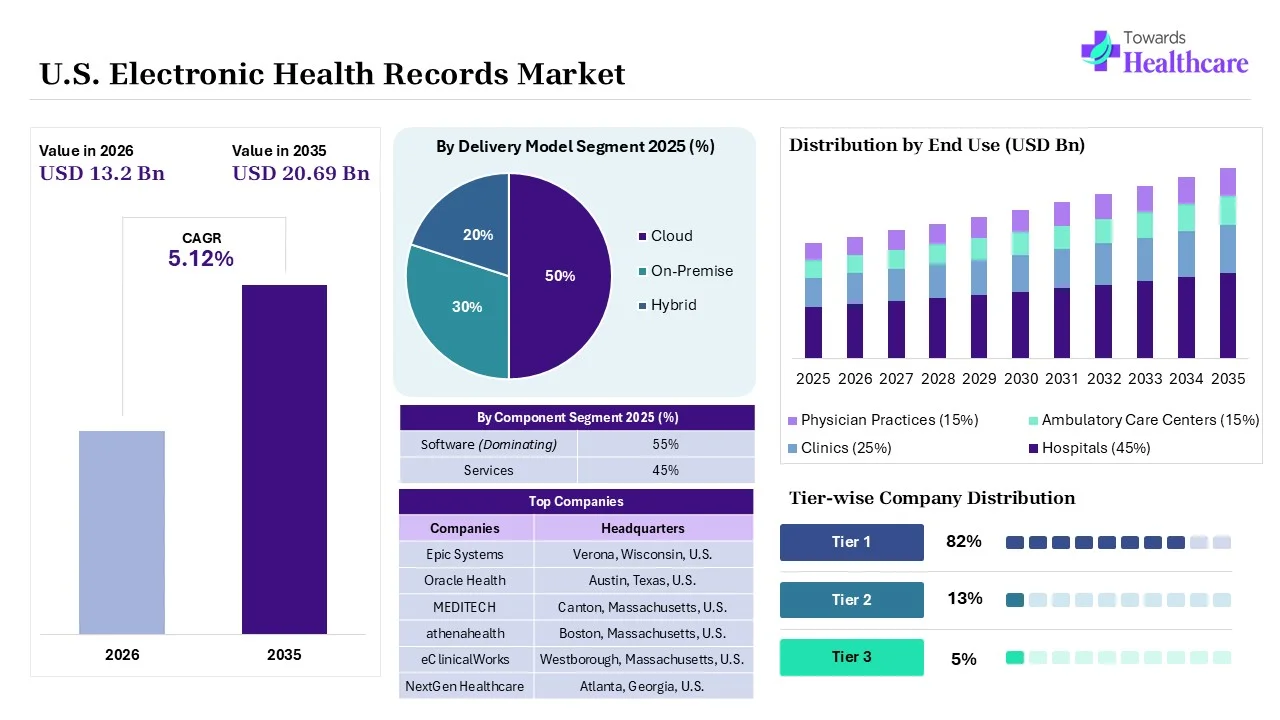
The U.S. electronic health records market size was reported at US$ 12.56 billion in 2025 and is expected to rise to US$ 13.2 billion in 2026 to reach US$ 20.69 billion by 2035. According to forecasts, it will grow at a CAGR of 5.12%. The U.S. electronic health records market is experiencing strong growth driven by the increasing digitalization of healthcare, rising demand for efficient patient data management, and expanding adoption of cloud-based health IT solutions. The integration of AI, interoperability technologies, and value-based care initiatives is further accelerating market expansion across hospitals, clinics, and physician practices.
The electronic health records (EHRs) are a digital version of patients’ medical records that allow healthcare providers to securely store, access, update, and share information, improving care coordination, accuracy, and treatment efficiency. The U.S. electronic health records market is growing due to the increasing adoption of digital healthcare technologies, rising demand for efficient patient data management, and the need for improved care conditions. Government initiatives promoting interoperability, expanding use of analytics, and further integration of AI and analytics are further supporting market growth. Additionally, healthcare providers are investing in EHR systems to enhance operational efficiency, regulatory compliance, and patient outcomes.
The U.S. electronic health records market is expected to benefits growing of AI, predictive analytics, and advanced interoperability solutions. Increasing demand for personalized healthcare, real-time data exchange, and population health management will create significant opportunities for EHR vendors to enhance clinical decision-making, patient engagement, and operational efficiency across healthcare settings.
| Metric | Data |
| Adoption of certified EHR systems among non-federal acute care hospitals | 96% |
| Adoption of EHR systems among office-based physicians | 89% |
| Adoption of EHR systems among office-based physicians | 42% |
| Adoption of certified EHR systems among office-based physicians | 78% |
| Hospitals capable of interoperable electronic health information exchange | 70% |
| Hospitals capable of interoperable electronic health information exchange | 46% |
| Increase in physician EHR adoption | 46% |
The table demonstrates the significant progress of electronic health record adoption and interoperability across the U.S. healthcare sectors. Certifies EHR usage has become nearly universal among acute care hospitals, while physician adoption has grown substantially over time. At the same time, the increasing ability of hospitals to electronically exchange and integrate patient information reflects ongoing advancements in healthcare connectivity, supporting improved care coordination, clinical efficiency, and data-driven decision-making.
The software segment held a dominant share of 55% in 2025 due to its central role in managing patient information, clinical workflow, billing, scheduling, and interoperability functions. Healthcare providers increasingly invest in advanced EHR software to improve operational efficiency, regulatory compliance, and care quality. The growing adoption of cloud-based platforms, AI, analytics, and integrated healthcare applications has further strengthened the segment’s leading position in the market.
The cloud segment held a dominant share of 50% in 2025 and is expected to grow at the fastest CAGR of 7.0% in the U.S. electronic health records market during the forecast period support services due to the scalability, cost-effectiveness, and ease of deployment. Cloud-based solutions enable healthcare providers to access patient data remotely, reduce IT infrastructure costs, and receive automatic software updates and security enhancements. Growing demand for interoperability, telehealth integration, and flexible healthcare data management has further driven the widespread adoption of cloud-based EHR platforms.
The hospitals segment held a dominant share of 45% in 2025 due to the high volume of patient data, complex clinical workflows, and increasing need for cardiovascular care management. Hospitals rely heavily on EHR systems for documentation, medication management, diagnostics, billing, and regulatory compliance. Growing investments in digital healthcare infrastructure, interoperability and data-driven decision-making have further strengthened EHR adoption across hospital settings.
The clinical information management segment led the U.S. electronic health records market with a share of 50% in 2025 due to its critical role in capturing, storing, and managing patient health data. Healthcare providers rely on these solutions to support clinical decision-making, improve care coordination, enhance patient safety, and streamline treatment workflows. Rising demand for accurate medical records, regulatory compliance, and data-driven healthcare delivery has further strengthened the segment’s market leadership.
The subscription segment led the U.S. electronic health records market with a share of 60% in 2025 and is expected to grow at the fastest CAGR of 6.8% in the market during the forecast period due to its affordability, scalability, and predictable recurring revenue structure. It allows end users to access advanced solutions without high upfront costs, making it highly attractive for small and large organizations alike. Additionally, continuous updates, flexible plans, and reduced maintenance burdens further drive adoption, encouraging long-term customer retention and strengthening overall market growth across various industries.
Leading companies in the U.S. electronic health records market include Epic Systems, Oracle Health (Cerner), MEDITECH, athenahealth, Veradigm, and eClinicalWorks. These players are driving market growth through advanced interoperable EHR platforms, cloud-based solutions, and AI-enabled clinical documentation and decision-support tools. Continuous investments in data integration, value-based care support, and seamless hospital–physician connectivity are further improving workflow efficiency, enhancing patient outcomes, and accelerating the digital transformation of healthcare across the United States.
By Component
By Delivery Model
By End-User
By Application
By Deployment
By Pricing Model
By Organization Size


