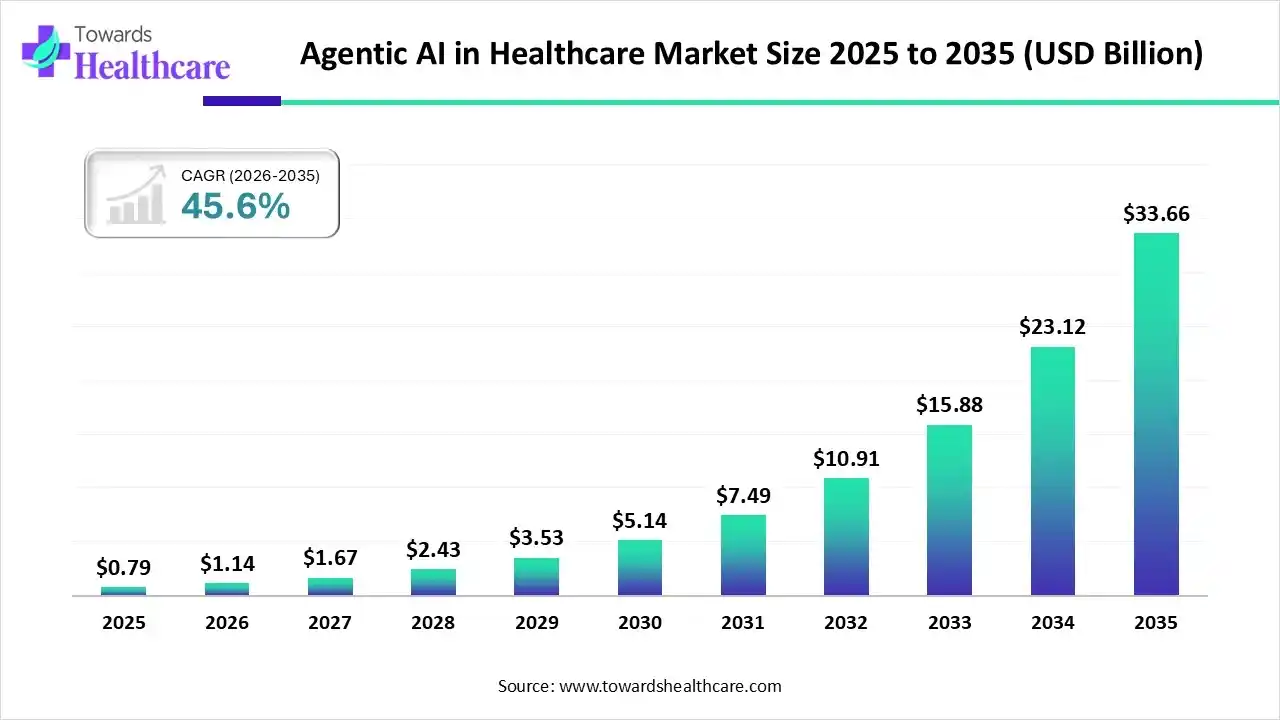
The global agentic AI in healthcare market size was estimated at USD 0.79 billion in 2025 and is predicted to increase from USD 1.14 billion in 2026 to approximately USD 33.66 billion by 2035, expanding at a CAGR of 45.6% from 2026 to 2035.
The escalating demand for personalized solutions in diverse sectors, including drug discovery and patient treatments, is impacting the adoption of agentic AI. Moreover, the industry is focusing on the integration of agentic AI systems into robotic surgery, with extensive outcomes.
Primarily, the adoption of autonomous AI systems, goal-driven agents that can reason, plan, and implement multi-step workflows with lowered human oversight, is referred to as agentic AI in healthcare market. Inclusion of a substantial catalyst, like the leveraging agents in handling prior authorizations, claims processing, and billing, is impacting the overall market progression. Also, some agents are facilitating the conduction of proactive, empathetic patient monitoring, symptom assessment, & medication management.
Agentic AI in healthcare refers to autonomous artificial intelligence systems that can understand objectives, reason through complex tasks, make decisions, and perform actions with limited human intervention. Increasing demand for efficient healthcare delivery and intelligent automation is accelerating adoption across clinical and administrative environments. Healthcare organizations are moving toward AI agents for clinical documentation, patient engagement, workflow coordination, decision support, and personalized care. Wider integration with electronic health records, remote care platforms, and connected medical systems could expand applications across hospitals, diagnostics, research, and pharmaceutical development. Improvements in generative AI, multimodal models, natural language processing, predictive analysis, and secure data integration are enhancing agent capabilities. Rising healthcare workloads, pressure to reduce operational costs, growing digitization, demand for faster clinical decisions, and increasing interest in personalized healthcare are supporting continued adoption.
The agentic AI in healthcare market is influenced by internal factors such as AI accuracy, data quality, interoperability, cybersecurity, system scalability, infrastructure readiness, implementation costs, and availability of skilled professionals. External factors include regulatory requirements, patient privacy expectations, healthcare policies, reimbursement conditions, technological competition, investment trends, and economic conditions. Growing healthcare workloads, workforce shortages, chronic disease prevalence, and increasing digitalization are creating favorable opportunities for adoption. At the same time, concerns regarding AI bias, transparency, accountability, data security, and human oversight can affect acceptance. Patient expectations for personalized and faster healthcare services are also encouraging adoption. Continuous advancements in generative AI, predictive analytics, multimodal systems, and secure data integration are further shaping the market’s development and influencing how healthcare organizations deploy autonomous AI solutions.
Elevating Proactive Clinical Decision Support (CDS)
Specifically, AI agents in ICUs and ERs are providing real-time diagnostic insights, evaluating imaging & patient history to recommend treatments.
Transforming AI in Medical Devices
The market is exploring the integration of agentic AI into robotic surgery and monitoring devices to improve procedures and understand patient data.
Fostering Modern Hospital Orchestration
The wider adoption of these agents is supporting the management of predictive maintenance of medical equipment, boost bed management, and synchronize staff scheduling based on real-time patient volume.
| Table | Scope |
| Market Size in 2026 | USD 1.14 Billion |
| Projected Market Size in 2035 | USD 33.66 Billion |
| CAGR (2026 - 2035) | 45.6% |
| Leading Region | North America by 55% |
| Historical Data | 2020 - 2023 |
| Base Year | 2025 |
| Forecast Period | 2026 - 2035 |
| Measurable Values | USD Millions/Units/Volume |
| Market Segmentation | By Agent System, By Product, By Technology, By Application, By End Use, By Region |
| Top Key Players | NVIDIA, Oracle, Microsoft, Thoughtful Automation Inc., Hippocratic AI Inc., Cognigy,Amelia US LLC, Beam AI, Momentum, Springs |
| Segments | Shares % |
| Single Agent Systems | 62% |
| Multi-Agent Systems | 38% |
How did the Single Agent Systems Segment Lead the Market in 2025?
In 2025, the single agent systems segment captured the largest share of the agentic AI in healthcare market. This is driven by its being easier to locate, integrate, and scale as compared to multi-agent architectures, & have significant application in targeted, high-friction, & repetitive tasks. They are now converting into more specialized forms, including virtual nurses for post-discharge follow-ups or emphasized diagnostic agents to assess specific imaging modalities.
Multi-Agent Systems
In the future, the multi-agent systems segment is expected to witness rapid growth. Ongoing advances in Large Language Models (LLMs) & Multi-Agent Reinforcement Learning (MARL) are enabling agents to unite, learn from experience, and adapt to novel protocols, which raises diagnostic accuracy and lowers medication errors. Moreover, their adoption is impelled by simplifying hospital operations, especially managing patient flow, automating report notifications, & enhancing resource administration to raise affordability.
| Segments | Shares % |
| Ready-to-Deploy Agents | 58% |
| Build-Your-Own Agents | 42% |
Which Product Dominated the Agentic AI in Healthcare Market in 2025?
The ready-to-deploy agents segment was dominant in the market by 58% share in 2025. This primarily covers specialized, pre-built, and production-ready systems to operate complex, multi-step, autonomous tasks with minimal human involvement. Nowadays, these agents prefer integration with crucial EHR platforms, like Epic and Oracle Health, by leveraging FHIR standards.
Build-Your-Own Agents
In the coming era, the build-your-own agents segment is expected to expand rapidly. Globally accelerating need for tailored AI solutions to manage complex, domain-specific, and non-linear workflows is fueling the segmental expansion. Also, healthcare systems are demanding automated administrative tasks, like billing, scheduling, and documentation, which is also supporting the evolution of these agents. The market is encouraging the use of low-code/no-code platforms, which allow non-technical users to build and deploy these agents.
| Segments | Shares % |
| Machine Learning | 45% |
| Natural Language Processing | 28% |
| Classification & Categorization | 16% |
| Context-Aware Computing* | 11% |
Why did the Machine Learning Segment Lead the Market in 2025?
In 2025, the machine learning segment held a major share of 45% of the agentic AI in healthcare market. This technology assists these agents in the analysis of large volume, multi-modal data, like electronic health records (EHRs), imaging, & genomics, to offer customized, real-time insights. ML can boost diagnostic accuracy in radiology, dermatology, & pathology by detecting anomalies in CT scans, MRIs, and X-rays more rapidly than manual analysis.
Context-Aware Computing
Moreover, the context-aware computing segment is predicted to expand fastest. The worldwide progression is propelled by the use of sensors, IoT devices, and AI to recognize a patient's or provider's situation in real-time, providing tailored care, escalating safety, and escalating operational effectiveness. The most common instance is context-aware EHR systems, which explore automatic display of relevant data for the patient in a specific room.
| Segments | Shares % |
| Medical Imaging | 18% |
| Electronic Health Records (EHRs) | 14% |
| Clinical Decision-Making | 13% |
| Hospital Resource Optimization | 11% |
| Remote Patient Care | 10% |
| Risk Prediction & Pandemic Preparedness | 9% |
| Personalized Treatment & Drug Discovery | 8% |
| Genomic Data Analysis | 7% |
| Chronic Disease Management | 6% |
| Medical Research & Data Analysis | 3% |
| Others | 1% |
Which Application Led the Agentic AI in Healthcare Market in 2025?
The medical imaging segment captured the dominating share of 18% of the market in 2025. Globally expanding burden of patient volumes & complex imaging studies is fueling the need for AI agents to pre-process images, find anomalies, and minimize interpretation times. These advanced agents are focusing on a combination of 2D/3D imaging with patient data for greater diagnostic precision.
Personalized Treatment & Drug Discovery
The personalized treatment & drug discovery segment is estimated to grow rapidly. AI agents are providing hyper-personalized medicine, which unites real-time data from IoT devices, wearables, Electronic Health Records (EHRs), & genomic profiles to adjust treatments as necessary. Many systems are executing simulation of complex biological interactions, estimation of potential side effects & effectiveness long before wet-lab testing.
| Segments | Shares % |
| Healthcare Companies | 42% |
| Healthcare Providers | 30% |
| Academic & Research Institutes | 14% |
| Healthcare Payers | 10% |
| Others | 4% |
Why did the Healthcare Companies Segment Dominate the Market in 2025?
In 2025, the healthcare companies segment accounted for the biggest share of 42% of the agentic AI in healthcare market. This mainly encompasses leading technology providers, specialized AI players, and advanced healthcare, pharmaceutical, and diagnostics firms. Extensive AI agents serve as "additional staff" for documentation, also to lower cognitive load on clinicians & relieve burnout. Additionally, agents implement the analysis of molecular structures and simulate clinical trial outcomes to accelerate R&D.
Healthcare Payers
The healthcare payers segment will expand rapidly. A major driver is the use of agentic AI for consistent monitoring of transaction patterns to terminate fraud in real-time before payments, which crucially lowers the $17 billion lost per year to fraud. These payers are stepping towards touchless claims processing, where agents identify anomalies, cross-reference clinical context, and authorize claims autonomously.
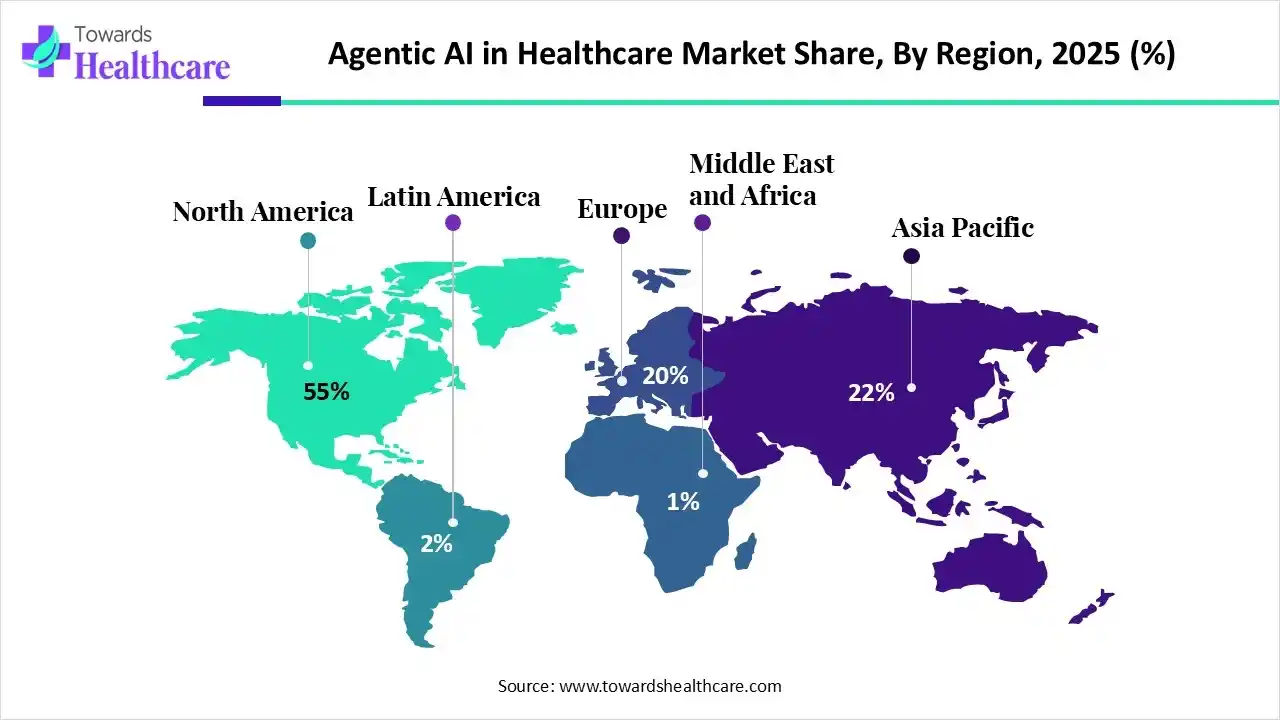
North America registered dominance in the agentic AI in healthcare market by 55%, due to the increasing administrative burdens, rising need for operational effectiveness, and rigorous investments in AI-enhanced technologies. Whereas, the region is emphasizing AI scribes that listen to patient-doctor conversations, develop summaries, and combine directly with Electronic Medical Records (EMRs). Particularly, Canada Health Infoway is promoting this with an AI Scribe Program and facilitating 10,000 licenses to primary care clinicians.
U.S. Market Trends
However, the U.S. market implemented pre-trained, specialized AI agents for specific tasks, like in radiology, oncology, or scheduling, with direct integration into workflows.
For instance,
Canada Market Trends
The market for agentic AI in healthcare is witnessing strong growth in Canada due to increased adoption of digital transformation in healthcare, growth in investment in AI, and strong governmental support for innovation in health care. Healthcare providers in Canada are using autonomous AI applications for improving different processes in healthcare like clinical decision-making, streamlining workflows, monitoring patients, and administrative decision-making.
Mexico Market Trends
The agentic AI in healthcare is growing steadily in Mexico due to implementation of new healthcare technologies. The agents are gaining popularity in Mexico as investment in health care technologies are rising and the healthcare institutions are willing to introduce autonomous AI systems into the health care business due to need to improve access to health care services.
In the coming era, the Asia Pacific is predicted to witness the fastest expansion in the agentic AI in healthcare market by 15% share. Significant drivers are having strong cloud-native infrastructure, 5G networks, and huge, various data sources. As well as, the region is majorly shifting towards agentic AI to convey greater productivity over the gen AI alone.
China Market Trends
Day by day, China is putting efforts into innovating "Agent Hospitals," by using specialized AI agents that integrate to handle patient cases, which can perform approximately 85% of standard clinical duties. Alongside, the Chinese government is spurring AI-assisted "intelligent terminals" and agents in major sectors by 2027.
India Market Trends
India has one of the fastest-growing markets for agentic AI in healthcare. The reason for this growth is the development of digital healthcare infrastructure in the country coupled with the emergence of start-ups that provide AI solutions.JapanJapan's market for agentic AI in healthcare benefits from its advanced healthcare facilities, the high level of aging population together with its technology. The growing installation of AI systems in care facilities is seen as a moving trend to help in diagnosing and monitoring patients.
| Company | Description |
| NVIDIA | Their offerings include different agentic AI platforms, such as NVIDIA NeMo, NVIDIA NIM (NVIDIA Inference Microservices), etc. |
| Oracle | A firm unveiled the Oracle Health EHR and Oracle Fusion Cloud Applications, using Oracle Cloud Infrastructure (OCI) for secure, data-driven automation. |
| Microsoft | This facilitates healthcare agent service in Copilot Studio, DAX Copilot for documentation, & medical imaging models, like MedImageInsight Premium & CXRReportGen Premium. |
| Thoughtful Automation Inc. | A company explores agentic AIO solutions with a specific target on revenue cycle management (RCM) & back-office operations. |
| Hippocratic AI Inc. | This emphasizes the development of non-diagnostic, patient-facing, and provider-facing AI agents. |
| Cognigy | They usually facilitate ready-to-deploy or easily customizable agents designed for particular healthcare workflows. |
| Amelia US LLC | It is using the Amelia 7.0 platform, which integrates generative AI, conversational AI, & Agentic+ frameworks. |
| Beam AI. | This focuses on the execution of pre-trained healthcare agents. |
| Momentum | A company offers specialized AI Agent development services for the HealthTech industry. |
| Springs | This usually provides diverse AI-enabled solutions to foster pharmaceutical operations, clinical research, and patient care. |
Strengths
Weaknesses
Opportunities
Threats
By Agent System
By Product
By Technology
By Application
By End Use
By Region




Principal Consultant
Payal Rabde is a Healthcare Market Research Analyst at Towards Healthcare Research & Consulting with 4+ years of experience in pharmaceuticals, biotechnology, medical devices, and life sciences.
Learn more about Payal Rabde

Reviewed By
Aditi Shivarkar is a seasoned professional with over 14 years of experience in healthcare market research. As a content reviewer, Aditi ensures the quality and accuracy of all market insights and data presented by the research team.
Learn more about Aditi Shivarkar