
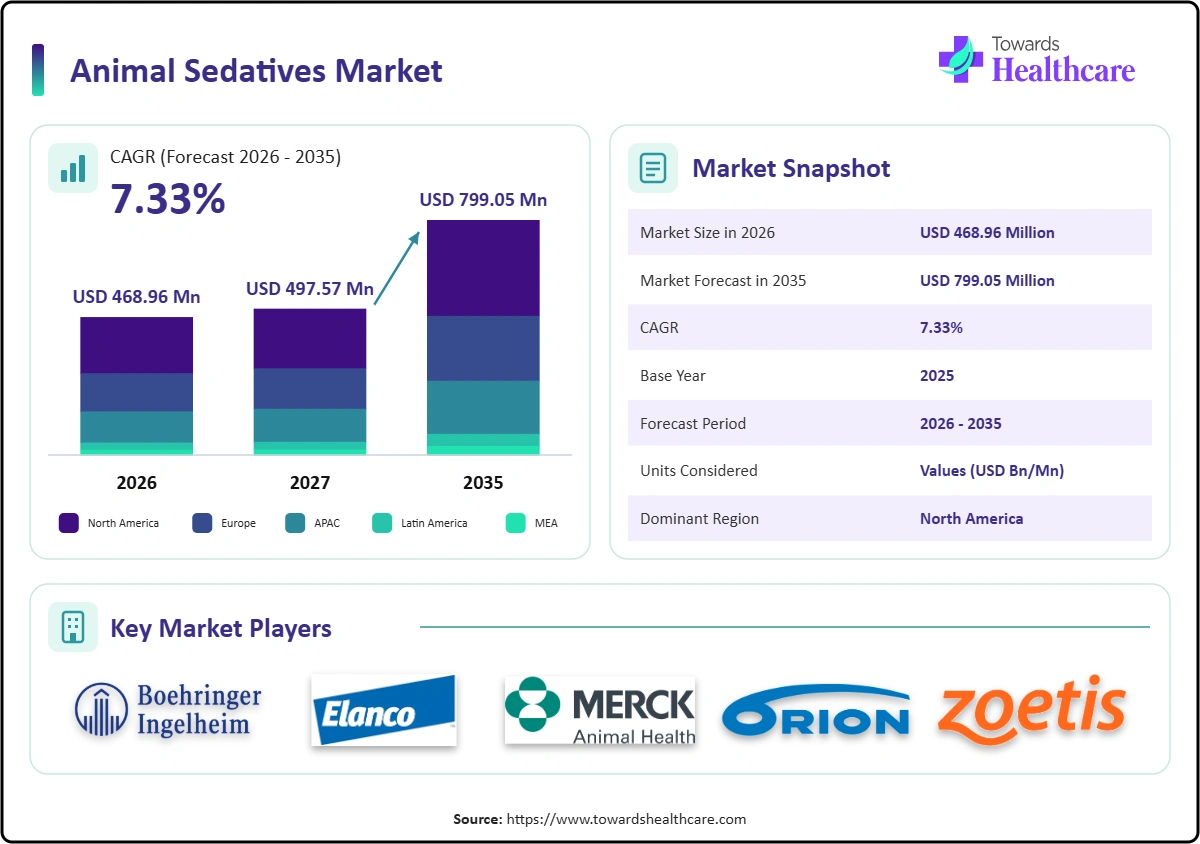
The animal sedatives market is projected to grow from USD 442.00 million in 2025 to USD 799.05 million by 2035, driven by increasing demand for sedation during veterinary examinations, diagnostic imaging, and surgical procedures for pets and horses. Growing veterinary adoption of sedatives to reduce animal fear, anxiety, and stress during clinical visits further supports market growth. Rising use of oral anxiolytics for at-home administration, combination sedation protocols, expanding equine and wildlife applications, and increasing veterinary procedures across Asia also contribute to demand. The market is projected to reach USD 594.29 million by 2030, registering a CAGR of 6.10% during 2026-2035.
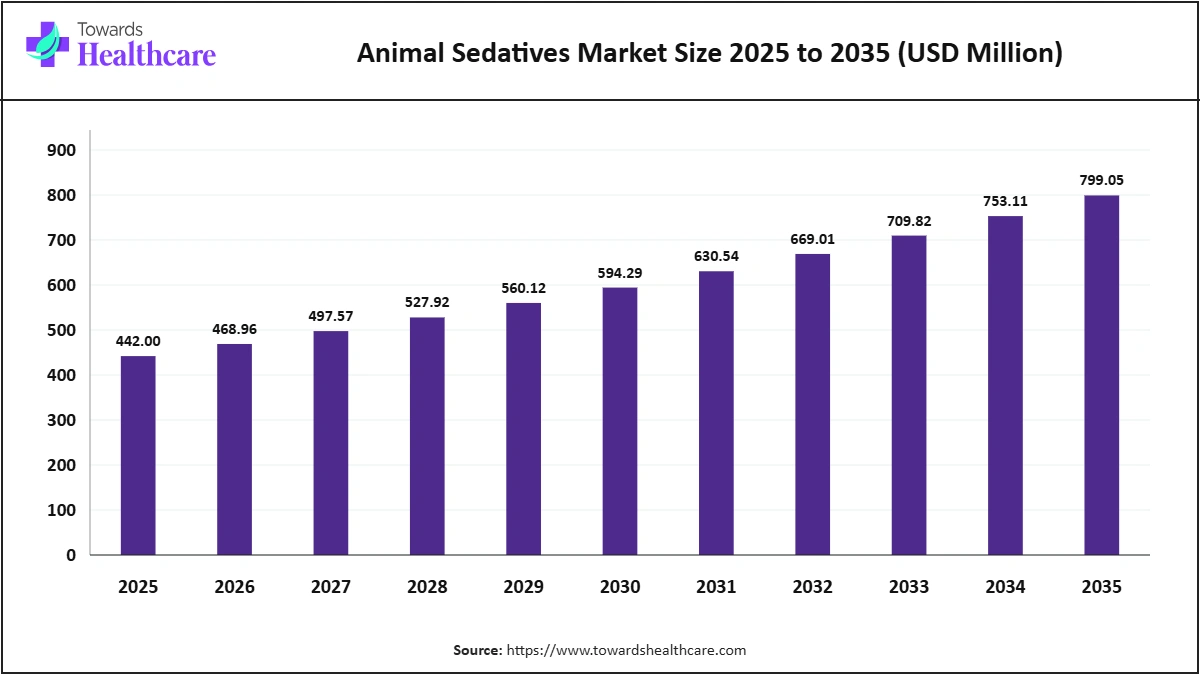
Analyst View: The market is growing due to increased awareness of animal welfare and the rising need for stress-free veterinary care. Growing use of sedation in routine examinations, surgeries, and diagnostic procedures is creating steady demand. Asia Pacific is also emerging as a promising growth market as veterinary services become more accessible. The growth rate reflects growth in veterinary procedures and new formulations, moderated by generic competition and controlled-substance rules.
Growing pet populations and increasing veterinary visits drive demand for animal sedatives. The rising number of surgical procedures and diagnostic imaging examinations further increases the need for effective sedation. Wider adoption of Fear Free practices encourages veterinarians to use sedatives to reduce animal anxiety and stress during clinical visits. Growth in equine sports medicine and demand for oral sedatives for at-home administration also support market expansion.
Generic competition puts pressure on product prices and profit margins. Strict controlled-substance regulations increase handling, storage, and compliance requirements. The risk of cardiovascular and respiratory complications also limits the use of certain sedatives. In addition, cost sensitivity among livestock producers and occasional drug supply shortages restrict market growth.
Product innovation in oral and transmucosal sedatives offers opportunities to expand behavioral treatment applications. Developing cat-specific formulations could address unmet veterinary needs and improve treatment options. Expanding veterinary services across Asia Pacific also creates new market opportunities. In addition, growing applications in wildlife management and aquaculture care offer further potential for market expansion.
| Segments | 2025 Share | 2025 Value (USD Million) | 2035 Value (USD Million) | CAGR 2026-2035 |
| Alpha-2 Adrenergic Agonists | 54.20% | 239.56 | 440.55 | 6.28% |
| Phenothiazines | 14.60% | 64.53 | 114.28 | 5.88% |
| Benzodiazepines | 13.80% | 61.00 | 108.02 | 5.88% |
| Butyrophenones | 6.40% | 28.29 | 50.10 | 5.88% |
| Others | 11.00% | 48.62 | 86.10 | 5.88% |
Note: 2025 is the base year; 2035 values are forecasts.
Sources: Expert interviews, secondary sources, Towards Healthcare database, and Towards Healthcare analysts.
Alpha-2 Adrenergic Agonists: This segment accounted for 54.20% market share and was valued at USD 239.56 million in 2025 and is projected to reach USD 440.55 million by 2035, at a CAGR of 6.28% from 2026 to 2035. Alpha-2 agonists such as dexmedetomidine, medetomidine, detomidine, ropivacaine, and xylazine produce dose-dependent sedation, muscle relaxation, and analgesia, and their effects can be reversed with atipamezole or other antagonists, which improves safety and recovery. They are the standard pre-anesthetic and procedural sedatives in small animal practice, the main standing sedatives for horses, and widely used in cattle and wildlife capture. Products such as Dexdomitor, Domitor, Dormosedan, and Domidine, together with oromucosal dexmedetomidine gel for noise aversion in dogs, support the class's leading share. Generic versions are expanding access while limiting price growth.
Phenothiazines: Phenothiazines generated USD 64.53 million of the animal sedatives market in 2025 and is estimated to reach USD 114.28 million by 2035, expanding at a CAGR of 5.88% from 2026 to 2035. Phenothiazines, mainly acepromazine, are long-acting tranquilizers that are inexpensive and widely used for premedication, transport, and calming in dogs, cats, and horses. They are often combined with opioids or alpha-2 agonists. Their share is stable, supported by low cost and long clinical familiarity, although some veterinarians limit their use in certain breeds and patients.
Benzodiazepines: The benzodiazepines segment held a 13.80% share and reached USD 61.00 million of the animal sedatives market in 2025 and is projected to reach USD 108.02 million by 2035, at a CAGR of 5.88% from 2026 to 2035. Benzodiazepines such as midazolam and diazepam provide sedation, muscle relaxation, and anticonvulsant effects with minimal cardiovascular impact, making them useful in combination protocols for older, sick, or high-risk patients. They are controlled substances, which adds handling requirements, but their safety profile supports growing use in combination sedation.
Butyrophenones: This segment was valued at USD 28.29 million in 2025 and is expected to represent USD 50.10 million by 2035, growing at a CAGR of 5.88% from 2026 to 2035. Butyrophenones such as azaperone are used mainly in pigs to reduce aggression and stress during mixing and transport, and in some wildlife applications. The segment is small and closely linked to swine production practices.
Others: Other segments generated USD 48.62 million in 2025 and are projected to grow to USD 86.10 million by 2035, exhibiting a CAGR of 5.88% from 2026 to 2035. Others include gabapentin and pregabalin used for situational anxiety, opioids such as butorphanol used in sedation protocols, trazodone, and newer agents and formulations. This group is growing as veterinarians use pre-visit oral medications to reduce fear and stress before clinic visits.
| Segments | 2025 Share | 2025 Value (USD Million) | 2035 Value (USD Million) | CAGR 2026-2035 |
| Dogs | 58.60% | 259.01 | 453.44 | 5.76% |
| Cats | 16.40% | 72.49 | 144.73 | 7.16% |
| Horses | 14.20% | 62.76 | 114.10 | 6.16% |
| Livestock & Wildlife | 10.80% | 47.74 | 86.78 | 6.16% |
Note: 2025 is the base year; 2035 values are forecasts.
Sources: Expert interviews, secondary sources, Towards Healthcare database, and Towards Healthcare analysts.
Dogs: The dogs segment was valued at USD 259.01 million of the market in 2025 and is projected to reach USD 453.44 million by 2035, at a CAGR of 5.76% from 2026 to 2035. Dogs account for the largest share because they undergo most examinations, imaging studies, dental procedures, and surgeries, and many need sedation for nail trims, radiographs, or anxious behavior.
Cats: This segment accounted for a 16.40% share and reached USD 72.49 million in 2025 and is projected to represent USD 144.73 million by 2035, exhibiting a CAGR of 7.16% from 2026 to 2035. Cats are the fastest-growing animal type because they are often stressed by transport and clinic visits, and veterinarians increasingly use pre-visit oral sedation and cat-friendly sedation protocols. Growing cat ownership and veterinary visit rates support demand.
Horses: The horses segment accounted for 14.20% (USD 62.76 million) of the animal sedatives market in 2025 and is projected to reach USD 114.10 million by 2035, expanding at a CAGR of 6.16% from 2026 to 2035. Horses require sedation for standing procedures such as dentistry, imaging, lameness examinations, wound care, and minor surgery. Alpha-2 agonists such as detomidine and romifidine, alone or with butorphanol, are standard.
Livestock & Wildlife: The livestock and wildlife segment accounted for 10.80% of the animal sedatives market in 2025, generating USD 47.74 million in revenue. The segment is projected to reach USD 86.78 million by 2035, registering a CAGR of 6.16% during 2026-2035.
The segment covers cattle, pigs, small ruminants, zoo animals, and wildlife captured for research and conservation activities. Xylazine and azaperone remain widely used in livestock sedation, while wildlife capture relies on potent alpha-2 agonists and combination drug protocols. New product approvals, including sedation products for fish, further expand the segment's applications and growth opportunities.
| Segments | 2025 Share | 2025 Value (USD Million) | 2035 Value (USD Million) | CAGR 2026-2035 |
| Parenteral | 63.40% | 280.23 | 478.16 | 5.49% |
| Oral & Transmucosal | 36.60% | 161.77 | 320.89 | 7.09% |
Note: 2025 is the base year; 2035 values are forecasts.
Sources: Expert interviews, secondary sources, Towards Healthcare database, and Towards Healthcare analysts.
Parenteral: The parenteral segment was valued at USD 280.23 million of the animal sedatives market in 2025 and is projected to represent USD 478.16 million by 2035, expanding at a CAGR of 5.49% from 2026 to 2035. Parenteral, including intravenous and intramuscular injection, accounts for the largest share because procedural and pre-anesthetic sedation in clinics requires predictable onset and depth of sedation.
Oral & Transmucosal: This segment accounted for a 36.60% share and reached USD 161.77 million in 2025. It is projected to reach USD 320.89 million by 2035, exhibiting a CAGR of 7.09% from 2026 to 2035. Oral & transmucosal include tablets, capsules, and gels that owners can give at home before a visit, travel, or noise events. This is the fastest-growing route because the Fear Free movement promotes pre-visit medication, and products such as oromucosal dexmedetomidine gel make at-home use easier.
| Segments | 2025 Share | 2025 Value (USD Million) | 2035 Value (USD Million) | CAGR 2026-2035 |
| Surgical | 55.80% | 246.64 | 426.71 | 5.63% |
| Diagnostic | 26.40% | 116.69 | 209.66 | 6.03% |
| Behavioral & Others | 17.80% | 78.68 | 162.68 | 7.53% |
Note: 2025 is the base year; 2035 values are forecasts.
Sources: Expert interviews, secondary sources, Towards Healthcare database, and Towards Healthcare analysts.
Surgical: The surgical segment accounted for a 55.80% (USD 246.64 million) share in 2025 and is estimated to reach USD 426.71 million by 2035, expanding at a CAGR of 5.63% from 2026 to 2035. Surgical applications include premedication before general anesthesia and sedation for minor surgical procedures. This is the largest application because every anesthetic procedure in dogs, cats, and horses typically begins with sedative premedication to reduce anesthetic requirements and improve safety.
Diagnostic: The diagnostic segment reached USD 116.69 million of the animal sedatives market in 2025. It is projected to reach USD 209.66 million by 2035, expanding at a CAGR of 6.03% from 2026 to 2035. Diagnostic covered sedation for ultrasound, radiography, CT, MRI, endoscopy, and sample collection. Growth in advanced imaging in veterinary practice supports demand.
Behavioral & Others: This segment held a 17.80% share, reaching USD 78.68 million in 2025 and is projected to reach USD 162.68 million by 2035, growing at a CAGR of 7.53% from 2026 to 2035. Behavioral & other segments include management of situational anxiety, noise aversion, travel and grooming, and handling of livestock and wildlife. This is the fastest-growing application as veterinarians and owners focus on reducing fear and stress.
Analyst View: The market is driven by the widespread use of alpha-2 adrenergic agonists, supported by their effectiveness, versatility, and reversible effects. Dogs remain the leading animal segment due to frequent veterinary visits and higher surgical and diagnostic needs. Injectable products continue to dominate clinical procedures, but oral and transmucosal formulations are gaining attention as owners increasingly prefer stress-free, at-home medication. Surgical procedures remain the primary application, while behavioral care is emerging as an important growth area as veterinarians place greater emphasis on animal comfort and low-stress handling.
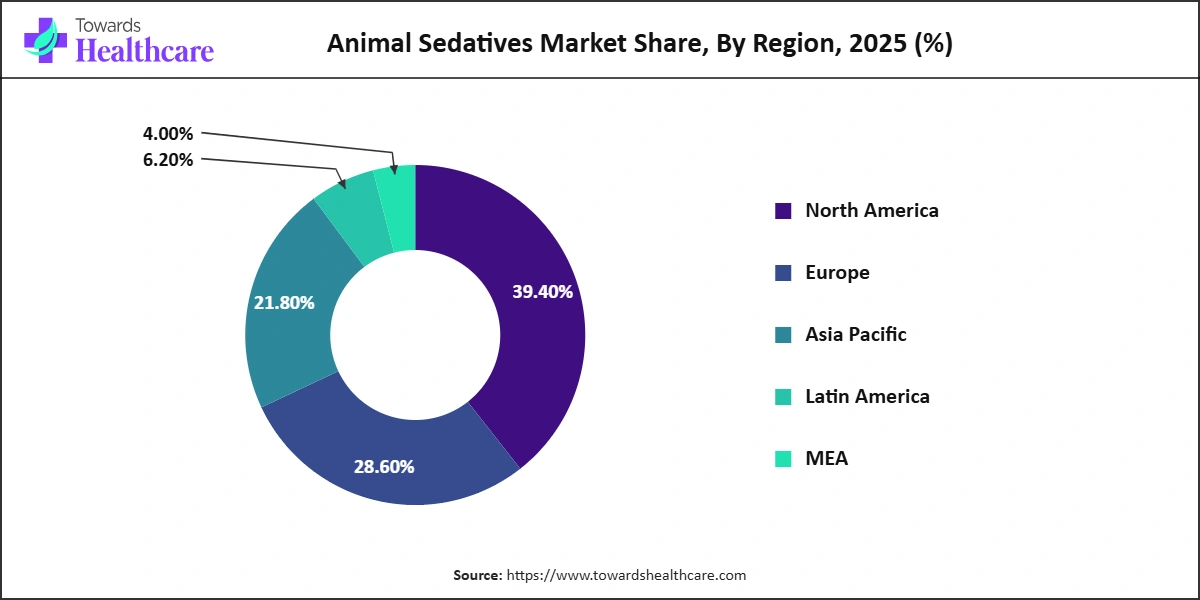
| Region | 2025 Share | 2025 Value (USD Million) | 2035 Value (USD Million) | CAGR 2026-2035 |
| North America | 39.40% | 174.15 | 298.38 | 5.53% |
| Europe | 28.60% | 126.41 | 224.94 | 5.93% |
| Asia Pacific | 21.80% | 96.36 | 195.51 | 7.33% |
| Latin America | 6.20% | 27.40 | 48.76 | 5.93% |
| Middle East & Africa | 4.00% | 17.68 | 31.46 | 5.93% |
Note: 2025 is the base year; 2035 values are forecasts.
Sources: Expert interviews, secondary sources, Towards Healthcare database, and Towards Healthcare analysts.
North America: North America dominated the market in 2025, accounting for 39.40% of revenue, valued at USD 174.15 million. The regional market is projected to reach USD 298.38 million by 2035, registering a CAGR of 5.53% during 2026-2035. High pet ownership, frequent veterinary visits, and an extensive network of general and specialty veterinary hospitals support regional demand. The growing use of surgery and advanced diagnostic imaging further increases the need for animal sedation. A large horse population also supports demand for equine sedatives. Recent product launches, including Dechra's Domidine in 2026, contribute to market activity. Meanwhile, consolidation in veterinary distribution, including the planned combination of Covetrus and MWI Animal Health, is reshaping product distribution and access across veterinary clinics.
Europe: The European animal sedatives market was valued at USD 126.41 million in 2025 and is projected to reach USD 224.94 million by 2035, registering a CAGR of 5.93% during 2026-2035. High companion animal ownership and well-established equine veterinary services across the UK, Germany, France and Ireland support regional demand. Finland-based Orion has played an important role in the development of medetomidine, dexmedetomidine and detomidine. European regulatory approvals for multiple sedative formulations for dogs, cats and horses further support product availability and market growth.
Asia Pacific: This region accounted for a 21.80% share, generating USD 96.36 million in 2025 and is estimated to reach USD 195.51 million by 2035, exhibiting a CAGR of 7.33% from 2026 to 2035. Asia Pacific is the fastest-growing region, supported by rising pet ownership and veterinary hospital investment in China, Japan, South Korea, and Australia. Expanding veterinary education and surgical capability increase sedative use; the livestock and aquaculture sectors add demand.
Latin America: Latin America held a 6.20% share and generated USD 27.40 million in 2025. It is projected to reach USD 48.76 million by 2035, expanding at a CAGR of 5.93% from 2026 to 2035. Latin America is supported by growing pet ownership in Brazil and Mexico and by large cattle and equine populations, where xylazine and other sedatives are used for handling and procedures.
Middle East & Africa: The Middle East and Africa market was valued at USD 17.68 million in 2025 and is projected to reach USD 31.46 million by 2035, registering a CAGR of 5.93% during 2026-2035. Demand is supported by established equine veterinary services in the Gulf region, wildlife capture and conservation programmes across Africa, and growing companion animal care in urban areas. Increasing veterinary treatment and animal management activities further support regional market growth.
Analyst View: The market shows strong regional potential, with North America leading due to high pet ownership, advanced veterinary facilities, and well-established equine care. Europe benefits from its mature veterinary healthcare system and strong presence of established animal health companies. Meanwhile, Asia Pacific is emerging as a key growth market, driven by rising pet adoption, expanding veterinary infrastructure, and increasing demand across livestock and aquaculture.
| Rank | Company Name | Market-Specific Revenue (USD Million) | 2025 Share | Key Products / Business | Headquarters |
| 1 | Zoetis | 92.00 | 20.81% | Dexdomitor, Domitor, Sileo, Dormosedan | United States |
| 2 | Dechra | 46.00 | 10.41% | Domidine, Zenalpha and sedation products | United Kingdom |
| 3 | Orion Corporation | 38.00 | 8.60% | Alpha-2 agonist originator products | Finland |
| 4 | Elanco | 28.00 | 6.33% | Sedation and anesthesia products | United States |
| 5 | Boehringer Ingelheim | 26.00 | 5.88% | Sedative and anesthetic products | Germany |
| 6 | Merck Animal Health | 22.00 | 4.98% | Sedation and anesthesia products | United States |
| 7 | Ceva Santé Animale | 18.00 | 4.07% | Sedatives and calming products | France |
| 8 | Vetoquinol | 16.00 | 3.62% | Sedation products | France |
| 9 | Chanelle Pharma | 8.00 | 1.81% | Generic sedatives | Ireland |
| 10 | Animalcare Group | 6.00 | 1.36% | Sedation and anesthesia products | United Kingdom |
Note: Company revenues and shares are 2025 estimates.
Sources: Company press releases, expert interviews, secondary sources, Towards Healthcare database and Towards Healthcare analysts.
Zoetis led the animal sedatives market with 20.81% (USD 92.00 million) of 2025 revenue, followed by Dechra at 10.41% (USD 46.00 million) and Orion Corporation at 8.60% (USD 38.00 million). Zoetis leads through Dexdomitor, Domitor and Dormosedan, developed with Orion, and Sileo oromucosal gel for noise aversion in dogs. Dechra offers detomidine and dexmedetomidine-based products including Domidine and Zenalpha, and Orion Corporation developed and supplies key alpha-2 agonist molecules. Elanco, Boehringer Ingelheim, Merck Animal Health, Ceva Santé Animale, Vetoquinol, Chanelle Pharma, and Animalcare Group compete through anesthesia and sedation portfolios, regional products, and generics.
The top 10 players accounted for 67.87% share and reached USD 300.00 million of 2025 revenue, while the remaining 32.13% (USD 142.00 million) was shared among generic drug makers, compounding pharmacies, and regional animal health companies. The animal sedatives market is moderately concentrated, and competition centers on safety and reversibility, onset and duration, species approvals, ease of administration, controlled-substance handling, and price. Generic competition is growing for older alpha-2 agonists and acepromazine.
The animal sedatives ecosystem links active ingredient suppliers with animal health manufacturers, veterinary distributors, veterinarians, and animal owners under drug and controlled-substance regulation.
| Ecosystem Stage | Role in the Market | Key Companies |
| Active Ingredients | Supply sedative and anxiolytic actives | API manufacturers |
| Manufacturers | Develop and produce sedative products | Zoetis, Orion, Dechra, Elanco, Boehringer Ingelheim, Merck |
| Distribution | Supply products to clinics and farms | Covetrus, MWI Animal Health, Patterson, regional distributors |
| Veterinarians | Select and administer sedation | Small animal, equine, livestock and wildlife veterinarians |
| Owners & Regulators | Use at-home products and regulate drugs | Pet and horse owners, FDA CVM, EMA, DEA |
Sources: Company press releases, expert interviews, secondary sources, Towards Healthcare database, and Towards Healthcare analysts.
The Towards Healthcare Companies Quadrant positions key participants in the animal sedatives market by market strength, reflecting revenue scale, market share and geographic reach, and by innovation and growth strategy, reflecting product portfolio breadth, R&D intensity and partnerships. Positions reflect each company's estimated 2025 animal sedative revenue and our assessment of its product innovation, species coverage, and distribution.
Sources: Company press releases, expert interviews, secondary sources, Towards Healthcare database, and Towards Healthcare analysts.
Leaders: Zoetis, Dechra, Orion, and Boehringer Ingelheim combine significant sedative revenue with leading alpha-2 agonist products, new formulations, and broad veterinary reach.
Challengers: Elanco has broad animal health portfolios but less sedative-specific innovation.
Innovators: Ceva Santé Animale and Animalcare Group bring calming products and regional sedation innovations.
Niche Players: Merck Animal Health, Vetoquinol, and Chanelle Pharma serve generic and regional segments.
The animal sedatives market was defined as sedative, tranquilizer, and anxiolytic drugs for companion animals, horses, livestock, wildlife, and laboratory animals, worldwide. The 2025 base year was built bottom-up from veterinary procedures requiring sedation by animal type, application and region, sedative doses and prices, and at-home anxiolytic use, and checked top-down against the sedative product revenue of leading animal health companies. Segment, regional, and company values were allocated from drug classes, animal types, routes, applications, and regional demand. Key estimates were verified by cross-checking company disclosures, regulatory and industry data, and published third-party estimates, and inputs that could not be reconciled were excluded. All segment, regional, and company figures were reconciled to the same 2025 base year, and the 2026-2035 forecast, which applies a constant CAGR from the 2025 base, was recalculated and validated.
Analyst View: The animal sedatives market grows steadily with veterinary procedures and the shift toward low-stress care. Our estimate links demand to procedures, doses, and prices, so the forecast follows pet and horse populations, surgical and imaging volumes, and new formulations. The main upside comes from oral anxiolytics and Asian veterinary growth, while the main risks are generic competition and regulatory burdens.