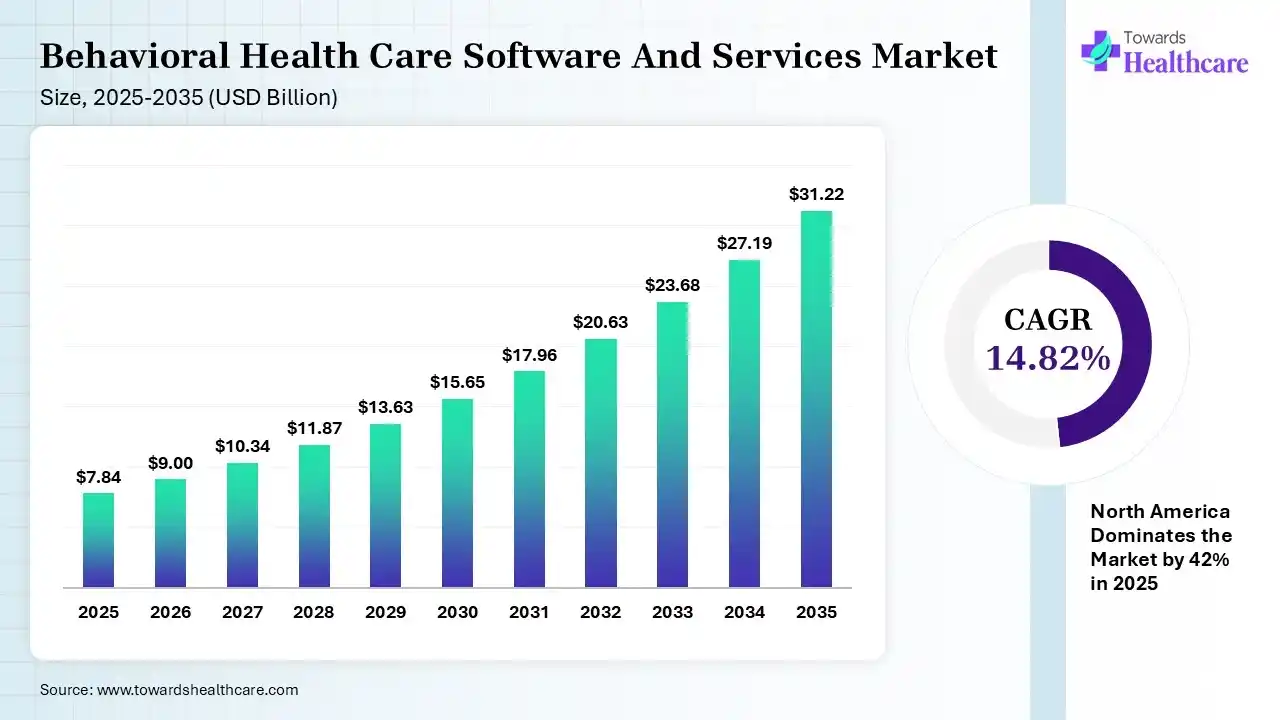
The global behavioral health care software and services market size was estimated at USD 7.84 billion in 2025 and is predicted to increase from USD 9 billion in 2026 to approximately USD 31.22 billion by 2035, expanding at a CAGR of 14.82% from 2026 to 2035. The market is expanding due to rising awareness of mental health disorders and increasing adoption of digital healthcare technologies. Growing demand for telehealth, electronic health records, and integrated patient management solutions is further driving market growth.
Behavioral healthcare software and services refer to digital solutions and support systems used to manage mental health, substance abuse, and behavioral treatment programs. These tools help healthcare providers streamline patient records, scheduling, billing, telehealth, and clinical care management. The behavioral health care software and services market is growing due to increasing awareness of mental health disorders, rising demand for telehealth services, and greater adoption of electronic health records and patient management systems. Healthcare providers are increasingly investing in digital platforms to improve treatment efficiency, patient engagement, and data management.
Artificial intelligence is transforming the market by improving patient monitoring, predictive analytics, and personalized treatment planning. AI-powered chatbots, virtual therapists, and automated clinical documentation help healthcare providers enhance efficiency and patient engagement. Advanced data analysis also supports early detection of mental health conditions and improves decision-making. As healthcare organizations increasingly adopt intelligent digital tools, AI continues to drive innovation and operational improvements across behavioral healthcare services.
The increasing adoption of virtual counseling and remote psychiatric care is improving access to mental health services. Healthcare providers are investing in telehealth platforms to deliver convenient, cost-effective, and continuous behavioral healthcare support, particularly in remote and underserved areas.
Behavioral healthcare organizations are shifting toward cloud-based software solutions for better data accessibility, secure storage, and streamlined workflow management. These platforms help providers improve operational efficiency, reduce infrastructure costs, and support seamless communication across healthcare networks.
Healthcare providers are increasingly adopting integrated platforms that combine patient records, billing, scheduling, and care coordination into one system. This trend is improving treatment efficiency, enhancing patient experience, and supporting better collaboration among healthcare professionals and behavioral care providers.
| Table | Scope |
| Market Size in 2026 | USD 9 Billion |
| Projected Market Size in 2035 | USD 31.22 Billion |
| CAGR (2026 - 2035) | 14.82% |
| Leading Region | North America by 42% |
| Historical Data | 2020 - 2023 |
| Base Year | 2025 |
| Forecast Period | 2026 - 2035 |
| Measurable Values | USD Millions/Units/Volume |
| Market Segmentation | By component, By Delivery Mode, By Functionality, By End User, By Application, By Deployment Size, By Region |
| Top Key Players | Oracle, Core Solutions, Inc., Epic Systems Corporation, Meditab, Holmusk, Netsmart Technologies, Inc., Qualifacts |
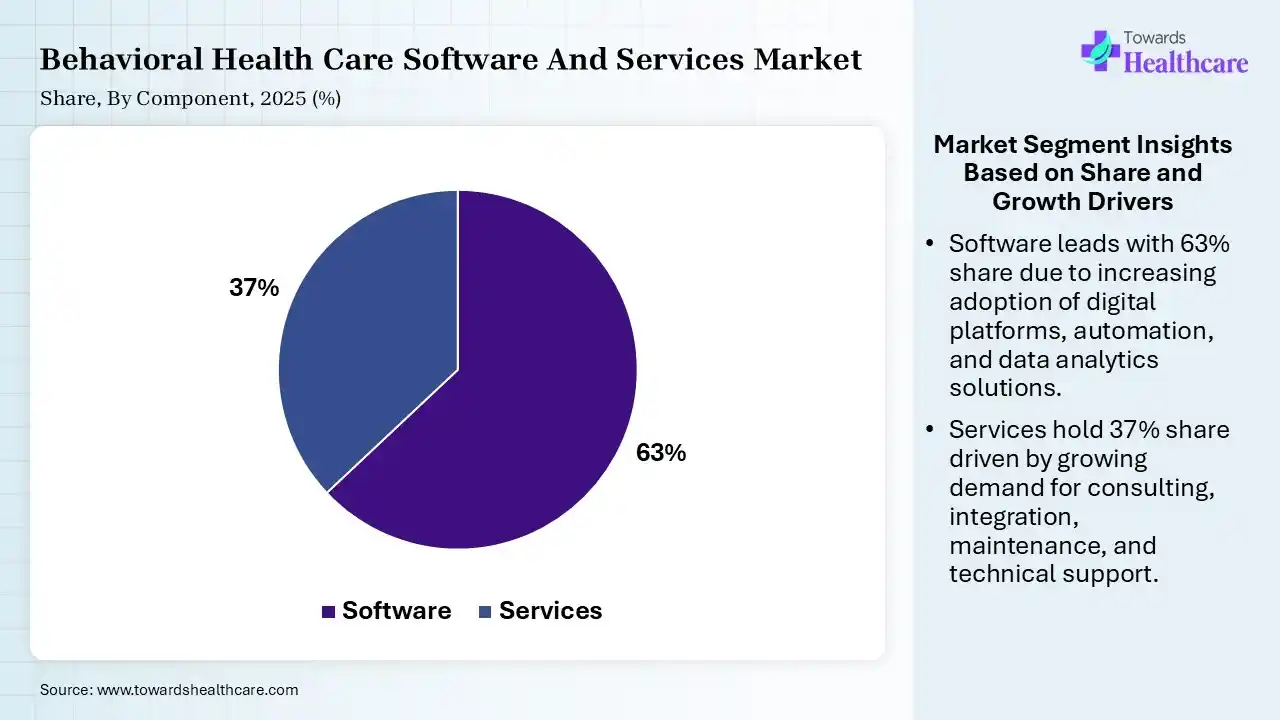
| Segment | Share 2025 (%) |
| Software | 63% |
| Services | 37% |
The Software Segment Dominated the Behavioral Health Care Software and Services Market in 2025
The software segment held a dominant share of 63% in 2025 due to the increasing adoption of electronic health records, patient management systems, telehealth platforms, and billing solutions across behavioral healthcare facilitities. Healthcare providers are investing heavily in digital software to improve operational efficiency, streamline clinical workflows, enhance patient data management, and support remote care services. Growing demand for integrated and cloud-based healthcare platforms further strengthened the segment’s market leadership.
The services segment held the second-largest share of 37% in 2025 and is expected to grow at the fastest CAGR in the behavioral health care software and services market during the forecast period due to the growing need for software implementation, training, maintenance, consulting, and technical support services across behavioral healthcare organizations. As healthcare providers increasingly adopt advanced digital platforms, demand for managed and professional services has risen to ensure smooth system integration, regulatory compliance, and efficient workflow management. Continuous upgrade, cybersecurity support, and ongoing operational assistance further contribute to the segment’s steady market growth.
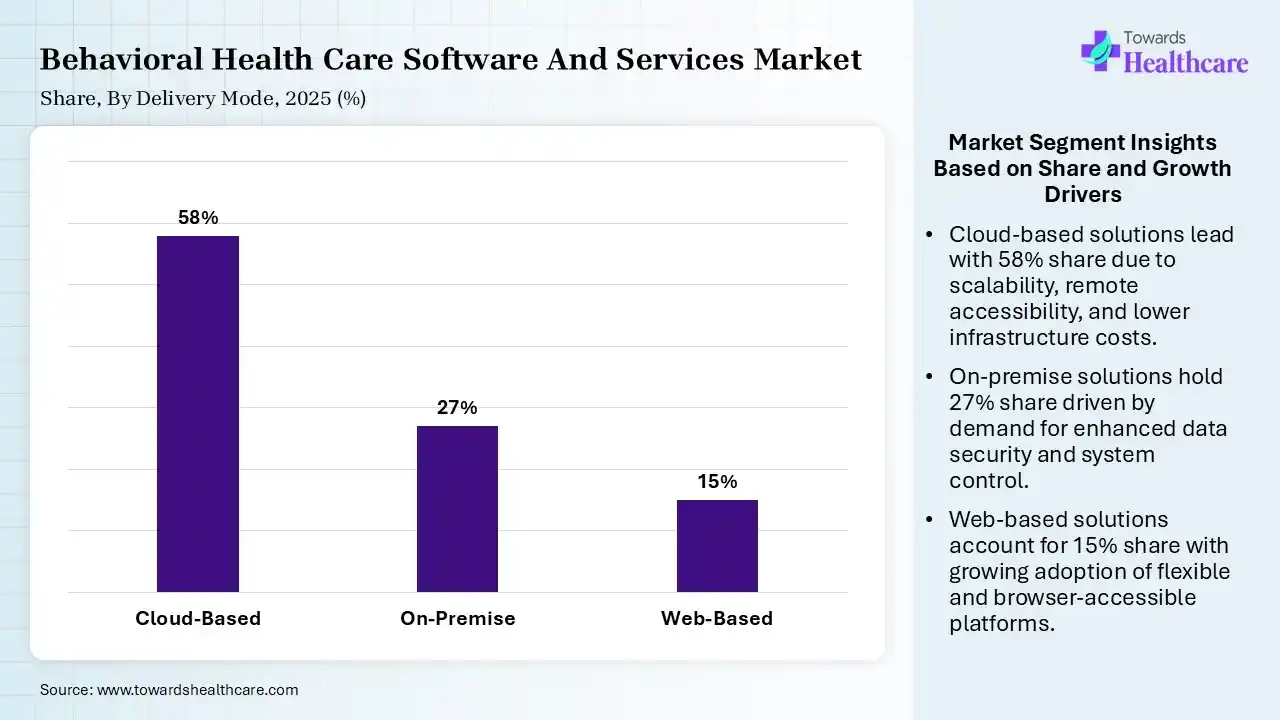
| Segment | Share 2025 (%) |
| Cloud-Based | 58% |
| On-Premise | 27% |
| Web-Based | 15% |
The Cloud-based Segment Led the Market in 2025 with the Largest Share
The cloud-based segment led the behavioral health care software and services market with a share of 58% in 2025 and is expected to grow at the fastest CAGR in the market during the forecast period due to its scalability, lower upfront costs, and easy remote accessibility. It enables real-time data sharing, seamless integration with other healthcare systems, and improved care coordination. Increasing demand for telehealth services, data security features, and flexible subscription models further accelerates cloud adoption across behavioral healthcare organizations.
The on-premise segment held the second-largest share of 27% in 2025 due to its strong data security, control, and compliance benefits. Many large hospitals and established healthcare organizations prefer on-premise systems to manage sensitive patient information internally. It also offers high customization, reliable performance, and integration with legacy systems, making it suitable for institutes with existing IT infrastructure and strict regulatory requirements.
The web-based segment held a 15% of behavioral health care software and services market share due to its easy accessibility through browsers without complex installation. It offers cost-effectiveness, quick deployment, and compatibility across multiple devices, making it suitable for small and mid-sized healthcare providers. Increasing demand for remote patient monitoring, telehealth services, and flexible care delivery is further driving the adoption of web-based platforms in behavioral healthcare organizations.
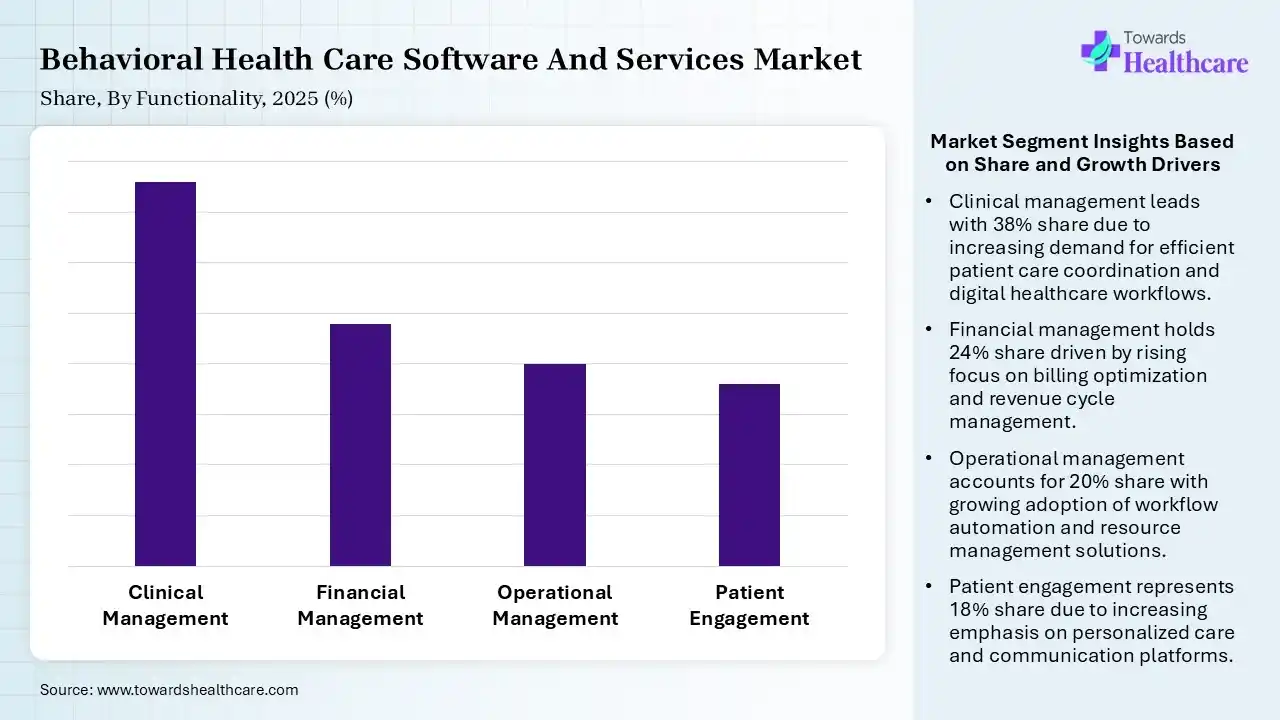
| Segment | Share 2025 (%) |
| Clinical Management | 38% |
| Financial Management | 24% |
| Operational Management | 20% |
| Patient Engagement | 18% |
The Clinical Management Segment Led the Behavioral Health Care Software and Services Market in 2025 with the Largest Share
The clinical management segment held a dominant share of 38% in 2025 due to its critical role in managing patient care processes, treatment planning, and clinical documentation. It helps healthcare providers improve diagnosis accuracy, streamline workflows, and enhance care coordination. Rising demand for efficient patient record management, better treatment outcomes, and compliance with healthcare regulations further strengthened the dominance of clinical management solutions across behavioral healthcare organizations.
The financial management segment held the second-largest share of 27% in 2025 due to the growing need for efficient billing, claims processing, and revenue cycle management. Behavioral healthcare providers are increasingly adopting digital financial tools to reduce administrative burden, minimize errors, and ensure timely reimbursements. Rising healthcare costs, insurance complexities, and the demand for transparent financial operations further drive the adoption of these solutions.
The patient engagement segment held 18% share in 2025 and is expected to grow at the fastest CAGR in the behavioral health care software and services market during the forecast period due to rising demand for improved communication between patients and providers. Increasing use of mobile apps, portals, and digital reminders is enhancing treatment adherence and satisfaction. Growing focus on personalized care, remote monitoring, and active patient involvement in mental health management is further driving rapid adoption of patient engagement solutions.
The operational management segment held a 20% of market share due to the increasing need for efficient scheduling, workflow automation, and resource optimization in healthcare facilities. Providers are adopting these solutions to reduce administrative burden, improve staff productivity, and enhance service delivery. Rising patient volumes, demand for streamlined operations, and focus on cost reduction are further driving the adoption of operational management tools in behavioral healthcare organizations.
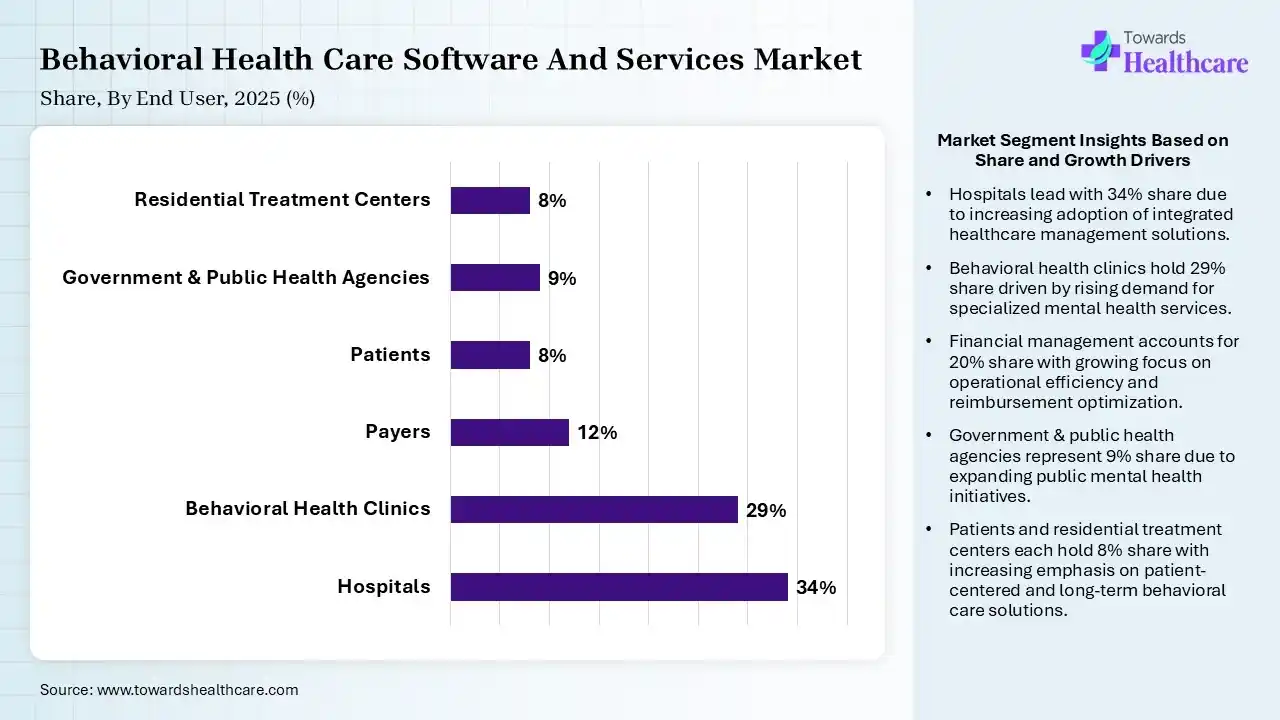
| Segment | Share 2025 (%) |
| Hospitals | 34% |
| Behavioral Health Clinics | 29% |
| Payers | 12% |
| Patients | 8% |
| Government & Public Health Agencies | 9% |
| Residential Treatment Centers | 8% |
The Hospitals Segment Led the Market in 2025 with the Largest Share
The hospitals segment dominated the behavioral health care software and services market with a share of 34% in 2025 due to the high patient inflow and availability of advanced infrastructure for mental health treatment. Hospitals widely adopt behavioral healthcare software to manage large volumes of patient data, streamline clinical workflows, and ensure regulatory compliance. Increasing integration of digital health systems, rising mental health admissions, and strong financial capacity further strengthen hospitals' market dominance.
The behavioral health clinics segment held the second-largest share of 29% in 2025 and is expected to grow at the fastest CAGR in the market during the forecast period due to the rising number of specialized mental health centers focusing on outpatient care and counseling services. These clinics increasingly adopt software solutions to manage appointments, patient records, and treatment plans efficiently. Growing demand for accessible and affordable mental health services, along with increasing awareness and early diagnosis of behavioral disorders, further supports the segment’s strong market position.
The payers segment held a 12% of behavioral health care software and services market share due to the increasing need for efficient claims management, cost control, and data-driven decision-making. Insurance providers are adopting advanced software to streamline reimbursement processes, reduce fraud, and improve transparency in behavioral health coverage. Rising mental health claims, expanding insurance penetration, and the shift toward value-based care models are further driving adoption among payers.
The government & public health agencies segment held a 9% of market share due to rising focus on mental health awareness and public welfare programs. Governments are increasingly investing in digital healthcare infrastructure to improve access, monitoring, and reporting of behavioral health conditions. Growing initiatives for crisis intervention, substance abuse management, and community mental health services are further driving adoption of advanced software solutions in this segment.
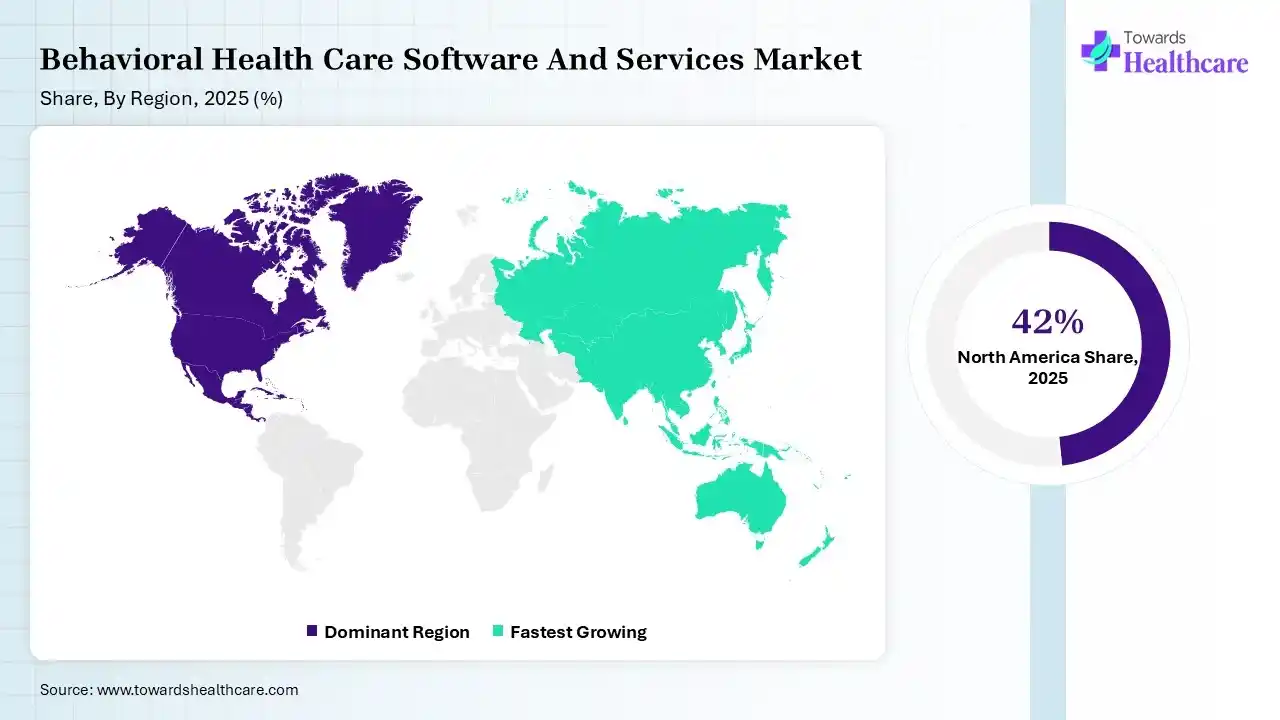
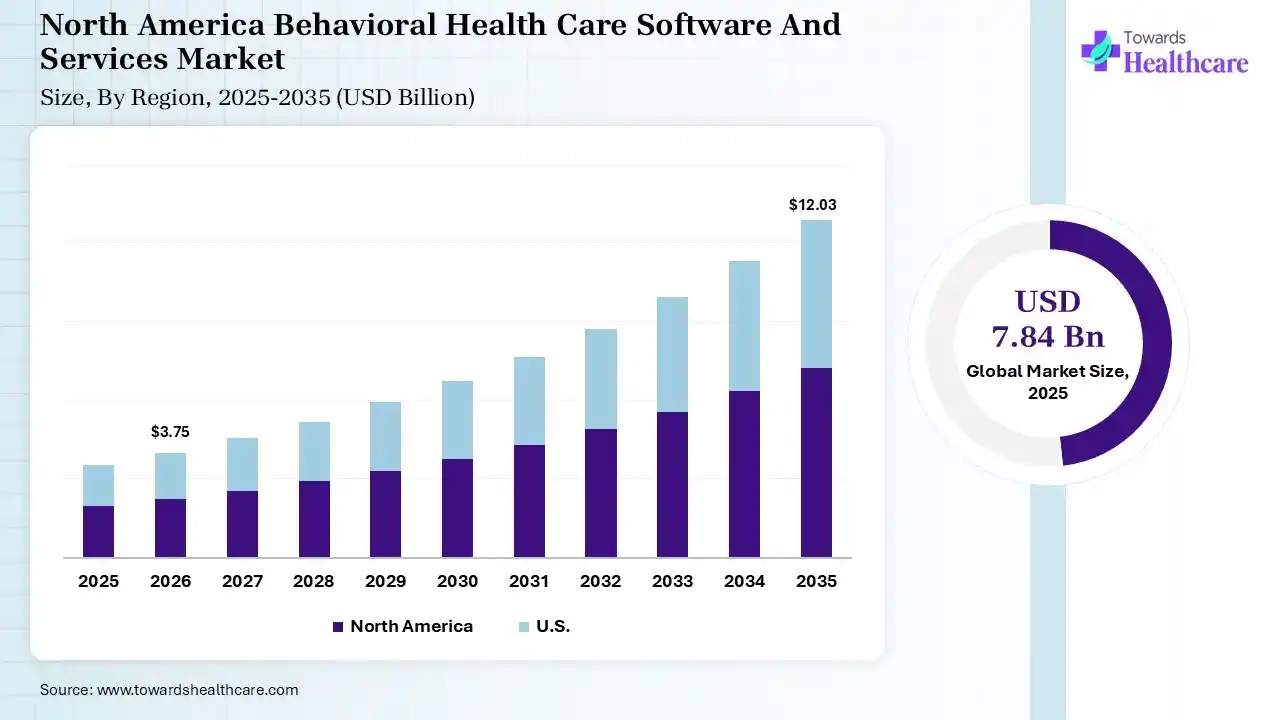
North America dominated the behavioral health care software and services market with a share of 42% in 2025 due to strong healthcare infrastructure, high adoption of advanced digital health technologies, and growing mental health awareness. The presence of leading market players. favorable government initiatives, and widespread use of telehealth and electronic health records further support market growth. Additionally, high healthcare spending and increasing demand for integrated behavioral care solutions strengthen the region’s leadership position.
U.S. Market Trends
The U.S. behavioral health care software and services market is driven by advanced healthcare infrastructure, high adoption of digital health technologies, and the strong presence of key market players. Rising mental health awareness, favorable government support, and widespread use of telehealth and EHR systems further drive growth. Additionally, high healthcare spending and increasing demand for integrated, patient-centric behavioral care solutions strengthen the country’s dominant market position.
Canada Market Trends
The behavioral health care software and services market in Canada is growing due to severe mental health pressures. Currently, one in five Canadians personally experiences a mental health problem yearly. An alarming five million citizens report that they do not get adequate care. To tackle this issue, the government supports regional health information technology integrations across provinces. Federal funding provided through Canada Health Infoway helps public clinics purchase secure electronic recording software to manage rising caseloads efficiently.
Asia Pacific held 21% share of the market in 2025 and is expected to grow at the fastest CAGR in the behavioral health care software and services market during the forecast period due to rising awareness of mental health, improving healthcare infrastructure, and rapid digitization of healthcare systems. Increasing government initiatives, growing adoption of telehealth services, and expanding patient base further support market growth. Additionally, rising investments by global players and improving access to affordable healthcare solutions are driving strong regional expansion.
India Market Trends
India is expected to grow at the fastest CAGR in the behavioral health care software and services market health awareness, a large patient population, and rapid digital transformation in healthcare. Expanding telehealth services, increasing smartphone penetration, and supporting government initiatives are improving access to mental healthcare. Additionally, growing investment in healthcare infrastructure and affordable digital solutions is accelerating market adoption across the country.
China Market Trends
China is rapidly accelerating its behavioral health care software and services market due to a massive disease burden. The World Health Organization estimates that fifty-four million Chinese citizens suffer from depression. In response, the National Health Commission launched a targeted initiative, designating 2025 to 2027 for expanding psychiatric services. The government mandates that every major city provide psychological outpatient treatment. This state policy drives hospitals to adopt advanced tracking software to handle heavy patient flows.
| Companies | Headquarters | Offerings |
| Oracle (Cerner Corporation) | Austin, Texas, USA | Electronic health records (EHR), clinical workflow systems, population health management, revenue cycle management, and cloud-based healthcare IT solutions for hospitals and health systems. |
| Core Solutions, Inc. | Illinois, USA | Behavioral health EHR platforms, care coordination tools, clinical documentation, billing systems, and solutions for mental health and substance use treatment providers. |
| Epic Systems Corporation | Verona, Wisconsin, USA. | Comprehensive EHR systems, patient portals, scheduling, telehealth solutions, hospital management software, and healthcare analytics tools. |
| Meditab | Sacramento, California, USA. | Intelligent Medical Software (IMS) including EHR, practice management, billing, telemedicine, and specialty-specific clinical solutions. |
| Holmusk | New York, USA. | Digital mental health analytics platform, real-world evidence solutions, behavioral health data integration, and predictive analytics for healthcare outcomes. |
| Netsmart Technologies, Inc. | Overland Park, Kansas, USA | Behavioral health and human services software, EHR, care coordination, telehealth, and population health management platforms. |
| Qualifacts | Nashville, Tennessee, USA | Cloud-based EHR and practice management solutions specifically designed for behavioral health and human services organizations. |
Strengths
Weaknesses
Opportunities
Threats
By component
By Delivery Mode
By Functionality
By End User
By Application
By Deployment Size
By Region









Principal Consultant
Payal Rabde is a Healthcare Market Research Analyst at Towards Healthcare Research & Consulting with 4+ years of experience in pharmaceuticals, biotechnology, medical devices, and life sciences.
Learn more about Payal Rabde

Reviewed By
Aditi Shivarkar is a seasoned professional with over 14 years of experience in healthcare market research. As a content reviewer, Aditi ensures the quality and accuracy of all market insights and data presented by the research team.
Learn more about Aditi Shivarkar