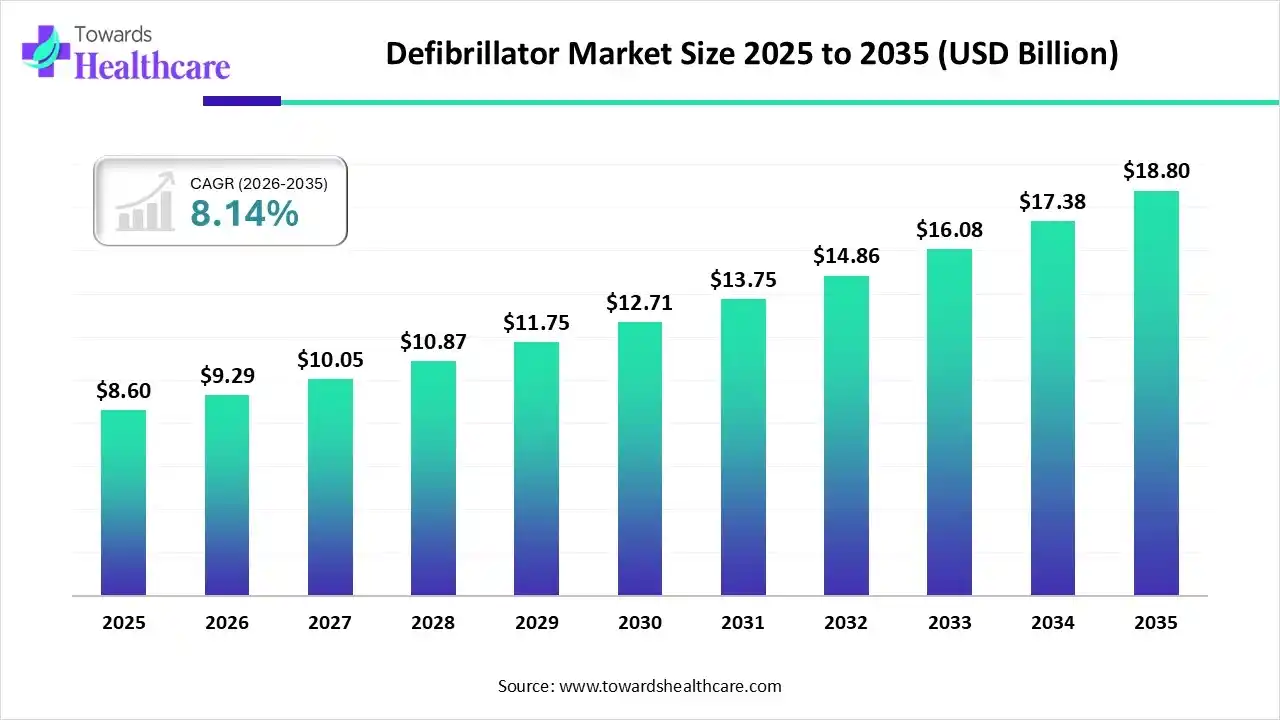
The global defibrillator market size was estimated at USD 8.6 billion in 2025 and is predicted to increase from USD 9.29 billion in 2026 to approximately USD 18.8 billion by 2035, expanding at a CAGR of 8.14% from 2026 to 2035.
The defibrillator market is growing due to the increasing applications in sudden cardiac arrest (SCA), ventricular fibrillation (VF), pulseless ventricular tachycardia (VT), and wearable cardioverter defibrillators (WCDs)
Defibrillators are devices that apply an electric current or charge to the heart to restore a standard heartbeat. Some implantable or wearable defibrillators fix certain dangerous arrhythmias, which are difficulties with the rhythm of the heartbeat. Defibrillators have various applications, based on the type. Automated external defibrillators (AEDs) are found in major public spaces. They save the lives of people who are in heart attack.
The growth of the defibrillator market can be attributed to a number of factors, including the growing rate of cardiovascular disease, the increasing number of cases of sudden cardiac arrest (SCA), and increasing awareness of emergency cardiovascular care. These devices are designed to provide a shock to the heart to restore it to normal rhythm in cases where a patient is experiencing a life-threatening arrhythmia, such as ventricular fibrillation or ventricular tachycardia.
The increasing amount of investment in health care facilities, government-sponsored initiatives promoting access to defibrillation in public, and the growing addition of automated external defibrillators (AEDs) within various public places, including airports, schools, business establishments, and athletic facilities, are all contributing to the increased growth of the defibrillator market. Additionally, there are technological improvements related to defibrillator systems that provide portable, wearable, and connected systems with real-time monitoring capabilities to enhance patient outcomes and increase use of the devices. As health care providers place greater emphasis on rapid emergency response to cardiac emergencies and on preventative care, they will continue to be a growing market for defibrillators in future years.
The defibrillator market focuses on medical devices that deliver controlled electrical shocks to restore a normal heart rhythm in patients experiencing sudden cardiac arrest or life-threatening arrhythmias. The market is expanding due to the rising incidence of cardiovascular diseases, increasing awareness of public access defibrillation, and growing investments in emergency medical infrastructure. Demand is further supported by favorable government initiatives promoting automated external defibrillators (AEDs) in public spaces and workplaces. Technological advancements, including AI-powered rhythm analysis, connected defibrillators with remote monitoring, wearable cardioverter defibrillators, cloud-based data management, and improved biphasic waveform technology, are enhancing treatment accuracy and response times. Future opportunities lie in expanding home healthcare, smart emergency response networks, and integration with digital health ecosystems, driven by continuous innovation and the increasing focus on rapid, life-saving cardiac interventions.
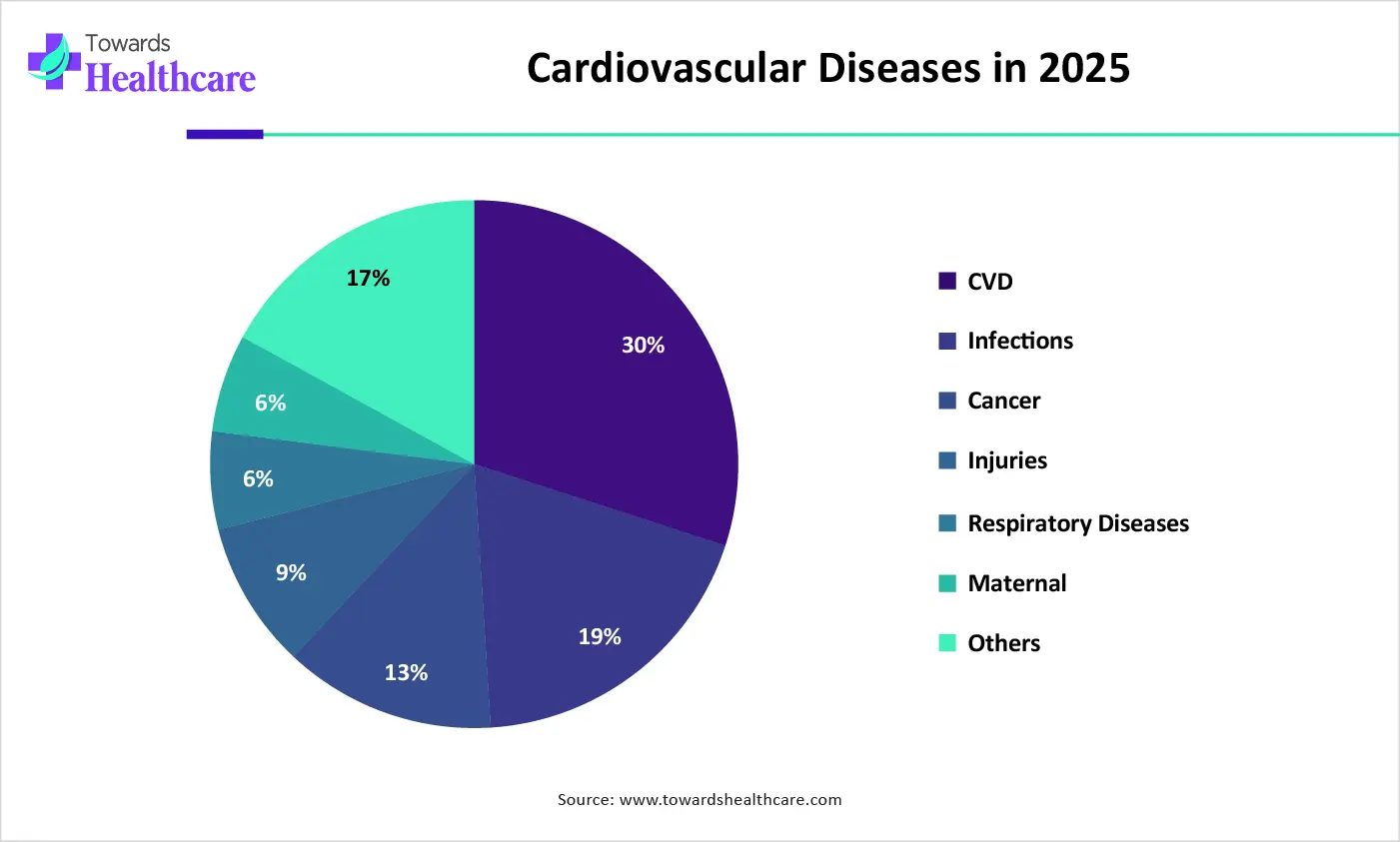
| Diseases | Percentages |
| CVD | 30% |
| Infections | 19% |
| Cancer | 13% |
| Injuries | 9% |
| Respiratory Diseases | 6% |
| Maternal | 6% |
| Others | 17% |
The integration of AI-driven technology into defibrillators drives the growth of the market, as AI-driven technology is used to calculate optimal geographical location and possible patrols to allow high access to automated external defibrillators. AI-based technology is enhancing the precision of heart rhythm readings, improving decision-making processes, and offering real-time feedback. AI-based systems offer immediate guidance on chest compression rate, depth, and recoil, enhancing resuscitation quality and consistency.
Smart & Connected Devices:
The incorporation of AI and advanced algorithms is modernizing defibrillator devices monitor and respond to asymmetrical cardiac rhythms. These novelties not only improve device efficacy but also enhance patient outcomes by reducing unnecessary interventions.
Miniaturization & Leadless Technology:
Innovation in battery technology and deep miniaturisation of electronics present the opportunity to implant the whole pacemaker system in the ventricle.
The development in defibrillator design shows significant progress in the management of cardiac arrhythmias and the prevention of SCA. By focusing on improving safety and efficacy, these new strategies address the challenges of conventional tools and prioritize patient compliance.
| Key Elements | Scope |
| Market Size in 2026 | USD 9.29 Billion |
| Projected Market Size in 2035 | USD 18.8 Billion |
| CAGR (2026 - 2035) | 8.14% |
| Leading Region | North America by 41% |
| Key Applications | Sudden cardiac arrest treatment, emergency response, cardiac rhythm management, ICU care, ambulances, public access defibrillation, implantable cardiac therapy |
| Primary End Users | Hospitals, emergency medical services (EMS), cardiac care centers, clinics, ambulatory surgical centers, military/public safety organizations, home healthcare providers |
| Key Challenges | High device cost, regulatory requirements, maintenance and training needs, reimbursement limitations, competition from alternative cardiac rhythm management technologies |
| Measurable Values | USD Millions/Units/Volume |
| Market Segmentation | By Product, By End User, Regional Outlook |
| Top Key Players | Medtronic, Abbott, Boston Scientific Corporation, BIOTRONIK SE & Co. KG, MicroPort Scientific Corporation, Koninklijke Philips N.V. |
| Segments | Shares % |
| Implantable Cardioverter Defibrillators (ICD) | 62% |
| External Defibrillators (ED) | 38% |
Which Product Led the Defibrillator Market in 2025?
In 2025, the implantable cardioverter defibrillators (ICDs) segment held the dominant market by 62% share, as ICDs avoid arrhythmic deaths, but they also affect quality of life (QOL) due to device-associated challenges. An ICD lowers the challenges of sudden death from cardiac arrest more than medicine. It is intended to treat dangerously rapid heart rates. It incessantly monitors the heart and restores it to its normal heart rate.
External Defibrillators
Whereas the external defibrillators segment is the fastest-growing in the market, as this device provides a fully robotic life-saving emergency therapy rapidly and is operable by any layperson. An automated exterior defibrillator increases the chance of saving the life of an SCA victim by 75%. The machineries are completely automated, portable, and analyzes the heart for shock rhythms. They are intended to give shocks robotically, and the rescuer does not press any button.
| Segments | Shares % |
| Hospitals | 48% |
| Pre-hospital | 18% |
| Public Access Market | 16% |
| Home Healthcare | 10% |
| Alternate Care Market | 8% |
Why did the Hospitals Segment Dominate the Market in 2025?
The hospitals segment is dominant in the defibrillator market by 48% share in 2025, as defibrillators reduce the challenges of sudden death in people who have a known arrhythmia or a high risk of a life-threatening arrhythmia from causes like genetic diseases, cardiac failure, or a prior cardiac arrest. Major hospitals and medical clinics employ the use of defibrillators on a routine basis as they strengthen an patients chance of survival.
Public Access Market
Whereas the public access market segment is the fastest growing in the market, as public automated external defibrillator (AED) defibrillation has increased survival rates as compared with defibrillation by EMS; this was most probably attributable to a much lower time to defibrillation. Public access defibrillation is specifically significant in witnessed cardiac arrests that happen in public places.
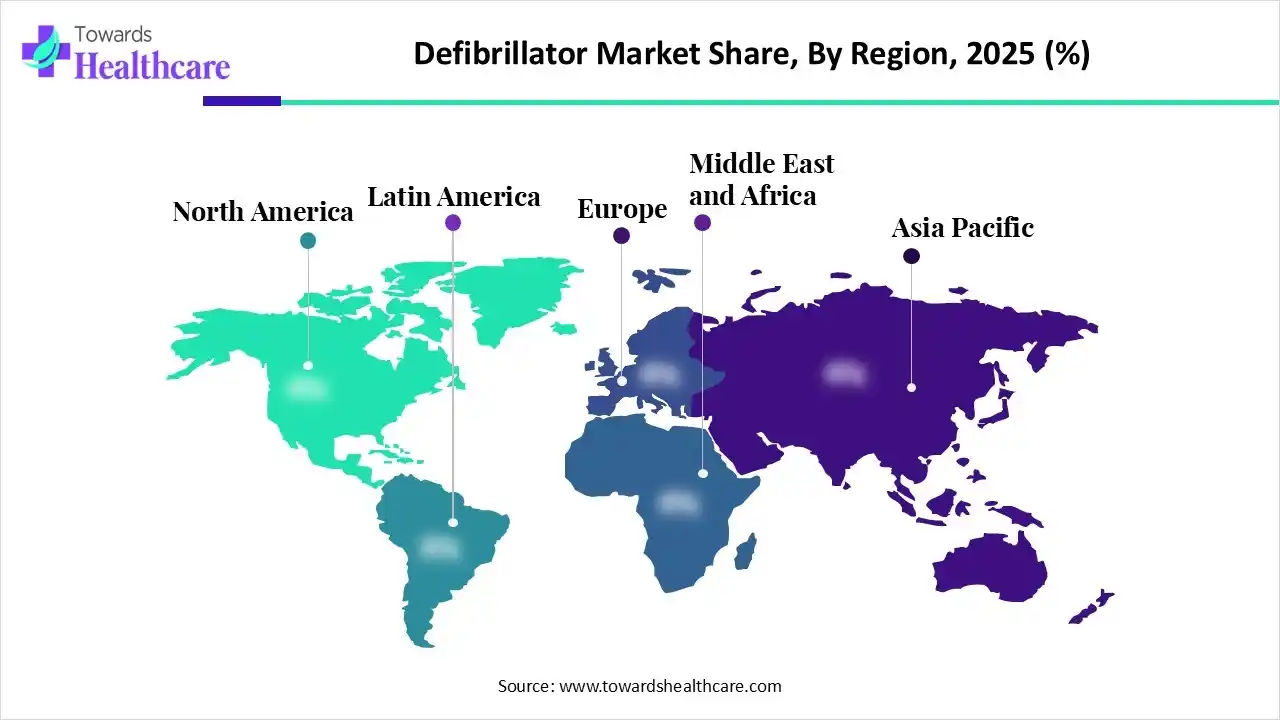
In 2025, North America led the defibrillator market by 41% share, as growing cases of cardiac diseases driven by continuing rises in high blood pressure, obesity, and other major complicating factors, cardiac disease continues to kill more people, according to the American Heart Association. In the United States, people have a heart attack each 40 seconds; each year, around 805,000 people in the United States have a heart attack. The presence of industry leaders like Medtronic, Abbott, Boston Scientific Corporation, and Stryker, which drives the growth of the market.
For Instance,
U.S. Market Trends
Increasing cases of cardiovascular diseases (CVD) are largely attributed to unhealthy lifestyle factors like alcohol consumption, physical inactivity, smoking, and unhealthy food habits. U.S. and international sites are to make and bolster the guideline infrastructure to help population-based heart disease prevention, which drives the growth of the market.
Canada
Canada has seen a steady increase in demand for defibrillators because of the high rate of cardiovascular disease, the desire for more awareness about sudden cardiac arrest, and an established health care system. The growing use of automated external defibrillators (AEDs) both in public and in hospitals has strengthened this industry.
Mexico
Mexico’s healthcare is also seeing a sharp increase in the number of defibrillators. The prevalence of cardiovascular disease continues to be a major national health problem, and many government initiatives aimed at improving emergency medical services, increased funding for health care, and higher public awareness of cardiac emergencies are all driving more defibrillator use in emergency rooms, doctors' offices, and public spaces.
Asia Pacific is set to experience rapid growth in the defibrillator market by 21% share due to the rapidly increasing burden of cardiovascular disease (CVD) in this region. The number of aging people in the Asia-Pacific will triple, reaching 1.3 billion by 2050, which increases the demand of defibrillator. Growing disposable incomes are driving healthcare investment, also increasing the burgeoning pow middle class in this region, which contributes to the growth of the market.
For Instance,
India Market Trends
In India, increasing Government initiatives and growing public awareness campaigns support bridging the gap and encourage preventive care. India's increasing cardiac cases highlight an emergency requirement for better medical care approaches, preventive awareness, and accessible treatment. Cardiac health awareness supports lowering disease rates and enhancing treatment achievement. Early identification and better lifestyle habits prevent severe conditions, which drives the growth of the market.
Japan
Japan is experiencing increased demand for defibrillators because of its rapidly aging population and the large number of cardiovascular diseases that the population suffers from. Strong emergency medical services, highly developed healthcare systems, and widespread usage of implantable cardioverter defibrillators (ICDs) are all contributing to the continued steady growth of this market.
China
China is increasing its demand for defibrillators more rapidly than any other market in the world because of the growing number of people who die from cardiovascular disease, the expanding healthcare system, and increased public education about cardiac emergencies. Extensive government efforts to improve emergency preparedness and increase access to advanced medical equipment have quickly led to more widespread adoption.
Europe is experiencing substantial growth in the defibrillator market by 26% share, as heart diseases are the leading cause of death in Europe, accounting for over 42.5% of all deaths per year, which increases the demand of defibrillator. The growing installation of automated external defibrillators (AEDs) in the workplace in Europe, which drives the growth of the market.
UK Market Trends
Cardiovascular disease (CVD) is the most usual causes of death in the UK, and more than 6 million people live with CVD. Medical care expenses relating to CVD are estimated at £7.4 billion per year, which drives the growth of the market.
Germany
Germany is at the forefront of the European market for defibrillators, due in part to its advanced cardiac care systems, high healthcare spending, and its significant level of adoption of innovative medical technologies. In addition, there is a growing emphasis on early intervention for sudden cardiac arrest, which is fuelling the need for both implantable and external defibrillators.
France
France’s defibrillator market continues to grow due to an increase in cardiovascular-related health awareness, continued increases in advanced cardiac devices, and improved healthcare systems throughout the country. Moreover, government initiatives to improve public access to AEDs and to improve response time for emergency responders also support the growth of the market.
| Ecosystem Category | Market Participants / Role |
| Technology Providers | Cardiac rhythm technology developers providing shock delivery systems, sensors, monitoring algorithms, battery systems, and connectivity technologies |
| Product Manufacturers | Companies manufacturing AEDs, implantable cardioverter defibrillators (ICDs), wearable defibrillators, hospital defibrillators, and accessories |
| Service Providers | Device maintenance, training, emergency response solutions, installation, monitoring, and after-sales support |
| Platform Providers | Digital cardiac monitoring platforms integrating defibrillator data with hospital information systems |
| CROs/CDMOs | Limited role; mainly involved in medical device testing, validation, electronics manufacturing, and component production |
| Software Vendors | AI-based ECG analysis, remote monitoring platforms, predictive cardiac analytics |
| Research Institutions | Cardiovascular research centers developing arrhythmia detection, cardiac safety technologies, and device innovation |
| End-User Industries | Healthcare systems, emergency medical services, government/public safety programs, sports facilities, workplaces |
R&D:
Manufacturing Processes:
Patient Services:
| Tier 1 | Tier 2 | Tier 3 | |
| Typical Market Influence | 75% | 20% | 5% |
| Tier 1 | ||||
| Company Name | Headquarters | Country | Why Relevant to This Market | Key Products/Services |
| Medtronic | Minneapolis, Minnesota, USA | USA | Global leader in cardiac rhythm management with significant ICD and defibrillator business | Implantable cardioverter defibrillators, cardiac resynchronization therapy defibrillators (CRT-D), monitoring solutions |
| Boston Scientific | Marlborough, Massachusetts, USA | USA | Major cardiovascular device company with strong electrophysiology and ICD portfolio | EMBLEM MRI S-ICD, RESONATE ICD systems, cardiac rhythm management technologies |
| Abbott | Abbott Park, Illinois, USA | USA | Strong cardiac care portfolio following expansion in electrophysiology and rhythm management | Implantable defibrillators, CRT-D systems, cardiac monitoring |
| Tier 2 | ||||
| Company Name | Headquarters | Country | Why Relevant to This Market | Key Products/Services |
| Nihon Kohden | Tokyo, Japan | Japan | Established patient monitoring and emergency cardiac equipment provider | AEDs, bedside defibrillators, ECG monitoring systems |
| Mindray | Shenzhen, China | China | Major medical device manufacturer expanding globally in emergency care | BeneHeart AEDs, patient monitoring, defibrillation systems |
| ZOLL Medical Corporation | Chelmsford, Massachusetts, USA | USA | Specialized emergency cardiac care company owned by Asahi Kasei | AEDs, wearable defibrillators, EMS defibrillation systems |
| Tier 3 | ||||
| Company Name | Headquarters | Country | Why Relevant to This Market | Key Products/Services |
| Defibtech | Guilford, Connecticut, USA | USA | Specialized AED manufacturer focused on public access defibrillation | Lifeline AED, automated external defibrillators |
| Cardiac Science | Bothell, Washington, USA | USA | Known AED technology provider with public safety applications | Powerheart AED systems |
| Nasco Healthcare | Fort Atkinson, Wisconsin, USA | USA | Provides emergency medical training equipment and AED simulation solutions | AED trainers and emergency response education products |
In April 2026, “Having both extravascular and transvenous defibrillation solutions allows physicians to meet patients where they are, providing different options that address patients’ individual needs, which can vary widely,” said Trevor Cook, VP and GM, Defibrillation Solutions at Medtronic.
Strengths
Weaknesses
Opportunities
Threat
By Product
By End User
Regional Outlook






Reviewed By
Aditi Shivarkar is a seasoned professional with over 14 years of experience in healthcare market research. As a content reviewer, Aditi ensures the quality and accuracy of all market insights and data presented by the research team.
Learn more about Aditi Shivarkar