The global digital health and AI market size was estimated at USD 320.12 billion in 2025 and is predicted to increase from USD 389.91 billion in 2026 to approximately USD 2300.31 billion by 2035, expanding at a CAGR of 21.8% from 2026 to 2035.
The market is rapidly growing, driven by AI-powered diagnostics, telemedicine, wearable devices, and predictive analytics, enhancing patient care, clinical efficiency, and cost-effective healthcare delivery.
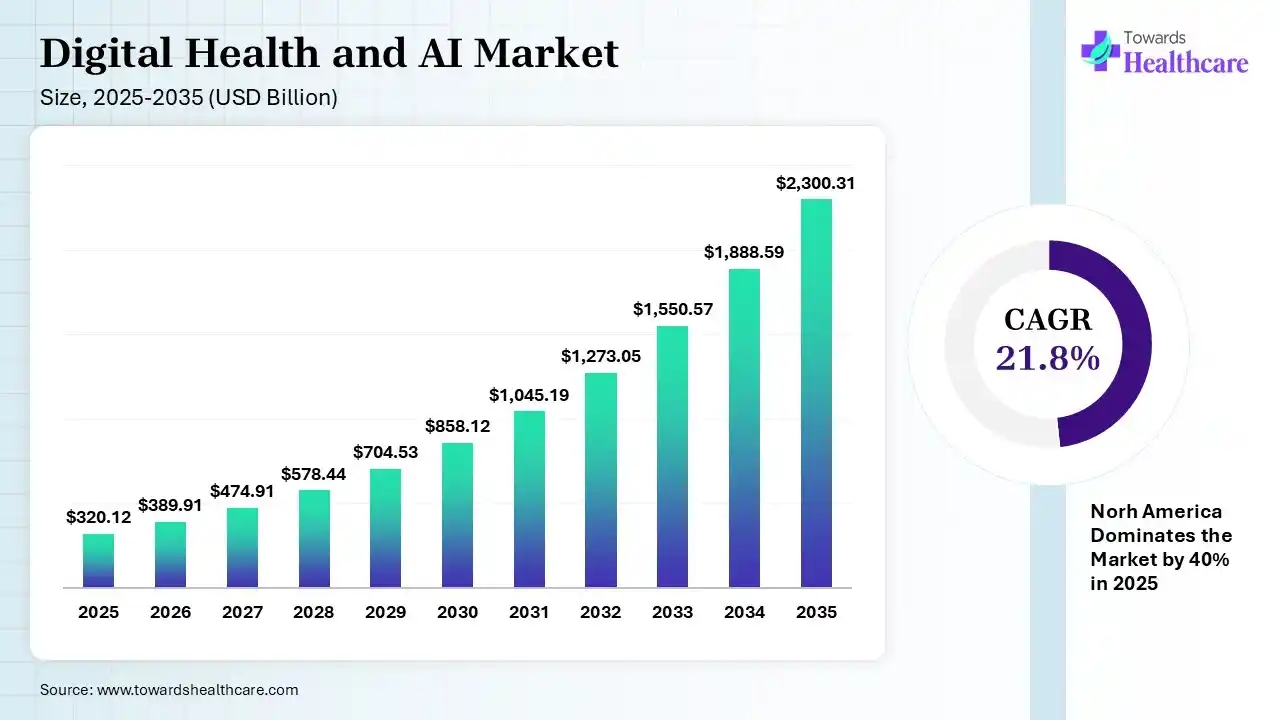
The integration of artificial intelligence into digital health technologies to collect, analyze, and interpret medical data enables improved clinical decisions, personalized patient care, and more efficient healthcare delivery. The digital health and AI market is expanding as healthcare providers adopt AI tools for faster diagnostics, personalized treatments, and remote patient monitoring. Growing volumes of medical data, the rise of telehealth, and the push for cost-effective care are key drivers. Advances in machine learning, predictive analytics, and wearable health devices are enhancing clinical efficiency and patient outcomes, fueling the global growth of the sector.
Artificial intelligence is significantly shaping the market by enabling faster and more accurate diagnostics, improving treatment personalization, and supporting real-time patient monitoring. It enhances clinical decision-making through predictive analytics and reduces operational costs by automating routine tasks. Additionally, AI-driven insights from large health datasets are accelerating innovation, improving patient outcomes, and increasing the adoption of advanced digital healthcare solutions worldwide.
Rise of Personalized Healthcare
AI is enabling highly tailored treatment plans by analyzing patient-specific data, including genetics and lifestyle. This shift toward precision medicine is expected to improve outcomes, increase patient engagement, and drive demand for advanced digital health solutions.
Expansion of Remote Monitoring and Telehealth
The growing use of wearable devices and telehealth platforms allows continuous patient monitoring outside clinical settings. AI enhances real-time data analysis, early disease detection, and proactive care, making healthcare more accessible and efficient.
Integration of Predictive and Preventive Care
AI-driven predictive analytics is shifting healthcare from reactive to preventive models. Identifying potential health risks early, it helps reduce hospitalizations, lower costs, and improve long-term population health management.
| Table | Scope |
| Market Size in 2026 | USD 389.91 Billion |
| Projected Market Size in 2035 | USD 2300.31 Billion |
| CAGR (2026 - 2035) | 21.8% |
| Leading Region | North America by 42% |
| Historical Data | 2020 - 2023 |
| Base Year | 2025 |
| Forecast Period | 2026 - 2035 |
| Measurable Values | USD Millions/Units/Volume |
| Market Segmentation | By Technology, By AI Technology, By Component, By Application, By End User, By Deployment Mode, By Region |
| Top Key Players | Microsoft Corporation, Alphabet Inc., IBM Corporation, Oracle Corporation, Cerner Corporation, Epic Systems Corporation, Koninklijke Philips N.V. |
The Telehealth/Telemedicine Segment Dominated the Market in 2025
| Segment | Share 2025 (%) |
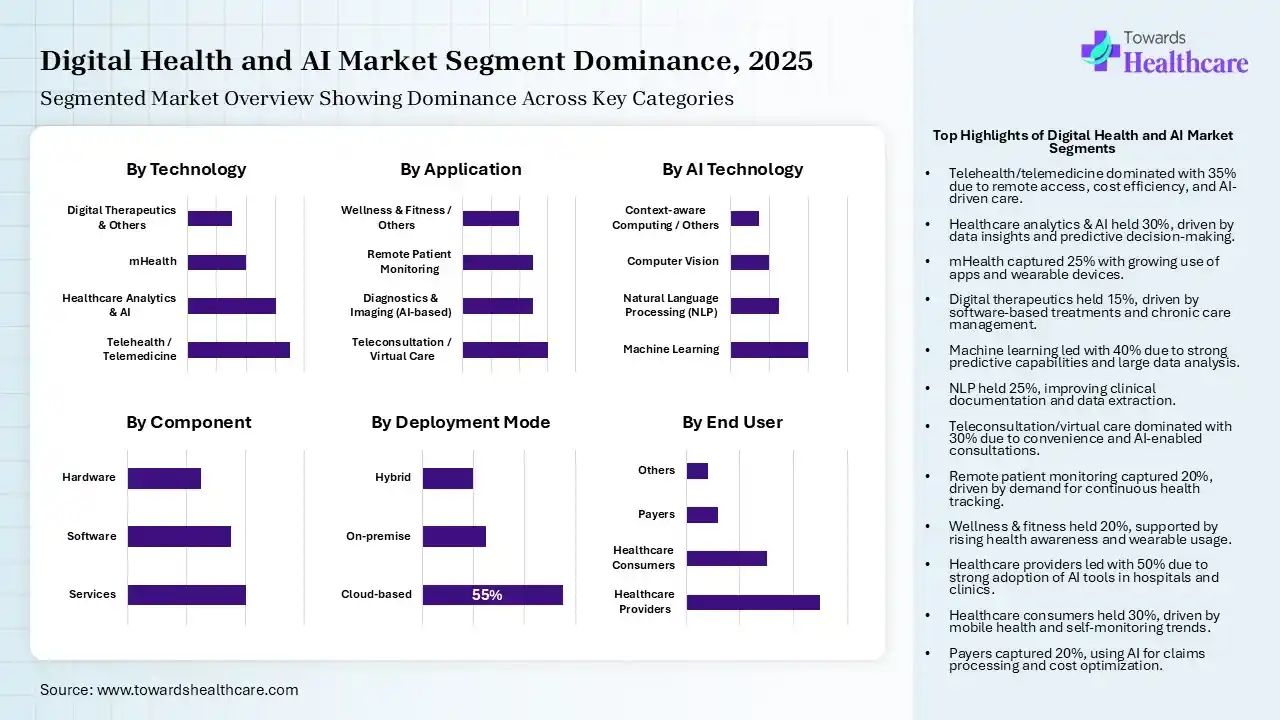
| Telehealth / Telemedicine | 35% |
| Healthcare Analytics & AI | 30% |
| mHealth | 20% |
| Digital Therapeutics & Others | 15% |
Explanation
The telehealth/telemedicine segment dominated the digital health and AI market with approximately 35% of the share in 2025 due to its ability to provide convenient, remote access to healthcare services. Increased demand for virtual consultations, integration of AI for real-time diagnosis and monitoring, reduced healthcare costs, and improved accessibility, especially in remote areas, significantly contributed to its leading market share.
With 96% of hospital executives prioritizing digital strategies, 58% are adopting generative AI in 2024.
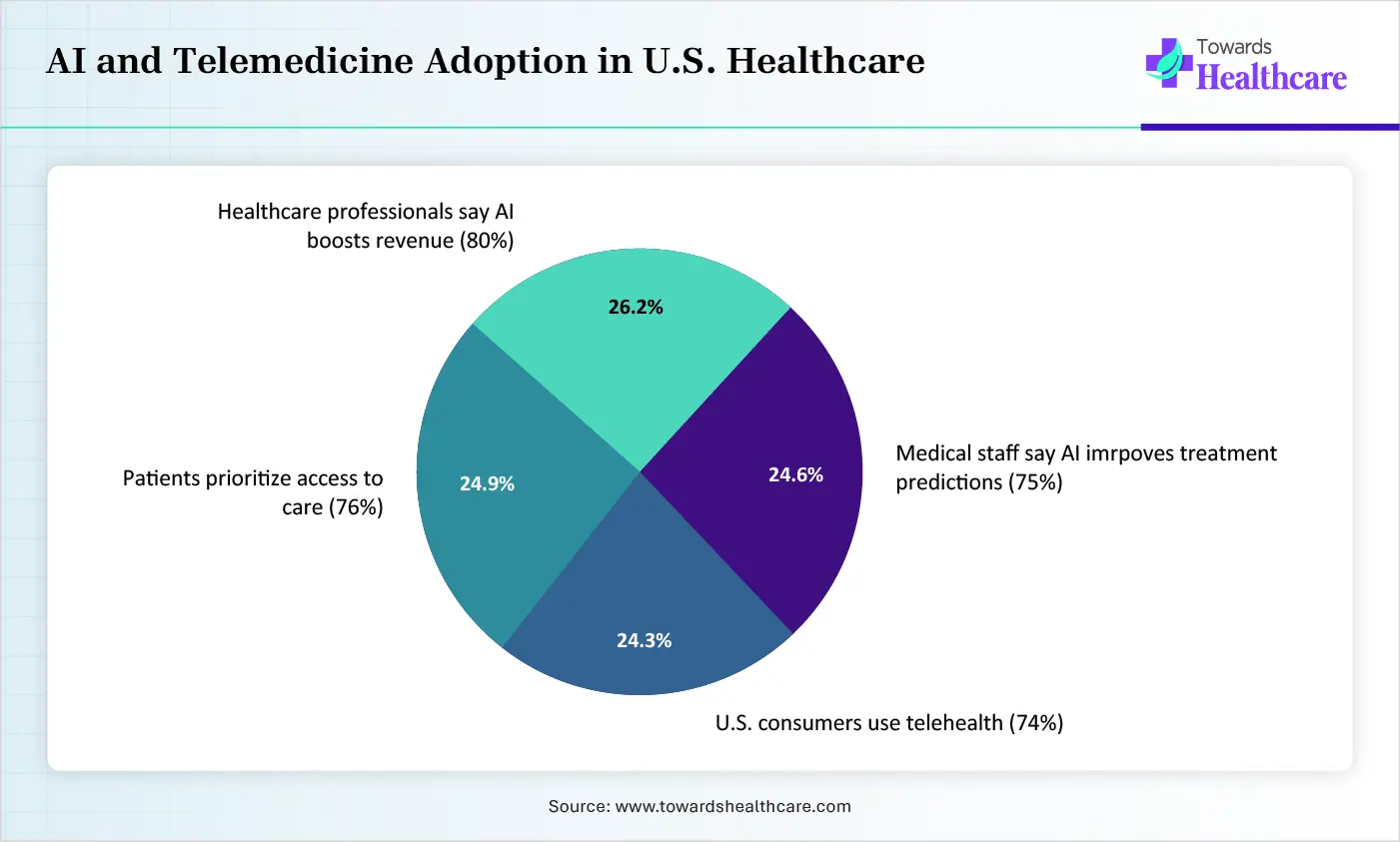
The healthcare analytics & AI segment held the second-largest share of approximately 30% of the market in 2025 due to its critical role in processing vast healthcare data for actionable insights. It supported clinical decision-making. Improved operational efficiency, enabled predictive analytics, and enhanced patient outcomes, driving widespread adoption across healthcare providers and contributing significantly to market growth.
The mHealth segment held a digital health and AI market share of approximately 25% in 2025 due to increasing smartphone penetration and widespread use of health apps and wearable devices. It enables real-time health tracking, remote monitoring, and personalized care. Integration of AI enhances user engagement, early diagnosis, and preventive care, driving strong adoption and market expansion.
The digital therapeutics & others segment captured approximately 15% share of the market in 2025 because of the growing demand for software-based treatments and non-invasive care solutions. AI integration is enhancing treatment effectiveness, patient adherence, and real-time monitoring. Increasing regulatory support and focus on chronic disease management are further driving adoption and market growth.
The Machine Learning Segment Led the Market in 2025 with the Largest Share
| Segment | Share 2025 (%) |
| Machine Learning | 40% |
| Natural Language Processing (NLP) | 25% |
| Computer Vision | 20% |
| Context-aware Computing / Others | 15% |
Explanation
The machine learning segment led the digital health and AI market with approximately 40% share in 2025 due to its strong capability to analyze large and complex healthcare datasets for accurate predictions and insights. It has been widely used in diagnostics, risk assessment, and personalized treatment planning. Its scalability, continuous learning ability, and integration across digital health platforms have driven its dominant market position.
The Natural Language Processing (NLP) segment held the second largest share of approximately 25% in 2025 due to its ability to extract insights from unstructured clinical data such as medical records, reports, and physician notes. It has improved documentation efficiency, enabled voice-based systems, and supported clinical decision-making, driving widespread adoption across healthcare organizations.
The computer vision segment held a market share of approximately 20% in 2025 due to its ability to analyze medical images for accurate and early diagnosis. It supports applications in radiology, pathology, and disease detection. Advancements in imaging technologies and AI algorithms are improving diagnostic precision, efficiency, and adoption across healthcare systems.
The context-aware computing/others segment captured approximately 15% share of the digital health and AI market in 2025 due to its ability to deliver personalized, real-time healthcare insights based on patient behavior, location, and environment. It enhances patient engagement, supports proactive care, and improves decision-making, driving increasing adoption across advanced digital health platforms.
The Teleconsultation/Virtual Care Segment held a dominant position in the Market in 2025
| Segment | Share 2025 (%) |
| Teleconsultation / Virtual Care | 30% |
| Diagnostics & Imaging (AI-based) | 25% |
| Remote Patient Monitoring | 25% |
| Wellness & Fitness / Others | 20% |
Explanation
The teleconsultation/virtual care segment dominated the market with a share of approximately 30% in 2025 due to its convenience, reduced need for in-person visits, and improved access to healthcare services. High patient adoption, integration of AI for faster diagnosis and follow-ups, and cost efficiency have significantly driven its widespread use across healthcare systems.
The diagnostics & imaging (AI-based) segment held the second largest share of approximately 25% in 2025 due to its ability to enhance accuracy and speed in disease detection. AI integration has improved image analysis, reduced diagnostic errors, and supported early detection. Increasing demand for advanced imaging solutions has driven their strong adoption across healthcare providers.
The remote patient monitoring segment captured approximately 20% share of the digital health and AI market in 2025 because of the rising demand for continuous health tracking and reduced hospital visits. AI-enabled devices have supported real-time data analysis, early detection, and personalized care. Increasing chronic disease cases and the adoption of wearable technologies have further driven its growth.
The wellness & fitness/other segment held a market share of approximately 20% in 2025 due to rising health awareness and growing use of fitness apps and wearable devices. AI integration has enabled personalized recommendations, activity tracking, and preventive care. Increasing consumer focus on lifestyle management has further driven adoption and market growth.
The Healthcare Providers Segment held the Largest Market Share in 2025
| Segment | Share 2025 (%) |
| Healthcare Providers | 50% |
| Healthcare Consumers | 30% |
| Payers | 12% |
| Others | 8% |
Explanation
The healthcare providers segment held approximately 50% revenue of the market in 2025 due to widespread adoption of AI-driven tools for diagnostics, treatment planning, and patient management. Hospitals and clinics have invested heavily in digital health solutions to improve efficiency, reduce costs, and enhance patient outcomes, driving their dominant position in the market.
The healthcare consumers segment held the second largest share of approximately 30% in 2025 due to increasing use of mobile health apps, wearable devices, and telehealth services. Growing awareness of personal health management and demand for convenient, at-home care solutions has driven adoption, supported by AI-enabled personalized insights and monitoring tools.
The payers segment held a digital health and AI market share of approximately 20% in 2025 due to increasing adoption of AI for claims processing, fraud detection, and risk assessment. It improved operational efficiency, reduced costs, and enabled data-driven decision-making. Rising focus on value-based care and cost optimization has further driven its growth.
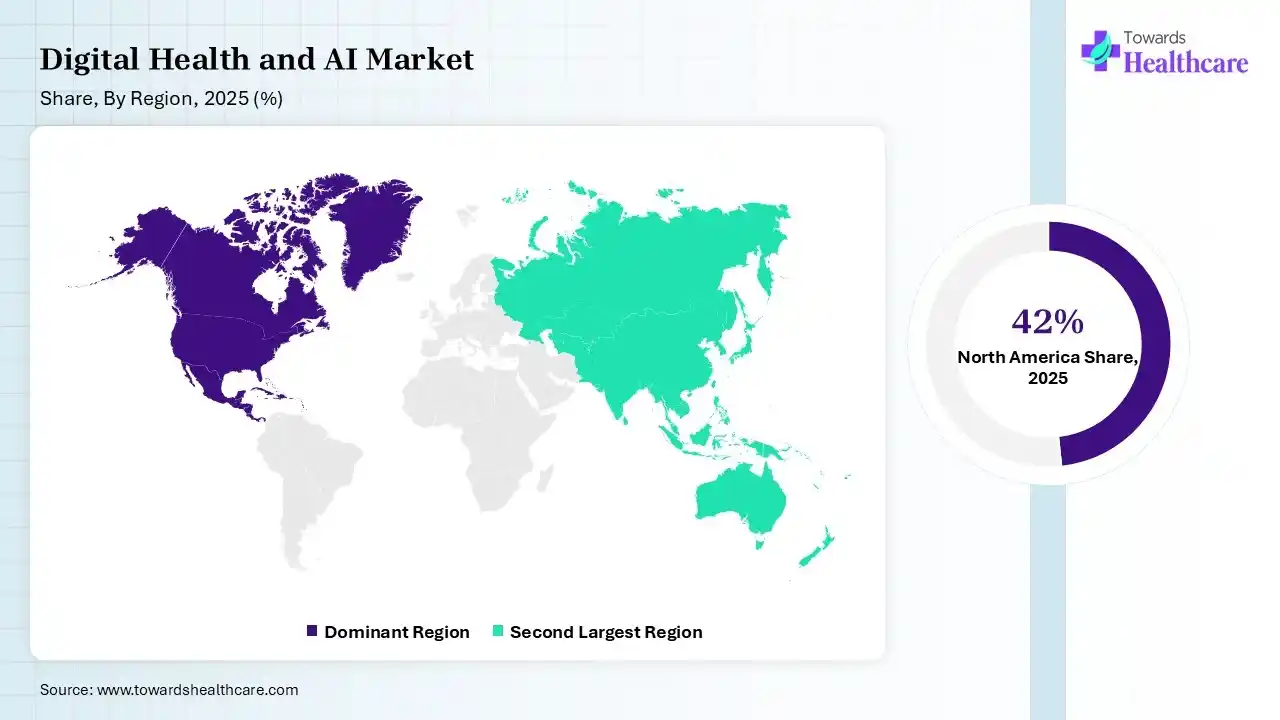
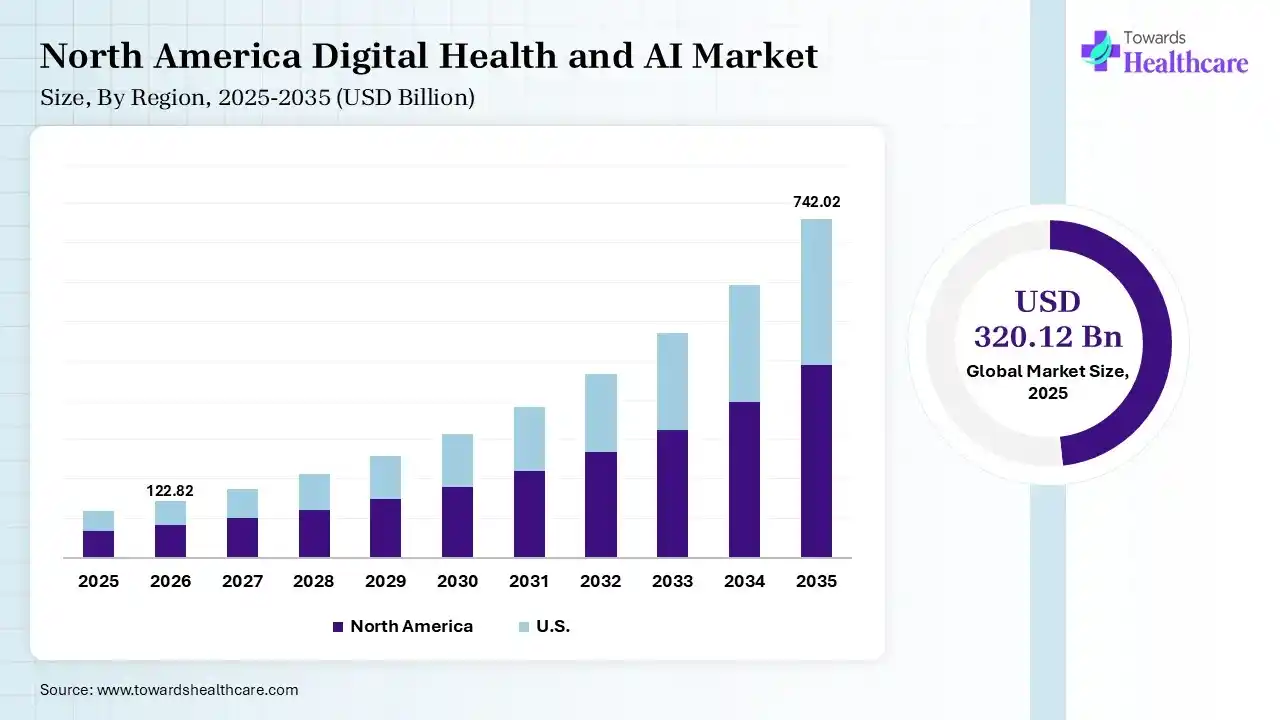
North America dominated the digital health and AI market with a share of approximately 42% in 2025 due to the strong presence of advanced healthcare systems, high adoption of AI-driven technologies, and significant investment in digital health innovations. The region benefited from widespread use of telehealth, electronic health records, and supportive regulatory policies. Additionally, continuous technological advancements, strong funding support, and increasing demand for efficient, data-driven healthcare solutions further accelerated market growth and adoption.
U.S. Market Trends
The U.S. led the digital health and AI market due to its strong ecosystem of technology innovators, advanced healthcare infrastructure, and high investment in AI research. Early adoption of digital health solutions, widespread use of electronic health records, and supportive regulations continue to drive growth, while increasing demand for efficient and personalized healthcare further strengthens its leadership.
Canada Market Trends
Canada's digital health and AI market is growing through strong government support, electronic health records, and expanding virtual care services. Competition includes technology companies, healthcare startups, and hospital networks developing AI solutions. AI is increasingly used for diagnostics, imaging, and workflow automation. Growth opportunities come from remote patient monitoring, rural healthcare access, cybersecurity investments, personalized medicine, and stronger partnerships between research institutions, hospitals, and digital health innovators.
Mexico Market Trends
Mexico is expanding its digital health and AI market through rising telemedicine adoption and healthcare digitalization. Public and private healthcare providers are investing in AI-powered diagnostics and patient management systems. Competition includes local technology firms, multinational companies, and healthcare startups. Growth opportunities come from improving healthcare access in underserved regions, increasing smartphone use, expanding cloud infrastructure, and government initiatives supporting digital transformation across medical facilities nationwide.
Asia Pacific is anticipated to grow at the fastest CAGR in the digital health and AI market, and it also held a revenue share of approximately 30% of the market in 2025 due to rising healthcare digitization, increasing smartphone penetration, and expanding access to telehealth services. Growing investments in healthcare infrastructure, supporting government initiatives, and a large patient population are driving demand, while rapid adoption of AI technologies is accelerating regional market growth.
India Market Trends
India is anticipated to grow at the fastest CAGR in the digital health and AI market due to rapid digital transformation, increasing smartphone and internet penetration, and expanding telehealth adoption. Government initiatives, growing healthcare investments, and a large patient population are driving demand, while rising awareness and adoption of AI-driven solutions are accelerating the market expansion.
China Market Trends
China remains a major digital health and AI market because of strong government support, advanced artificial intelligence capabilities, and large healthcare datasets. Technology companies actively develop AI tools for diagnostics, medical imaging, and hospital management. Competition is intense among domestic firms and global healthcare technology providers. Growth opportunities include precision medicine, smart hospitals, wearable health devices, expanding cloud platforms, and continued investments in healthcare innovation.
Japan Market Trends
Japan's digital health and AI market benefits from an aging population and strong demand for efficient healthcare services. Hospitals increasingly adopt AI for diagnostics, robotic assistance, and clinical decision support. Competition includes established healthcare technology companies and innovative startups. Growth opportunities come from remote monitoring, home healthcare, digital therapeutics, electronic health records, and government programs encouraging healthcare digitalization while improving care quality and operational efficiency nationwide.
Europe is anticipated to grow at a notable CAGR in the digital health and AI market due to strong regulatory frameworks, increasing adoption of digital health technologies, and rising investments in AI-driven healthcare solutions. The region benefits from well-established healthcare systems, a growing focus on data privacy and interoperability, and expanding use of telehealth and electronic records, which are collectively supporting steady market growth.
UK Market Trends
The UK is anticipated to grow at a significant CAGR in the digital health and AI market due to strong government support, increasing investments in AI-driven healthcare, and widespread adoption of digital health technologies. The presence of advanced healthcare infrastructure, growing focus on innovation, and rising demand for efficient, data-driven care solutions are further driving market expansion in the country.
Germany Market Trends
Germany is strengthening its digital health and AI market through advanced healthcare infrastructure and supportive digital health regulations. Hospitals and healthcare providers increasingly use AI for imaging, diagnostics, and workflow optimization. Competition includes global technology companies, medical device manufacturers, and local software developers. Growth opportunities come from electronic patient records, digital therapeutics, predictive analytics, precision medicine, and greater integration of AI across healthcare delivery systems.
France Market Trends
France is expanding its digital health and AI market through national healthcare digitalization strategies and increasing artificial intelligence adoption. Hospitals are integrating AI into radiology, pathology, and clinical decision support. Competition includes healthcare software providers, research organizations, and international technology companies. Growth opportunities include telehealth expansion, data-driven healthcare, personalized medicine, stronger research collaborations, and increasing investments in secure digital infrastructure supporting modern patient care nationwide.
R&D
Clinical Trials
Patient Support and Services
| Companies | Headquarter | Offerings |
| Microsoft Corporation | Redmond, USA | Cloud-based healthcare platforms, AI-driven analytics, virtual care tools, and solutions for clinical data integration and decision support |
| Alphabet Inc. | Mountain View, USA | AI-powered healthcare research, medical imaging analysis, health data platforms, and predictive analytics solutions |
| IBM Corporation | Armonk, USA | AI-based healthcare analytics, clinical decision support systems, and tools for population health management |
| Oracle Corporation | Austin, USA | Cloud healthcare infrastructure, electronic health record systems, and AI-enabled data management solutions |
| Cerner Corporation | Missouri, USA | Digital health records, hospital information systems, and data-driven clinical workflow solutions |
| Epic Systems Corporation | Wisconsin, USA | Integrated EHR platforms, patient management systems, and AI-supported clinical tools |
| Koninklijke Philips N.V. | Amsterdam, Netherlands | AI-enabled imaging systems, remote patient monitoring, and connected healthcare solutions |
In July 2026, commenting on his appointment, Ravi Joshi, President & CEO – Digital Healthcare, said, “Digital healthcare presents an exciting opportunity to be the health partner every Atithi can trust, at every moment of their life. And transcend their relationship with health from being episodic and reactive to continuous and lifelong care partnerships. I look forward to building this new business, beginning with our Doctor’s Program, and creating innovative digital healthcare solutions that complement Happiest Health’s broader vision of preventive and integrated healthcare.”
Strengths
Weaknesses
Opportunities
Threats
By Technology
By AI Technology
By Component
By Application
By End User
By Deployment Mode
By Region







Principal Consultant
Payal Rabde is a Healthcare Market Research Analyst at Towards Healthcare Research & Consulting with 4+ years of experience in pharmaceuticals, biotechnology, medical devices, and life sciences.
Learn more about Payal Rabde

Reviewed By
Aditi Shivarkar is a seasoned professional with over 14 years of experience in healthcare market research. As a content reviewer, Aditi ensures the quality and accuracy of all market insights and data presented by the research team.
Learn more about Aditi Shivarkar