

Pipeline Programs

CGT Companies Tracked

Manufacturing Facilities


The global blockchain in pharmaceutical market size was estimated at USD 1.14 billion in 2025 and is predicted to increase from USD 1.43 billion in 2026 to approximately USD 11.23 billion by 2035, expanding at a CAGR of 25.7% from 2026 to 2035.
Globally accelerating focus on ensuring the drug’s authenticity, integration of blockchain with IoT, and rigorous regulatory compliance are impelling innovations in technology. Gradually, leading pharma companies are spurring robust cold chain solutions to maintain the quality of temperature-sensitive products, like vaccines.
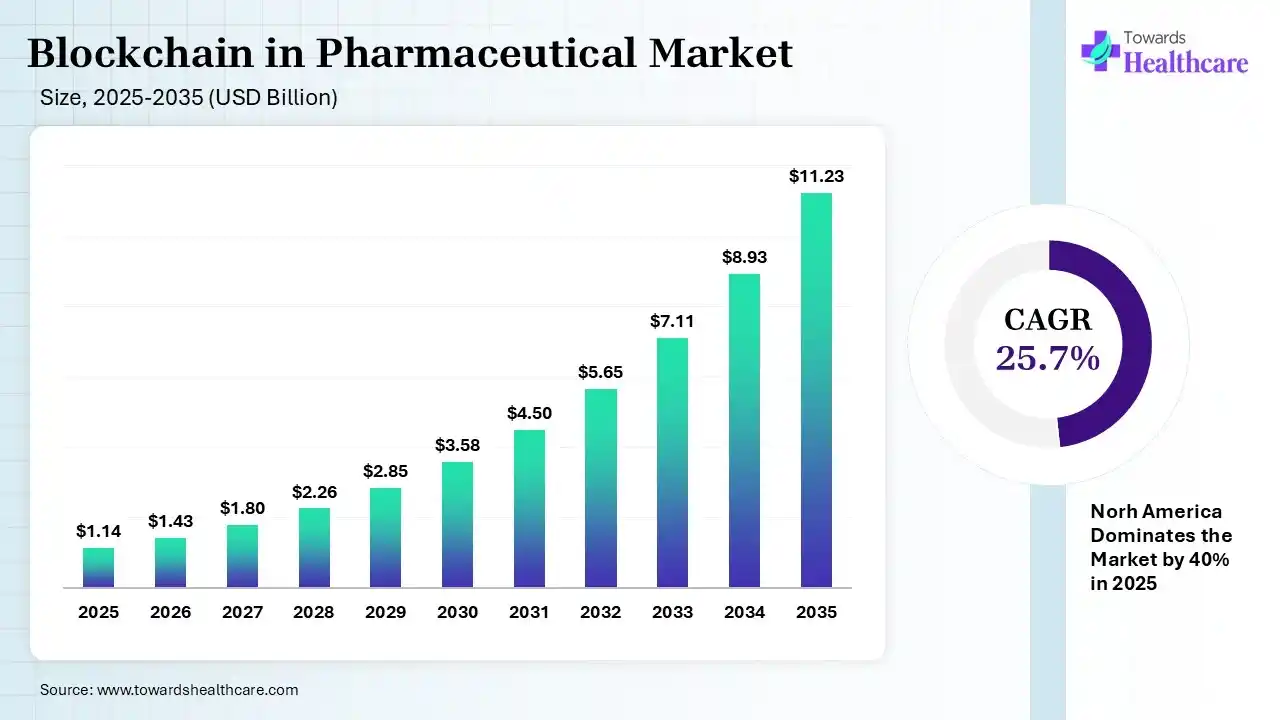
The global blockchain in pharmaceutical market is expanding due to the key aspects of advanced blockchain, which highly provide a decentralized, tamper-proof system to monitor drugs from manufacturer to patient, with enhanced visibility & also allows for faster identification of concerns. Alongside, through the unique digital identities (UPI) of products, it helps regulators to ensure authenticity at any stage, which protects consumers & brand reputation. Moreover, blockchain has a major role in preserving patient data through decentralized storage & cryptographic signatures, which decreases issues in healthcare data exchanges.
Blockchain in the pharmaceutical is the application of decentralized digital ledger technology to securely record, verify and share data across drug development, manufacturing, distribution, clinical trials, and the pharmaceutical supply chain. The market is growing due to increasing concerns over counterfeit medicine, rising demand for end-to-end drug traceability, and stricter regulatory compliance requirements. Technological advancements, including blockchain integration and artificial intelligence (AI), internet of things (IoT), smart contracts, and cloud platforms, are improving supply chain transparency, data security, and operational efficiency.
A key trend is the adoption of blockchain-enabled serialization and real-time product tracking to enhance patient safety. Future opportunities lie in expanding decentralized clinical trials management, secure cross-broader data exchange decentralized clinical trial management, secure cross-broader data exchange, automated compliance processes, and collaborative digital ecosystems that strengthen pharmaceutical quality, transparency, and global supply chain resilience.
The worldwide adoption of AI is extensively bolstering drug discovery, supply chain security, and clinical trials through the integration of predictive analytics with immutable, decentralized data management. Whereas, rigorous AI algorithms are supporting the analysis of blockchain-recorded data to improve inventory, estimate demand, and find bottlenecks, leading to minimal waste & ensuring quality control.
Emphasizing IoT & AI Integration
Through the pairing of blockchain with IoT, enabling real-time tracking of environmental conditions for sensitive products, by using AI in the study of this data to foster production, quality control, & logistics.
Expanding Scalability & Performance Improvement
The upcoming era will execute Layer-2 solutions and off-chain data storage mechanisms to minimize on-chain storage burdens & increase scalability, with strong performance.
Surging Privacy-Securing Technologies
Due to the rising issues regarding data privacy & published GDPR and HIPAA regulations, the market will pose emerging advanced techniques, including Zero-Knowledge Proofs (ZKPs) to verify data authenticity without exposing sensitive information.
| Table | Scope |
| Market Size in 2026 | USD 1.43 Billion |
| Projected Market Size in 2035 | USD 11.23 Billion |
| CAGR (2026 - 2035) | 25.7% |
| Leading Region | North America by 40% |
| Key Applications | Drug serialization, supply chain traceability, counterfeit drug prevention, clinical trial data integrity, regulatory compliance, smart contracts, patient data exchange |
| Primary End Users | Pharmaceutical manufacturers, biotech companies, wholesalers, distributors, hospitals, pharmacies, regulators, CROs |
| Key Challenges | Integration complexity, interoperability issues, regulatory uncertainty, implementation costs, scalability concerns |
| Measurable Values | USD Millions/Units/Volume |
| Market Segmentation | By Product, By Application, By End User, By Region |
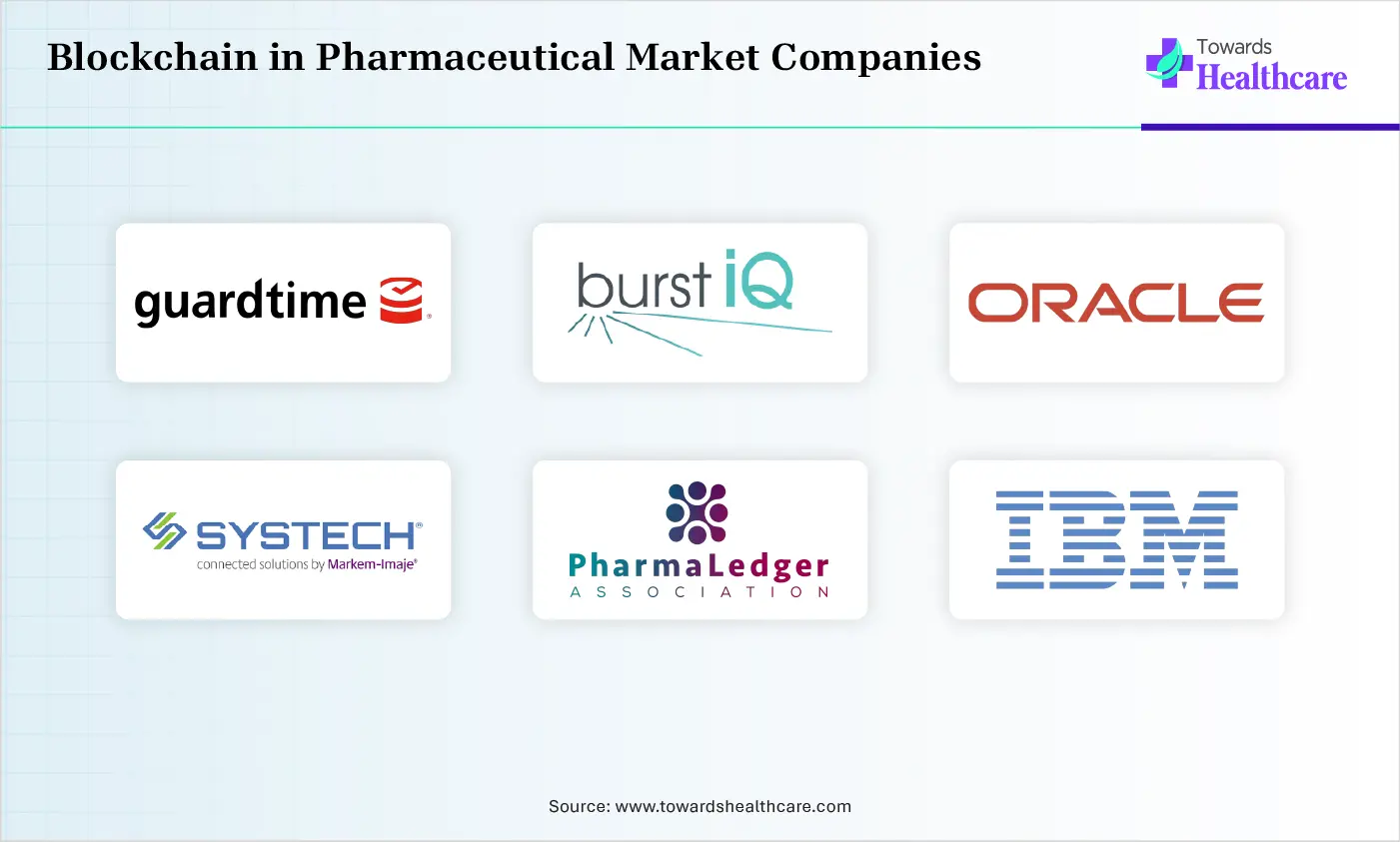
| Top Key Players | Guardtime, BurstIQ, Oracle, Systech, PharmaLedger Association, PharmaTrail AG, IBM, Blockchain Industry Group (BIG) |
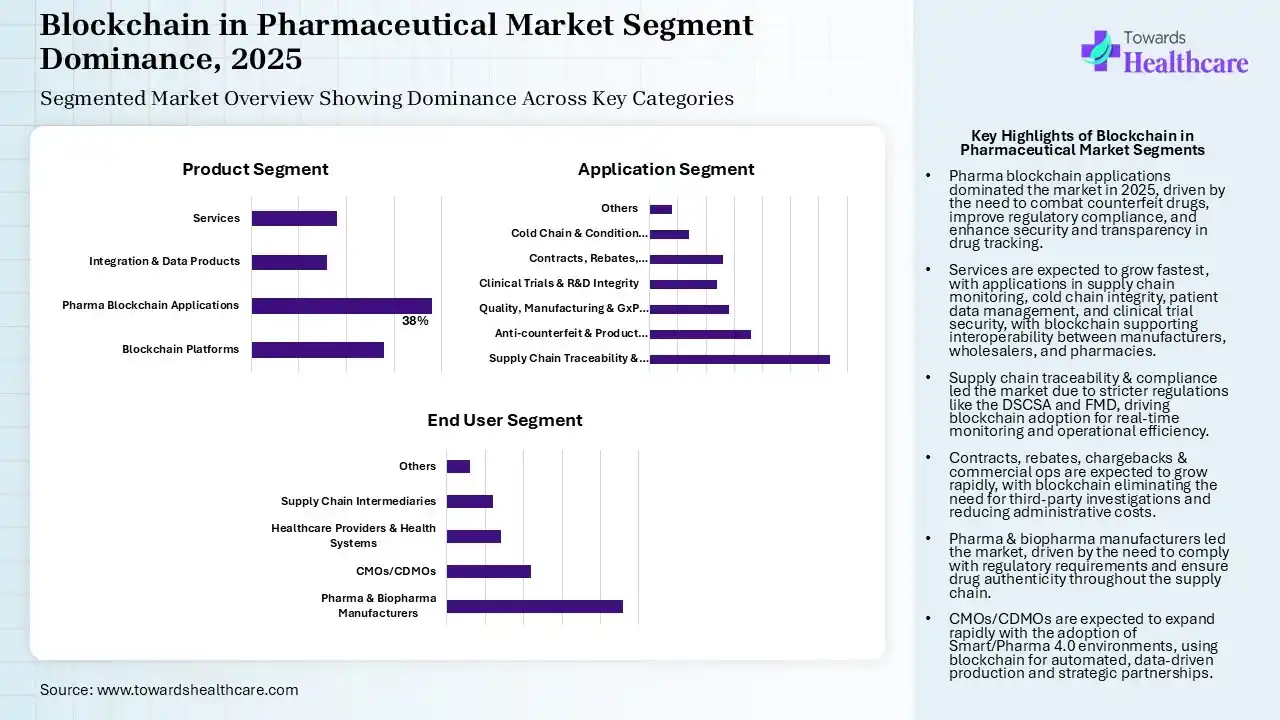
The Pharma Blockchain Applications Segment Led the Market in 2025
| Segment | Share 2025 (%) |
| Blockchain Platforms | 28% |
| Pharma Blockchain Applications (Dominant) | 38% |
| Integration & Data Products | 16% |
| Services (Fastest Growing) | 18% |
Explanation
In 2025, the pharma blockchain applications segment captured a major share of the blockchain in pharmaceutical market by 28%. Key drivers are accelerating the need to remove counterfeit drugs, rising demands for regulatory agencies for stringent traceability, and a growing necessity for increased security, transparency, & effectiveness in tracking. Consistent developments are focusing on merging new platforms, such as Nebula & EncrypGen, which enable managing & controlling access to their genetic data.
However, the services segment is predicted to show the fastest growth. This primarily covers supply chain monitoring, cold chain integrity, patient data management, & clinical trial data security. The era is pushing a full-scale, production-ready blockchain network to meet the strict interoperability requirements of the DSCSA & likeness EU directives. For this, companies are stepping towards consortium-based models, which spur interoperability between manufacturers, wholesalers, & pharmacies.
The Supply Chain Traceability & Compliance Segment Dominated the Market in 2025
| Segment | Share 2025 (%) |
| Supply Chain Traceability & Compliance | 32% |
| Anti-counterfeit & Product Authentication | 18% |
| Quality, Manufacturing & GxP Evidence | 14% |
| Clinical Trials & R&D Integrity | 12% |
| Contracts, Rebates, Chargebacks & Commercial Ops | 13% |
| Cold Chain & Condition Monitoring Attestations | 7% |
| Others | 4% |
Explanation
The supply chain traceability & compliance segment led the blockchain in pharmaceutical market by 32% in 2025. Expansion of stricter regulatory guidelines like DSCSA, & the need for optimized operational efficiency & cold chain monitoring are fueling the adoption of advanced blockchain. Gradually, the market has been implementing the integration of blockchain with IoT sensors to offer real-time monitoring of sensitive products, like vaccines & biologics.
On the other hand, the contracts, rebates, chargebacks & commercial ops segment is estimated to expand rapidly. A prominent driver is rising failures of millions in industries due to weak, manual, and often disputed chargeback reconciliation, where smart contracts omit the requirement for third-party investigation, also saving billions of expenditures & lowers revenue leakage. Besides this, these rebates assist in automating retrospective rebates paid to payers based on contractually accepted performance encouragement, which minimizes administrative friction.
The Pharma & Biopharma Manufacturers Segment Was Dominant in the Market in 2025
| Segment | Share 2025 (%) |
| Pharma & Biopharma Manufacturers | 46% |
| CMOs/CDMOs | 22% |
| Healthcare Providers & Health Systems | 14% |
| Supply Chain Intermediaries | 12% |
| Others | 6% |
Explanation
In 2025, the pharma & biopharma manufacturers segment registered dominance in the blockchain in pharmaceutical market by 46% in 2025. Dominance is led by the surging need to comply with strict regulations of the US Drug Supply Chain Security Act (DSCSA) and the EU Falsified Medicines Directive (FMD), rising demand to boost operational efficiency, lower spending, and adapt to advanced integrations. Mainly in tracking and tracing of drugs from raw materials to patients, blockchains bolster ensuring authenticity & preserving brand reputation.
Moreover, the CMOs/CDMOs segment is anticipated to expand at a rapid CAGR. Eventual developments are posing the wider adoption of Smart/Pharma 4.0 environments, where blockchain serves as a trust layer for automated, data-driven production for CMOs. Besides this, advanced technology is allowing for strategic alliances, which evolve into one-stop-shop circumstances for perfect data sharing around the comprehensive development-to commercialization chain.
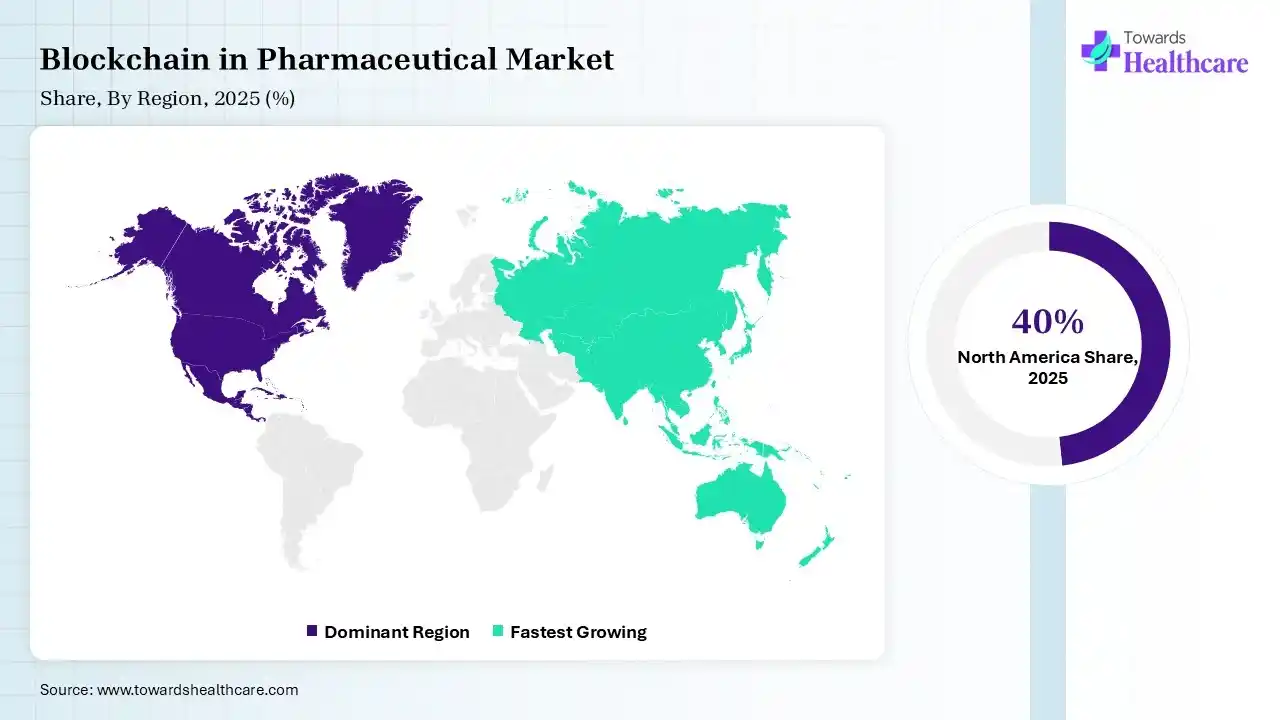
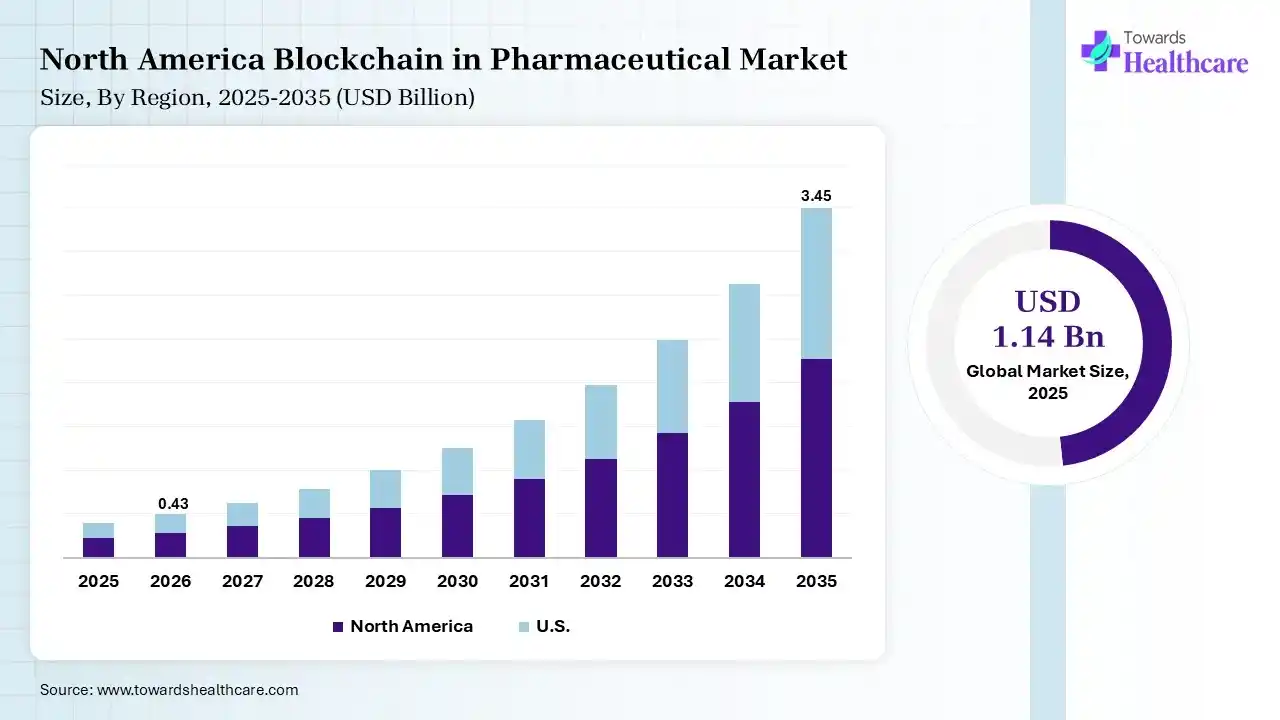
North America led the blockchain in pharmaceutical market by 40% in 2025 due to the roughly $200 billion annual loss of the pharmaceutical industries, & the emergence of stringent rules, like the Drug Supply Chain Security Act (DSCSA) in the U.S. Also, provincial health authorities are rigorously testing blockchain solutions, particularly for tracking controlled substances & high-value pharmaceuticals.
For instance,
U.S. Market Trends
The U.S. was the biggest contributor to the blockchain in pharmaceutical market, as it has implemented MediLedger, a prominent blockchain network. This is widely employed to verify returned medicines & automate chargebacks, with leaders, such as Pfizer, Genentech, Amgen, & substantial wholesalers, including McKesson & Cardinal Health.
Canada’s Blockchain in Pharmaceutical Marekt Leads Through String Digital Innovation
Canada’s blockchain in pharmaceutical market dominates due to its advanced digital healthcare infrastructure, strong pharmaceutical and biotechnology sector, and increasing investment in secure supply chain technologies. Rising adoption of blockchain for drug traceability, counterfeit prevention, clinical trials data management, and regulatory compliance, supported by government-backed digital health initiatives and collaborations between technology providers and pharmaceutical companies, countries to strengthen the country’s leadership.
Asia Pacific is predicted to register rapid expansion in the market, as China, Japan, and South Korea are heavily investing in the digital revolution. Also, APAC has been encouraging the execution of Blockchain-as-a-Service (BaaS) & permissioned networks to meet privacy and regulatory standards.
For instance,
China Market Trends
Furthermore, China’s blockchain in pharmaceutical market is shifting towards integration of blockchain with supply chain finance, which enables pharmaceutical players to solve liquidity concerns, as in Jixiangtian. This further facilitates a secure platform for interactions among manufacturers, third-party logistics, & financial institutions.
India Blockchain in Pharmaceutical Market Expands Through Digital Transformation
India’s blockchain in pharmaceutical market is expanding due to the rapid growth of the pharmaceutical manufacturing sector, increasing demand for secure drug traceability, and rising concerns over counterfeit medicines. Growing adoption of blockchain-enabled supply chain solutions, supportive digital health initiatives, expanding clinical research activities, and increasing investments in AI- and IoT -integrated blockchain platforms are accelerating market growth across the country.
The growth of the blockchain in pharmaceutical market in Europe is supported by increasing focus on drug traceability, strong regulatory frameworks, rising concerns about counterfeit medicines, growing digital transformation in healthcare, and expanding adoption of advanced technologies across pharmaceutical supply chains. Additionally, collaborations among pharmaceutical companies, technology providers, and research institutions further strengthen blockchain implementation across the region.
Germany Market Trends
In Germany, the growth of the blockchain in pharmaceutical market is driven by strong pharmaceutical manufacturing capabilities, increasing investments in digital health technologies, rising demand for secure data management, and strict regulatory compliance requirements. The country’s focus on Industry 4.0 initiatives and growing collaboration between technology firms and pharmaceutical companies further accelerates blockchain adoption.
| Ecosystem Segment | Key Participants | Role in Market |
| Technology Providers | IBM, Oracle, Microsoft, SAP, VeChain | Develop blockchain infrastructure and enterprise blockchain platforms |
| Product Manufacturers | Pfizer, Merck, Roche, Novartis, Bayer | Implement blockchain solutions for traceability and compliance |
| Service Providers | Accenture, Deloitte, IBM Consulting | Deployment, integration, consulting, and managed services |
| Platform Providers | Chronicled (MediLedger), TraceLink, FarmaTrust, Embleema | Blockchain-enabled pharmaceutical transaction and traceability platforms |
| CROs/CDMOs | IQVIA, Parexel, Syneos Health | Clinical trial data management and blockchain pilot implementations |
| Software Vendors | Oracle, SAP, TraceLink, Rfxcel | Supply chain visibility, serialization, and compliance software |
| Research Institutions | PharmaLedger Consortium, academic research centers, healthcare blockchain initiatives | Development of standards, pilots, and validation frameworks |
| End-User Industries | Pharmaceuticals, Biotechnology, Healthcare Providers, Regulators | Adoption of blockchain-based operational workflows |
| Tier 1 | Tier 2 | Tier 3 | |
| Typical Market Influence | 65% | 25% | 10% |
| Tier 1 | ||||
| Company Name | Headquarters | Country | Why Relevant to This Market | Key Products/Services |
| IBM | Armonk, New York | USA | Global leader in enterprise blockchain deployments across pharmaceutical traceability | IBM Blockchain, Pharma Ledger Solutions |
| Oracle Corporation | Austin, Texas | USA | Strong pharmaceutical supply chain and compliance ecosystem | Oracle Blockchain Platform |
| Microsoft Corporation | Redmond, Washington | USA | Extensive healthcare cloud and blockchain integration capabilities | Azure-based blockchain solutions |
| Tier 2 | ||||
| Company Name | Headquarters | Country | Why Relevant to This Market | Key Products/Services |
| TraceLink | Wilmington, Massachusetts | USA | Global pharmaceutical serialization and digital supply network provider | Supply chain traceability platform |
| Rfxcel | Reno, Nevada | USA | Strong pharmaceutical compliance and track-and-trace solutions | Serialization and blockchain-enabled visibility |
| FarmaTrust | London, England | United Kingdom | Dedicated pharmaceutical blockchain company | Drug authentication and anti-counterfeit platform |
| Tier 3 | ||||
| Company Name | Headquarters | Country | Why Relevant to This Market | Key Products/Services |
| VeChain Foundation | Singapore | Singapore | Active pharmaceutical traceability projects and anti-counterfeiting initiatives | VeChain ToolChain |
| Blockpharma | Paris | France | Dedicated pharmaceutical anti-counterfeiting solution provider | Mobile drug verification platform |
| Modum | Zurich | Switzerland | Blockchain-enabled pharmaceutical logistics monitoring | Temperature and supply chain monitoring |
Strengths
Weaknesses
Opportunities
Threats
By Product
By Application
By End User
By Region






Principal Consultant
Rohan Patil is a seasoned market research professional with over 5+ years of focused experience in the healthcare sector, bringing deep domain expertise, strategic foresight, and analytical precision to every project he undertakes.
Learn more about Rohan Patil

Reviewed By
Aditi Shivarkar is a seasoned professional with over 14 years of experience in healthcare market research. As a content reviewer, Aditi ensures the quality and accuracy of all market insights and data presented by the research team.
Learn more about Aditi Shivarkar









