
The ECG-less cardiac imaging market is on an upward trajectory, poised to generate substantial revenue growth, potentially climbing into the hundreds of millions over the forecast years from 2026 to 2035. This surge is attributed to evolving consumer preferences and technological advancements reshaping the industry.
A rise in the geriatric population and a changing lifestyle are highly susceptible to the arrival of different heart conditions, like CAD and heart failure. These cases are fueling demand for advanced and non-invasive imaging solutions, such as MRI and CT. Alongside, players are bolstering AI-enhanced platforms and other imaging approaches to raise the pace and efficiency of diagnosis.
Very firstly, the ECG-less cardiac imaging market covers an advanced Computed Tomography (CT) technique, which creates high-quality images of the heart and coronary arteries without the requirement of physical ECG electrodes. This adoption is raised by the growing demand for rapid, more effective, and accessible diagnostic tools. Moreover, leading firms are modernising portable 6-lead ECG devices, such as AliveCor KardiaMobile, which are integrated with AI to facilitate the diagnosis of left ventricular systolic dysfunction (LVSD).
In the current era, AI has a significant role in the diagnosis sector, as its algorithms allow ECG-less cardiac imaging, and also enable high-quality cardiac CT and MRI scans without needing conventional ECG leads for gating. Moreover, several studies have shown that the widespread coverage scanners, like 16cm, 230–280ms rotation, which are integrated with AI-powered algorithms to develop a virtual cardiac phase map. However, the use of Generative Adversarial Networks (GANs) is enabling the creation of "cine-like" cardiac MRI from real-time sequences, which addresses the need for stringent, breath-held ECG-gated sequences.
Recently developed GE Healthcare's "ECG-less Cardiac" and Snapshot Freeze 2 are allowing faster, high-quality imaging by correcting motion in just one heartbeat, which makes scanning quicker, less invasive, and unique for patients with tachycardia or arrhythmias.
Companies are leveraging smart wristbands by using light-based sensors for continuous, non-invasive monitoring of critical signs and biometric identification.
Ongoing research activities include integration of ECG-less CT with routine imaging, like for pulmonary embolism, to save time and lower workload in emergency, trauma, and acute stroke scenarios.
How did the MRI-Based ECG-Less Cardiac Imaging Segment Lead the Market in 2025?
In 2025, the MRI-based ECG-less cardiac imaging segment captured the biggest share of the ECG-less cardiac imaging market. This is more beneficial for unstable, trauma, or emergency patients with a rapid diagnosis. An extensive method, such as self-gated phase-contrast (flow) MRI, enables the recording of blood flow and velocity without ECG, which makes it substantial for patients where ECG signals are inaccessible or unreliable. Whereas, PT-triggered cardiac MRI widely employs a weak, ultra-wideband radiofrequency signal to monitor internal motion.
AI & Software-Driven Image Reconstruction Platforms
The AI & software-driven image reconstruction platforms segment will expand rapidly. It is fueled by AI adoption, which further automates difficult tasks, such as image segmentation, heart function calculation, and coronary artery calcium scoring, which significantly saves time for radiologists. The latest example comprises DeepHeartCT, a specialized AI system generated for fully automatic and quicker cardiac CTA segmentation of cardiovascular structures. Alongside, Eko Health is using AI-driven software with digital stethoscopes to find heart murmurs and structural concerns, often bypassing traditional cardiac echo for screening.
Which Procedure Type Dominated the ECG-Less Cardiac Imaging Market in 2025?
The cardiac morphology & function assessment segment led the market in 2025. A key driver is the use of SnapShot Freeze 2 (SSF2) and SmartPhase, which automatically select the best cardiac phase and correct for motion in coronary arteries, chambers, and valves, and also evolve diagnostic-quality images even without ECG gating. Advanced ECG-less CT can also assess structural heart disease, particularly TAVI, atrial appendage closure in patients, over the traditional, gated, high-resolution imaging techniques.
Tissue Characterization & Fibrosis Detection
The tissue characterization & fibrosis detection segment is predicted to expand fastest. The globe is increasingly preferring non-invasive and minimally invasive diagnostic techniques for minimal patient risk and expanded comfort, which are the recent gold standard for tissue analysis. Ongoing breakthroughs in MR Fingerprinting are enabling the simultaneous acquisition of multiple tissue parameters, like T1, T2, and T1ρ, to measure fibrosis and extracellular volume (ECV) in a single, expedited scan, which is fundamentally more versatile regarding heart rate variations.
Why did the Hospitals & Cardiac Centers Segment Lead the Market in 2025?
The hospitals & cardiac centers segment held the dominating share of the ECG-less cardiac imaging market in 2025. They are emphasising patient-friendly cardiovascular diagnostics by skipping the need for ECG electrodes/leads. Specifically, Copenhagen Hospital has done an evaluation and utilization of ECG-less Cardiac CT to strengthen scanning capabilities for patients with increased heart rates who were previously ineligible for conventional cardiac CT.
Diagnostic Imaging Centers
Moreover, the diagnostic imaging centers segment will witness rapid growth. They are highly using this technology to combat time-consuming prep work, including attaching electrodes and checking ECG signals & 32–46% in examination time, which enables rapid scanning and increased patient throughput. Whereas the GE Revolution Apex Elite is using a simulated ECG signal developed from a pre-scan pulse measurement.
Which Application Dominated the ECG-Less Cardiac Imaging Market in 2025?
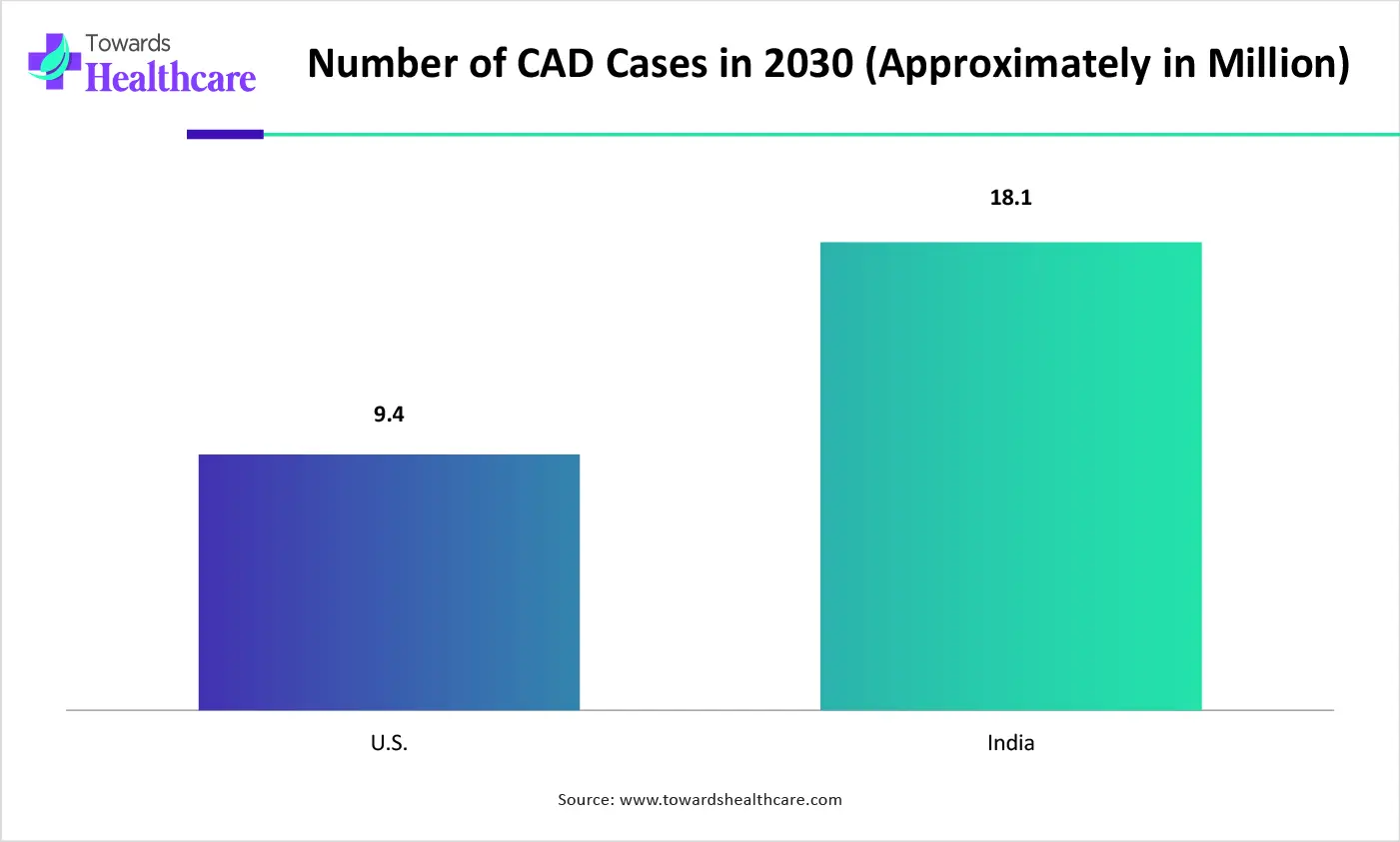
In 2025, the coronary artery disease (CAD) segment captured a major share of the market. According to a study, there were the highest cases of CAD in Central Europe, Eastern Europe, and Central Asia. They are highly demanding non-invasive solutions, such as CMR and CCTA, which act as an efficient "gatekeepers" to invasive coronary angiography (ICA), with minimal patient risks and difficulties linked with catheters.
Heart Failure Evaluation
The heart failure evaluation segment will grow rapidly. The use of this advanced imaging skips the requirement for ECG patches, skin prep, and grounding straps, which ultimately enhances patient comfort and lowers total exam time. The emergence of non-invasive coronary CT angiography (CCTA) supports finding coronary obstructions in acute HF patients. Recently, Philips unveiled AI-enabled techniques, which allow diagnostic-quality cardiac MRI without breath-holds, i.e., vital for heart failure patients facing difficulties following breathing instructions.
North America led with the biggest share in 2025, due to the rising burden of an ageing population & instances of heart disease, heart failure, and arrhythmias. The American Heart Association (AHA) and American College of Cardiology (ACC) have upgraded their guidelines of Coronary CT Angiography (CCTA) to a Class 1A recommendation for chest pain evaluation, by integrating with Medicare reimbursements.
U.S. Market Trends
Moreover, the U.S. market is putting efforts into integrating AI-assisted reconstruction algorithms in CT and MRI, which compensates for the limitations of real-time ECG signals, and also allows high-resolution imaging, even in patients with greater or irregular heart rates.
Asia Pacific is anticipated to witness rapid expansion, as the region is demanding faster, on-the-spot, and precise diagnosis in emergency departments and outpatient settings. Alongside, India and Thailand are experiencing higher demand for high-quality, affordable diagnostics from medical tourists, which propels the adoption of premium, rapid imaging systems.
India Market Trends
In India, mainly Delhi, Mumbai, Pune, Chennai, and Hyderabad are greatly adopting one-beat cardiac CT, such as 16 cm+ wide detectors. Also, Sir HN Reliance Foundation Hospital in Mumbai unveiled South Asia's prominent Naeotom Alpha Photon-Counting CT scanner to offer superior spatial resolution and enable excellent tissue characterization.
| Company | Description |
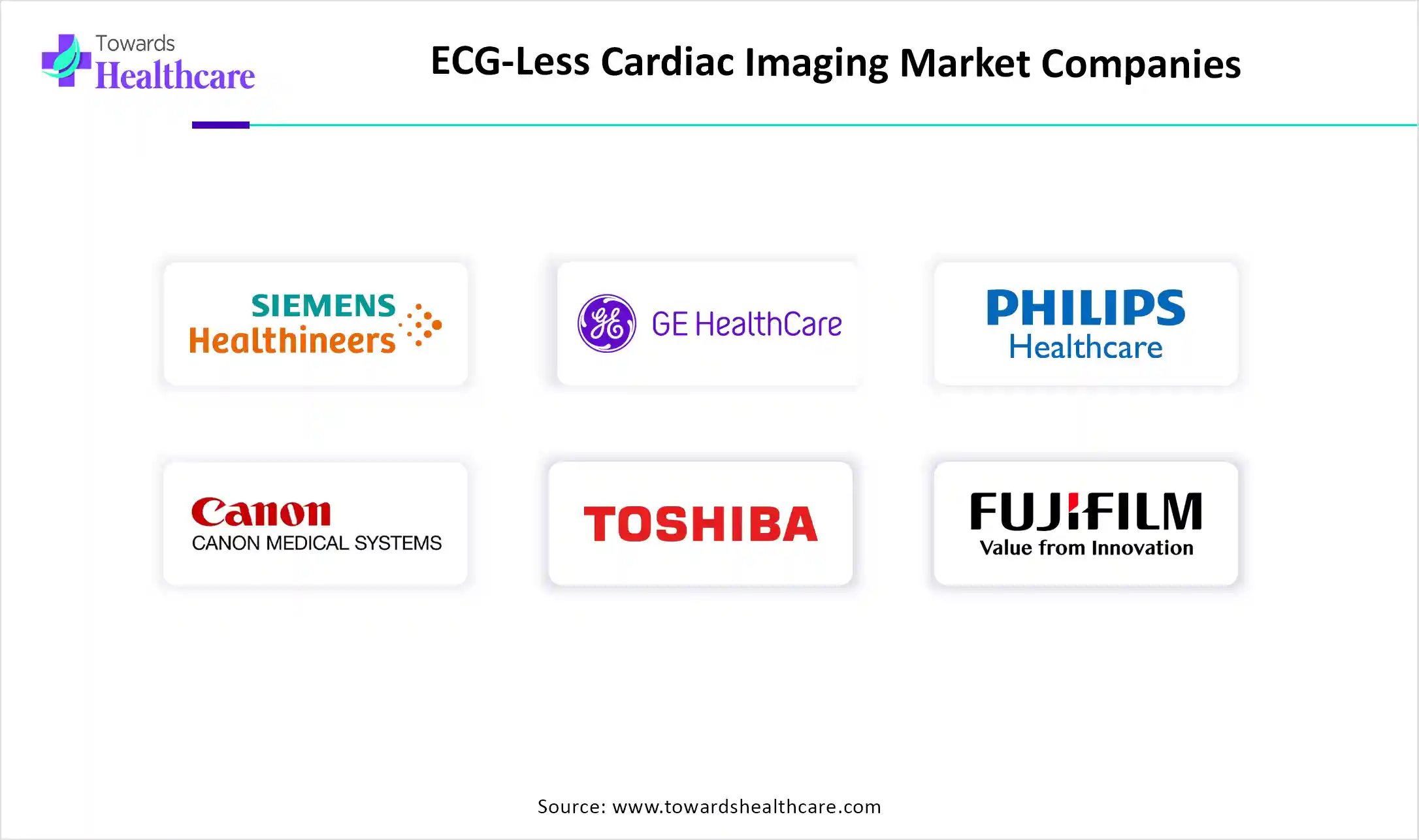
| Siemens Healthineers | This provides various advanced, ECG-less cardiac imaging solutions across MRI, CT, and Nuclear Medicine. |
| GE Healthcare | It introduced ECG-less Cardiac, an industry-first software-based acquisition mode. |
| Philips Healthcare | A firm specialises in high-speed acquisition, AI-powered automation, and spectral technology. |
| Canon Medical Systems | This offers ultra-fast hardware and intelligent software algorithms. |
| Toshiba/Canon | This emphasizes one-beat, wide-area detector CT imaging. |
| Fujifilm Healthcare | It explored diverse imaging solutions, like Cardio StillShot |
| Hitachi Medical Systems | This introduced LISENDO 880 (and 880LE) premium 2D/3D cardiovascular ultrasound system. |
| Agfa Healthcare | It offers cardiology imaging and management software through its Enterprise Imaging platform. |
| HeartVista, Inc. | This usually facilitates the One-Click Cardiac Package. |
| Arterys, Inc. | It unveiled Arterys Cardio AI software. |
By Technology/Modality
By Procedure Type
By End-User/Care Setting
By Application
By Region



Principal Consultant
Deepa Pandey is a focused and detail-oriented market research professional with growing expertise in the healthcare sector, delivering high-quality insights across therapeutic areas, diagnostics, biotechnology and healthcare services.
Learn more about Deepa Pandey

Reviewed By
Aditi Shivarkar is a seasoned professional with over 14 years of experience in healthcare market research. As a content reviewer, Aditi ensures the quality and accuracy of all market insights and data presented by the research team.
Learn more about Aditi Shivarkar










