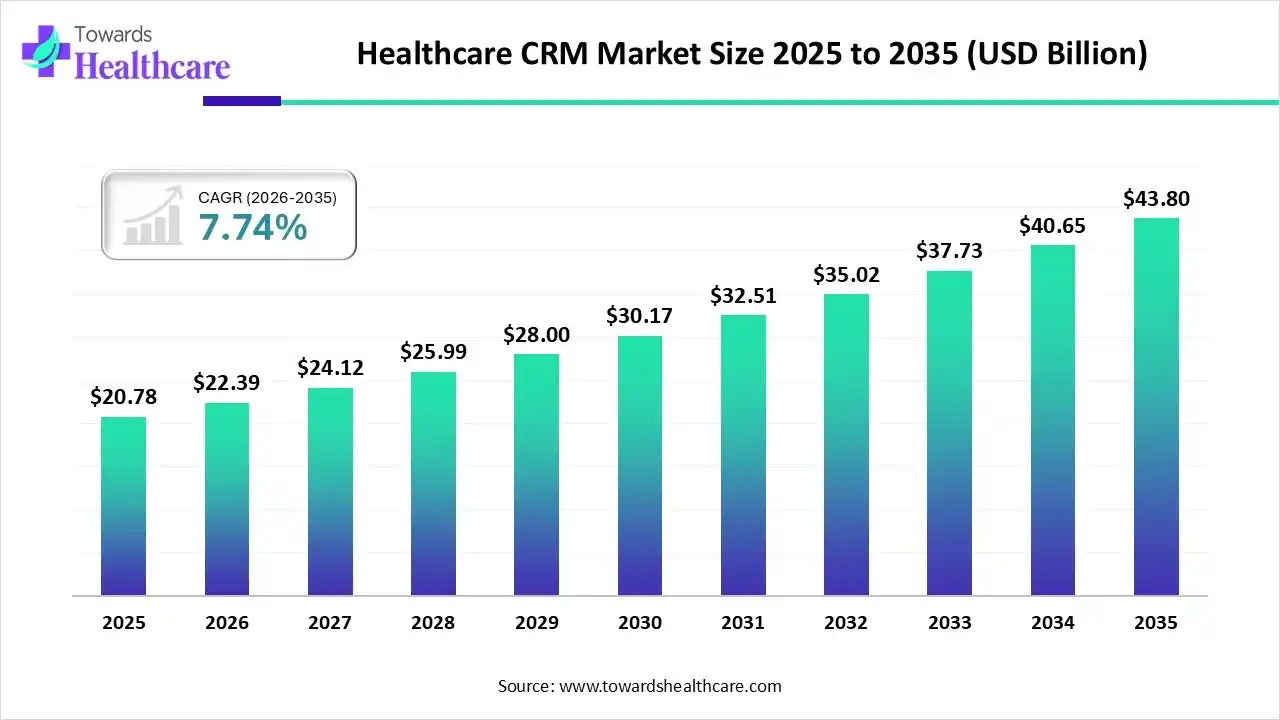
The global healthcare CRM market size is calculated at USD 20.78 billion in 2025, grew to USD 22.39 billion in 2026, and is projected to reach around USD 43.8 billion by 2035. The market is expanding at a CAGR of 7.74% between 2026 and 2035. The growing demand for improved patient care, technological advancements, and the burgeoning healthcare sector are the major growth factors of the market.
Healthcare customer relationship management (CRM) is a tool to manage patients in healthcare organizations. It is used to engage, acquire, and retain patients. It helps healthcare professionals store and manage information, improve service and engagement, enhance patient acquisition strategy, and automate marketing and sales processes. Several organizations develop software to streamline complex healthcare processes and offer a hassle-free medical experience. CRM effectively manages inter-department communication by automating mundane tasks using smart workflows. It also ensures data security using cloud-based services and other mechanisms. This also enables healthcare professionals to provide personalized care, leading to better decision-making.
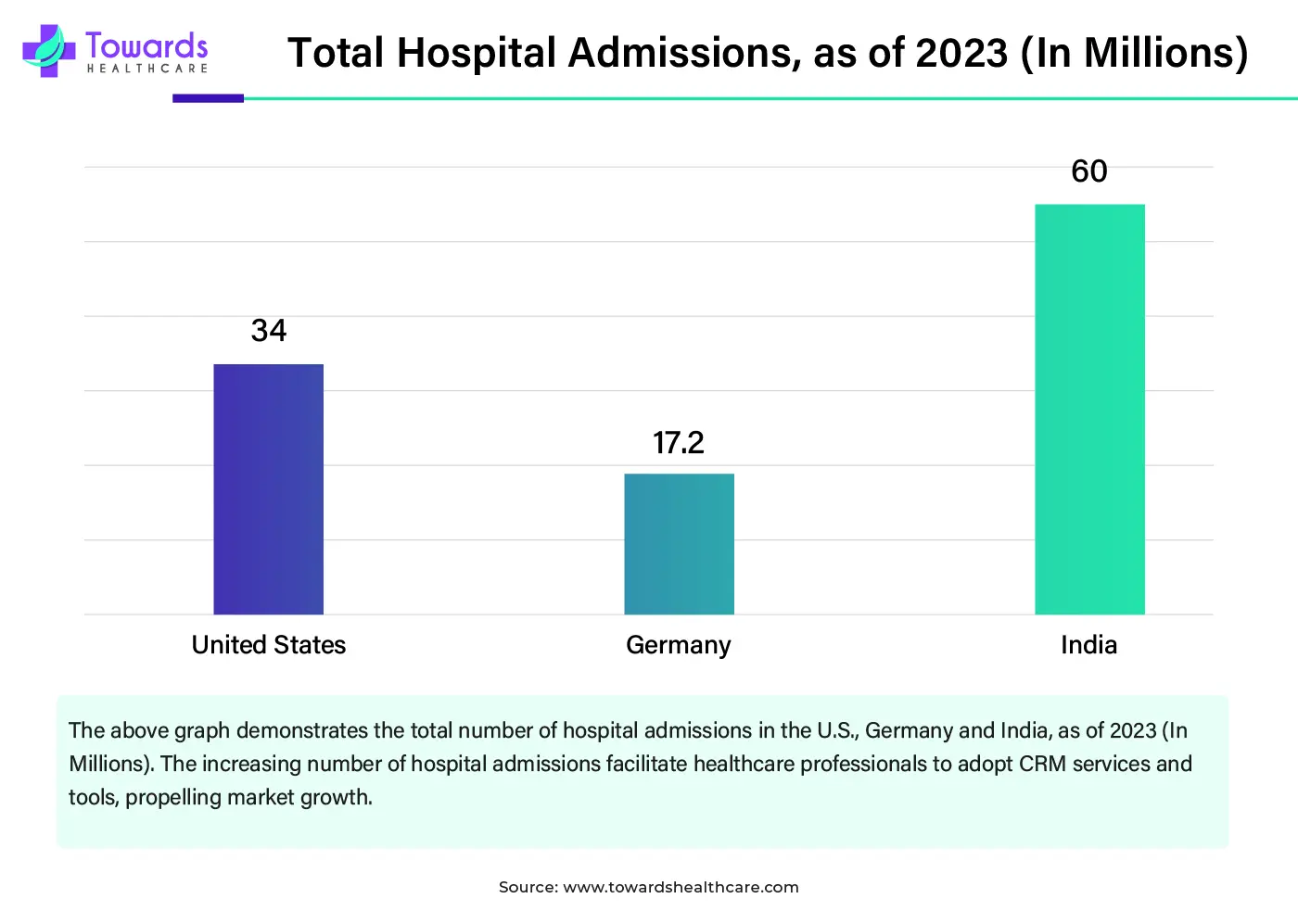
The rising incidences and prevalence of chronic disorders increase the number of hospitalizations of patients. This necessitates healthcare organizations to adopt CRM systems. The growing demand for improved patient care boosts the market. The advent of advanced technologies revolutionizes the way patients are managed in a healthcare setting. The increasing funding by several government and private organizations to advance healthcare also augments the market. The burgeoning healthcare sector potentiates market growth.
Personalized Patient Engagement
Healthcare providers are focusing more on personalized communication. CRM platforms help manage patient preferences, appointments, follow-ups, and outreach. Future systems will support smoother engagement across channels. This can improve patient satisfaction, strengthen relationships, and encourage better continuity of care.
Cloud-Based CRM Adoption
Cloud platforms are gaining popularity because they reduce infrastructure needs and support remote access. Hospitals and clinics are moving toward integrated systems. Future demand will favor scalable CRM solutions that connect patient information, scheduling, marketing, and communication across healthcare organizations.
Stronger Data Integration
Healthcare organizations want CRM systems that connect information from multiple departments and channels. Better integration can provide a clearer patient view. Future development will emphasize interoperability, secure data exchange, automated workflows, and easier coordination between providers, patients, and healthcare teams
Integrating artificial intelligence (AI) in healthcare CRM introduces automation in the system, leading to advanced services. Automation in administrative tasks significantly reduces the burden on healthcare professionals, allowing them to focus more on patient care. AI-enabled CRM allows for image analysis, speech recognition, precision medicine, and clinical notes. It ensures efficiency and accuracy in workflows, reducing manual errors. AI can also play a vital role in developing software for linking patient relationships and information management. AI can overcome several challenges faced in a healthcare setting such as scheduling errors, financial issues, marketing issues, poor customer service metrics data, and training staff. The advent of chatbots and virtual assistants provides instant, 24x7 assistance to patients, answers common questions, and provides information about medications and treatments.
Driver
Improved Patient Care
The major growth factor of the healthcare CRM market is the growing demand for improved patient care. Improving patient care has become a priority for all healthcare providers to achieve high patient satisfaction. The burgeoning healthcare sector enables healthcare professionals to adopt CRM tools. The increasing market competitiveness also encourages them to use CRM tools to manage and engage more patients in the healthcare setting. This allows them to strengthen their position in the market. Adopting CRM tools also increases patient repetition rate in a hospital or other healthcare setting. Patients can easily schedule their appointments and receive personalized care across clinical, consumer, and wellness experiences. CRM tools can also reduce administrative burden and increase operational efficiency, leading to potential revenue growth.
Restraint
High Implementation Cost
The major challenge of the market is the high implementation cost of advanced healthcare CRM software in a healthcare organization. This limits the affordability of several organizations in low- and middle-income countries. This necessitates costly investment that acts as a barrier to adoption, restricting the market.
Opportunity
Personalized Treatment
The future of the healthcare CRM market is promising, driven by the growing need for personalized treatment of patients. Personalized treatment refers to providing the right treatment to the right patient at the right time. Numerous government organizations launch initiatives to promote personalized care and provide funding. The rising demographic changes, especially in underdeveloped and developing countries, increase the demand for personalized care. A recent survey found that 72% of patients want more personalized care tailored to their individual clinical needs. The rise of telehealth, advancements in health technology, and demand for improved patient outcomes. The growing concierge medicine field can also potentiate the market, presenting future growth opportunities. Thus, most healthcare organizations are investing heavily in models of care.
| Metric | Details |
| Market Size in 2026 | USD 22.39 Billion |
| Projected Market Size in 2035 | USD 43.8 Billion |
| CAGR (2026 - 2035) | 7.74% |
| Leading Region | North America by 58% |
| Key Applications | Patient engagement, appointment management, care coordination, marketing automation, provider relationship management, population health outreach, HCP engagement |
| Primary End Users | Hospitals, clinics, healthcare systems, payers, pharmaceutical companies, medical device companies, healthcare networks |
| Key Growth Drivers | Digital transformation, patient-centric care models, AI-driven engagement, cloud adoption, omnichannel communication, healthcare consumerization |
| Measurable Values | USD Millions/Units/Volume |
| Market Segmentation | By Component, By Functionality, By Deployment Mode, By End-Use and By Region |
| Top Key Players | Actium Health LLC, Caspio, Creatio CRM, HubSpot, Insightly, Inc., LeadSquared, Mercury Healthcare, Inc., Microsoft Dynamics, Onpipeline, Pipedrive, PlayMaker Health, Salesforce, Inc., Veeva Systems, Inc., Zendesk for Healthcare, Zoho CRM |
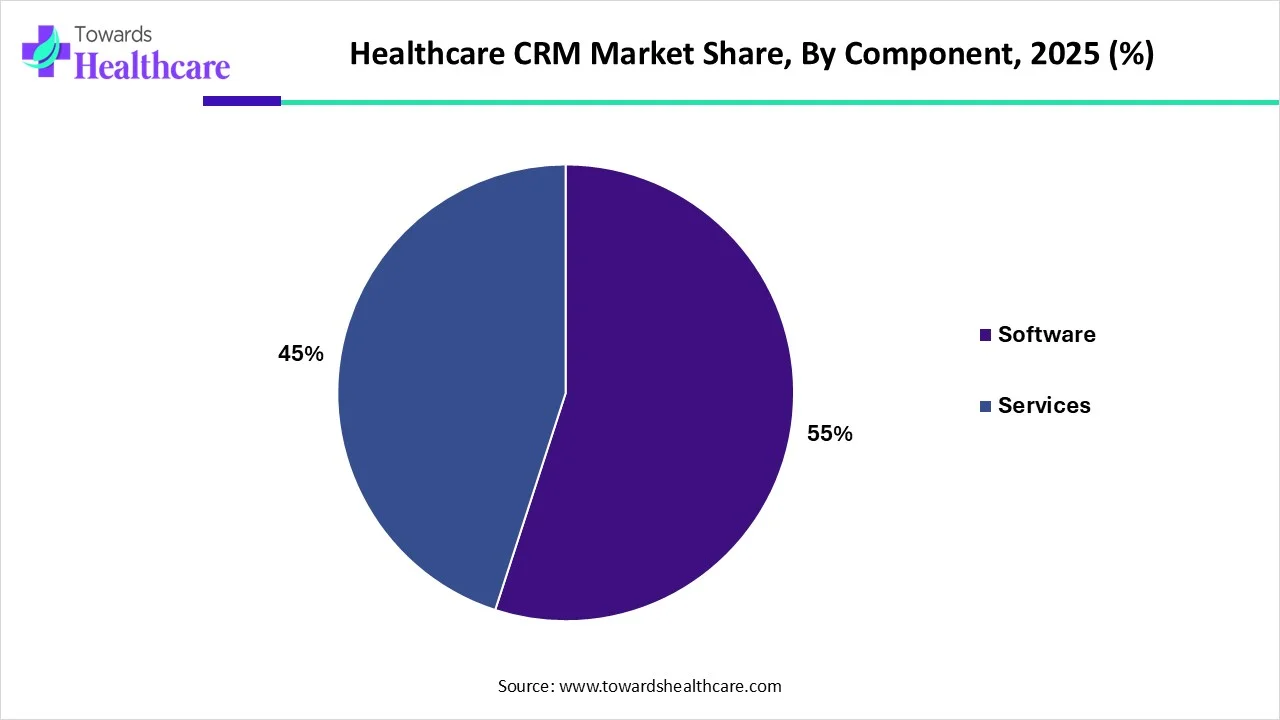
| Segments | Shares % |
| Software | 55% |
| Services | 45% |
Explanation
Why Did the Software Segment Dominate in the Healthcare CRM Market?
By component, the software segment held a dominant presence in the healthcare CRM market by 55% in 2025. The rising adoption of advanced technology such as AI and ML promotes the development of innovative software to enhance patient relationships. The demand for CRM software increases due to affordability, flexibility, and scalability. The software provides customized solutions to healthcare professionals and aids automation and analytics, driving sales. Integrating software in the healthcare system, allows professionals to maintain the confidentiality of patient data and other relevant information.
Service Segment to Show Lucrative Growth
By component, the service segment is estimated to show lucrative growth in the market during the forecast period. Numerous tech companies provide services to help businesses grow through customized solutions. The lack of trained professionals in healthcare organizations to operate complex software systems potentiates the demand for CRM services. This also enables professionals to minimize IT costs by eliminating licensing. Services are widely preferred by small- and medium enterprises with limited workforces and capital investments.
| Segment | Share 2025 (%) |
| Sales | 40% |
| Customer Service and Support | 20% |
| Digital Commerce | 15% |
| Marketing | 10% |
| Cross-CRM | 15% |
Explanation
How the Sales Segment Dominated the Healthcare CRM Market?
By functionality, the sales segment held the largest share of the healthcare CRM market by 40% in 2025 and is projected to expand rapidly in the market in the coming years. Healthcare CRM is used for various purposes, including increasing sales. Increasing sales for healthcare organizations is essential to strengthen their position in the market. CRM helps to increase sales by upselling and cross-selling, communicating regularly with patients, increasing employee productivity, and automating complex processes. The increasing number of hospitals and rising market competitiveness promote the segment’s growth.
| Segments | Shares % |
| Cloud/Web-based Model | 60% |
| On-premise Model | 40% |
Explanation
Which Deployment Type Segment Held the Dominating Share of the Healthcare CRM Market?
By deployment mode, the cloud/web-based model segment led the global market by 60% in 2025. The cloud-based or web-based model ensures that customer data is accessible from anywhere and at any time, saving a lot of time for professionals. They are easy to install, cost-effective, secure, and flexible, fueling the segment’s growth. This model can store vast amounts of patient data and offer scalability. Additionally, cloud-based CRM helps healthcare organizations to serve patients better, improve employee productivity, and increase profitability. It also eliminates the need for special infrastructure to install CRM systems, reducing infrastructure costs.
On-premise Model Segment: Fastest-Growing
By deployment mode, the on-premise model segment is expected to grow at the fastest rate in the market during the forecast period. As on-premise CRM models require specialized infrastructure in a healthcare setting, they are predominantly preferred by large hospitals. The increasing investments and collaborations boost the segment’s growth. They are operated by the user’s IT department, enabling complete control and ownership of patient data stored offline.
| Segments | Shares % |
| Healthcare Providers | 50% |
| Healthcare Payers | 25% |
| Life Sciences Industry | 25% |
Explanation
What Made Healthcare Providers the Dominant Segment in the Healthcare CRM Market?
By end-use, the healthcare providers segment registered its dominance over the global healthcare CRM market by 50% in 2025. Healthcare providers include doctors, nurses, therapists, pharmacists, etc. The rising incidences of acute and chronic disorders require people to visit healthcare centers such as hospitals and clinics. This leads to increasing use of CRM to manage patient data effectively and reduce the burden on healthcare professionals. CRM allows doctors and nurses to focus primarily on patient conditions.
Healthcare Payer Segment: Fastest-Growing
By end-use, the healthcare payer segment is anticipated to grow with the highest CAGR in the market during the studied years. The growing need for government and private reimbursement policies due to increasing healthcare expenses augments the segment’s growth. Insurance companies have a huge consumer database. Hence, incorporating CRM helps manage multiple policies in a single system. CRM helps insurance companies to organize prospects, track opportunities, and automate activities, enabling insurance agents to focus more on customer’s needs.
 Increasing Healthcare Spending Dominated North America
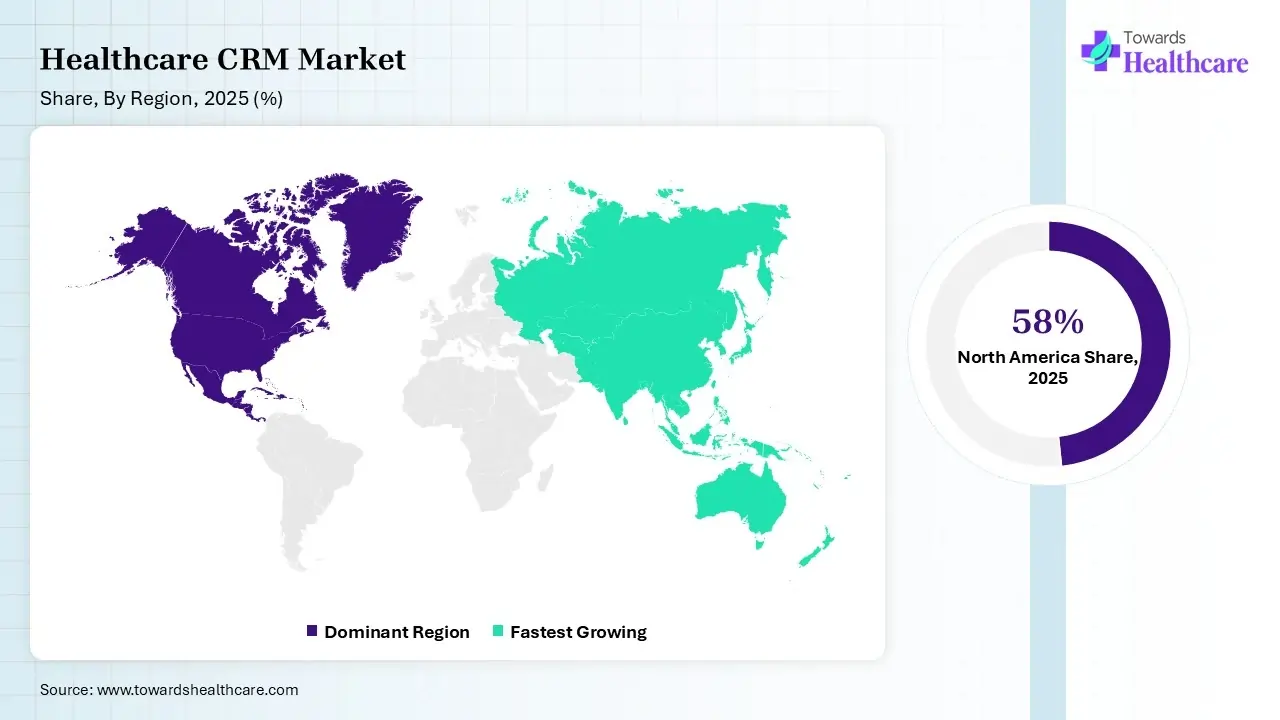
North America dominated the global healthcare CRM market share by 58% in 2025. The presence of key players, technological advancements, and increasing collaborations drive the market. Salesforce, Pipedrive, and Zoho are some of the key players that hold a major share of the market in North America. The favorable government support and rising investments positively impact market growth. In 2023, the U.S. federal government announced healthcare spending of $1.5 trillion. While, the Canada government spent around $344 billion on healthcare in 2023. The increasing number of hospitals and clinics potentiate the chances of adopting CRM tools. There are around 7,378 hospitals in the U.S. and 329 hospitals in Canada, as of 2024.
U.S. Healthcare CRM Market Trends
The presence of well-developed healthcare in the U.S. is increasing the adoption rates of the CMR platforms to enhance patient engagement and their outcomes. The growing healthcare investments, regulatory support, and technological advancements are also increasing their use and innovations.
Canada Market Trends
Canada’s healthcare CRM adoption is closely tied to digital patient services and provincial health systems. Clinics want better appointment reminders, follow-ups, and patient communication. Privacy remains a major consideration. Vendors need strong interoperability with existing records. Opportunities are emerging in virtual care and specialty clinics, where CRM tools can coordinate outreach and improve patient retention across fragmented healthcare settings. Rural providers also need remote engagement tools to reach patients effectively.
Asia-Pacific is anticipated to grow at the fastest rate in the market by 15% share during the forecast period. The rising population, rapidly expanding healthcare sector, and increasing adoption of advanced technologies drive the market. The growing disposable incomes, healthcare awareness, and geriatric population augments the healthcare sector in Asia-Pacific. According to the Press Information Bureau report, India’s healthcare landscape is transforming a digital transformation, driven by government policies, growing investments in digital health, and technological advancements. In 2023, China reported the highest number of hospital admissions, amounting to 301 million, representing around 21.4% of its total population. The Japanese government launched the “Medical Digital Transformation Promotion Plan” initiative to accelerate healthcare digitization.
India Market Trends
India’s hospital chains are pushing healthcare CRM beyond basic patient records. Appointment management, follow-up calls, marketing, and patient feedback are common uses. Competition includes global software firms and local healthcare technology providers. Large urban hospitals lead adoption, while smaller facilities remain price sensitive. Future demand should benefit from expanding digital health services and rising consumer expectations for convenient care. Integration with payment systems and languages widen usage beyond metropolitan centers.
China Healthcare CRM Market Trends
China is experiencing a rapid digital transformation in the healthcare sector, which is increasing the adoption of CRM platforms. The growing patient volume, rising government health initiatives, expanding healthcare, and increasing use of telehealth platforms are also increasing their use.
Europe is a notable region in the Healthcare CRM market with the share 22% in 2025 due to its emphasis on digital healthcare transformation and strong regulatory frameworks. The region is actively investing in e-health solutions to improve patient care and operational efficiency, particularly in countries like Germany, the UK, and France. Additionally, Europe focuses on patient-centric care, and the increasing adoption of AI and ML technologies, particularly regarding data privacy and security, contributes to the adoption of secure and compliant CRM systems.
For instance,
Germany Healthcare CRM Market Trends
Germany consists of advanced healthcare institutions, which utilize advanced digital health tools like healthcare CRM platforms. At the same time, the growing demand for personalized communication, increasing technological advancements, and expanding government initiatives are also encouraging their adoption and use.
UK Market Trends
In the UK, NHS pressures are creating interest in CRM tools that simplify patient communication and administrative work. Private providers are another growth area. CRM platforms can support referrals, reminders, feedback, and patient engagement. Data protection and interoperability matter strongly. Suppliers that fit NHS workflows may gain traction. Demand should rise as healthcare organizations expand digital appointment and communication services. Cloud deployment is attractive for care teams and community services.
South America is expected to show significant growth in the healthcare CRM market during the forecast period, due to the growing healthcare digitalization. The expanding private hospitals, increasing healthcare investments, and growing use of smartphones are also increasing the adoption of CRM platforms. Moreover, growing medical tourism is also promoting market growth.
Brazil Healthcare CRM Market Trends
The expanding healthcare in Brazil is increasing the use of healthcare CRM platforms to enhance patient outcomes and data management. The growing adoption of new digital healthcare tools and government support are also encouraging their use, driving new opportunities for their innovations.
Argentina Market Trends
Argentina’s healthcare CRM market is developing around hospitals, clinics, and diagnostic centers. Providers are looking for patient follow-up and appointment management. Economic instability can limit software budgets, encouraging subscription models. Local technology firms compete with international vendors. Buenos Aires remains the adoption center. Opportunities are growing in patient engagement, digital scheduling, and communication tools for healthcare networks. Integration with electronic records could make these platforms more valuable for coordinated care.
| Ecosystem Segment | Description |
| Technology Providers | Cloud, AI, analytics, interoperability, and data infrastructure providers enabling CRM platforms. |
| Product Manufacturers | Vendors developing healthcare-specific CRM software and engagement platforms. |
| Service Providers | Consulting, implementation, integration, training, and managed services firms supporting CRM deployments. |
| Platform Providers | Enterprise cloud and healthcare engagement platforms delivering CRM functionality. |
| CROs/CDMOs (Where Applicable) | Organizations utilizing CRM systems for investigator, site, physician, and customer engagement in life sciences. |
| Software Vendors | CRM application developers focused on healthcare providers, payers, and life sciences organizations. |
| Research Institutions | Academic medical centers and healthcare research organizations utilizing CRM systems for patient recruitment and engagement. |
| End-User Industries | Hospitals, health systems, clinics, payers, pharmaceuticals, biotechnology, medical devices, and diagnostics companies. |
R&D
Clinical Trials and Regulatory Approvals
Patient Support and Services
| Tier 1 | Tier 2 | Tier 3 | |
| Typical Market Influence | 65–75% | 20–25% | 5–10% |
| Tier 1 | ||||
| Company Name | Headquarters | Country | Why Relevant to This Market | Key Products/Services |
| Salesforce, Inc. | San Francisco, California | USA | Widely recognized market leader in healthcare CRM with dedicated healthcare and life sciences clouds. | Health Cloud, Life Sciences Cloud, Marketing Cloud |
| Microsoft Corporation | Redmond, Washington | USA | Strong healthcare CRM adoption through enterprise healthcare ecosystems. | Dynamics 365, Microsoft Cloud for Healthcare |
| Oracle Corporation | Austin, Texas | USA | Major healthcare IT provider with CRM and healthcare engagement solutions. | Oracle Health, Oracle CX, Oracle Health Sciences |
| Tier 2 | ||||
| Company Name | Headquarters | Country | Why Relevant to This Market | Key Products/Services |
| IQVIA Holdings Inc. | Durham, North Carolina | USA | Leading life sciences engagement platform provider with extensive CRM deployment footprint. | IQVIA OCE (Orchestrated Customer Engagement) |
| Pegasystems Inc. | Cambridge, Massachusetts | USA | Strong healthcare customer engagement and workflow automation capabilities. | Pega Customer Engagement, Healthcare CRM |
| Innovaccer Inc. | San Francisco, California | USA | Fast-growing healthcare engagement and patient relationship platform provider. | Healthcare Experience Platform, Patient CRM |
| Tier 3 | ||||
| Company Name | Headquarters | Country | Why Relevant to This Market | Key Products/Services |
| Zoho Corporation | Chennai, Tamil Nadu | India | Growing adoption among small and mid-sized healthcare providers. | Zoho CRM Plus, Healthcare CRM |
| hc1 | Indianapolis, Indiana | USA | Healthcare-specific CRM and customer engagement platform provider. | hc1 Healthcare CRM Platform |
| Keona Health | Chapel Hill, North Carolina | USA | Specialized patient relationship and access management solutions. | Keona Patient Relationship Management |
Bijay Singh, Head of Business Unit Healthcare at DKSH, commented on the launch of ConnectPlus that the company is improving their operations and setting a new benchmark for healthcare distribution across Asia Pacific. Through this platform, the company will ultimately contribute to better health outcomes by improving patients’ access to quality care. He added that this reinforces their commitment to leading with agility in an evolving healthcare landscape.
By Component
By Functionality
By Deployment Mode
By End-Use
By Region






Principal Consultant
Payal Rabde is a Healthcare Market Research Analyst at Towards Healthcare Research & Consulting with 4+ years of experience in pharmaceuticals, biotechnology, medical devices, and life sciences.
Learn more about Payal Rabde

Reviewed By
Aditi Shivarkar is a seasoned professional with over 14 years of experience in healthcare market research. As a content reviewer, Aditi ensures the quality and accuracy of all market insights and data presented by the research team.
Learn more about Aditi Shivarkar