Pipeline Programs

CGT Companies Tracked

Manufacturing Facilities


The U.S. AI in physical therapy market size was estimated at USD 179.23 million in 2025 and is predicted to increase from USD 224.54 million in 2026 to approximately USD 1706.98 million by 2035, expanding at a CAGR of 25.28% from 2026 to 2035.
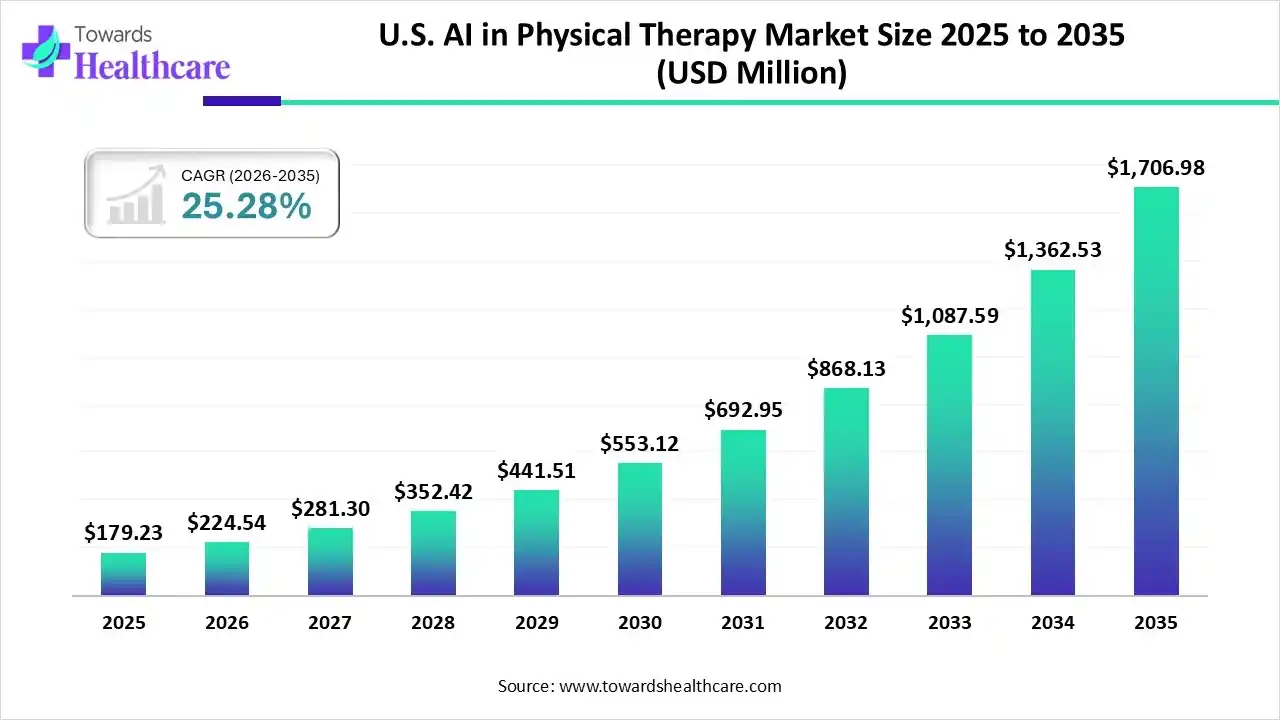
The market is rapidly expanding, driven by rising musculoskeletal conditions, increased telehealth use, and AI-based tools that improve treatment efficiency and patient outcomes. Furthermore, advancements in computer vision and wearable sensors allow for more precise, personalized care and enhanced patient engagement.
AI in physical therapy refers to the use of artificial intelligence technologies to assist, enhance, and personalize physical rehabilitation treatment, improving efficiency, patient outcomes, and clinical decision-making. The U.S. AI in physical therapy market is growing rapidly due to rising musculoskeletal disorders, increasing adoption of telehealth and remote care, and demand for personalized rehabilitation. AI-powered tools enhanced treatment efficiency, track patient progress, and support clinicians in decision-making, driving widespread adoption across hospitals, clinics, and home health -care settings.
| Table | Scope |
| Market Size in 2026 | USD 224.54 Million |
| Projected Market Size in 2035 | USD 1706.98 Million |
| CAGR (2026 - 2035) | 25.28% |
| Historical Data | 2020 - 2023 |
| Base Year | 2025 |
| Forecast Period | 2026 - 2035 |
| Measurable Values | USD Millions/Units/Volume |
| Market Segmentation | By Component, By Deployment Mode, By Application, By End Use |
| Top Key Players | Sword Health, Inc., Kemtai.com, Raintree Systems, Prompt Therapy Solutions, Empower EMR (by MerlinWave, Inc.), Kaia Health, NXGN Management, LLC |
| Segments | Shares % |
| Software | 64% |
| Services | 36% |
Why did the software Segment Dominate in the U.S. AI in Physical Therapy Market in 2025?
The software segment dominated the market by 64% in 2025 due to its ability to deliver scalable, cost-effective, and easily upgradable solutions for therapy planning, motion analysis, progress tracking, and remote care. Unlike hardware, software platforms integrate seamlessly with existing systems, support data-driven decision-making, and enable continuous personalization of therapy programs, driving higher adoption among providers and clinics.
Services
The services segment is expected to grow at the fastest CAGR during the forecast period due to rising demand for implementation support, systems integration, training, and ongoing maintenance. Healthcare providers increasingly rely on specialized service partners to optimize digital therapy solutions, ensure regulatory compliance, and achieve seamless adoption, driving sustained demand for professional and managed services across care settings.
| Segments | Shares % |
| Cloud-Based | 58% |
| Server-Based | 42% |
How the Cloud-based Segment Dominated the Market in 2025?
The cloud-based segment dominated the U.S. AI in physical therapy market of share 58% in 2025 and is expected to grow at the fastest CAGR due to its scalability, cost efficiency, and remote accessibility. Cloud platforms enable real-time data analysis, virtual therapy delivery, and seamless integration with digital health systems, supporting personalized care, continuous monitoring, and rapid adoption across clinics, hospitals, and home-care settings.
| Segments | Shares % |
| Musculoskeletal (MSK) Rehabilitation | 34% |
| Post-Acute & Post-Surgical Rehabilitation | 26% |
| Neurological Rehabilitation | 18% |
| Sports & Performance Therapy | 14% |
| Others | 8% |
Why the Musculoskeletal (MSK) Rehabilitation Segment Dominated the U.S. AI in Physical Therapy Market?
The musculoskeletal (MSK) rehabilitation segment dominated the market by 34% share due to the high prevalence of orthopedic injuries, arthritis, and post-surgical recovery cases. MSK conditions require continuous monitoring, movement assessment, and personalized therapy plans, making technology-enabled solutions highly effective. Growing sports injuries, an aging population, and increasing demand for outpatient and home-based rehabilitation further strengthened this segment’s market leadership.
Post-acute & Post-surgical Rehabilitation
The post-acute & post-surgical rehabilitation segment is expected to grow at the fastest CAGR during the forecast period due to rising surgical volumes and shorter hospital stays. Providers increasingly adopt technology-enabled rehabilitation to support recovery after discharge, monitor patient progress remotely, and reduce readmission. Growing emphasis on value-based care and home-based recovery solutions further accelerates adoption in this segment.
| Segments | Shares % |
| Outpatient Physical Therapy Clinics | 46% |
| Hospitals & Health Systems | 28% |
| Homecare Settings | 18% |
| Others | 8% |
Why Did the Outpatient Physical Therapy Clinics Segment Dominate in the U.S. AI in Physical Therapy Market in 2025?
The outpatient physical therapy clinics segment dominated the market by 46% share in 2025 due to their high patient footfall, cost-effective care delivery, and focus on volume of musculoskeletal and post-injury cases, driving strong adoption of digital therapy tools for treatment planning, progress tracking, and patient engagement, reinforcing their leading market position.
Homecare Settings
The homecare settings segment is expected to grow at the fastest CAGR during the forecast period due to rising demand for convenient, cost-effective rehabilitation outside clinical facilities. Increasing preference for at-home recovery, especially among elderly and post-surgical patients, along with improved remote monitoring and virtual therapy support, enables continuous care, better adherence, and reduced hospital visits, accelerating adoption across the U.S. AI in physical therapy market.
Northeast
The Northeast is witnessing rapid AI adoption in physical therapy, driven by major hospital systems in New York and Boston integrating AI-powered motion tracking to optimize rehabilitation protocols and enhance patient outcomes, alongside significant investments in digital health tools and EMR systems.
South
The South is rapidly adopting AI in physical therapy to bridge gaps in care across rural areas, with Texas and Florida leading in the use of telehealth, remote patient monitoring, and AI-powered apps to address high patient volumes and increase access to rehab services.
Midwest
The Midwest is focusing on AI-driven rehabilitation for its aging population, with clinics and hospital systems in Illinois and Ohio using AI for movement analysis and fall prevention, supported by strong investments in wearable technologies and remote monitoring to enhance patient independence and care.
West
The West leads in innovative AI applications, with California and Washington utilizing AI-powered, computer-vision platforms for real-time rehabilitation, focusing on personalized and hybrid, at-home care models that blend advanced technology with specialized therapy, driven by high-tech adoption rates and extensive digital health research.
R&D
Clinical Trials
Patient Support and Services
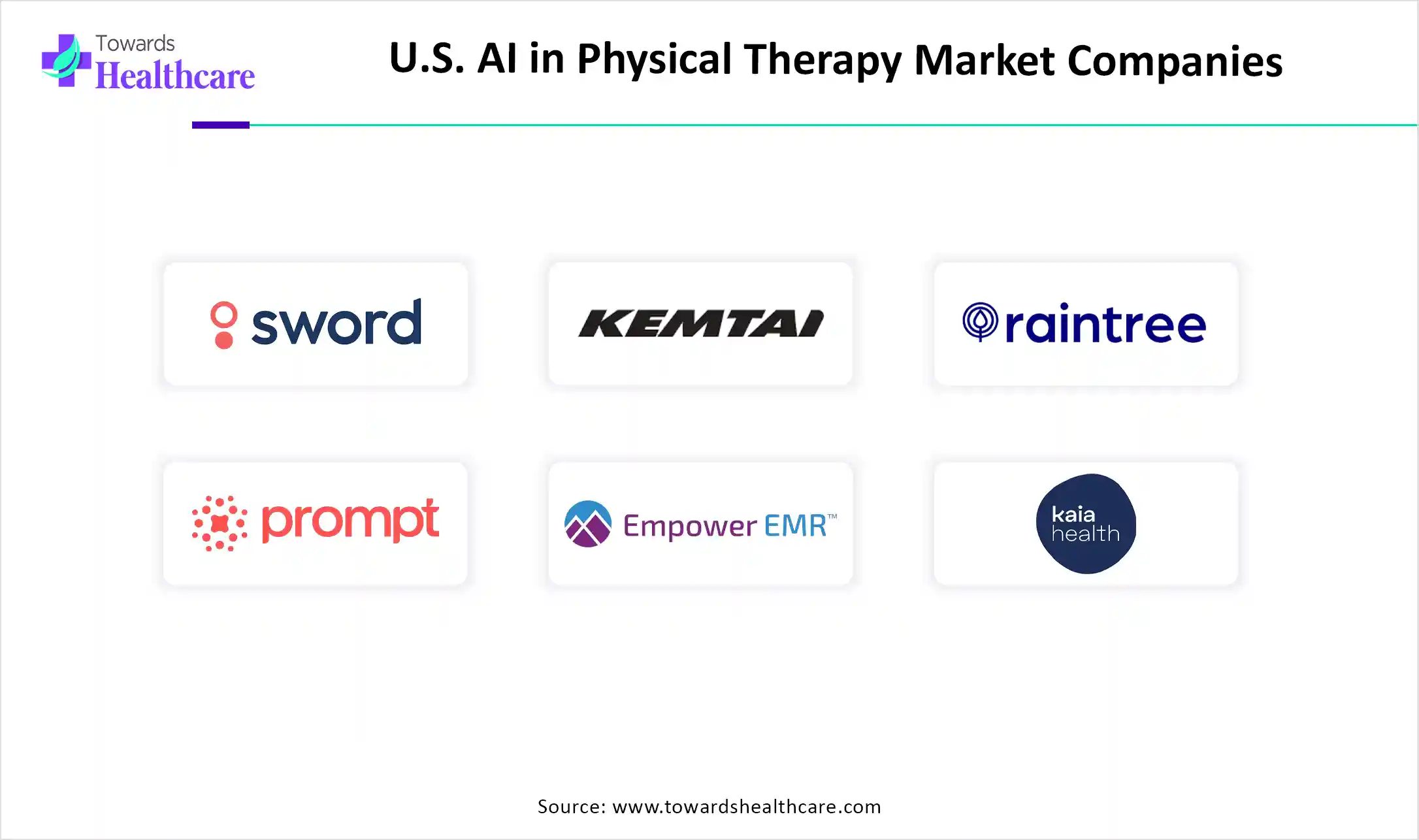
| Companies | Headquarters | Offerings |
| Sword Health, Inc. | New York, U.S. | Provides virtual physical therapy programs using motion-tracking technology and clinician oversight to deliver personalized musculoskeletal and post-surgical rehabilitation at home. |
| Kemtai.com | Tel Aviv, Israel | Develops computer vision–based exercise coaching solutions that analyze body movement in real time, supporting guided rehabilitation and therapy adherence. |
| Raintree Systems | Arizona, U.S. | Offers electronic medical record and practice management platforms designed for physical therapy clinics, supporting documentation, scheduling, billing, and performance analytics. |
| Prompt Therapy Solutions | U.S. | Provides cloud-based EMR and workflow solutions tailored for outpatient rehabilitation providers, improving clinical documentation efficiency and patient data management. |
| Empower EMR (by MerlinWave, Inc.) | U.S. | Delivers therapy-focused EMR systems that support clinical documentation, compliance, and operational workflows across rehabilitation practices. |
| Kaia Health | New York, U.S. | Provides app-based digital therapy programs for musculoskeletal and chronic pain conditions, combining guided exercises with real-time feedback and remote care support |
| NXGN Management, LLC | U.S. | Operates healthcare technology and management solutions supporting rehabilitation and therapy service delivery, with a focus on operational optimization and care coordination. |
Strengths
Weaknesses
Opportunities
Threats
By Component
By Deployment Mode
By Application
By End Use





Reviewed By
Aditi Shivarkar is a seasoned professional with over 14 years of experience in healthcare market research. As a content reviewer, Aditi ensures the quality and accuracy of all market insights and data presented by the research team.
Learn more about Aditi Shivarkar