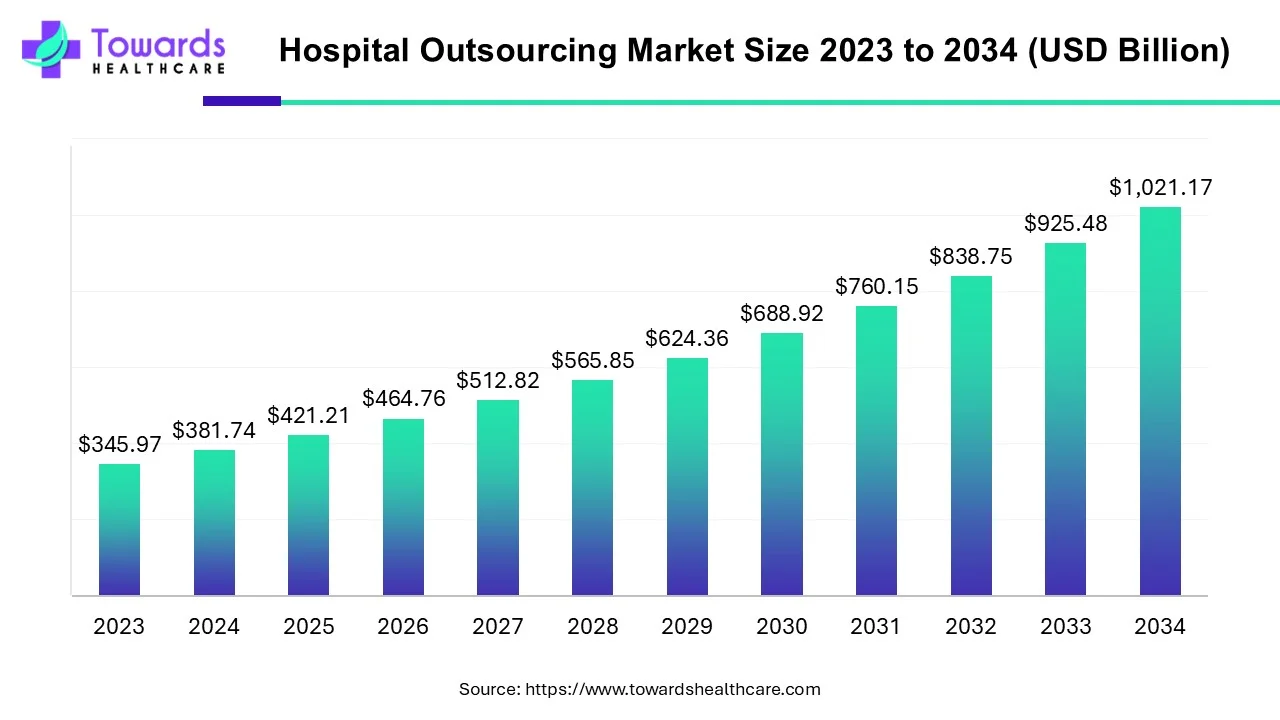
The global hospital outsourcing market size was calculated at US$ 421.21 in 2025, grew to US$ 464.76 billion in 2026, and is projected to reach around US$ 1021.17 billion by 2034. The market is expanding at a CAGR of 10.34% between 2025 and 2034. With an increasing population and growing cases of patients, hospitals need a lot of resources to fulfill the demand. Hence, a lot of hospitals and medical institutions outsource various resources, which promotes the growth of the hospital outsourcing market.
There is ongoing pressure on the healthcare sector to provide high-quality medical treatment. Healthcare outsourcing services may be the greatest option for hospitals looking to maximize productivity and improve patient care results. Hospitals can delegate their distinct duties to a different vendor with specialized knowledge and experience by outsourcing non-core activities. In the end, this aids healthcare institutions in concentrating on their primary functions and providing superior patient care.
Since the healthcare sector is always evolving, the main justifications for outsourcing are to enhance customer service, cut expenses, and boost adaptability to changing market demands. Providers of outsourcing services possess the necessary infrastructure and knowledgeable staff to manage the diverse needs of healthcare institutions. This further allows them to concentrate on their most important responsibility, which is to provide the finest services possible to the patients.
Automation and artificial intelligence (AI) are two of the most popular developments in healthcare outsourcing. AI is essential to the healthcare BPO industry. Helping agents and automating workflows maximizes a lot of non-clinical activities. Additionally, it provides insights for forecasting and enhances data management for reporting. Finally, it facilitates distant clinical operations like telehealth and enhances on-site medical services. Along with lowering expenses, this technology can enhance patient outcomes, accuracy, and efficiency. In addition to offering useful insights into patient data, AI may be used to automate processes like medical coding, invoicing, and customer support.
The hospital outsourcing market comprises external services provided to hospitals for non-core and specialized activities such as diagnostics, medical billing, IT, facility management, laboratory services, and administrative operations. The market is growing as hospitals seek to control operating expenses, improve service quality, and focus internal resources on patient care. A major trend is the outsourcing os revenue cycle management, clinical support, and digital healthcare operations to specialized providers. Technological advancements in artificial intelligence, cloud computing, automation, data analytics, and telehealth are improving workflow efficiency, accuracy, and service delivery. Rising patient volumes, healthcare workforce shortages, increasing administrative complexity, and pressure to optimize hospital resources are key market drivers. Future opportunities include AI-enabled administrative services, remote diagnostic support, integrated digital platforms, and outcomes-based outsourcing models. Greater use of predictive analytics and interoperable systems is expected to further process and support scalable healthcare operations.
Driver
Demand for RCM
Healthcare providers' emphasis on streamlining financial procedures is reflected in the increased need for revenue cycle management, or RCM. RCM includes everything from insurance verification and patient registration to processing claims and collecting payments. Efficient RCM guarantees correct billing lowers claim denials and speeds up revenue cycles as healthcare reimbursement grows more complex. By streamlining processes, improving cash flow, and facilitating efficient resource allocation, outsourcing RCM services helps healthcare businesses maintain and expand their financial stability.
Restraint
Data and Privacy Concerns
The shortage of qualified workers in developing nations is one of the major obstacles that restrict healthcare companies' ability to outsource. Furthermore, worries about data security and privacy may restrict the use of outsourcing services in the healthcare sector. Healthcare professionals' hesitancy to outsource vital tasks because of the possible harm to patient care is another barrier. These elements somewhat obstruct the hospital outsourcing market.
Opportunity
Rise in Telemedicine
In response to the growing need for effective telemedicine solutions, healthcare providers are increasingly outsourcing services, including medical transcription, telehealth assistance, and remote patient monitoring. This pattern is indicative of a larger movement to use outsourcing to improve patient access to distant healthcare services globally and expedite operational procedures. As a result, the healthcare BPO industry is expanding significantly as businesses look to streamline their processes and adjust to the changing demands of digital healthcare delivery. As a result, the growing use of telemedicine is changing the healthcare BPO industry and increasing demand for outsourced services that support digital healthcare platforms and enable virtual patient consultations.
| Table | Scope |
| Market Size in 2025 | USD 421.21 Billion |
| Projected Market Size in 2034 | USD 1021.17 Billion |
| CAGR (2025 - 2034) | 10.34% |
| Leading Region | North America by 71% |
| Historical Data | 2020 - 2023 |
| Base Year | 2024 |
| Forecast Period | 2025 - 2034 |
| Measurable Values | USD Millions/Units/Volume |
| Market Segmentation | By Service, By Type, By Region |
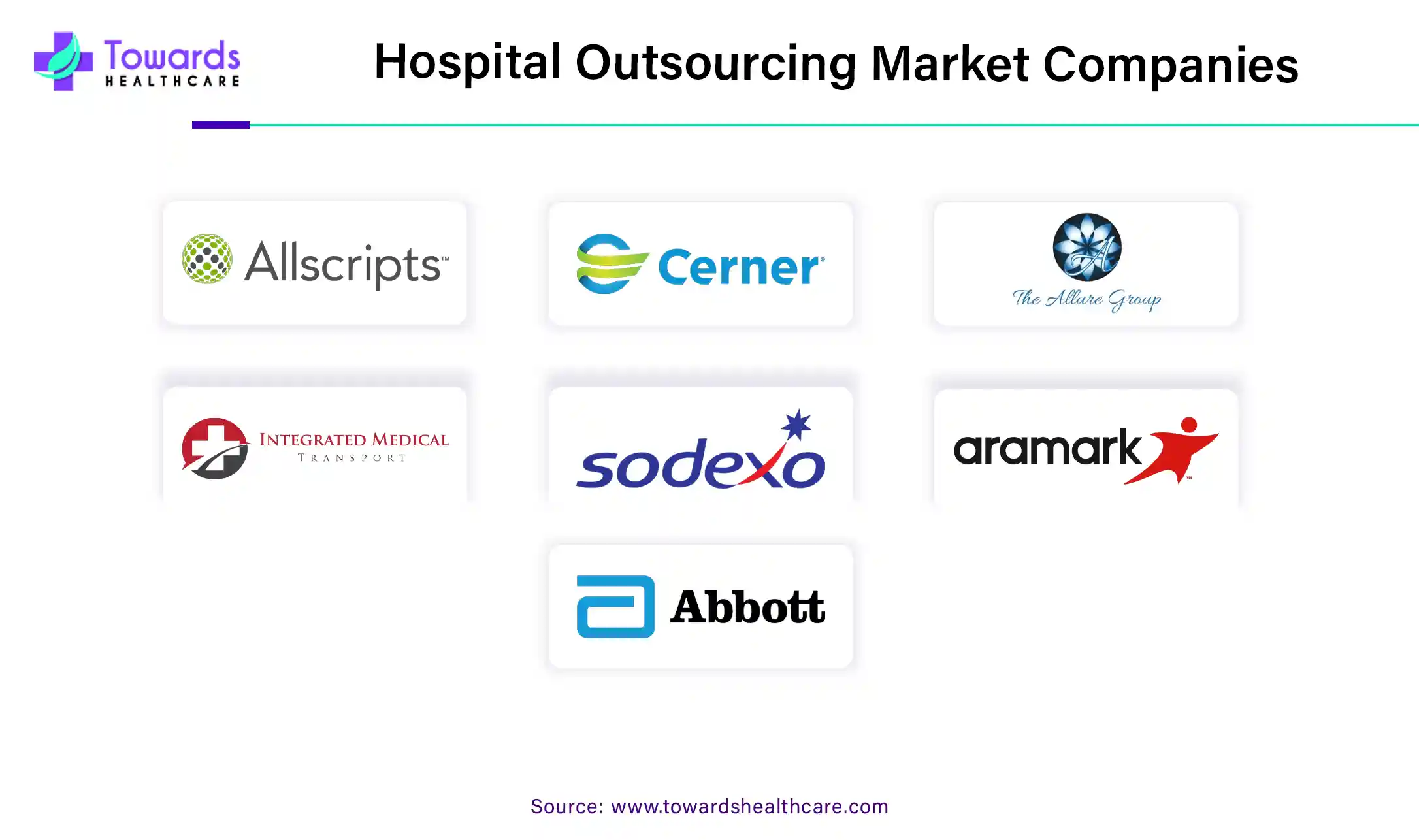
| Top Key Players | Allscripts, Cerner Corporation, The Allure Group, Integrated Medical Transport, Sodexo, Aramark Corporation, LogistiCare Solutions, LLC (ModivCare), Flatworld Solutions Inc., Abbott, ABM INDUSTRIES INCORPORATED |
By service, the clinical services segment held the largest share of the hospital outsourcing market in 2025. Pharmacy compounding, dialysis, radiology, and neurology are just a few of the more than 250 clinical treatments that fall under the category of acquired services. Clinical functions can be outsourced in a variety of ways. Virtual command centers and hospital-at-home programs are more recent possibilities that can reduce the number of personnel required. Indirect costs, including employee pay and benefits and operating expenses related to maintaining physical personnel and buildings, can be reduced by assigning specialized therapeutic services to others.
By service, the transportation services segment is expected to grow at a lucrative growth rate in the hospital outsourcing market during the forecast period. Patients can benefit from healthcare transportation services in a variety of ways. They offer various medical transaction services and transportation services from one location to another. Unfavorable Medicaid recipients, such as the elderly, disabled, and those with low incomes, must have non-emergency medical transportation services in order to receive healthcare transportation services. People who are in a variety of life-or-death circumstances need emergency medical transportation services.
By type, the private hospitals segment captured the major share of the hospital outsourcing market in 2025. Restrictions on cost coupled with operational flexibility and a concentration on core clinical business are the reasons for the notable increase. The goal of private hospital outsourcing is to satisfy clients with the assistance of qualified experts. The development of outsourcing businesses in the private hospital sector is a result of changes in government regulations regarding hospitals and a lack of internal services to address complicated issues.
By type, the public hospitals segment is estimated to grow rapidly in the hospital outsourcing market during the predicted timeframe. Despite financial limitations, public hospitals work to provide high-quality care at a reasonable cost. Focusing on patient care is made possible by outsourcing non-core tasks like facilities management, IT, and invoicing. Public hospitals are increasingly looking for outside partners to ensure compliance and effective service delivery due to growing patient populations and increasingly complicated regulations.
North America dominated the hospital outsourcing market share by 71% in 2025. Some of the biggest healthcare marketplaces in the world are found in North America, where demand for affordable healthcare solutions is rising along with healthcare spending. The area is a desirable market for outsourcing services due to its numerous hospitals and healthcare providers, as well as its well-established healthcare infrastructure. Furthermore, as healthcare professionals in North America want to concentrate on patient care and lessen the strain of administrative tasks, the rise in chronic illnesses has raised their need for outsourcing services. All things considered, the North American hospital outsourcing industry offers substantial development prospects for service providers, especially in the areas of clinical services outsourcing, healthcare IT outsourcing, and revenue cycle management. The market is anticipated to increase as a result of the growing tendency toward value-based care models and the growing implementation of digital technology.
The rapid uptake of cutting-edge technology by pharmaceutical firms, pharmacies, medical equipment makers, and healthcare institutions has created new prospects for development for the U.S. healthcare system. The skilled experts who oversee the activities are responsible for the infrastructure of this business. Increased awareness of outsourcing healthcare IT services and the substantial presence of major industry participants in the U.S. are responsible for the growth of the healthcare outsourcing market. The growing strategic initiatives of top companies, such as partnerships, product launches, and other moves, are another important driver of market development during the course of the projection period. For instance, in order to meet the growing need for outsourcing solutions.
U.S. Growth Driven by Healthcare Efficiency and Cost Optimization
The U.S. hospital outsourcing market is significantly growing due to rising healthcare costs, increasing patient volumes, and persistent pressure to improve operational efficiency. Hospitals are increasingly outsourcing administrative, billing, IT, laboratory, and facility-management functions to specialized providers. Growing adoption of cloud platforms, automation, and artificial intelligence is further improving workflow efficiency. Workforce shortages and increasing administrative complexity are also supporting outsourcing demand.
Canada Expands Through Efficient Healthcare Operations
Canada’s hospital outsourcing market is notably expanding due to increasing healthcare service demand, workforce constraints, and the need to improve operational efficiency. Hospitals are increasingly using external providers for administrative, IT, diagnostic, and facility-management functions. Growing adoption of digital healthcare technologies, cloud-based systems, and automation is supporting streamlined operations. Rising pressure to manage healthcare resources effectively while maintaining quality patient services is further encouraging outsourcing adoption.
Asia Pacific is estimated to host the fastest-growing hospital outsourcing market during the forecast period. The need for healthcare outsourcing solutions keeps growing as companies place a higher priority on creativity and efficiency. The use of smart technology, an emphasis on sustainability, and the use of sophisticated materials are some of the major trends impacting the industry. These innovations are improving user experiences and changing the range of products available. To take advantage of new possibilities in the Asia Pacific region's changing landscape, stakeholders must continue to be proactive in adjusting to these developments.
Numerous pharmaceutical businesses are seeking to increase their footprint in China, which would need investing in outsourcing services for legal representation, clinical trial applications, product registrations, and paperwork. According to the analysis by FMI, this is anticipated to keep increasing market sales. Both a developing local health technology industry and encouraging government initiatives like the Universal Health Insurance Scheme are expected to fuel demand in India. Offshore assistance in obtaining and preserving government approvals for medications, medical equipment, and gadgets is offered by medical affairs outsourcing.
China Maintains Notable Market Share Through Healthcare Modernization
China has a notable market share in the hospital outsourcing market due to its large healthcare system, expanding hospital infrastructure, and increasing demand for efficient healthcare operations. Hospitals are increasingly adopting outsourced administrative, IT, diagnostic, and facility-management services to improve efficiency and manage operational complexity. Growing digitalization, automation, and investment in healthcare technology are further supporting outsourcing adoption across the country.
India Grows Through Expanding Healthcare Outsourcing
India’s hospital outsourcing market is significantly growing due to rising healthcare demand, increasing patient volumes, and the need to control operational costs. Hospitals are increasingly outsourcing administrative, billing, IT, diagnostic, and facility-management services to specialized providers. The availability of skilled healthcare and technology professionals, expanding hospital infrastructure, and growing adoption of digital platforms and automation are further supporting market expansion.
In January 2025, the implementation of a government-private sector effort to treat patients with simple crises began. According to Minister Abela, private hospitals would treat patients with medical and surgical diagnoses under this partnership, with government funding covering the costs. He stated that patients with simple diseases would receive the appropriate care, including procedures, in the private sector as part of this effort, which will supplement the services offered by Mater Dei Hospital.
By Service
By Type
By Region



Principal Consultant
Payal Rabde is a Healthcare Market Research Analyst at Towards Healthcare Research & Consulting with 4+ years of experience in pharmaceuticals, biotechnology, medical devices, and life sciences.
Learn more about Payal Rabde

Reviewed By
Aditi Shivarkar is a seasoned professional with over 14 years of experience in healthcare market research. As a content reviewer, Aditi ensures the quality and accuracy of all market insights and data presented by the research team.
Learn more about Aditi Shivarkar