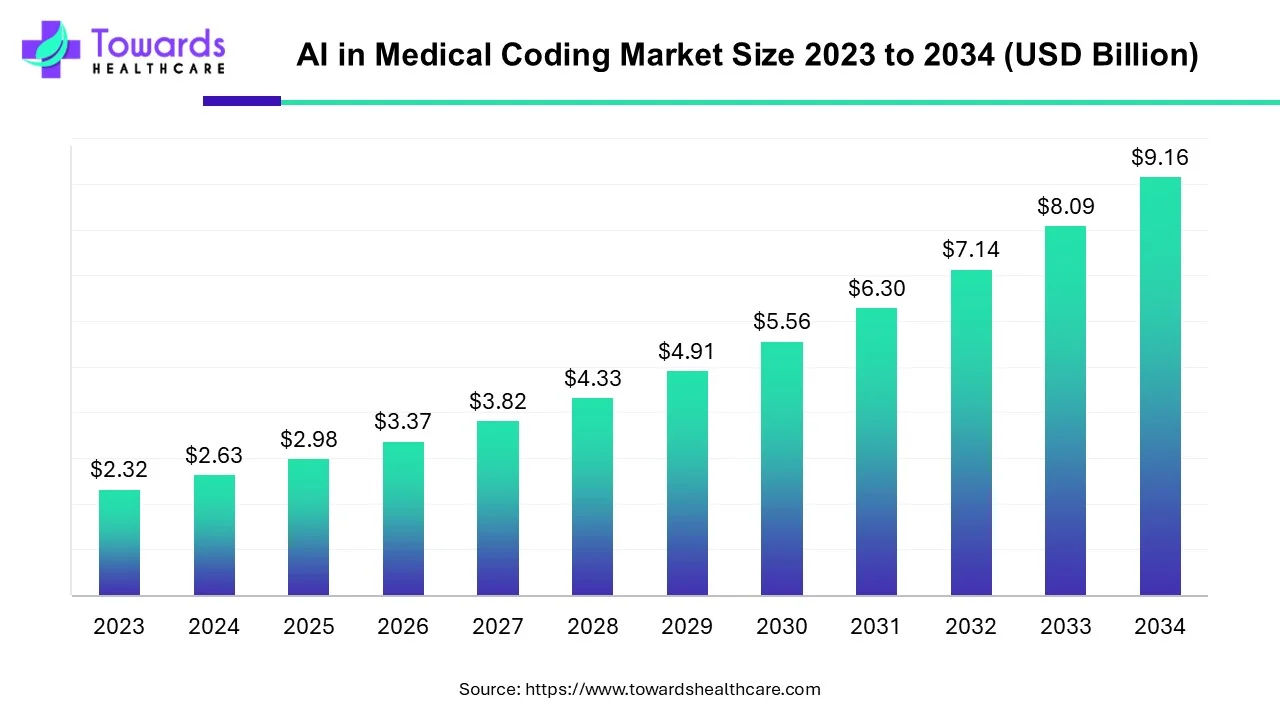
The global AI in medical coding market size is expected to grow from USD 2.98 billion in 2025 to USD 10.39 billion by 2035, with a CAGR of 13.3% throughout the forecast period from 2026 to 2035, as a result of the rising demand for advancing technologies.
According to a recent American Health Information Management Association (AHIMA) survey, 85% of healthcare organizations reported increased coding efficiency after implementing AI-based solutions.
AI has revolutionized medical coding by automating the coding process, reducing errors, and increasing efficiency. AI-powered coding tools use natural language processing (NLP) and machine learning algorithms to analyse medical records, identify relevant codes, and assign them automatically. AI coding tools can also learn from previous coding decisions, gradually improving accuracy. AI coding tools can process vast amounts of data faster than human coders, reducing the time and cost of medical coding. There are numerous advantages to using AI in medical coding.
AI coding tools can also reduce medical coding error rates, ensuring accurate and consistent documentation. AI coding tools can reduce the time and cost of medical coding, allowing healthcare providers to better allocate resources. Third, artificial intelligence coding tools can improve patient outcomes by detecting trends and patterns in medical data, allowing for early detection and intervention.
AI is transforming the medical coding landscape by providing solutions to improve productivity and accuracy:
The use of AI in medical coding has significantly reduced error rates. Advanced machine learning algorithms detect patterns and nuances in medical documentation, reducing the possibility of coding errors. This accuracy not only improves the quality of patient records, but it also reduces the financial risk associated with coding errors. According to reports, the integration of AI system in healthcare facilities has resulted in a staggering 30% reduction in coding errors.
Furthermore, AI can contribute to the cost saving by optimizing workflow and reducing need for repeat imaging. The potential for improved patient outcomes and operational efficiency has driven increased investment and partnership in the AI medical imaging sector, fostering market expansion on global scale.
Efficiency gains arise from the overwhelming increase in data volume driven by electronic health records and digital health technologies. AI systems process large datasets quickly, enabling more efficient coding. This saves time and helps healthcare providers manage the growing volume of patient data effectively. Scalability is crucial as healthcare data continues to expand. AI solutions can scale to handle large datasets without a proportional resource increase, accommodating expanding patient populations and increasing health information.
The adaptability of AI to changes in coding guidelines and regulations is a key advantage. AI systems can adjust rapidly, ensuring healthcare providers remain compliant with the latest standards and reducing the risk of non-compliance penalties. Quality assurance is enhanced through AI in medical coding, acting as a valuable tool for cross-referencing coded data against benchmarks and standards. This contributes to overall quality improvement in medical coding processes.
The accuracy and efficiency gains AI offers make it a valuable solution for handling the increasing volume of medical data. As the healthcare industry undergoes digital transformation, AI ensures precise and timely coding, ultimately benefiting healthcare providers, payers, and patients.
The impediments AI faces in the medical coding market due to data privacy and security concerns reflect a multifaceted challenge that extends beyond technological consideration. Integrating artificial intelligence into healthcare systems introduces a critical need for carefully handling sensitive patient information. The significance of this challenge is underscored by the nature of healthcare data, which often includes highly confidential patient records. Maintaining a robust and secure environment is imperative in light of the potential consequences of data breaches or unauthorized access. Beyond compromising patient confidentiality, such an incident can violate legal regulations governing health information, with potential legal and financial repercussions for healthcare providers and organizations.
Additionally, the integration of AI in medical coding further amplifies these concerns due to the automation and analysis of vast amounts of patient data. Ensuring that AI algorithms comply with stringent privacy standards and are resilient to potential cyber threats is a complex undertaking that demands ongoing vigilance. The need to adhere to evolving regulations, such as the Health Insurance Portability and Accountability Act (HIPAA) in the United States, adds a layer of complexity, necessitating continuous efforts to stay abreast of compliance requirements and ensure the responsible use of AI.
Furthermore, ethical considerations are also important in navigating the challenges of AI in healthcare. Concerns about the transparency of AI algorithms, the possibility of bias in automated decision making processes, and securing equitable accessibility to medical services for all segments of the population add to the complexities of the issues at hand. Striking a delicate balance between the promise of improved efficiency and diagnostic accuracy offered by AI medical coding and the need to protect patient information and uphold ethical standards is a complex task that necessitates comprehensive strategies and ongoing collaboration among technology developers, healthcare providers, regulatory bodies, and ethicists.
The infusion of artificial intelligence (AI) and machine learning (ML) into medical coding marks a pivotal advancement, introducing transformative possibilities for the healthcare industry. AI-assisted coding systems, powered by intricate algorithms, revolutionize the analysis of extensive medical data, yielding a spectrum of advantages.
Additionally, the integration addresses the imperative of precision in healthcare by significantly refining medical coding accuracy. Leveraging the prowess of AI and ML in pattern recognition and data analysis, these systems become indispensable in ensuring meticulous patient care and billing processes. Moreover, the automation inherent in AI mitigates the risks associated with human errors in traditional coding methods, averting billing discrepancies and potential complications in patient care.
AI-driven coding systems streamline workflows, expediting the analysis and coding of medical records. This accelerates the coding process and liberates healthcare professionals to dedicate their expertise to more intricate tasks. The cost-effectiveness of AI-assisted coding contributes to overall operational efficiency, reducing the need for extensive manual coding efforts and minimizing errors, thereby translating into substantial savings in time and resources.
Furthermore, the scalability of AI and ML technologies becomes crucial as healthcare data burgeons exponentially. These technologies adeptly handle the dynamic and expanding nature of the healthcare industry, ensuring the efficacy of the coding process amid increasing volumes and complexities of medical data. The adaptability of machine learning algorithms in AI-assisted coding systems further cements their value, allowing continuous learning and evolution based on new coding guidelines, regulatory changes, and emerging medical practices. Integrating AI and ML enhances accuracy and efficiency. It presents novel avenues for growth in the medical coding market, offering healthcare organizations a comprehensive toolkit for improved processes, reduced errors, cost savings, and adaptability to the evolving healthcare landscape.
The adoption of AI in medical coding market is increasing noticeably, owing mainly to the contribution of medical billing companies. Incorporating artificial intelligence (AI) technologies into medical coding processes improves efficiency, accuracy, and overall performance in healthcare billing operations. Medical billing companies are using AI to streamline and automate coding tasks, reducing manual workload and the risk of errors. AI algorithms can quickly analyze large amounts of medical data, identify relevant codes and ensure coding standards are followed. This speeds up the coding process and improves accuracy, resulting in more precise patient billing. The mutually beneficial collaboration between AI-driven medical coding and medical billing companies is helping healthcare organizations improve their financial outcomes. Automating coding tasks by AI systems aids cost-cutting efforts by preventing overbilling and underbilling.
Additionally, integrating AI technologies in medical coding aligns seamlessly with the advanced capabilities of automated billing systems and electronic health records, further optimizing workflow efficiency.
The medical coding market is expanding as medical billing companies continue to be AI-driven. This trend will continue as the demand for accurate, efficient, and technologically advanced coding processes remains high in the evolving healthcare system landscape. Collaboration between AI and medical billing companies is the key driver shaping the medical coding market's future trajectory.
| Key Elements | Scope |
| Market Size in 2026 | USD 3.37 Billion |
| Projected Market Size in 2034 | USD 9.16 Billion |
| CAGR (2026 - 2035) | 13.3% |
| Leading Region | North America |
| Historical Data | 2020 - 2023 |
| Base Year | 2025 |
| Forecast Period | 2026 - 2035 |
| Measurable Values | USD Millions/Units/Volume |
| Market Segmentation | By Components, By End User, By Region |
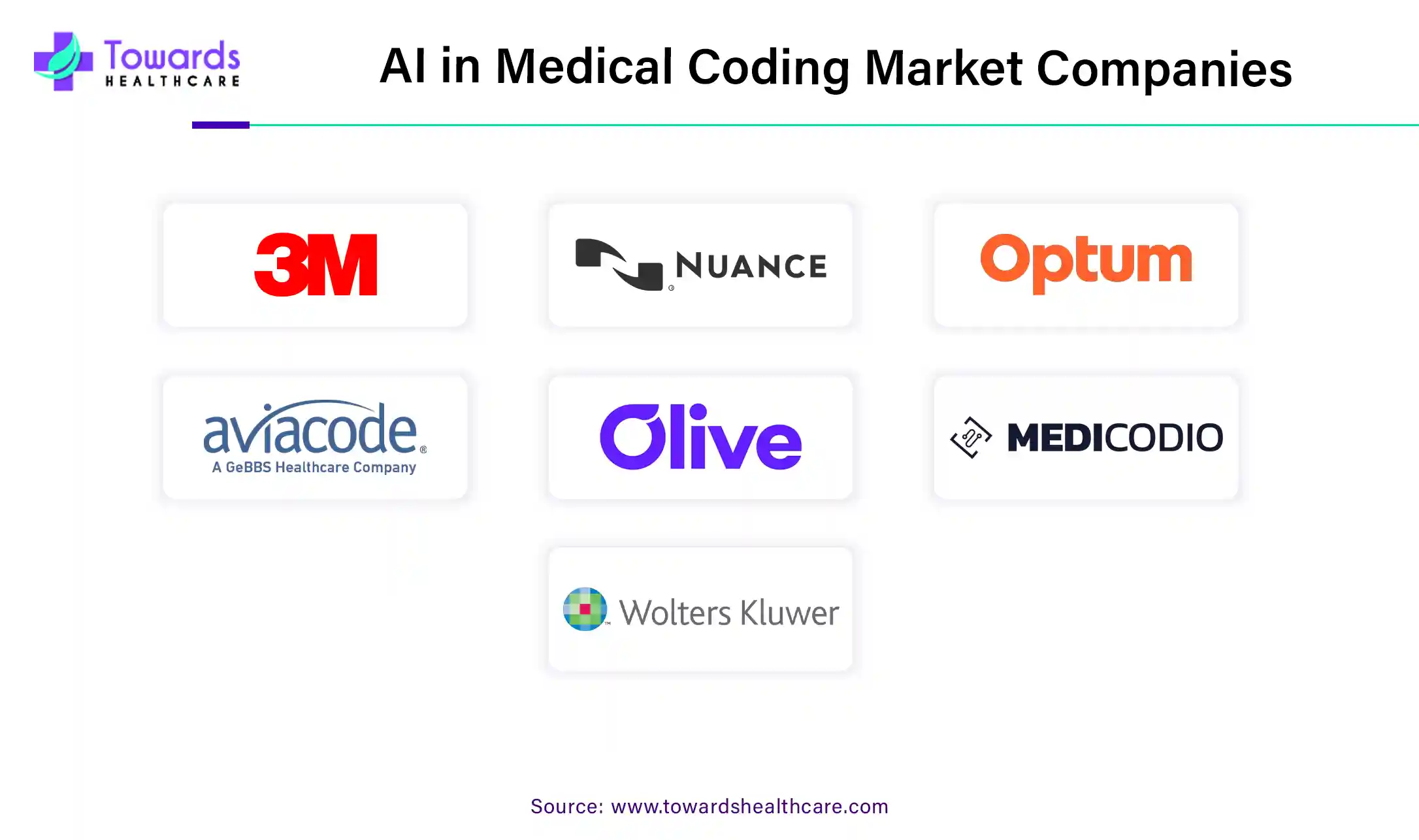
| Top Key Players | 3M Health Information System, Nuance Communications, TruCode LLC, Optum, Cerner corporation, Aviacode, Olive AI, Medicodio, Fathom, Inc., Wolters Kluwer Health |
Which Component Segment Dominated the AI in Medical Coding Market?
By component, the outsourced segment held a dominant presence in the market in 2025. Outsourcing refers to contracting a third-party company to complete the coding tasks on behalf of the original company. Some common outsourcing services include medical coding audits, charge capture, clinical documentation improvement (CDI), and hierarchical condition category (HCC). AI offers potential benefits such as enhanced efficiency and effective coding service. It automates the entire process using robots, improving outcomes. Outsourcing can offer customized services based on the requirements and reduce the overhead expenditure, enhancing productivity. Outsourcing is mainly preferred by organizations having a lack of suitable infrastructure and trained professionals.
By component, the in-house segment is predicted to witness significant growth in the market over the forecast period. The increasing investments enable companies to adopt AI tools and software to revolutionize medical coding. The availability of user-friendly tools and software makes it easier for professionals to operate without advanced training. In-house services also allow companies to maintain privacy, reducing the chances of data leaks. AI systems can detect errors in real-time, allowing professionals to take timely action.
Why Did the Healthcare Providers Segment Dominate the AI in Medical Coding Market?
By end-user, the healthcare providers segment led the global market in 2025. Healthcare providers such as doctors, nurses, and other staff can benefit from AI in medical coding by improving coding accuracy and efficiency. Integrating AI in medical coding can provide real-time patient data to healthcare professionals and help them focus on patient care. It reduces the risk of human errors and accelerates the entire workflow in a healthcare setting.
By end-user, the payers segment is projected to expand rapidly in the market in the coming years. Healthcare payers such as government and private health insurance companies adopt AI for medical coding. AI can assist in filing medical claims, leading to faster reimbursement and fewer claim denials. AI in medical coding enables healthcare payers to maintain large amounts of patient data, reducing manual errors. Thus, AI can increase accuracy, efficiency, and revenue capture.
In 2025, North America dominated the AI in medical coding market, a trend expected to continue throughout the forecast period. North America makes significant R&D investments, particularly in the healthcare and artificial intelligence sectors. This investment fuels innovation and the advancement of artificial intelligence(AI) applications in various medical fields, including medical coding. Capital is readily available in the region for startups and technology firms. This funding encourages the growth of AI startups specializing in healthcare, such as medical coding solutions. North American healthcare institutions, technology companies, and startups frequently collaborate on AI projects. These alliances promote medical coding solutions.
U.S. Market Trends
The presence of a robust healthcare infrastructure and favorable reimbursement policies propels the need for medical coding. The Centers for Medicare and Medicaid Services encourage the use of a standardized coding system, providing a uniform language for nationwide claims processing. The U.S. healthcare insurers process over 5 billion claims for payment.
Canada Market Trends
The rising adoption of electronic health records (EHRs) is transforming the healthcare sector, increasing the demand for medical coding. MEDITECH and Epic Systems Corporation are the major providers of EHR systems in Canada, accounting for 53.3% of all EHR systems in Canada.
In the evolving landscape of AI in medical coding across Europe, key countries such as the UK, Germany, and France are at the forefront of adoption. These nations showcase a strong commitment to embracing technological advancements in healthcare. Advances in healthcare technology propel the growth in this market play a pivotal role. The integration of artificial intelligence in medical coding not only enhances accuracy. This technology allows healthcare providers to optimize resource allocation and focus on better patient care. There is a notable push towards digitization within the healthcare sector. Electronic Health Records (EHRs) create a conducive environment for AI applications.
Medical coding, a crucial aspect of healthcare data management, benefits from this digital transformation, enabling quicker access to information and facilitating interoperability. Europe sees rapid evolution in AI in medical coding market driven by technological advancements and a digital healthcare push; the journey is not without obstacles. Navigating diverse regulatory landscapes and addressing data privacy concerns are critical aspects influencing the pace and success of implementation across the continent.
Germany Market Trends
The German government actively promotes digitization in the healthcare sector through various initiatives and funding. Germany’s Health Data Lab provides access to data from 75 million insured individuals, representing 90% of the country’s population. This offers unprecedented opportunities to advance digital health innovation and research with global impact.
UK Market Trends
The increasing number of hospital admissions fosters the market. In January 2025, there were around 406,300 hospital admissions in emergency departments. The Association of British Insurers reported that private insurers paid £3.57 billion in medical insurance claims in 2023, an increase of 21% compared to 2022.
Throughout the forecast period, Asia Pacific is expected to have the fastest growth in the AI in medical coding market. Asia Pacific, which includes countries such as China and India, has experienced rapid economic growth. As a result, healthcare expenditures have risen, increasing demand for advanced technologies such as AI in medical coding. The Asia-Pacific region is home to a sizable proportion of the global population. This, together with the high prevalence of various disease, has resulted in an increasing demand for effective healthcare solutions. In large healthcare systems, artificial intelligence in medical coding can help streamline administrative task and ensure accurate billing and coding.
China Market Trends
The Chinese government formed the “National AI Industry Investment Fund” with an initial capital of ¥60 billion to encourage the development and deployment of AI technologies in the healthcare sector. The Healthy China 2030 and Made in China 2025 initiatives also govern the implementation of EHRs in healthcare organizations.
Japan Market Trends
Annually, more than 1,700 million healthcare insurance claims are registered in the National Database in Japan. The increasing use of electronic medical records and a focus on streamlining healthcare processes drive the market. The Japanese government supports the adoption of AI in the healthcare sector.
The Middle East & Africa are expected to grow at a considerable CAGR in the upcoming period. The rising adoption of advanced technologies, the rapidly expanding healthcare sector, and the increasing number of hospital admission propels market growth. The increasing number of medtech startups and favorable government support augment the market. Government bodies launch initiatives to promote the integration of digital tools in the healthcare sector.
Cresco Safe, Solventum, and Solutions3X are major providers of AI platforms for medical coding in the UAE. The UAE government actively invests in digital health, benefiting healthcare institutions and patients. Policymakers focus on the adoption and implementation of digital technologies, such as AI and telemedicine in the healthcare sector.
Yossi Shahak, CEO of Maverick Medical AI, commented on the launch of CodePilot that the platform enables seamless automation from report creation to billing and delivers over 97% accuracy, reducing coding denials by more than 50%. The company aims to expand beyond medical coding into billing and mid-revenue cycle processes, accelerating reimbursement and enhancing accuracy.
By Components
By End User
By Region




Principal Consultant
Payal Rabde is a Healthcare Market Research Analyst at Towards Healthcare Research & Consulting with 4+ years of experience in pharmaceuticals, biotechnology, medical devices, and life sciences.
Learn more about Payal Rabde

Reviewed By
Aditi Shivarkar is a seasoned professional with over 14 years of experience in healthcare market research. As a content reviewer, Aditi ensures the quality and accuracy of all market insights and data presented by the research team.
Learn more about Aditi Shivarkar