Pipeline Programs

CGT Companies Tracked

Manufacturing Facilities


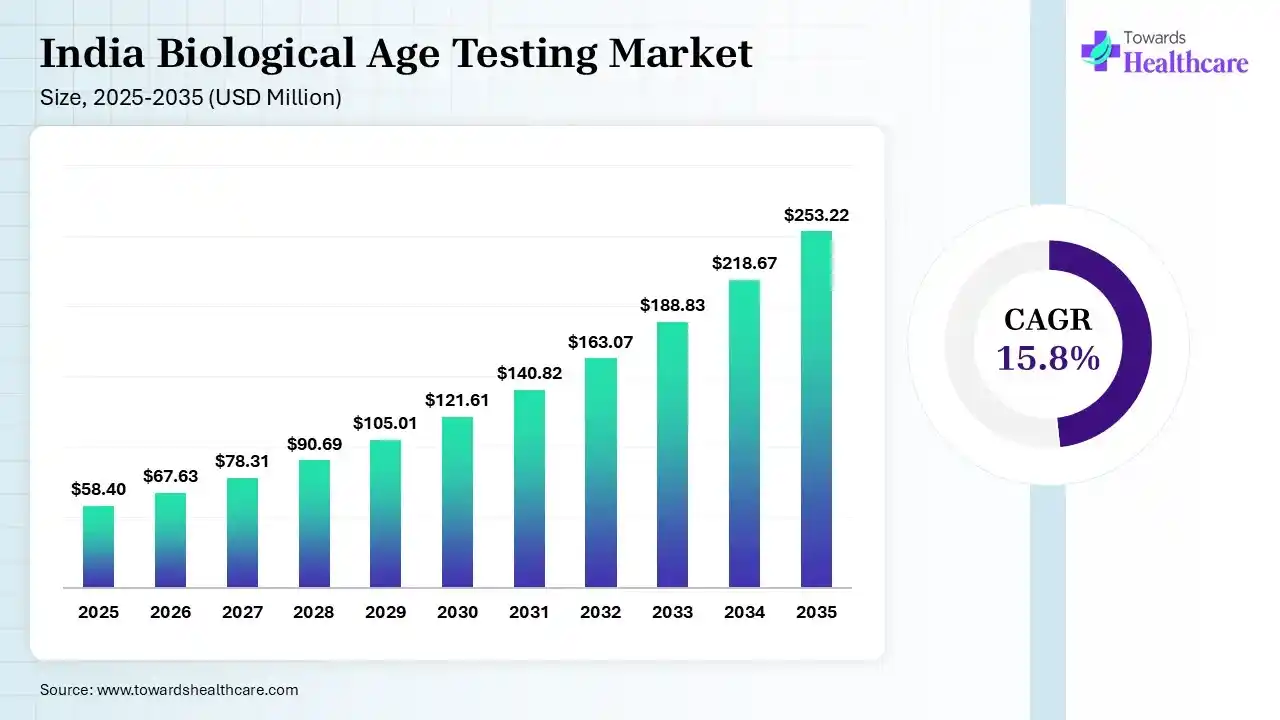
The India biological age testing market was valued at USD 58.4 million in 2025 and is projected to reach USD 253.22 million by 2035, expanding at a CAGR of 15.8% from 2026 to 2035. It is an emerging segment of India's broader longevity diagnostics industry, which includes epigenetic age testing, telomere analysis, multi-omics profiling, proteomics-based aging biomarkers, metabolomics, microbiome diagnostics, and hormone/metabolic profiling.
India longevity diagnostics industry generated approximately US$105.6 million in revenue in 2025; it is estimated to reach US$113.0 million in 2026. India reported for approximately 3.8% of the global longevity diagnostics industry in 2025. Importantly, epigenetic age testing was the largest test-type segment in India in 2025, while multi-omics profiling is identified as the fastest-growing segment.
This market trajectory reflects increasing consumer and healthcare interest in preventive health, longevity, personalized medicine, and early identification of biological changes associated with aging. The Indian market is still relatively early-stage and concentrated among affluent urban consumers, longevity clinics, advanced diagnostic providers, and health-conscious individuals. Current pricing illustrates the premium positioning. AIWO lists an epigenetic age test at ₹60,000, while MapmyGenome lists MapmyEpiGenome at ₹85,000 on its current product page.
Market expansion is likely to come from three developments over the assessment period. First, technological costs may decline, enabling more affordable testing. Second, home collection and digital health platforms can expand geographical access. Third, providers may move beyond one-time biological-age reports toward recurring monitoring programs.
The addressable market could therefore expand from premium epigenetic testing into lower-cost biomarker assessments, multi-omics testing, corporate wellness and longevity-clinic programs. The most significant long-term opportunity may be the creation of a recurring model based on initial biological-age assessment → personalized intervention → periodic retesting → longitudinal monitoring.
The long-term opportunity is unlikely to depend solely on giving consumers a single "biological age" number. More commercially useful offerings are likely to combine biological age with organ-specific aging, metabolic health, inflammation, physical function, and longitudinal change.
Important market-sizing note: the US$105.6 million figure should be described as the India longevity diagnostics market, not as a standalone biological-age-testing market, unless a separate biological-age-specific dataset is available. This distinction is important when preparing a professional market report.
India biological age testing market is an emerging niche within the broader longevity diagnostics, preventive healthcare, and biomarker markets. Biological-age testing estimates physiological/biological aging using measures such as DNA methylation, biomarkers, telomere length, metabolomics, and other multi-omics approaches.
The Indian market is gradually shifting from premium wellness testing to evidence-based longevity diagnostics. Future growth will depend on more than providing a single biological age score. Tests that also assess organ health, metabolism, inflammation, physical function, and changes over time are likely to offer greater value to consumers and healthcare providers.
India's biological age testing market can be segmented according to test type, technology, end use, distribution channel. This segmentation is important because different customers have substantially different requirements and willingness to pay.
| Technology/Biomarker Approach | 2025 Share | CAGR | 2035 Share |
| Epigenetic/DNA Methylation | 43% | 17.20% | 49% |
| Clinical & Physiological Biomarkers | 21% | 12.80% | 18% |
| Telomere Analysis | 15% | 11.60% | 11% |
| Proteomics-Based Aging Biomarkers | 8% | 16.50% | 8% |
| Metabolomics Testing | 6% | 18.10% | 7% |
| Microbiome Aging Diagnostics | 4% | 17.40% | 4% |
| Other / Emerging Biomarkers | 3% | 13.50% | 3% |
| Testing Method | 2025 Share | CAGR | 2035 Share |
| DNA Methylation/Epigenetic Clocks | 45% | 17.50% | 51% |
| Blood Biomarker-Based Phenotypic Age | 24% | 12.90% | 19% |
| Telomere Length Testing | 15% | 11.80% | 11% |
| Multi-Omics Biological Age | 8% | 21.40% | 10% |
| Physical / Functional Age Assessment | 5% | 14.20% | 5% |
| Other Methods | 3% | 13.10% | 4% |
| End User | 2025 Share | CAGR | 2035 Share |
| Direct-to-Consumer/Wellness Users | 38% | 15.60% | 34% |
| Longevity & Preventive Healthcare Clinics | 24% | 19.20% | 28% |
| Hospitals & Healthcare Providers | 15% | 16.40% | 17% |
| Diagnostic Laboratories | 10% | 14.80% | 9% |
| Research & Academic Institutions | 8% | 17.50% | 8% |
| Pharmaceutical & Biotech Companies | 5% | 18.00% | 4% |
From a technology and test-type perspective, the market includes epigenetic age testing, telomere length analysis, multi-omics profiling, proteomics-based aging biomarkers, metabolomics testing, microbiome aging diagnostics, and hormone/metabolic profiling. The epigenetic/DNA methylation testing segment accounts for the largest technology share of 43% of the 2025 market, while the DNA methylation/epigenetic segment is the dominant test type with 45% of the market share. Furthermore, the metabolomics testing segment is the fastest-growing technology with 18.1% CAGR, whereas the multi-omics biological age segment is rapidly expanding with 21.40% CAGR.
From an end-use perspective, the broader longevity diagnostics market can be divided into direct-to-consumer (DTC), longevity clinics, hospitals and clinical laboratories, and other users. Globally, direct-to-consumer (DTC) represented the largest end-use segment in 2025, accounting for approximately 38% of revenue. This trend is relevant to India because home collection and online purchasing can reduce barriers to accessing specialized testing. Moreover, the longevity clinics segment is expected to expand rapidly with a 19.2% CAGR during the predicted period.
1. Health-conscious consumers: Individuals interested in preventive healthcare, fitness, nutrition, and healthy aging, where they focus on accuracy, price, convenience. This is likely to be an important early-adopter segment.
2. Affluent longevity consumers: Consumers willing to spend substantially more on advanced epigenetic or multi-omics assessments. Current products priced at ₹60,000–₹85,000 demonstrate the premium nature of some offerings.
3. Hospitals and longevity clinics: These organizations can use biological-age testing as part of comprehensive preventive-health assessments, clinical monitoring, and personalized longevity programs. Their key purchase criteria are clinical utility, workflow integration, validation, interpretation, and repeatability.
4. Corporate wellness customers: Employers may potentially use advanced health assessments within premium employee wellness programs, although affordability and clinical usefulness will influence adoption.
5. Research and biotechnology organizations: Research institutions, pharmaceutical companies, and biotechnology businesses can use aging biomarkers for research, clinical studies, and development of interventions targeting age-related conditions. Their key focus areas are biomarker depth, datasets, reproducibility, validation, longitudinal data, and population relevance.
Customer segmentation can also be based on price sensitivity. The market could develop into an entry-level biomarker segment, mid-priced biological-age assessments, premium epigenetic tests, and highly specialized multi-omics packages.
A particularly important future segment is the repeat-testing customer. Biological-age testing becomes commercially more valuable when customers return periodically to monitor changes. This creates an opportunity for subscription-based longevity programs.
Overall, the Indian market is likely to develop from a relatively narrow base of affluent, health-conscious urban consumers toward a broader customer ecosystem involving DTC consumers, healthcare providers, corporate wellness programs, and research organizations. The strongest consumer proposition is therefore measurement + interpretation + longitudinal monitoring, rather than selling a biological-age number as a definitive health forecast. The key to mass adoption will be improving affordability, accessibility, clinical interpretation, and consumer understanding.
India's biological age testing competitive landscape is developing around genomics companies, diagnostic providers, longevity platforms, and health-tech businesses. Competition is currently differentiated less by simple test availability and more by technology, number of biomarkers, breadth of reporting, price, convenience, clinical interpretation, and integration with other health services.
One visible participant is AIWO Health, which offers an at-home epigenetic age test priced at ₹60,000. The company states that the test is conducted using a dry-blood sample and processed through its partnership with TruDiagnostic. The reported outputs include OMICm age, DunedinPACE, immune age, telomere length, inflammation, fitness age, and other reports. This positions the offering as a comprehensive molecular-aging assessment rather than simply a single biological-age number.
Another important participant is MapmyGenome, which markets MapmyEpiGenome at ₹85,000 on its current product page. The product combines biological-age assessment using DunedinPACE and OMICmAge with 11 organ-system age scores, more than 185 clinical biomarkers, telomere length, and physical-performance measurements such as VO₂ max and gait speed. It also offers at-home finger-prick blood collection. This creates differentiation through breadth of health information and integration of multiple measurements rather than relying exclusively on an epigenetic clock.
The competitive environment also includes broader genomics and longevity businesses that may compete indirectly. Companies offering genetic testing, microbiome analysis, preventive-health packages, and personalized wellness services can potentially add biological-age testing to their portfolios. MapmyGenome, for example, offers broader genomic and microbiome products alongside its epigenetic offering, demonstrating the movement toward integrated longevity platforms.
Moreover, NuGenomics markets NuGen Rewind, a longevity-oriented testing package covering areas such as inflammation, metabolism, vascular health, mitochondrial function, sleep and hormonal rhythms, which offers an approach that demonstrates another important market model: biological age can act as an entry point into a broader longevity-health platform.
MyDiagnostics currently markets a DNA-methylation biological-age test with biological age, Dunedin pace of aging, telomere length, organ-system measures, and other markers. It offers home blood collection and lists a current package price of ₹45,000. The presence of premium-priced offerings indicates that biological-age testing remains an early-adopter and premium diagnostic category, leaving significant room for lower-cost standardized products.
The Longevity Centre positions biological-age testing within a physician-led personalized longevity program and reports using GrimAge, PhenoAge, and Horvath analyses. It lists centers across Delhi, Gurgaon, Mumbai, Pune, Nagpur, Goa, Bengaluru and Hyderabad. The clinic model could be particularly important because it converts a laboratory result into a care pathway, including interpretation, lifestyle modification, and longitudinal monitoring.
| Competitive factor | Key consideration |
| Technology | Epigenetics, biomarkers, multi-omics |
| Testing depth | Number and type of biomarkers |
| Price | Premium vs. affordable testing |
| Sample collection | Clinic vs. home collection |
| Interpretation | Automated vs. expert/clinical |
| Product breadth | Single test vs. complete longevity package |
| Digital experience | Online reports and monitoring |
| Recurring services | Retesting and subscriptions |
| Partnerships | Labs, hospitals and research institutions |
An important competitive trend is the shift from "biological age testing" to "longevity management." Providers can differentiate by combining testing with nutrition, fitness, physician consultation, and lifestyle recommendations.
Therefore, the competitive landscape should not be evaluated solely by the number of biological-age tests available. A stronger analysis should compare technology + price + biomarkers + customer experience + clinical interpretation + distribution + recurring revenue model. This broader framework better reflects how competition is likely to evolve as the Indian longevity diagnostics market develops.
Pricing in India's biological age testing market varies significantly according to the technology used, number of biomarkers assessed, laboratory infrastructure, sample type, degree of interpretation, and additional healthcare services included in the package. Basic biomarker-based assessments can potentially be offered at relatively accessible prices, while advanced epigenetic and multi-omics assessments occupy the premium end of the market.
Current market offerings illustrate this wide premium positioning. AIWO currently lists an at-home epigenetic age test at ₹60,000. Its package uses a dry-blood sample and includes multiple reports covering biological age, aging pace, immune status, telomere length, inflammation, fitness age, and other metrics. MapmyGenome's MapmyEpiGenome is listed at ₹85,000 and combines epigenetic age assessment with 11 organ-system age scores, more than 185 clinical biomarkers, telomere length, and physical-performance measures.
The principal cost drivers include specialized laboratory testing, DNA methylation analysis, sequencing or other analytical technologies, reagents, bioinformatics, quality control, sample transportation, and professional interpretation. International laboratory processing can also increase costs; AIWO, for example, states that samples are shipped to TruDiagnostic's laboratory in the United States.
A major future opportunity is price segmentation. Providers could offer basic biomarker-based tests at lower prices, premium epigenetic tests for affluent consumers, and comprehensive multi-omics packages for high-value customers. Subscription-based retesting could further change the economics from a one-time purchase to recurring revenue.
The market is being shaped by a combination of increasing demand for preventive healthcare, growing consumer interest in healthy aging, advances in genomics and epigenetics, and the expansion of personalized healthcare. Consumers increasingly seek measurable indicators of their health beyond conventional disease screening, creating an opportunity for biological-age assessments to function as a wellness and preventive-health tool.
Technology is another important growth driver. The broader global longevity diagnostics market is being supported by epigenetic clocks, next-generation sequencing, multi-omics profiling, and AI-enabled biomarker analysis. Globally, epigenetic age testing represented 25.5% of the longevity diagnostics market in 2025, while direct-to-consumer testing represented 40.0%.
However, several restraints could limit rapid mass adoption in India. Advanced tests remain expensive relative to conventional diagnostic tests. Consumer understanding is also limited, and biological-age results can be difficult to interpret because different testing methodologies measure different biological characteristics. The lack of universally standardized biological-age measures is another challenge.
Clinical validation is particularly important. A biological-age score should not automatically be interpreted as a disease diagnosis or a guaranteed predictor of future health. Providers therefore need to communicate test limitations clearly and establish analytical and clinical validity.
The market opportunity lies in making testing more affordable, improving Indian-specific validation, expanding home collection, integrating wearable and lifestyle data, and connecting testing with actionable interventions. This could shift the industry from one-time testing toward longitudinal health monitoring.
The technology landscape is evolving from relatively simple aging indicators toward increasingly comprehensive molecular and computational assessments. The principal technologies include DNA methylation/epigenetic clocks, telomere analysis, blood-based biomarker algorithms, proteomics, metabolomics, microbiome analysis, and multi-omics profiling.
DNA methylation is currently particularly important because epigenetic clocks can evaluate methylation patterns at numerous genomic locations and convert these measurements into biological-age or aging-rate estimates. Commercial products in India are already using sophisticated epigenetic approaches. AIWO's offering, for example, states that it analyzes more than 900,000 DNA methylation sites and provides multiple aging-related reports.
The next stage is likely to involve multi-omics integration. India's longevity diagnostics market already identifies multi-omics profiling as the fastest-growing test-type segment. This approach can combine information from different biological layers, potentially providing a broader understanding of aging mechanisms than a single biomarker.
AI and machine learning are also becoming important because biological-age testing generates large datasets requiring sophisticated analysis. Algorithms can potentially integrate laboratory results, genetic information, lifestyle factors, wearable-device data, and longitudinal measurements.
Innovation is also occurring in sample collection and accessibility. MapmyGenome currently offers at-home finger-prick collection for its epigenetic testing package.
The longer-term technological direction is therefore likely to be integrated longevity platforms rather than isolated biological-age tests, combining molecular testing, AI interpretation, continuous health monitoring, and personalized recommendations.
India's biological age testing market can develop through several distribution channels, including direct-to-consumer platforms, diagnostic laboratories, hospitals, longevity clinics, wellness centres, health-tech companies, and corporate wellness programs. Among these, the direct-to-consumer (DTC) model is particularly relevant because biological-age testing is attractive to consumers who actively seek personalized health information.
The DTC model typically involves online purchase, home sample collection, laboratory analysis, and digital delivery of results. This reduces the need for consumers to visit specialized clinics and allows providers to serve customers across multiple cities. Current products demonstrate that this model is already being used. AIWO offers at-home sample collection and online consultation, while MapmyGenome promotes at-home finger-prick collection for its biological-age testing product.
The hospital and longevity-clinic model provides another opportunity. Here, biological-age testing can become one component of a broader preventive-health package involving physician consultations, nutrition, fitness, metabolic testing and lifestyle interventions.
B2B opportunities include corporate wellness programs, premium employee-health packages, research partnerships and diagnostic-laboratory collaborations.
From a business perspective, the most attractive model may increasingly be testing plus recurring monitoring. Instead of selling only a single test, providers can offer a package consisting of an initial assessment, personalized intervention, six- or twelve-month retesting, and longitudinal progress tracking.
This model can generate recurring revenue while also making the test more actionable. It transforms biological-age testing from a one-time wellness product into a broader preventive-health service.
The Indian biological age testing market is likely to develop initially in major metropolitan and economically developed healthcare markets. Cities such as Mumbai, Pune, Bengaluru, Delhi-NCR, Hyderabad, Chennai and Ahmedabad offer favorable conditions because of their concentration of private healthcare providers, diagnostic laboratories, technology companies, affluent consumers and wellness services.
South India's advantage is not simply consumer demand; it comes from the combination of research infrastructure and commercial healthcare capacity, making the region important for both technology development and adoption. West India is likely to remain particularly important for premium preventive-health and longevity services, where consumers may be more willing to pay for advanced testing. The key opportunity in North India is expanding biological-age testing from premium metropolitan consumers into hospital-based preventive medicine and broader diagnostic networks. The East/Northeast opportunity is currently smaller, but digital ordering, centralized laboratory processing, and home sample collection could reduce geographic barriers.
Urban markets are particularly important because advanced biological-age tests are currently positioned at premium price points. For example, AIWO lists its epigenetic test at ₹60,000, while MapmyGenome's MapmyEpiGenome is priced at ₹85,000. Such pricing makes early adoption more likely among affluent and health-conscious urban consumers.
Western and southern India could become important commercial centres because of their strong healthcare and technology ecosystems. Maharashtra, Karnataka, Telangana, Tamil Nadu and Gujarat have large private healthcare and diagnostic networks that can support distribution and sample logistics.
The next stage of geographical expansion is likely to involve national diagnostic networks and home sample collection. At-home testing reduces the dependence on physical longevity clinics and allows companies to serve customers outside the largest metropolitan areas. Current commercial listings already show at-home availability across multiple Indian cities.
However, broader penetration will depend on reducing prices, increasing awareness, and establishing trusted interpretation services. Tier-2 and Tier-3 cities could become important longer-term markets if providers introduce affordable tests and use digital consultations.
Thus, the regional development pattern is likely to move from premium metro adoption → wider urban penetration → national home-testing distribution.
The regulatory and clinical environment is one of the most important factors influencing the long-term development of biological age testing. Unlike conventional diagnostic tests that may measure a clearly defined clinical parameter, biological-age testing can produce a composite score whose interpretation depends on the underlying algorithm, biomarkers, and reference population.
Consequently, providers need to distinguish between wellness information, risk assessment, and clinical diagnosis. A biological-age result should not automatically be presented as proof that an individual is biologically "healthy" or "unhealthy." The methodology and limitations should be clearly communicated.
Clinical validation is also important. Providers need evidence regarding analytical accuracy, reproducibility, appropriate reference populations, and the relevance of the biological-age measurement to meaningful health outcomes. Indian-specific validation can become particularly valuable because algorithms developed using other populations may not necessarily perform identically in Indian populations.
Data protection is another major consideration. Biological-age tests may involve genetic or epigenetic information and therefore generate highly sensitive personal health data. Companies need appropriate consent, secure storage, controlled access, and transparent policies concerning data use and sharing.
The market can benefit from partnerships between diagnostic companies, hospitals, universities and research institutions to conduct longitudinal studies and validate aging biomarkers in Indian populations.
Overall, stronger clinical evidence and transparent communication could increase physician and consumer confidence. Regulatory clarity, laboratory quality standards, and responsible health claims will also become increasingly important as biological-age testing moves from a niche wellness product toward broader healthcare applications.
Biological age testing offers investment opportunities because it connects several rapidly developing fields: genomics, diagnostics, preventive healthcare, health technology, personalized medicine, and longevity services.
Potential investors include diagnostic companies, genomics firms, biotechnology companies, health-tech platforms, hospitals, wellness businesses, and venture-capital funds. Investors may particularly focus on businesses that combine proprietary technology with recurring revenue and scalable distribution.
Partnerships can accelerate market development. A genomics company + diagnostic laboratory partnership can expand testing capacity, while a health-tech platform + laboratory model can provide digital ordering and home collection. Hospitals and longevity clinics can combine biological-age testing with physician-led interventions. Corporate wellness providers can incorporate testing into premium employee-health programs.
Research partnerships are equally important. Universities and research institutions can help validate biological-age algorithms and generate Indian longitudinal datasets. These datasets may eventually support locally optimized aging models.
An important investment opportunity is the transition from individual testing to integrated longevity platforms. MapmyGenome, for example, already markets a package combining genetics, gut microbiome, and epigenetics, illustrating how providers can expand beyond a single biological-age measurement.
For investors, important evaluation factors include scientific validation, technology differentiation, repeat-testing potential, laboratory infrastructure, data capabilities, and regulatory compliance.
The long-term outlook for biological age testing in India is linked closely to the expansion of preventive healthcare, longevity medicine, personalized diagnostics, and consumer health technology. The broader Indian longevity diagnostics idustry is projected to increase from US$105.6 million in 2025 to US$197.9 million by 2033, representing an 8.3% CAGR during 2026-2033. Epigenetic age testing currently represents the largest test-type segment, while multi-omics profiling is expected to grow fastest.
The market is likely to evolve in three stages. The first stage is premium biological-age testing, primarily serving affluent and health-conscious urban consumers. The second stage is broader adoption through lower-cost biomarker testing, home collection, and diagnostic-network partnerships. The third stage could involve integrated longevity platforms combining epigenetics, blood biomarkers, genetics, microbiome, wearables, fitness, and AI-based analytics.
Pricing is likely to remain an important market variable. Current premium products are priced around ₹60,000-₹85,000, demonstrating both the sophistication of the technology and the opportunity for lower-cost alternatives.
The strongest long-term commercial opportunity may therefore lie beyond the test itself. Providers could build recurring models around testing → personalized recommendations → intervention → monitoring → retesting.
Future market development will depend on affordability, clinical validation, consumer education, Indian-specific research, technological improvements, and regulatory clarity. If these factors progress together, biological-age testing could become a component of a wider preventive-health and longevity ecosystem rather than remaining a niche premium diagnostic product.
By Technology / Biomarker Approach
By Testing Method
By End User
By Distribution Channel
By Region


Principal Consultant
Payal Rabde is a Healthcare Market Research Analyst at Towards Healthcare Research & Consulting with 4+ years of experience in pharmaceuticals, biotechnology, medical devices, and life sciences.
Learn more about Payal Rabde

Reviewed By
Aditi Shivarkar is a seasoned professional with over 14 years of experience in healthcare market research. As a content reviewer, Aditi ensures the quality and accuracy of all market insights and data presented by the research team.
Learn more about Aditi Shivarkar