
Pipeline Programs

CGT Companies Tracked

Manufacturing Facilities


The KRAS inhibitors market is projected to reach US$ 0.78 billion in 2026 and US$ 5.08 billion by 2036, growing at a CAGR of 20.6% during 2027-2036. KRAS G12C remains an established treatment category, while research into other KRAS mutations and broader RAS-targeted therapies is expanding the development pipeline. New drug approvals and positive clinical results further strengthen market growth.
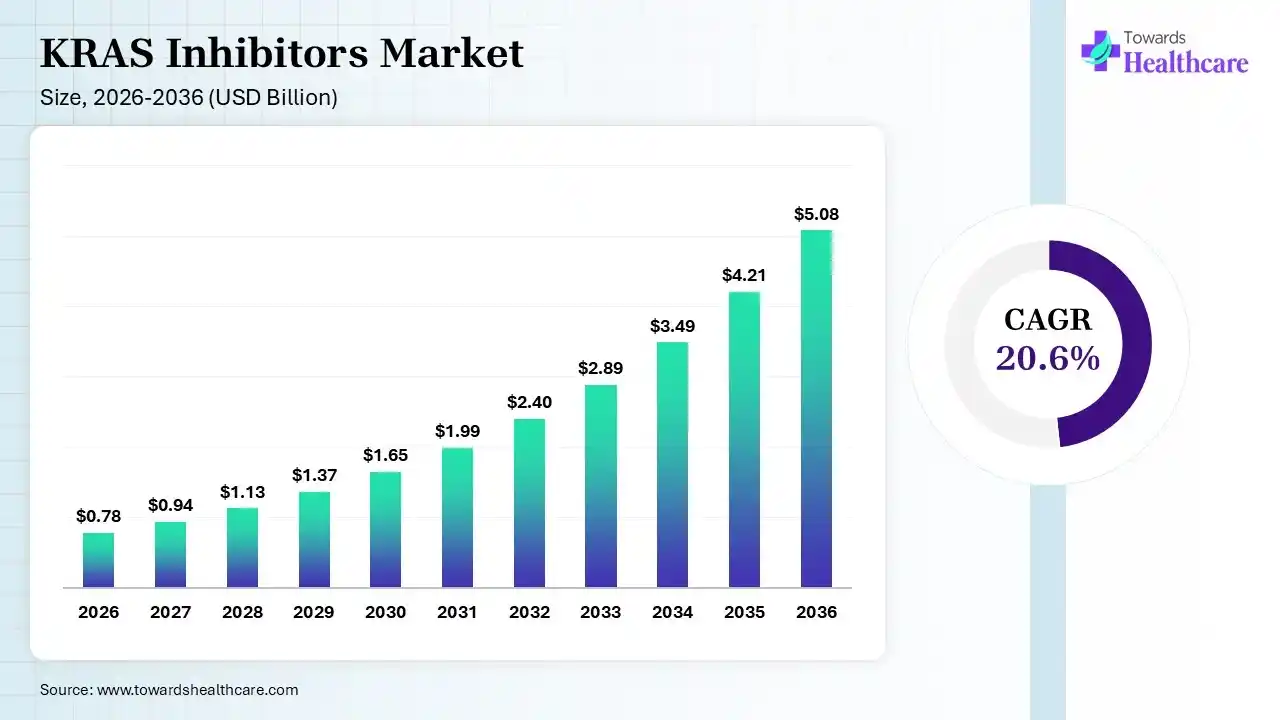
The KRAS inhibitors market is expanding beyond KRAS G12C therapies as developers target additional mutations and broader RAS pathways. Rising demand for targeted cancer treatments, advances in mutation-specific drug development, and the need to overcome treatment resistance are key market drivers. Approved KRAS G12C therapies have established a commercial foundation, while new treatment approaches extend the market to more patients and cancer types.
Market demand varies by cancer type, mutation profile, and treatment history. Non-small cell lung cancer (NSCLC) and colorectal cancer are key areas for KRAS G12C therapies. Pancreatic cancer also represents a significant unmet clinical need and an important area of drug development. Treatment eligibility and commercial potential depend on the specific mutation, prior therapies, and clinical evidence for each indication.
Commercial growth depends on demonstrating meaningful clinical benefits, securing regulatory approval, and establishing reimbursement and patient access. The report assesses these factors to distinguish established treatment revenues from opportunities that remain dependent on clinical trials and future approvals.
The KRAS inhibitors market is segmented by mutation target, drug category, cancer indication, treatment line, treatment approach, distribution channel, and geography. Each dimension affects the eligible patient population, clinical positioning, competitive intensity, and potential revenue.
By mutation target, KRAS G12C represents an established treatment category. KRAS G12D and other variants offer additional opportunities as clinical research advances. Broader RAS-targeted approaches expand treatment coverage if developers establish acceptable safety and meaningful clinical benefit.
By cancer indication, NSCLC is a key application for KRAS G12C inhibitors. Colorectal cancer requires indication-specific treatment strategies, including evaluation of combination regimens. Pancreatic cancer has become an important area of development for broader RAS-targeted therapies. Other solid tumors provide further opportunities as evidence develops.
By treatment approach, the market includes monotherapy and combination therapy. Combination regimens improve outcomes or help address resistance. Their commercial potential depends on the benefit achieved, tolerability, treatment complexity, and overall cost.
| Segmentation dimension | Principal categories | Commercial significance |
| Mutation target | KRAS G12C, KRAS G12D, other KRAS variants, broader RAS-targeted approaches | Defines eligible patients and the competitive field |
| Drug category | Approved inhibitors, next-generation inhibitors, investigational targeted therapies | Separates current sales from future opportunities |
| Cancer indication | NSCLC, colorectal cancer, pancreatic cancer, other solid tumors | Captures differences in mutation prevalence and clinical use |
| Treatment line | Later-line treatment, earlier-line treatment where approved | Influences patient volume and treatment duration |
| Treatment approach | Monotherapy, combination therapy | Evaluates efficacy, resistance management, and treatment burden |
| Distribution channel | Specialty pharmacies, hospital pharmacies, other authorized channels | Determines access and distribution requirements |
| Geography | North America, Europe, Asia-Pacific, Latin America, Middle East and Africa | Reflects differences in approval, reimbursement, and access |
The main growth driver is rising demand for effective targeted treatments for KRAS-mutated cancers. Molecular testing helps clinicians identify patients eligible for specific inhibitors. Wider access to testing and greater adoption of precision oncology expand the eligible patient pool and increase treatment uptake.
Drug resistance remains a major market challenge. Some patients develop disease progression after an initial response, increasing the need for new therapies and treatment combinations. Developers address resistance mechanisms and demonstrate meaningful clinical benefits to support wider adoption.
Combination therapy is a key area of development. Combining KRAS inhibitors with other targeted drugs or established cancer treatments improves response rates and delays resistance. However, these regimens increase toxicity, treatment complexity, and costs. Their clinical use depends on strong evidence of efficacy, safety, and long-term benefit.
Opportunities are concentrated in patient populations with limited targeted treatment options. New inhibitors gain a competitive advantage by demonstrating meaningful clinical benefits in clearly defined patient groups. Broader mutation coverage and combination regimens further expand market opportunities, subject to clinical evidence and regulatory approval.
Key Coverage
KRAS inhibitor pricing varies by product, dosage, treatment duration, country, and reimbursement arrangement. Monthly treatment cost and total treatment-course cost are important measures for comparing therapies. Manufacturer net revenue differ from list prices because of discounts, rebates, and other contractual terms.
Pricing decisions depend on clinical benefit, available alternatives, patient population, and payer evaluation. A therapy with differentiated outcomes establishes a stronger commercial position, but its adoption still depend on reimbursement and budget impact.
Combination regimens create additional cost considerations because the total treatment expense includes the KRAS inhibitor and companion medicines. Payers assess the combined cost against the clinical benefit and the availability of alternative regimens.
Demand for KRAS inhibitors depends on cancer incidence, mutation prevalence, testing availability, treatment eligibility, and physician adoption. The addressable patient population be calculated by mutation and indication. Total cancer incidence does not represent the number of patients eligible for a specific drug.
The value chain begins with drug discovery and target validation. It continues through preclinical research, clinical development, regulatory review, manufacturing, market access, distribution, and treatment delivery. Early-stage developers carry substantial scientific and clinical risk. Commercial value increases when a therapy demonstrates benefit, receives approval, and reaches eligible patients.
Supply requirements differ between marketed products and investigational therapies. Commercial medicines need consistent production, quality control, and distribution. Clinical candidates require dependable trial supply and manufacturing processes that support potential commercial scale-up.
Innovation focuses on improving target inhibition, extending treatment response, addressing resistance, and reaching mutations with limited treatment options. Key development approaches include next-generation inhibitors, mutation-specific compounds, broader RAS-targeted therapies, and combination regimens.
Clinical differentiation is essential. Developers demonstrate meaningful benefit in the intended patient population while maintaining an acceptable safety profile. Early clinical activity does not establish long-term efficacy or commercial viability. Pipeline assessment consider trial phase, patient population, clinical endpoints, safety findings, and development milestones.
Regulatory approval is indication-specific. Approval for one mutation or cancer type does not establish approval for another. Developers seeking broader use generate evidence that supports the proposed population and treatment setting.
Molecular diagnostics are central to market adoption. Testing identifies patients with mutations relevant to a particular therapy. Access, accuracy, turnaround time, and laboratory capabilities influence how quickly eligible patients receive treatment.
| Segments | 2026 Share | 2026 Market Value (USD Million) |
| KRAS G12C | 65% | $507 |
| KRAS G12D | 15% | $117 |
| Other KRAS Mutations | 12% | $93.6 |
| Pan-KRAS and Broader RAS-Targeted Approaches | 8% | $62.4 |
KRAS G12C is estimated to account for the largest share because it has an established commercial base supported by approved targeted treatments. KRAS G12D, other mutation-specific programs, and broader RAS-targeted approaches represent developing opportunities as clinical research expands the range of addressable mutations.
| Segments | 2026 Share | 2026 Market Value (USD Million) |
| Approved KRAS Inhibitors | 67% | $522.6 |
| Next-Generation KRAS Inhibitors | 18% | $140.4 |
| Other Investigational KRAS-Targeted Therapies | 9% | $70.2 |
| Combination Regimens Involving KRAS Inhibitors | 6% | $46.8 |
Approved KRAS inhibitors are estimated to lead current revenue, reflecting commercial use of established products. Next-generation candidates, investigational therapies, and combination regimens are expected to shape future competition as developers seek stronger responses, longer-lasting benefit, and ways to overcome resistance.
| Segments | 2026 Share | 2026 Market Value (USD Million) |
| Non-Small Cell Lung Cancer (NSCLC) | 55% | $429 |
| Colorectal Cancer | 22% | $171.6 |
| Pancreatic Cancer | 13% | $101.4 |
| Other Solid Tumors | 10% | $78 |
NSCLC is estimated to represent the largest indication segment, supported by the established role of KRAS G12C-targeted treatment in this cancer type. Colorectal and pancreatic cancers are important areas of development, while broader solid-tumor research may expand the market if new therapies demonstrate clinical benefit.
| Segments | 2026 Share | 2026 Market Value (USD Million) |
| Later-Line Treatment | 76% | $592.8 |
| Earlier-Line Treatment Where Approved | 16% | $124.8 |
| Other Indication-Specific Treatment Settings | 8% | $62.4 |
Later-line treatment is estimated to account for most current market revenue, reflecting the role of targeted KRAS therapies in advanced cancers after prior treatment. Earlier-line use could grow as clinical evidence and regulatory approvals support broader use in treatment pathways.
| Segments | 2026 Share | 2026 Market Value (USD Million) |
| Monotherapy | 72% | $561.6 |
| Combination Therapy | 28% | $218.4 |
Monotherapy is estimated to hold the larger share as approved targeted treatments are used as standalone regimens in eligible settings. Combination therapy is an important development strategy, particularly for addressing resistance, improving response durability, and expanding treatment options across tumor types.
| Segments | 2026 Share | 2026 Market Value (USD Million) |
| Specialty Pharmacies | 45% | $351 |
| Hospital Pharmacies | 40% | $312 |
| Other Authorized Distribution Channels | 15% | $117 |
Specialty and hospital pharmacies are estimated to account for most distribution, given the specialist oversight, monitoring, and access requirements associated with oncology medicines. Other authorized channels serve eligible patients and healthcare systems according to local distribution rules and reimbursement arrangements.
| Segments | 2026 Share | 2026 Market Value (USD Million) |
| North America | 45% | $351 |
| Europe | 28% | $218.4 |
| Asia-Pacific | 18% | $140.4 |
| Latin America | 5% | $39 |
| Middle East and Africa | 4% | $31.2 |
North America is estimated to lead the market due to earlier access to approved oncology medicines, established precision-oncology infrastructure, and substantial clinical development activity. Europe represents another significant market, while Asia-Pacific growth may be supported by expanding cancer diagnosis, clinical research, and access to targeted therapies.
The United States is estimated to account for the largest share of North American revenue, supported by access to targeted oncology treatments, specialist cancer centers, and clinical research activity. Canada and Mexico contribute smaller shares, influenced by differences in treatment access and healthcare-system funding.
Western Europe is estimated to lead the European market due to established oncology services and access to innovative medicines in major healthcare systems. Market access and reimbursement differences across Eastern Europe may affect the pace of adoption.
Germany, the United Kingdom, and France are estimated to be important Western European markets due to their oncology treatment infrastructure and participation in clinical research. Uptake across the region will also depend on national reimbursement decisions and the availability of approved therapies.
Eastern European market development is expected to vary with access to precision oncology, medicine funding, and local treatment guidelines. The rest-of-region category includes markets not separately listed.
China and Japan are estimated to represent major Asia-Pacific markets, with India and South Korea also contributing to regional demand. Adoption will depend on regulatory approvals, diagnostic testing capacity, local clinical evidence, and affordability.
Brazil is estimated to be the largest separately identified market in Latin America. Access to targeted therapies across the region may vary with public and private reimbursement, availability of molecular testing, and specialist oncology services.
The GCC and South Africa are estimated to be relevant markets within the region, while the rest-of-region category covers other countries. Market growth will depend on oncology infrastructure, access to molecular diagnostics, and the ability of healthcare systems to fund specialized cancer medicines.
| Company | Relevant market exposure | Competitive assessment focus |
| Amgen | Sotorasib (Lumakras), a KRAS G12C inhibitor | Product revenue, approved uses, and lifecycle strategy |
| Bristol Myers Squibb | Adagrasib (Krazati), a KRAS G12C inhibitor | Commercial positioning, clinical evidence, and indication expansion |
| Revolution Medicines | Daraxonrasib and a broader RAS(ON) inhibitor portfolio | Marketed therapy, next-generation assets, and mutation coverage |
| Eli Lilly and Company | Olomorasib, a second-generation KRAS G12C inhibitor in development | Clinical differentiation and development strategy |
| Genentech / Roche | Divarasib, a next-generation KRAS G12C inhibitor in development | Clinical outcomes and potential competitive positioning |
| Jacobio Pharma | Glecirasib and pan-KRAS development programs | Commercial activity in China and pipeline expansion |
| Erasca | Pan-RAS and pan-KRAS development programs | Clinical development and broader mutation coverage |
| AstraZeneca | Collaboration involving a pan-KRAS inhibitor program with Jacobio | Partnership strategy and potential access to new targets |
| Summit Therapeutics | Collaboration evaluating combinations with RAS-targeted inhibitors | Combination development and oncology positioning |
| Tango Therapeutics | Collaboration involving RAS-targeted combinations with a PRMT5 inhibitor | Combination strategy in molecularly defined tumors |
| Boehringer Ingelheim | Oncology research and targeted therapy capabilities relevant to the broader RAS pathway | Pipeline activity and strategic partnerships; direct KRAS asset exposure requires verification |
| Novartis | Oncology research and targeted therapy capabilities relevant to the broader pathway | Pipeline and partnership screening; direct KRAS inhibitor exposure requires verification |
Competition depends on clinical benefit, safety, mutation coverage, treatment convenience, and the ability to manage resistance. Marketed KRAS G12C inhibitors have established the commercial category. New entrants demonstrate value in efficacy, tolerability, dosing, or patient coverage.
Competition intensifies as next-generation candidates advance and new therapies enter overlapping indications. Developers targeting different mutations initially address separate patient populations. Direct competition rises if multiple products gain approval for the same mutation and cancer type.
The report distinguishes current product revenue from future pipeline potential. Investigational therapies have strategic value without generating current commercial sales. Their future position depends on trial outcomes, regulatory milestones, launch timing, reimbursement, and competing products.
Regional market performance depends on product approvals, reimbursement policies, diagnostic infrastructure, oncology treatment pathways, and access to specialist care. North America remains an important market for targeted oncology therapies. Its share of the KRAS inhibitors market requires a dedicated market-sizing assessment.
Europe has a varied market access environment. National reimbursement decisions and healthcare budgets influence product launch timelines and patient access. In Asia-Pacific, commercial opportunities depend on cancer burden, molecular testing availability, local approvals, treatment affordability, and domestic pharmaceutical development.
Other regions present growth opportunities as diagnostic capabilities and access to targeted therapies improve. Patient need alone does not translate into commercial revenue. The report evaluates testing access, reimbursement, product availability, and healthcare-system capacity to assess regional market potential.
Strategic activity focuses on pipeline access, combination development, target expansion, and oncology commercialization. Licensing agreements and research partnerships provide access to new compounds and complementary expertise. Acquisitions give companies control over intellectual property, clinical assets, and drug development platforms.
Transaction value depends on the scientific rationale, clinical stage, development risk, and size of the potential patient population. Early-stage assets carry substantial uncertainty. Later-stage candidates offer a clearer path to commercialization but require greater investment and face more direct competition.
Partnerships involving diagnostics and clinical research support patient identification and clinical trial execution. Their value depends on measurable outcomes, including trial progress, regulatory submissions, approvals, and commercialization results.
The main market white spaces include KRAS mutations without established targeted treatments, patients who develop treatment resistance, and cancers with inadequate outcomes from existing therapies. These opportunities differ by mutation, indication, scientific feasibility, and commercial potential.
KRAS G12D and broader RAS-targeted approaches remain important areas of drug development. Combination therapies target resistance mechanisms and aim to improve treatment response. Their adoption depends on demonstrated clinical benefit. New therapies also require a clearly defined treatment role and supporting evidence for the intended patient population.
The report assesses opportunities based on unmet medical need, estimated eligible population, clinical maturity, competitive intensity, development risk, and potential market access. Numerical rankings remain unassigned until sufficient supporting evidence becomes available.
| Force | Market assessment |
| Competitive rivalry | High strategic intensity as companies compete on clinical outcomes, mutation coverage, and pipeline progress. |
| Threat of new entrants | Limited by drug discovery complexity, clinical development costs, regulatory requirements, and intellectual property. |
| Supplier bargaining power | Influenced by specialized manufacturing capabilities and availability of clinical and commercial supply. |
| Buyer bargaining power | Driven by payer negotiations, reimbursement policies, treatment alternatives, and evidence of clinical value. |
| Threat of substitutes | Includes other targeted therapies, chemotherapy, immunotherapy, and alternative treatment regimens selected by cancer type and clinical setting. |
Market attractiveness depends on patient volume, unmet clinical need, treatment differentiation, pricing potential, and competitive intensity. Mutation-specific therapies target defined patient populations and deliver meaningful clinical value when supported by strong outcomes. Broader target coverage expands the eligible population while introducing additional scientific and safety challenges.
The report compares opportunities by mutation subtype, cancer indication, treatment line, and region. Each opportunity is assessed based on patient eligibility, clinical evidence, pipeline maturity, competition, reimbursement, and development risk. Scores and rankings remain unassigned until sufficient evidence supports a consistent comparison.
Through 2035, the KRAS inhibitors market depends on established products and the success of next-generation therapies. Existing products provide a commercial foundation. Further expansion depends on new mutation targets, stronger clinical outcomes, effective resistance management, and broader access to molecular testing.
The base-case outlook assesses established product sales and credible pipeline progression. The upside scenario considers successful launches, broader indications, and combination regimens that improve outcomes. The downside scenario accounts for clinical failures, safety limitations, delayed approvals, resistance, and restricted reimbursement.
By Mutation Target
By Drug Category
By Cancer Indication
By Treatment Line
By Treatment Approach
By Distribution Channel
By Geography


Principal Consultant
Payal Rabde is a Healthcare Market Research Analyst at Towards Healthcare Research & Consulting with 4+ years of experience in pharmaceuticals, biotechnology, medical devices, and life sciences.
Learn more about Payal Rabde

Reviewed By
Aditi Shivarkar is a seasoned professional with over 14 years of experience in healthcare market research. As a content reviewer, Aditi ensures the quality and accuracy of all market insights and data presented by the research team.
Learn more about Aditi Shivarkar