The global mental health EHR software market size was estimated at USD 1.77 billion in 2025 and is predicted to increase from USD 2.04 billion in 2026 to approximately USD 7.16 billion by 2035, expanding at a CAGR of 15% from 2026 to 2035.

The Mental Health EHR Software Market is experiencing steady growth driven by rising mental health awareness, increasing patient volumes, and the need for streamlined clinical documentation. North America dominates the market due to advanced healthcare IT infrastructure, early adoption of digital health solutions supportive reimbursement policies, and the strong presence of leading EHR vendors focused on behavioral health workflows.
Mental health EHR software refers to specialized electronic health record systems designed for behavioral and mental healthcare providers to securely manage patient records, treatment plans, clinical notes, therapy sessions, billing, and compliance, while supporting coordinated, data-driven mental health care delivery. The mental health EHR software market is driven by rising mental health disorder prevalence, growing demand for digital healthcare solutions, regulatory compliance requirements, improved data security needs, and increased adoption of telepsychiatry and integrated care models.
AI integration can significantly enhance mental health EHR software by automating clinical documentation, reducing administrative burden, and allowing clinicians to focus more on patient care. Advanced analytics can identify patterns in patient data, supporting early risk detection for conditions such as depression or anxiety. AI-powered clinical decision support improves treatment planning through personalized insights and evidence-based recommendations. Natural language processing enables accurate transcription of therapy notes, while predictive tools enhance care coordination, appointment management, and outcome tracking. Additionally, AI strengthens data accuracy, interoperability, and population-level insights, ultimately improving care quality, efficiency, and patient engagement in mental health services.
Telehealth and Mobile Access Expansion
Integration with telepsychiatry and mobile platforms is growing, enabling remote consultations, real-time updates, and greater accessibility for patients and providers.
Interoperability and Data Sharing
Focus on seamless integration with other health systems enhances coordinated care, enabling secure, efficient exchange of mental health records across platforms.
Patient-Centered Care Models
Future EHRs will emphasize personalized care planning, real-time feedback tools, and outcome tracking to improve patient engagement and treatment effectiveness.
Regulatory Support and Standardization
Evolving global healthcare policies and data standards will drive adoption, ensure compliance, and support privacy-focused innovations in mental health EHR software.
Advanced Analytics for Population Health
Growth in predictive modeling and big data analysis will support public health insights, resource planning, and early intervention strategies in mental health care.
| Key Elements | Scope |
| Market Size in 2026 | USD 2.04 Billion |
| Projected Market Size in 2035 | USD 7.16 Billion |
| CAGR (2026 - 2035) | 15% |
| Leading Region | North America 52.4% |
| Historical Data | 2020 - 2023 |
| Base Year | 2025 |
| Forecast Period | 2026 - 2035 |
| Measurable Values | USD Millions/Units/Volume |
| Market Segmentation | By Deployment Mode, By Component, By End-User, By Region |
| Top Key Players | Cerner (Oracle Health), Epic Systems, Netsmart Technologies, Qualifacts Systems, NextGen Healthcare, Valant, TherapyNotes, Welligent, AdvancedMD, ICANotes |
| Segments | Shares % |
| Cloud-Based | 74.40% |
| On-Premises | 25.60% |
Which Deployment Mode Segment Dominated the Mental Health EHR Software Market?
The cloud-based segment dominates the market with a share of 74.4% due to lower upfront costs, scalability, remote accessibility, and faster implementation. Cloud platforms support telehealth integration, real-time data access, automatic updates, enhanced data security, and compliance, making them ideal for distributed mental health care settings.
On-Premises
The on-premises segment is estimated to grow at the highest CAGR of 13% in the market due to increasing concerns over data privacy, cybersecurity, and regulatory compliance. Large hospitals and government institutions prefer on-premises systems for greater control over sensitive patient data, customization capabilities, and integration with legacy healthcare IT infrastructure.
| Segments | Shares % |
| Software | 72.40% |
| Services | 27.60% |
Why Did Software Dominate the Mental Health EHR Software Market?
The software segment dominates the market with a share of 72.4% due to its central role in managing clinical documentation, treatment planning, scheduling, billing, and compliance. Growing demand for specialized behavioral health features, AI-enabled analytics, interoperability, and customizable platforms further strengthens adoption across hospitals, clinics, and private mental health practices.
Services
The services segment is anticipated to grow at the highest CAGR of 12.5% in the market due to rising demand for implementation, training, customization, integration, and ongoing technical support. Healthcare providers increasingly rely on service partners to ensure regulatory compliance, smooth system adoption, workflow optimization, and continuous updates in complex behavioral health environments.
| Segments | Shares % |
| Hospitals | 42.60% |
| Clinics/Residential Settings | 30% |
| Private Practices | 15% |
| Others | 12.40% |
How did the Hospitals Segment Dominate the Mental Health EHR Software Market?
The hospitals segment dominates the market with a share of 42.6% due to high patient volumes, complex clinical workflows, and the need for integrated mental and physical health records. Hospitals prioritize advanced EHR systems to support multidisciplinary care, regulatory compliance, data security, and efficient coordination across inpatient, outpatient, and emergency mental health services.
Clinics/ Residential Settings
The clinics/residential settings segment is anticipated to grow at the highest CAGR of 12.6% in the mental health EHR software market because these care environments are expanding to meet rising demand for accessible, community‑based, and at‑home mental health services. Adoption is further propelled by cloud‑based, cost‑effective EHR solutions that streamline workflows, support telehealth integration, improve patient engagement, and allow smaller practices to manage records and care coordination efficiently.
| Segments | Shares % |
| Clinical Documentation | 37.60% |
| E-Prescribing | 12% |
| Telehealth Integration | 10% |
| Billing & Revenue Cycle | 15% |
| Analytics & Reporting | 25% |
Clinical Documentation
The clinical documentation segment dominates the market with a share of 37.6% because accurate, standardized documentation is essential for recording assessments, treatment plans, and progress notes, ensuring care quality and regulatory compliance. Its comprehensive templates and workflow support improve coordination, reduce administrative burden, and strengthen outcomes tracking across behavioral health settings.
Telehealth Integration
The telehealth integration segment is anticipated to grow at the highest CAGR of 12.8% in the mental health EHR software market because rising demand for remote care has driven providers to embed virtual visit capabilities within EHRs. It improves access for patients, simplifies documentation of virtual sessions, enhances communication across care teams, and supports secure, real‑time record updates during teletherapy.
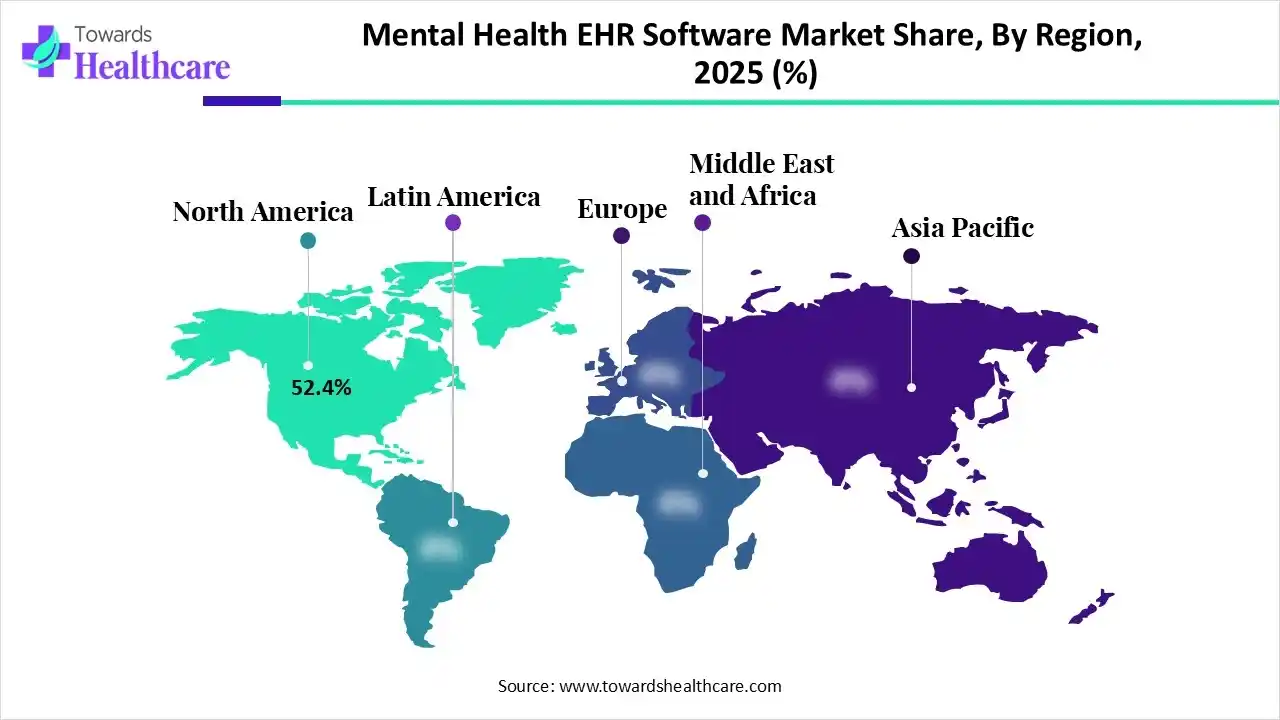
North America dominated the global mental health EHR software market with a share of 52.4% in 2025. North America dominates the market due to its advanced healthcare IT infrastructure, widespread digital health adoption, and supportive government policies promoting EHR use. High mental health awareness, significant investment in technology, presence of major vendors, and strong regulatory frameworks further drive rapid implementation and market leadership in the region.
U.S. Market Trends
The U.S. dominates the North American market due to its advanced healthcare infrastructure, strong government initiatives promoting EHR adoption and interoperability, high digital health investment, and widespread mental health service demand, driving technology integration across providers and boosting software uptake.
Asia Pacific is anticipated to grow at the highest CAGR of 14.5% global mental health EHR software market by 15% share during the forecast period. The Asia‑Pacific region is the fastest‑growing in the market due to rapid digital health infrastructure expansion, rising public awareness of mental health, and supportive government initiatives promoting healthcare IT adoption. Increasing telehealth networks, affordable cloud‑based solutions, and investments by local and international vendors further accelerate regional uptake.
China Market Trends
China is the fastest‑growing country in the Asia‑Pacific mental health EHR software market because of strong government support for healthcare digitization, rising awareness of mental health needs, and expanded healthcare infrastructure drive adoption. Increasing integration of EHR with telehealth, cloud‑based solutions, and AI‑enhanced systems further accelerates digital record use across providers.
Europe is expected to grow at a significant CAGR in the global mental health EHR software market by 20% share during the forecast period. Europe is a notably growing region in the market because increasing awareness of mental health issues and supportive government policies are driving digitalization efforts. Robust public healthcare systems, strong privacy regulations like GDPR, interoperability standards, and investments in secure, integrated EHR solutions further bolster regional adoption.
UK Market Trends
The UK dominates the European mental health EHR software market because its mature digital health ecosystem and strong public‑private collaboration, led by the NHS’s Digital Mental Health Pathways and long‑term digital strategies, drive widespread technology adoption. High digital literacy, streamlined regulatory approval processes, and robust broadband infrastructure further support scalable, integrated EHR deployment.
Brazil and Mexico lead the mental health EHR software market in South America due to strong government funding in digital health, increased use of openEHR standards, and greater smartphone and wearable integration. Demand for integrated patient management systems and efforts to combat mental health stigma are driving growth. Government digitalization initiatives, especially in Brazil's universal healthcare and Mexico's sectors, have advanced EHR use. Latin American providers are adopting openEHR to avoid vendor lock-in, with Brazilian hospitals surpassing some developed regions in interoperability. High smartphone ownership among millennials and Gen Z in urban areas like Brazil, Argentina, and Colombia has increased demand for mental health apps, tele-mental health services, and wearables. Efforts to reduce stigma and focus on mental health have heightened the need for specialized EHR systems in hospitals and private practices. The rise of cloud-based and mobile solutions allows smaller clinics and practitioners to adopt technology more efficiently.
Brazil Market Trends
Brazil dominates the mental health EHR software market due to rapid digital advancements from government policies, high rates of mental health disorders, and extensive telehealth usage. The market is expanding over 10% annually, fueled by the digitization of public healthcare (SUS) and private sector growth. The government supports this transition with national e-health strategies aimed at improving service quality and interoperability by moving from paper to digital records. The rise of remote counseling and teleconsultation necessitates flexible, secure, and integrated EHR platforms, driving innovation. A strong demand for mental health services, stemming from a high prevalence of disorders, has accelerated the growth of digital solutions. Brazil is increasingly adopting AI-driven decision support systems, IoT health monitoring devices, and cloud-based systems.
The Market in the Middle East and Africa (MEA) is rapidly growing by 7.60% share, driven by government-led digital transformation, significant healthcare investments, and a rising demand for specialized digital mental health services. The UAE and Saudi Arabia are leading this growth with their swift adoption of new technologies and strategic healthcare digitization plans. Gulf Cooperation Council (GCC) countries, especially Saudi Arabia and the UAE, are investing heavily in modernizing healthcare infrastructure. The COVID-19 pandemic has accelerated the shift to telehealth, including telepsychiatry and online counseling, increasing the demand for mental health EHR systems that facilitate virtual consultations in a region facing rising stress and lifestyle disorders. Healthcare providers in the MEA are focusing on integrating advanced technologies like AI and ML into their EHR platforms to improve diagnostic accuracy and streamline clinical workflows.
UAE Market Trends
The UAE dominates the mental health EHR software market due to strong government digitization efforts, such as Malaffi in Abu Dhabi, substantial investments in cloud health infrastructure, and a commitment to enhancing mental health services. The demand for effective patient management solutions and the rise of telehealth, particularly in Dubai and Abu Dhabi, drive this growth. The government has invested over AED 1 billion in eHealth, with initiatives like the National Policy for Health Data Management encouraging adoption across facilities. High smartphone usage and 5G connectivity facilitate the rapid uptake of mHealth and cloud-based EHRs, especially in private clinics and hospitals. Increased awareness and cultural shifts, accelerated by the COVID-19 pandemic, have heightened the demand for accessible mental health services. Emphasizing the integration of mental health with overall health records improves care continuity and attracts investments in patient-centered platforms.

| Vendor | Key Offerings / EHR Focus | Headquarters (City, Country) |
| Cerner (Oracle Health) | Integrated behavioral health modules within the broader EHR ecosystem | North Kansas City, Missouri, USA |
| Epic Systems | Comprehensive EHR with behavioral health workflows & patient engagement | Verona, Wisconsin, USA |
| Netsmart Technologies | Behavioral health-centric EHR & care coordination solutions | Overland Park, Kansas, USA |
| Qualifacts Systems | Behavioral health EHR (e.g., Credible, CareLogic, InSync) | Nashville, Tennessee, USA |
| NextGen Healthcare | EHR with integrated behavioral health functionalities | Atlanta, Georgia, USA |
| Valant | Behavioral health-focused EHR for clinical & practice management | Seattle, Washington, USA |
| TherapyNotes | EHR + practice management tailored to therapy groups | USA |
| Welligent | Cloud-based behavioral health EHR & workforce tools | USA |
| AdvancedMD | EHR + practice management with behavioral health content | USA |
| ICANotes | Purpose-built behavioral health EHR with a clinical documentation focus | USA |
Strengths
Weaknesses
Opportunities
Threats
By Deployment Mode
By Component
By End-User
By Functionality
By Region





Reviewed By
Aditi Shivarkar is a seasoned professional with over 14 years of experience in healthcare market research. As a content reviewer, Aditi ensures the quality and accuracy of all market insights and data presented by the research team.
Learn more about Aditi Shivarkar