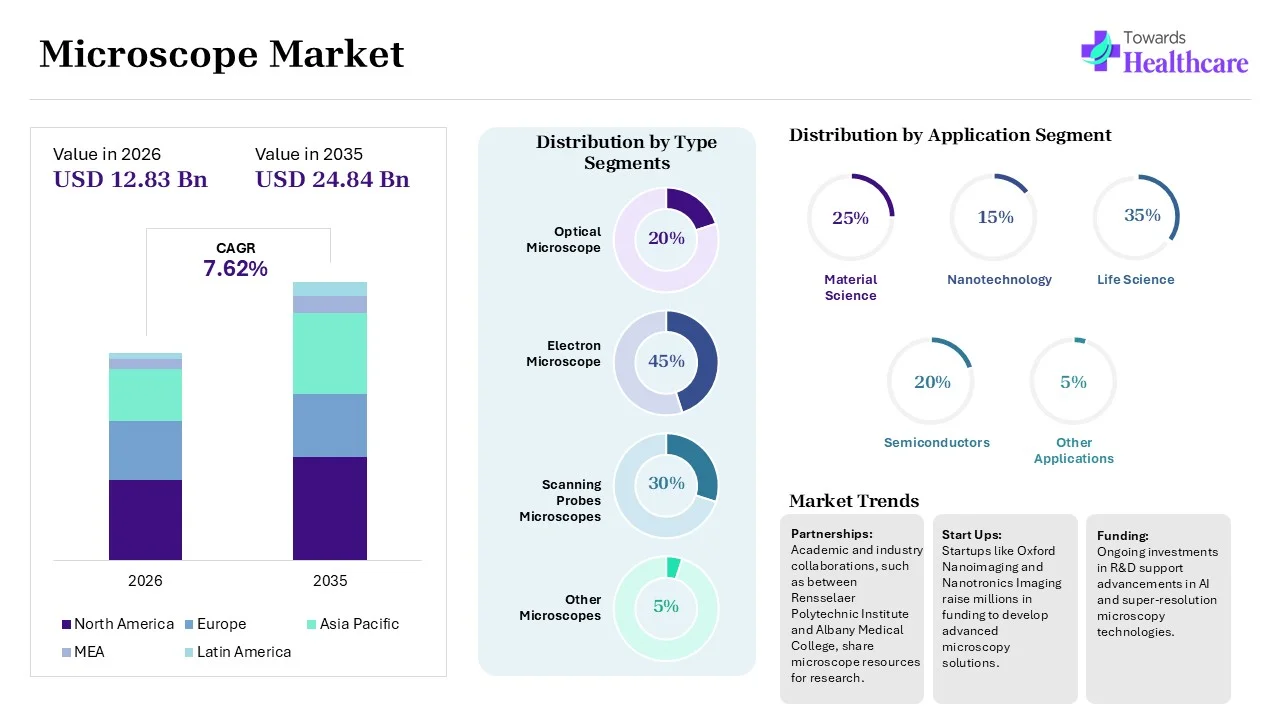
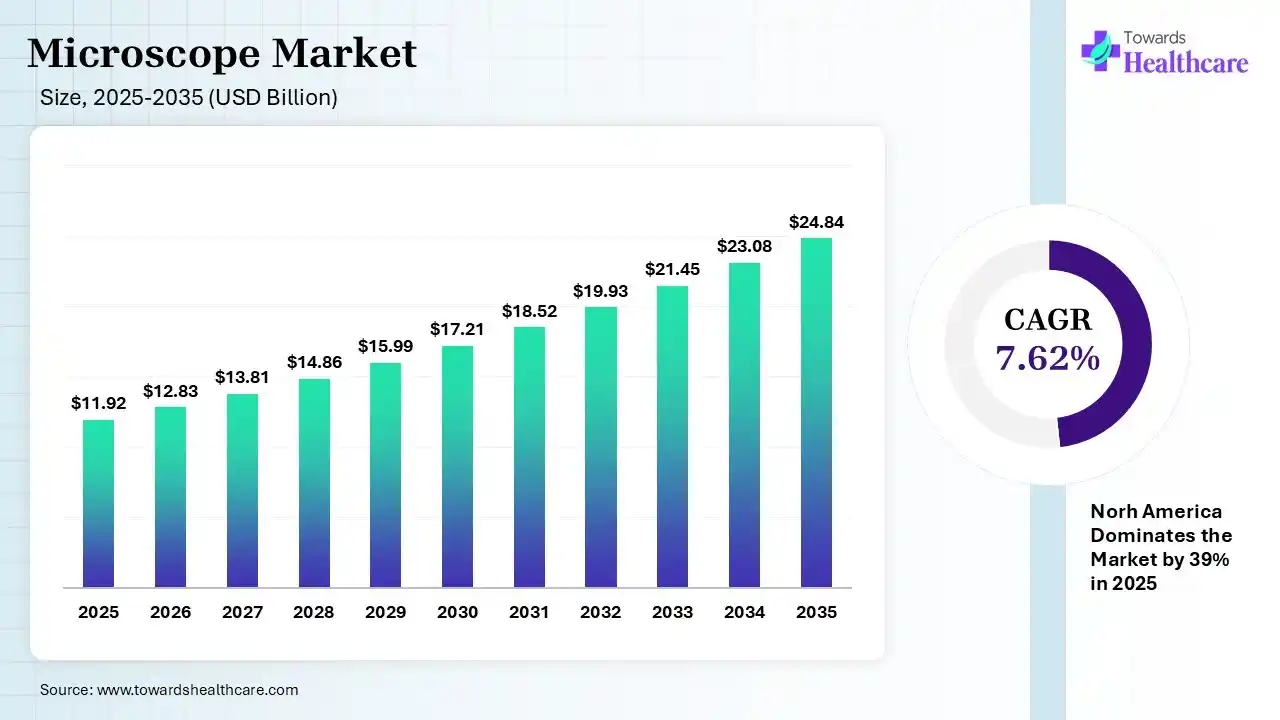
The global microscope market size was estimated at USD 11.92 billion in 2025 and is predicted to increase from USD 12.83 billion in 2026 to approximately USD 24.84 billion by 2035, expanding at a CAGR of 7.62% from 2026 to 2035.
The growing chronic diseases and R&D activities are increasing the use of microscopes. Their growing applications, AI integration, R&D investments, technological advancements, and launches are promoting the market growth.
The microscope market is driven by a shift towards data-centric digital pathology and industrial needs. The microscope refers to the instruments used to enlarge or magnify the images of small samples or objects that cannot be viewed with the naked eye. They are used for a wide range of applications encompassing studies related to cells or plants, as well as for the detection of various diseases.
A microscope is a scientific instrument designed to magnify and visualize objects that are too small to be seen with the naked eye, enabling detailed observation of cells, microorganisms, tissues, and materials. The microscope market is expanding due to rising investments in life sciences, precision medicines, and advanced materials research. Increasing demand for digital pathology, semiconductor inspection, and nanotechnology is driving the adoption of high-performance imaging systems. Technological advancements such as AI-powered image analysis, automated scanning, super-resolution microscopy, and cloud-based data sharing are improving accuracy and workflow efficiency. A key trend is the integration of machine learning with microscopy for faster diagnostic and research insights. Future opportunities lie in portable digital microscopes, multimodal imaging platforms, and expanding applications in personalized medicine, biotechnology, and industrial quality control, supported by growing research funding and laboratory modernization initiatives.
Driver
Expanding Diagnostic Applications
The growing incidence of infectious diseases, diabetes, and cancer is increasing the demand for microscopes for their early detection. This is increasing their use in the analysis of pathogens, cells, or tissues, where their high-resolution and live-cell imaging are also increasing their use for high-quality and precision diagnosis.
Restraint
Requirement of Skilled Personnel
The use of a microscope involves complex processes such as the development of samples, focusing techniques, and data interpretation, which makes it difficult to operate. This increases the demand for skilled personnel, limiting their use.
Opportunity
Growing Environmental Applications
The growing environmental awareness is increasing the demand for air, soil, and water analysis, which in turn is increasing the use of microscopes. They are being used for the analysis of microbes, particulates, and pollutants. They are also being used for the analysis of microplastics, plant tissue, and other environmental studies across the research institutes.
The integration of AI in the microscope is increasing to offer automated image analysis and enhanced accuracy with minimal human errors. It helps in faster identification of samples, where its 3D analysis also offers visualization of complex structures. Its automation also helps in controlling the focus, sample position, and scanning, where its growing integration with telemedicine is also promoting the real-time diagnosis and remote analysis.
Growing R&D Activities
The growing R&D activities across the pharmaceutical and biotechnology industries are increasing the demand for microscopes for the analysis of cells, drug discovery, genetic research, and molecular analysis, where the growing investments and funding are also increasing the adoption of advanced microscopes.
Expansion of Nanotechnology and Semiconductors
The rapid expansion of the nanotechnology and semiconductor industry is increasing the adoption of microscopes for the analysis and manipulation of various materials, microchips, as well as for the identification of their defects
Technological Advancements
The growth in technological advancements is increasing the development of new portable and affordable microscopes offering 3D surface analysis, digital imaging, and live-cell imaging with a wide range of applications.
| Table | Scope |
| Market Size in 2026 | USD 12.83 Billion |
| Projected Market Size in 2035 | USD 24.84 Billion |
| CAGR (2026 - 2035) | 7.62% |
| Leading Region | North America by 39% |
| Key Applications | Cell biology, pathology, microbiology, drug discovery, genomics, nanotechnology, semiconductor inspection, materials science, clinical diagnostics, academic research |
| Primary End Users | Research institutes, universities, hospitals, pathology laboratories, pharmaceutical companies, biotechnology companies, semiconductor manufacturers, industrial R&D centers |
| Market Maturity | Mature with continuous growth driven by digitalization, AI integration, and advanced imaging technologies |
| Measurable Values | USD Millions/Units/Volume |
| Market Segmentation | By Type, By Application, By Region |
| Top Key Players | ZEISS Group, Leica Microsystems, Nikon Corporation, Evident, Thermo Fisher Scientific, JEOL Ltd., Keyence Corporation, Bruker Corporation, Hitachi High-Tech, Meji Techno |
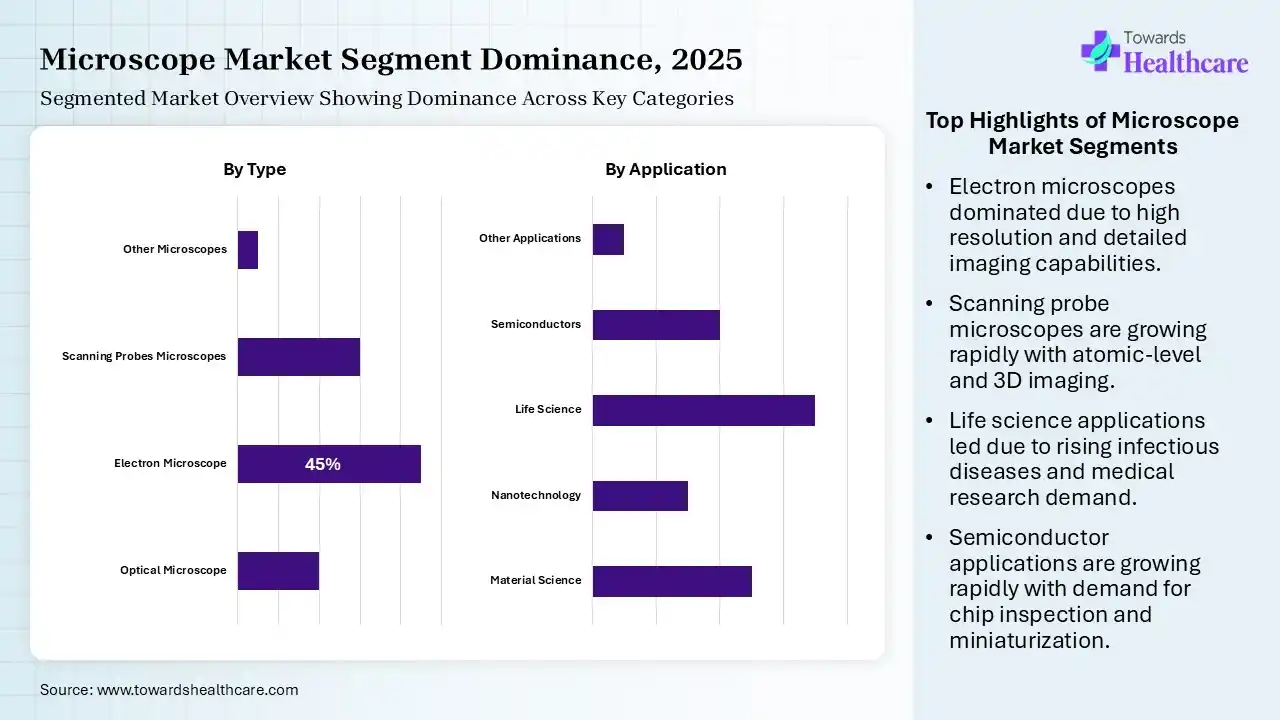
Why Did the Electron Microscope Segment Dominate in the Microscope Market in 2025?
The electron microscope segment held the dominating share in the market by 20% in 2025, due to its high resolution and magnification power. They also provided detailed imaging, which increased their use in the material science and nanotechnology applications. Furthermore, the TEM and SEM also offered more detailed information, which increased their use in the analysis of surface and internal structures of the samples.
Scanning Probes Microscopes
The scanning probe microscopes segment is expected to show the highest growth during the upcoming years, due to their atomic-level resolution and 3D imaging, which is increasing their use in nanotechnology and biotechnology. They are also being used in the analysis of magnetic, electrical, and mechanical properties of samples, enhancing their applications.
| Segment | Share 2025 (%) |
| Material Science | 25% |
| Nanotechnology | 15% |
| Life Science | 35% |
| Semiconductors | 20% |
| Other Applications | 5% |
What Made Life Science the Dominant Segment in the Microscope Market in 2025?
The life science segment registered its dominance over the global market by 25% in 2025, due to a growth in infectious diseases. This increased the use of microscopes for their early detection, where the growing medical research activities also increased their adoption rates. The growth in drug development has also increased its use across various industries and institutes.
Semiconductors
The semiconductors segment is expected to show the fastest growth rate during the predicted time, due to growing advancements in smartphones and computers, which are increasing the adoption of microscopes for the inspection of their micro- or nanoscale defects. The growing development of miniaturized chips is also increasing their demand.
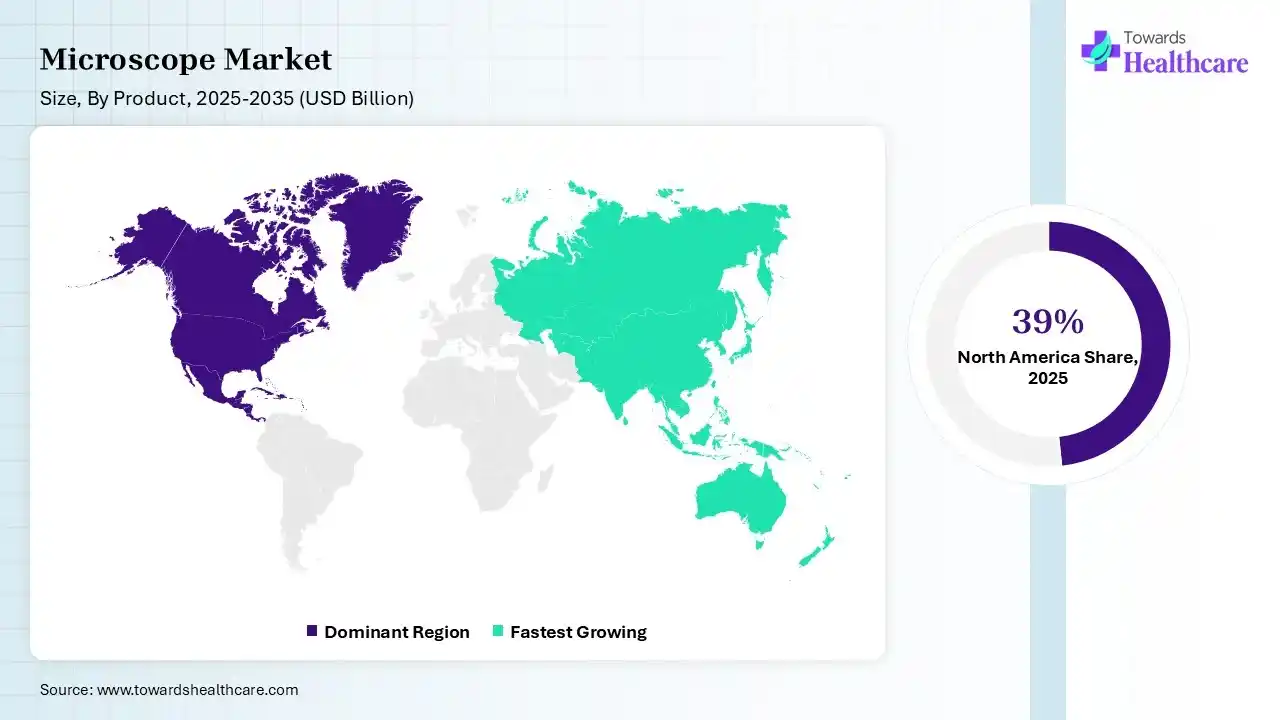
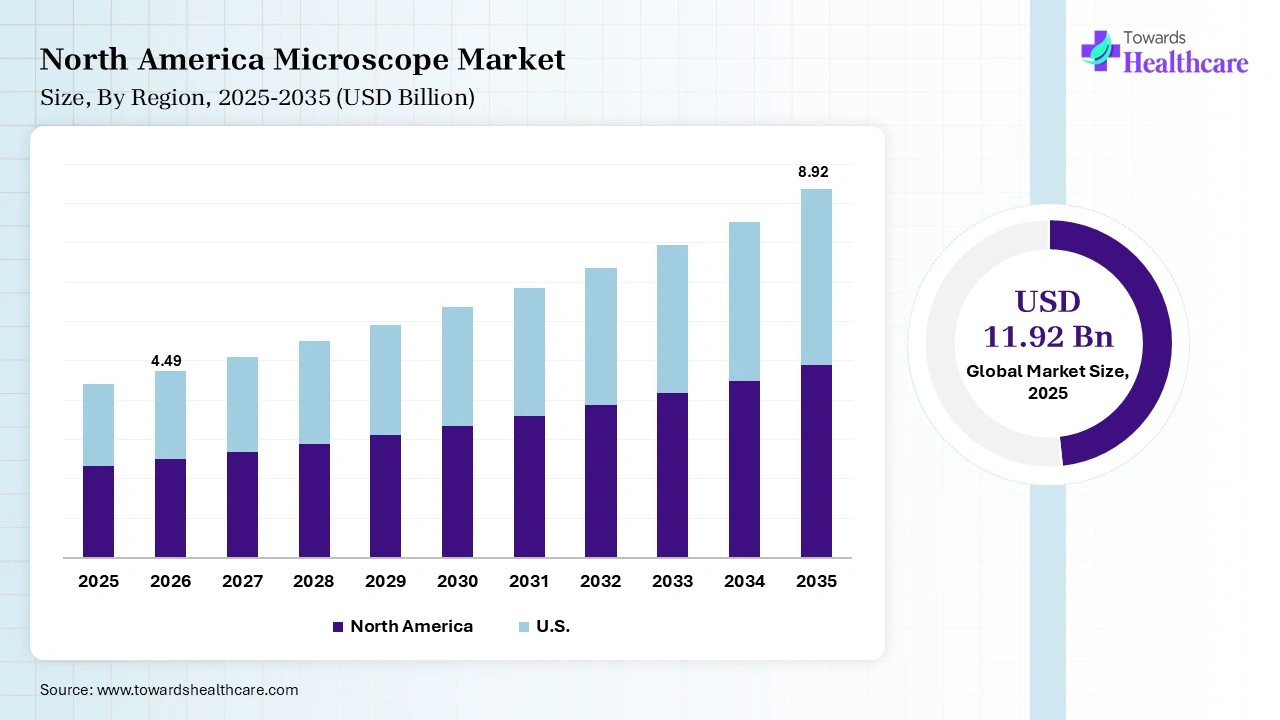
North America dominated the microscope market by 39% share in 2025, due to the presence of a well-developed R&D infrastructure, which increased the use of microscopes for a wide range of applications. The presence of advanced industries and growth in the R&D funding also increased their innovations and adoption rates, where the technological advancements also contributed to the market growth.
U.S. Market Trends
The presence of advanced healthcare infrastructure and industries in the U.S. is increasing the use of microscopes for diagnostics and the development of new treatment options. The growing technological advancements and government funding are also increasing the development of advanced microscopes and encouraging their adoption for various applications.
Canada Microscope Market Gains Momentum Through Research Excellence and Advanced Healthcare
Canada microscope market is growing due to increasing investments in biomedical research, biotechnology, and precision medicine. Rising demand for advanced imaging in academic institutions, pharmaceutical R&D, and clinical diagnostics is accelerating microscopes adoption. Government funding for life sciences, expanding nanotechnology research, and the integration of AI-enabled digital microscopy and automated imaging systesm are further supporting market growth and technological innovation.
Asia Pacific is expected to host the fastest-growing microscope market during the forecast period, due to the rapid expansion of the healthcare sector, driving the adoption of microscopes. The growing R&D activities, health investments, and expanding institutions are also increasing their adoption rates. Additionally, growing government initiatives and expanding the electronic industry are also enhancing the market growth.
India Market Trends
India is experiencing a rapid growth in the healthcare sector, which is increasing the adoption of microscopes across diagnostic labs, pathology centres, and hospitals. The growing R&D activities across the biotechnology, pharmaceutical, nanotechnology, and semiconductor industries and institutions are also increasing their use.
China Microscope Market Expands with Industrial Innovation and Life Science Growth
China microscope market is growing due to the rapid expansion of biotechnology, pharmaceutical manufacturing, and semiconductor industries. Increasing investments in life science research, academic institutions, and healthcare infrastructure are driving demand for advanced imaging technology. Government support for scientific innovation, rising adoption of AI-enabled digital microscopy, and growing application in materials science, nanotechnology, and industrial quality inspection are further accelerating market growth.
Europe is expected to grow significantly in the microscope market during the forecast period, due to the presence of advanced industries driving the development of advanced microscopes. The robust healthcare sector is also increasing its use, which is supported by government funding. Additionally, their growing applications and technological advancements are also promoting the market growth.
UK Market Trends
The presence of robust industries and institutions across the UK is increasing the use of microscopes for diagnostics and drug development. At the same time, the expansion of nanotechnology and medical research is also increasing their use, where the industries are also collaborating to develop advanced microscopes.
| Category | Market Participants & Role |
| Technology Providers | Companies developing optical systems, electron microscopy platforms, imaging sensors, AI algorithms, automation technologies, and advanced microscopy components |
| Product Manufacturers | Microscope OEMs producing optical microscopes, electron microscopes, confocal systems, digital microscopes, and research imaging platforms |
| Service Providers | Calibration, maintenance, imaging services, microscopy analysis services, and laboratory support providers |
| Platform Providers | Digital microscopy platforms enabling image management, remote collaboration, automated analysis, and cloud-based workflows |
| CROs/CDMOs | Limited direct involvement; some research service providers use advanced microscopy for drug discovery and biological analysis |
| Software Vendors | Image processing, AI-based analysis, quantitative microscopy, and laboratory workflow software companies |
| Research Institutions | Universities, government laboratories, and biomedical research centers driving microscopy innovation |
| End-User Industries | Healthcare diagnostics, pharmaceuticals, biotechnology, semiconductor manufacturing, materials science, education |
R&D
Clinical Trials and Regulatory Approvals
Instrument Manufacturing
Packaging and Serialization
Distribution to Hospitals, Pharmacies
Patient Support and Services
| Tier 1 | Tier 2 | Tier 3 | |
| Typical Market Influence | 62% | 27% | 11% |
| Tier 1 | ||||
| Company Name | Headquarters | Country | Why Relevant to This Market | Key Products/Services |
| Thermo Fisher Scientific | Waltham, Massachusetts, USA | USA | One of the largest global microscopy suppliers with strong life sciences and electron microscopy business | Electron microscopes, cryo-EM systems, analytical microscopy solutions |
| Carl Zeiss AG | Oberkochen, Baden-Württemberg, Germany | Germany | Global leader in optical and advanced microscopy technologies | Light microscopes, confocal microscopy, super-resolution systems, electron microscopy |
| Danaher Corporation | Washington, D.C., USA | USA | Major microscopy player through Leica Microsystems and imaging technologies | Confocal microscopes, surgical microscopy, research imaging systems |
| Tier 2 | ||||
| Company Name | Headquarters | Country | Why Relevant to This Market | Key Products/Services |
| Hitachi High-Tech Corporation | Tokyo, Japan | Japan | Strong position in electron microscopy and semiconductor inspection | SEM, TEM, analytical microscopy systems |
| Evident Corporation | Tokyo, Japan | Japan | Specialized microscopy company formed from Olympus scientific imaging business | Biological microscopes, industrial microscopes, imaging solutions |
| Bruker Corporation | Billerica, Massachusetts, USA | USA | Provides advanced microscopy and analytical research instruments | AFM, nano-scale imaging, scientific microscopy solutions |
| Tier 3 | ||||
| Company Name | Headquarters | Country | Why Relevant to This Market | Key Products/Services |
| Meiji Techno Co., Ltd. | Saitama, Japan | Japan | Specialized optical microscope manufacturer | Biological and industrial microscopes |
| TESCAN ORSAY HOLDING | Brno, Czech Republic | Czech Republic | Growing advanced electron microscopy company | SEM, FIB-SEM, scientific imaging platforms |
| Keyence Corporation | Osaka, Japan | Japan | Strong industrial microscopy and automated inspection business | Digital microscopes, measurement microscopes |
In November 2025, "GoScope's innovation and features advance the way we work in the OR. It provides an immersive, continuous view while I operate in an upright posture. Voice commands allow control of the microscope without breaking the sterile field, and video recording supports case review," said Kavitha L. Ranganathan, MD, Director of Craniofacial Reconstruction, Brigham and Women's Hospital; Co-Director, Cleft and Craniofacial Team, Shriners Children's Boston.
Strengths
Weaknesses
Opportunities
Threats
By Type
By Application
By Region









Principal Consultant
Shivani Zoting is a dedicated research analyst specializing in the healthcare industry. With a strong academic foundation, a B.Sc. in Biotechnology and an MBA in Pharmabiotechnology, she brings a unique blend of scientific understanding and strategy.
Learn more about Shivani Zoting
Reviewed By
Aditi Shivarkar is a seasoned professional with over 14 years of experience in healthcare market research. As a content reviewer, Aditi ensures the quality and accuracy of all market insights and data presented by the research team.
Learn more about Aditi Shivarkar