
Pipeline Programs

CGT Companies Tracked

Manufacturing Facilities


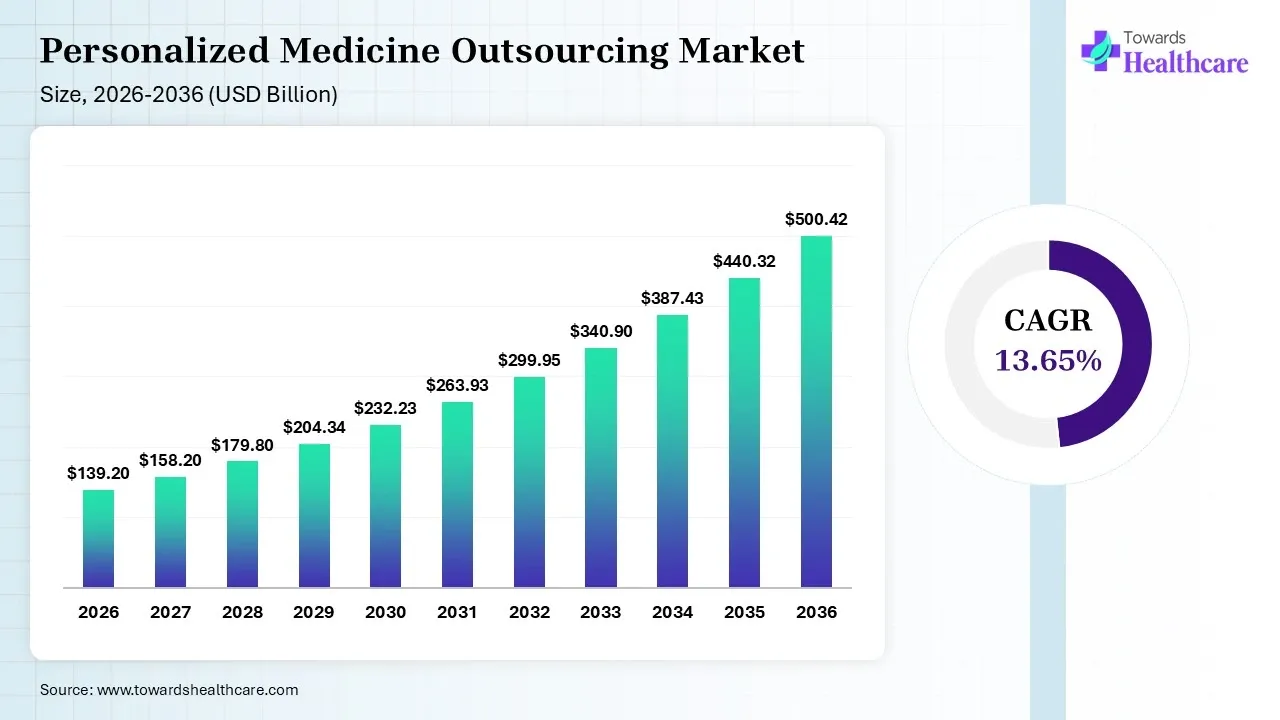
Personalized medicine outsourcing market size is calculate at US$ 139.2 billion in 2026, grew to US$ 158.2 billion in 2027, and is projected to reach around US$ 500.42 billion by 2036, expanding at a CAGR of 13.65% between 2027 and 2036.
Market Size & Growth Outlook
Regional Market Spotlight
Segmental Spotlight
The personalized medicine outsourcing market refers to the industry that focuses on services offered by third-party companies for the creation, testing, and delivery of patient-specific drugs. The list of services includes genetic tests, biomarker testing, clinical trials management, drug discovery, and companion diagnostics development. Higher demand for individual therapies, advancements in the field of genomics, and higher investments in precision medicine are the reasons why pharmaceutical and biotech firms are outsourcing specific tasks. It allows saving on R&D expenses, acquiring expert knowledge, and accelerating the research process. Higher demand for personalized treatments and more complicated clinical trials will give more scope for outsourcing firms.
Rising Demand for Targeted Treatments
Increased demand for personalized treatments is driving pharmaceutical and biotech companies to delegate specialized research work. Service providers provide their expertise in genetic testing, biomarkers, and clinical trials, which will help pharmaceutical and biotech companies cut costs, make research more efficient, and deliver treatments quickly.
High Costs and Data Privacy Concerns
Several barriers affect personalized medicine outsourcing market growth, such as high costs of testing, complex regulatory frameworks, and concerns about confidential patient information. Data security for genetic material should be ensured by reliable systems. All this may lead to increased costs of operations and decreased willingness of outsourcing among small biotechnology and pharmaceutical companies.
Expanding Genomic Research
Developments in genomics and precision medicine are a good ground for the outsourcing provider to broaden its specialized services. Investment in companion diagnostics, biomarker discovery, and personalized clinical trials can bring new clients. Emerging markets represent an opportunity due to the increasing use of diagnostics and treatment techniques.
Contract Clinical Development Held a 31.00% Share, Valued at USD 43.15 Billion in 2026
| Segment | Share 2026 (%) | Market Value 2026 |
| Contract clinical development | 31.00% | USD 43.15 billion |
| Contract manufacturing | 24.00% | USD 33.41 billion |
| Genomic and biomarker testing | 16.00% | USD 22.27 billion |
| Companion diagnostics development | 10.00% | USD 13.92 billion |
| Bioinformatics and data analytics | 8.00% | USD 11.14 billion |
| Regulatory and quality services | 5.00% | USD 6.96 billion |
| Pharmacovigilance and real-world evidence | 6.00% | USD 8.35 billion |
| Total | 100.00% | USD 139.20 billion |
The contract clinical development segment held a market share of 31% in the personalized medicine outsourcing market in 2026 and was worth USD 43.15 billion owing to increasing demand for targeted therapy trials and patient selection based on biomarkers. The demand for specialized clinical studies among pharmaceutical and biotech companies is causing them to outsource their clinical trials to gain access to the expertise needed for the process. Contract manufacturing was valued at USD 33.41 billion with a market share of 24%, and genomic and biomarker testing had a market share of 16%. Companion diagnostics was valued at 10%.
Analyst View: Contract clinical development will continue to dominate as a key segment due to the demand for specialized trials and patient selection in personalized medicines. Genomics testing and companion diagnostics may have a role to play due to growing adoption.
Phase III Clinical Trials Held a 25.00% Share, Valued at USD 34.80 Billion in 2026
| Segment | Share 2026 (%) | Market Value 2026 |
| Preclinical development | 16.00% | USD 22.27 billion |
| Phase I clinical trials | 12.00% | USD 16.70 billion |
| Phase II clinical trials | 17.00% | USD 23.66 billion |
| Phase III clinical trials | 25.00% | USD 34.80 billion |
| Phase IV and post-market studies | 12.00% | USD 16.70 billion |
| Analytical and translational development | 18.00% | USD 25.06 billion |
| Total | 100.00% | USD 139.20 billion |
The third-phase clinical trial constituted 25% of the overall personalized medicine outsourcing market and was valued at USD 34.80 billion owing to the need for large sample trials to assess the safety and efficacy of the therapy. In many instances, the clinical trial requires proper patient selection based on genetic information and biomarkers. The preclinical development constituted 16%, valued at USD 22.27 billion, while the Phase I clinical trial constituted 12%, with a value of USD 16.70 billion. Phase II clinical trials constituted 17%, valued at USD 23.66 billion. The analytical and translational development had a market share of 18%, valued at USD 25.06 billion. The fourth phase and post-market trial constituted 12%, with a value of USD 16.70 billion.
Analyst View: Phase III clinical trials would continue to be a prominent segment due to the extensive need for clinical validation of personalized therapies. Similarly, analytical and translational development could emerge as another prominent segment.
Oncology Held a 36.00% Share, Valued at USD 50.11 Billion in 2026
| Segment | Share 2026 (%) | Market Value 2026 |
| Oncology | 36.00% | USD 50.11 billion |
| Rare and genetic diseases | 17.00% | USD 23.66 billion |
| Immunology and inflammatory diseases | 12.00% | USD 16.70 billion |
| Neurological diseases | 9.00% | USD 12.53 billion |
| Cardiovascular and metabolic diseases | 10.00% | USD 13.92 billion |
| Infectious diseases | 7.00% | USD 9.74 billion |
| Other therapeutic applications | 9.00% | USD 12.53 billion |
| Total | 100.00% | USD 139.20 billion |
In 2026, oncology held a 36% share of the market, worth USD 50.11 billion, owing to rising demand for precision medicine, biomarkers, and genetic profiling in treating various forms of cancer. Clinical trials and development of diagnostic methods were outsourced for better treatment and development of drugs. Rare & genetic diseases came second, holding a 17% market share worth USD 23.66 billion, owing to advancements in genetic research and treatments of rare diseases. Immunology and inflammatory diseases held a 12% share, worth USD 16.70 billion, whereas cardiovascular and metabolic diseases held 10% of the market, worth USD 13.92 billion. Neurological diseases held a 9% market share, worth USD 12.53 billion. Infectious diseases held a 7% market share worth USD 9.74 billion, whereas other therapeutic applications held a 9% market share worth USD 12.53 billion.
Analyst view: The growth in personalized medicines is expected to help oncology remain a leading therapeutic application due to the use of precision medicines. Rare diseases may provide new opportunities for outsourcing companies, as pharmaceutical companies look for outsourcing providers for advanced research.
Monoclonal Antibodies and Targeted Biologics Held a 25.00% Share, Valued at USD 34.80 Billion in 2026
| Segment | Share 2026 (%) | Market Value 2026 |
| Monoclonal antibodies and targeted biologics | 25.00% | USD 34.80 billion |
| Small-molecule targeted therapies | 20.00% | USD 27.84 billion |
| Cell and gene therapies | 18.00% | USD 25.06 billion |
| RNA-based therapies | 10.00% | USD 13.92 billion |
| Genomic and molecular diagnostics | 12.00% | USD 16.70 billion |
| Protein and multi-omics technologies | 8.00% | USD 11.14 billion |
| Other precision medicine technologies | 7.00% | USD 9.74 billion |
| Total | 100.00% | USD 139.20 billion |
The segment of monoclonal antibodies and targeted biologics captured 25% of the market share in 2026, with a valuation of USD 34.80 billion. This dominance can be explained by the rising need for targeted medicines and their manufacturing and clinical development. Biologics research and production is often outsourced by pharmaceutical companies as a way to receive expert technical support. Targeted small molecules occupied 20% of the market, with USD 27.84 billion in value due to the rising need for medicines targeting certain disease pathways. The cell and gene therapies segment made up 18% of the market, valued at USD 25.06 billion because of innovations in genetic medicine. Genomic and molecular diagnostics made up 12% of the market, worth USD 16.70 billion, while RNA therapies accounted for 10% of the market, with USD 13.92 billion in value. Proteins and multi-omics made up 8% of the market, worth USD 11.14 billion, while other precision medicine technologies were 7% of the market, with USD 9.74 billion.
Analyst View: Monoclonal antibodies and targeted biologics are forecasted to remain dominant in the future due to the growing need for targeted treatments. RNA technologies and cell and gene therapies may become new outsourcing opportunities in the future.
Pharmaceutical Companies Held a 36.00% Share, Valued at USD 50.11 Billion in 2026
| Segment | Share 2026 (%) | Market Value 2026 |
| Pharmaceutical companies | 36.00% | USD 50.11 billion |
| Biotechnology companies | 30.00% | USD 41.76 billion |
| Diagnostic and laboratory companies | 13.00% | USD 18.10 billion |
| Academic and research institutions | 7.00% | USD 9.74 billion |
| Hospitals and healthcare networks | 5.00% | USD 6.96 billion |
| Government and public research organizations | 4.00% | USD 5.57 billion |
| Other end users | 5.00% | USD 6.96 billion |
| Total | 100.00% | USD 139.20 billion |
In 2026, pharmaceutical companies held 36% of the total personalized medicine outsourcing market share, amounting to USD 50.11 billion, because of increasing investment in targeted drug discovery, clinical trials, and biomarker-based treatments. Outsourcing enables these companies to gain access to specialized knowledge, manage the cost of research, and make the process efficient. Biotechnology companies took the second spot at 30%, amounting to USD 41.76 billion, on the rise of research activities in terms of advanced therapies and genetic medicines. Diagnostic and laboratory companies made up 13%, worth USD 18.10 billion, due to growing demand for genomic testing and molecular diagnostics. Academic and research institutions accounted for 7%, amounting to USD 9.74 billion, while hospitals and healthcare networks constituted 5%, worth USD 6.96 billion. Government and public research institutions provided 4%, amounting to USD 5.57 billion, while others accounted for 5%, worth USD 6.96 billion.
Analyst View: Pharmaceutical companies will likely continue to use outsourcing services in future years as their personalized drug development becomes increasingly complicated. Biotechnology companies and diagnostic laboratories will also increase outsourcing services in order to have access to technology and clinical development expertise.
Full-Service Integrated Outsourcing Held a 32.00% Share, Valued at USD 44.54 Billion in 2026
| Segment | Share 2026 (%) | Market Value 2026 |
| Full-service integrated outsourcing | 32.00% | USD 44.54 billion |
| Project-based outsourcing | 28.00% | USD 38.98 billion |
| Functional service provision | 17.00% | USD 23.66 billion |
| Strategic partnerships and preferred-provider models | 13.00% | USD 18.10 billion |
| Technology licensing and platform partnerships | 10.00% | USD 13.92 billion |
| Total | 100.00% | USD 139.20 billion |
The full-service integrated outsourcing segment contributed 32% in 2026, valued at USD 44.54 billion, owing to high demand for integrated research, clinical development, testing, and regulatory support. Full-service integrated outsourcing is preferred by pharmaceutical and biotech companies due to easy management of projects. The project-based outsourcing is expected to capture a 28% share in 2026, valued at USD 38.98 billion due to demand for customized services and project-based arrangements. The functional service provision captured a 17% share in 2026, valued at USD 23.66 billion, as companies were outsourcing functions of their business. Strategic partnerships and preferred providers captured a 13% share in 2026, valued at USD 18.10 billion, while technology and platform licensing is expected to capture a 10% share in 2026, valued at USD 13.92 billion.
Analyst View: Full-service integrated outsourcing is likely to continue gaining popularity among companies for streamlining support in personalized medicine. Project-based outsourcing and strategic partnerships are also likely to benefit from growing demand for flexible service arrangements, specialized capabilities, and advanced technologies.
| Regions | Share 2026 (%) | Market Value 2026 |
| North America | 35.14% | USD 48.92 billion |
| Europe | 27.00% | USD 37.58 billion |
| Asia Pacific | 27.00% | USD 37.58 billion |
| Latin America | 5.50% | USD 7.66 billion |
| Middle East & Africa | 5.36% | USD 7.46 billion |
| Total | 100.00% | USD 139.20 billion |
North America dominated the personalized medicine outsourcing market in 2026 with a revenue share of 35.14%, valued at USD 48.92 billion. North America functions on the basis of high-quality healthcare infrastructure and huge research investments. This region comprises important nations like the U.S., Canada, and Mexico. Of these countries, the market share of the U.S. is significant at 30.00%, estimated to be USD 41.76 billion; that of Canada is 3.50%, worth USD 4.87 billion; and that of Mexico is 1.64%, amounting to USD 2.28 billion. The growth of the market in North America will be largely influenced by research and development activities in the biopharmaceutical sector and progress in precision oncology in the U.S., genomics research and biotech innovations in Canada, and clinical research in Mexico.
Europe captured a revenue share of 27.00% in 2026, valued at 37.58 billion in 2026. Europe stands out as an important and developed hub in personalized medicine outsourcing, backed by strong clinical systems and research institutions. Some of the major countries in this region include Germany, the UK, France, Switzerland, Italy, and other European countries. Germany is the leading country in the region with a market share of 6.50% worth USD 9.05 billion, followed by the UK with a 5.00% market share worth USD 6.96 billion, and France with a 4.00% market share worth USD 5.57 billion. Driving forces behind the growth of the European market include biopharmaceutical development, research in genomic medicine, translational medicine, advanced pharmaceutical R&D, and clinical trials. Collaboration between these countries in the biotechnology sector keeps Europe as an important supplier of advanced and quality-targeted outsourcing solutions.
Asia Pacific captured a revenue share of 27.00% in 2026, valued at 37.58 billion in 2026. The Asia Pacific region demonstrates rapid growth and considerable scale in the field of personalized medicine outsourcing because of increasing biopharmaceutical innovation, substantial clinical trials, and efficient manufacturing facilities. In terms of personalized medicine outsourcing, such important markets within the Asia Pacific region can be considered to be China, Japan, India, South Korea, and Other Asia Pacific. China leads in the generation of revenue in the Asia Pacific region with a share of 10.00%, amounting to USD 13.92 billion, while Japan and India each generate a 5.00% share worth USD 6.96 billion. The dynamics of development in the Asia Pacific region are driven by China's biopharmaceutical capacities, Japan's precision oncology, India's robust CRO/CDMO capabilities, and targeted biologics manufacturing in South Korea and Australia.
Latin America captured a revenue share of 5.50% in 2026, valued at 7.66 billion in 2026. Latin America constitutes an emerging market that has become more and more significant in clinical research service outsourcing as well as molecular diagnostics outsourcing. The major sub-regions within Latin America include Brazil and Other Latin America. The main market in this region includes Brazil, with a market share of 2.50% worth USD 3.48 billion. Clinical research service outsourcing activities are becoming more and more common in Latin American countries due to the growth in clinical trial service outsourcing, improved regional healthcare facilities, and also greater emphasis on molecular diagnostics. The neighboring Latin American countries, together with Brazil, help in the recruitment of patients for regional clinical trials.
Middle East and Africa captured a revenue share of 5.36% in 2026, valued at 7.46 billion in 2026. The Middle East and Africa region illustrates stable growth of personalized medicine outsourcing due to increased investments in genomic projects and healthcare advancement programs in the region. The Middle East and Africa region consists of two separate sub-regions, including the Middle East and Africa. The Middle East region holds a 3.00% market share of USD 4.18 billion, whereas the Africa region holds a 2.36% market share of USD 3.29 billion. National genomics and advanced precision medicine initiatives in the Middle East and expansion of genomic surveillance and clinical trial programs in Africa represent key market drivers. Growing emphasis on disease prevention and therapeutic treatments is expected to drive collaboration with leading international contract research organizations. Hence, the Middle East and Africa are constantly improving their strategic clinical infrastructure, increasing their involvement in the global personalized medicine outsourcing landscape.
Research and development drives the personalized medicine outsourcing market by supporting biomarker discovery, genetic testing, drug target identification, and tailored treatment development. Outsourcing partners provide specialized expertise and advanced technologies.
Companies involved: IQVIA, Thermo Fisher Scientific, Charles River Laboratories, Labcorp, ICON plc, WuXi AppTec, Parexel.
Clinical research organizations manage patient recruitment, trial coordination, genetic data collection, and regulatory submissions. Their expertise helps personalized medicine developers evaluate treatment safety, effectiveness, and compliance with approval requirements.
Companies involved: ICON plc, Parexel, IQVIA, Syneos Health, Labcorp, Fortrea, Medpace.
Outsourcing providers support patients through genetic testing coordination, treatment guidance, care management, and follow-up services. These activities improve treatment access, patient engagement, and adherence to personalized medicine plans.
Companies involved: IQVIA, Parexel, Syneos Health, ICON plc, Precision for Medicine, Labcorp, Fujirebio.
| Company | Estimated Market Share (%) |
| IQVIA | 8.50% |
| ICON plc | 7.50% |
| Lonza Group | 6.50% |
| Thermo Fisher Scientific | 5.50% |
| Labcorp | 4.50% |
| Combined Top 5 | 32.50% |
| Other Players | 67.50% |
The personalized medicine outsourcing market exhibits moderate consolidation, as the top five firms capture a total market share of 32.50%. IQVIA commands the largest market share of 8.50% due to the company’s data analytics and clinical trial services. ICON plc captures a market share of 7.50% through specialized research services. Lonza Group claims 6.50% of market share owing to the firm’s cell and gene therapy manufacturing expertise. Thermo Fisher Scientific and Labcorp capture 5.50% and 4.50% market shares, respectively, through their lab and diagnostic services.
| Leaders | Strong Challengers |
| IQVIA | ICON plc |
| Lonza Group | Thermo Fisher Scientific |
| Labcorp | Charles River Laboratories |
| Precision for Medicine | Parexel International |
| Specialists | Emerging / Regional Players |
| Foundation Medicine | Syngene International |
| Natera | Medpace |
| Guardant Health | WuXi AppTec |
| NeoGenomics | MedGenome |
Competitive quadrant for personalized medicine outsourcing market segments the major companies in the market based on the strategic positioning of these companies into four different categories. Market leaders such as IQVIA, Lonza Group, Labcorp, and Precision for Medicine have established a strong market position with their wide range of clinical and manufacturing capabilities. Strong market challengers like ICON plc, Thermo Fisher Scientific, Charles River Laboratories, and Parexel International have established a solid footprint in the global market and huge operational scale. Market specialists, including Foundation Medicine, Natera, Guardant Health, and NeoGenomics, provide focused niche solutions in genomics and diagnostics.
| Ecosystem Stage | Relevant Companies/Participants | Role in the Market | |
| Raw Materials / Inputs | Thermo Fisher Scientific, Merck KGaA, QIAGEN, Integrated DNA Technologies | Supply reagents, sequencing consumables, assay materials, and molecular biology inputs | |
| Components / Technology | Illumina, PacBio, Oxford Nanopore Technologies, 10x Genomics, Agilent Technologies | Provide sequencing platforms, genomic analysis systems, and molecular profiling technologies. | |
| Manufacturing / Production | Lonza Group, Catalent, Thermo Fisher Scientific, Samsung Biologics, WuXi Biologics | Manufacture biologics, advanced therapies, and specialized pharmaceutical products | |
| Processing / Integration | IQVIA, ICON plc, Labcorp, Precision for Medicine, Charles River Laboratories | Integrate clinical development, biomarker analysis, laboratory services, and precision trial operations. | |
| Distribution / Sales | McKesson, Cencora, Cardinal Health, Marken, World Courier | Support pharmaceutical distribution, specialty logistics, and temperature-controlled shipments | |
| End Users / Buyers | Pfizer, Roche, AstraZeneca, Novartis, Merck & Co., Bristol Myers Squibb, Amgen, emerging biotechnology companies | Commission outsourced research, diagnostics, clinical development, and personalized therapy manufacturing | |
In August 2026, “Obtaining the Class C Drug Manufacturing License is a pivotal milestone for Porton Advanced,” CEO Andrew Chen said. “It is not only a validation of our quality system but a fulfillment of our commitments to our clients. We will align with our clients’ product launch schedules to prepare for commercial supply. Moving forward, we will continue to uphold our customer-centric values, leveraging our operational and delivery excellence to partner with innovators.”
The personalized medicine outsourcing market is changing as pharmaceutical and biotech companies look for outsourced help in developing medicines according to individual patient traits. Service providers are becoming very useful in genetic studies, biomarker discovery, clinical trial management, and regulatory compliance. Service providers’ competencies allow companies to cope with complicated research operations and use advanced technologies without additional capital expenditures. Collaboration with service providers becomes increasingly important for enhancing the quality of the research process and patient treatment. The main problems of data protection, regulatory differences, expensive testing, and clinical complexity still exist. Nevertheless, good technical skills and collaborations can contribute to the growth of the market in the future.
By Service Type
By Development Phase
By Therapeutic Application
By Technology and Therapeutic Modality
By End User
By Outsourcing Engagement Model
By Region


Principal Consultant
Payal Rabde is a Healthcare Market Research Analyst at Towards Healthcare Research & Consulting with 4+ years of experience in pharmaceuticals, biotechnology, medical devices, and life sciences.
Learn more about Payal Rabde

Reviewed By
Aditi Shivarkar is a seasoned professional with over 14 years of experience in healthcare market research. As a content reviewer, Aditi ensures the quality and accuracy of all market insights and data presented by the research team.
Learn more about Aditi Shivarkar