
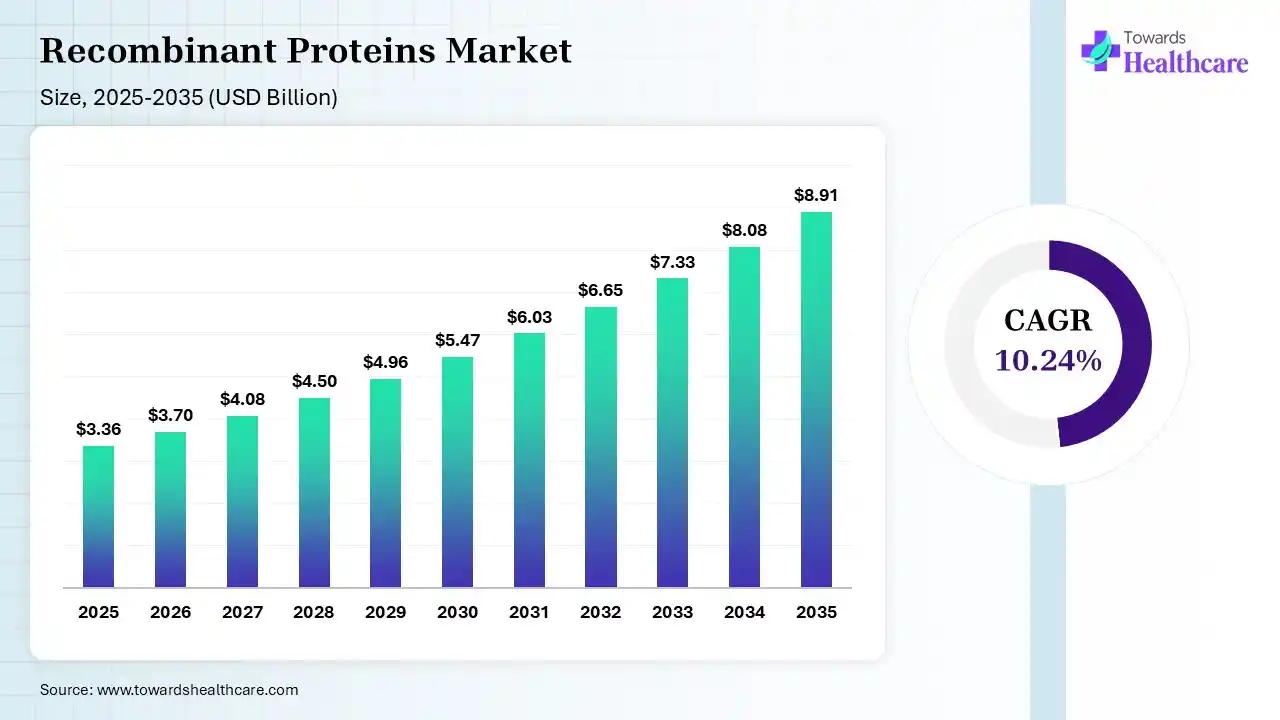
The global recombinant proteins market size stood at USD 3.36 billion in 2025, grew to USD 3.70 billion in 2026, and is forecast to reach USD 8.91 billion by 2035, expanding at a CAGR of 10.24% from 2026 to 2035. Growth in the market can be attributed to factors such as rising incidence of chronic diseases like cancer, diabetes, and autoimmune disorders, growing demand for biologics and biosimilars due to the expiration of patients, rising demand for customized medicine, and increasing government initiatives are anticipated to drive market growth.
Recombinant DNA (rDNA) technology, which combines at least two DNA sequences that rarely occur together in nature, is used to create recombinant proteins. High protein yields, free of animal contaminants, and regulated batch-to-batch fluctuation are all possible with recombinant protein synthesis. The possible use of these rDNA libraries and the resulting proteins as replacement therapy, inhibitors of disease pathways, or other anti-disease medicines are then carefully examined.
Recombinant protein manufacturing is a well-established biotechnological method for producing certain proteins of interest on a large scale. The process of creating recombinant proteins starts at the genetic level when the target protein's coding sequence is isolated and cloned into an expression plasmid vector. The vector and the desired gene are then transferred to an appropriate host, which causes gene expression, transcription, and messenger RNA (mRNA) translation into proteins. Despite being generated from human DNA, the majority of therapeutic recombinant proteins are produced in microbes like bacteria, yeast, or animal cells in culture. In order to boost research productivity and expand their revenue-generating products, major companies in the recombinant proteins market are investing in their R&D programs.
The recombinant proteins market comprises proteins produced through genetically engineered host cells, such as bacteria, yeast, or mammalian cells, for therapeutic, diagnostic, research, and industrial applications. The market is growing due to increasing demand for biologic drugs, rising prevalence of chronic diseases, and expanding use of recombinant proteins in vaccines, replacement therapies, and laboratory research. A major trend is the development of next-generation recombinant proteins with improved stability and therapeutic performance. Technological advancements in gene editing, protein engineering, cell-line development, and high-throughput expression systems are improving production efficiency and consistency. Increasing adoption of mammalian and microbial expression platforms is also supporting scalable manufacturing. Future opportunities are emerging from personalized medicines, biosimilars, regenerative medicines, and advanced protein therapeutics. Additionally, automation and AI-assisted protein design are accelerating candidate and AI-assisted protein design are accelerating candidate development, while improved purification technologies are helping manufacturing achieve higher yields and product quality
AI is transforming the recombinant proteins market by accelerating protein design, engineering production, quality control, and improving efficiency across various stages. Through machine learning, AI is able to keep updated on vital bioreactor parameters and make real-time modifications to preserve ideal production conditions. It also quickly identifies and optimizes protein structures, reducing development time and cost. By examining patient data, it also makes it possible to create personalized medicines, which result in more specialized care. By identifying differences in protein structure and purity, AI also improves quality control. In general, AI is influencing the future of recombinant proteins by accelerating, improving the accuracy, and lowering the cost of biopharmaceutical development.
Driver
Increasing Incidence of Chronic Disorders
The necessity for targeted and efficient protein treatment approaches has ultimately increased due to the growing incidence of chronic illnesses. According to the American Cancer Society, the most prevalent malignancies are those of the skin, prostate, colorectal, lung, and breast. To counter this, a number of projects have been started to use recombinant DNA technologies to provide more effective immunotherapy. The goal of these recombinant products is to eradicate the tumor and strengthen the immune system's resistance to malignant cells. Immunostimulants, vaccines, antibodies, immunotoxins, and fusion proteins are the most significant recombinant products used in anticancer therapy.
Restraint
High Cost Production
Using recombinant DNA technology to produce proteins in large quantities requires a significant investment of time, labor, and resources. Furthermore, the cost of recombinant proteins for medicinal applications might be in the billions of dollars per kilogram. The manufacturing of recombinant proteins is expensive due to these variables, which eventually raises the cost of therapeutic goods. This constrains their accessibility and restricts market expansion by making them costly for many patients, particularly in developing nations. Furthermore, the high cost of production puts pressure on biopharmaceutical businesses to grow their profits, which can raise medicine costs and ultimately lead to pressure from regulators and payers.
Opportunity
Rising demand for recombinant proteins for biotherapeutics
Biotherapeutic medications made from recombinant proteins have transformed the way that many illnesses, such as cancer, autoimmune conditions, and infectious diseases, are treated. Because biotherapeutics may target certain cells and tissues and are successful in treating a variety of ailments, their demand is growing. The economics and efficiency of the drug development process have been greatly enhanced by the use of recombinant proteins in biotherapeutics. As a result, the development of biotherapeutic medications has been a top focus for many pharmaceutical firms, which is expected to support the recombinant protein market's expansion throughout the course of the projected year.
| Table | Scope |
| Market Size in 2026 | USD 12.90 Billion |
| Projected Market Size in 2035 | USD 36.36 Billion |
| CAGR (2026 - 2035) | 12.2% |
| Leading Region | North America by 42% |
| Historical Data | 2020 - 2023 |
| Base Year | 2025 |
| Forecast Period | 2026 - 2035 |
| Measurable Values | USD Millions/Units/Volume |
| Market Segmentation | By product, By therapeutics, By application, By end-user, By region |
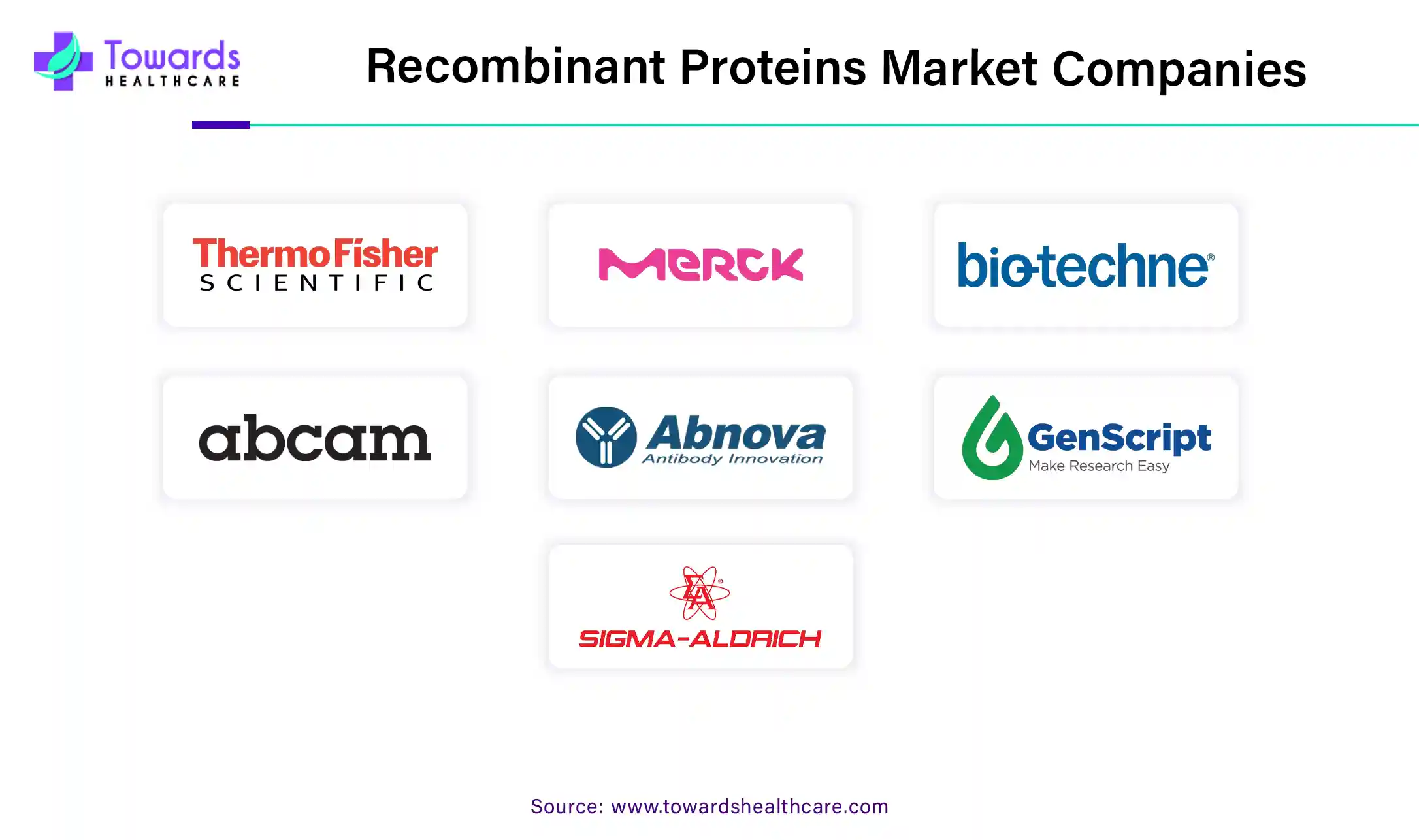
| Top Key Players | Thermo Fisher Scientific, Merck KGaA, Bio-Techne, Abcam plc, Abnova Corporation, GenScript Biotech Corporation, Sigma-Aldrich Company, GE HealthCare, ProSpec-Tany TechnoGene Ltd., BPS Bioscience, RayBiotech Life, Inc., STEMCELL Technologies Inc., Bio-Rad Laboratories, Inc., Proteintech Group, Inc., Sino Biological, Inc. |
On the basis of product, the cytokines & growth factors segment held the largest revenue share of the recombinant proteins market in 2025. It is widely used in a variety of domains, including immunology, neurology, COVID-19, HIV/AIDS, and cancer. The category is expanding as a result of the growing global acceptance of cytokines in cancer treatment and their recognition as biomarkers for disease detection. The rising prevalence and incidence of cancer, funding for cancer treatment research, and giving rise to new goals for chemotherapy are driving market expansion. The market is also increasing internationally due to the need for recombinant protein products in regenerative medicine and increased funding for research and development in the battle against cancer.
By product, the antibodies segment is estimated to grow significantly in the recombinant proteins market during the forecast period. Western blotting, immunohistochemistry, and ELISA are among the diagnostic procedures that heavily rely on recombinant antibodies. They are perfect for identifying disease-related antigens and biomarkers due to their excellent sensitivity and specificity. Their need for diagnostic applications has increased as a result, especially for conditions including autoimmune disorders, infections, and cancer.
The therapeutics segment dominated the recombinant protein recombinant proteins market in 2025. Protein-based treatments are expected to become more in demand as disorders, including cancer, immunological disorders, metabolic disorders, and genetic abnormalities, become more common. Furthermore, one of the world's top causes of death is cancer, and the World Health Organisation (WHO) projects a significant increase in cancer cases in the years to come. Consequently, it is anticipated that the therapeutics market will expand.
Based on the application, the drug discovery & development segment is estimated to grow significantly in the recombinant proteins market during the forecast period. Research and development efforts are growing, which is helping the market flourish. Important market participants' product releases are also anticipated to propel the category. Diseases including diabetes, cancer, infectious diseases, hemophilia, and anemia can all be effectively treated using protein therapies. Globally, there will be 643 million diabetics by 2030 and 783 million by 2045, according to the International Diabetes Federation. The need for the creation of efficient recombinant proteins is anticipated to increase in the upcoming years due to the significant rise in the number of people with diabetes.
Based on end-users, the pharma & biotechnology companies segment dominated the global recombinant proteins market in 2025. The trend towards biologics and biosimilars has led to bio-manufacturers investing millions of dollars in research and development to expand their product pipeline, develop new technologies, and improve bioprocessing instruments. Developments in recombinant protein products have also been aided by growing consumer demand, increased player rivalry, and a variety of end-user applications.
Over the course of the forecast period, the academic and research institutes segment is anticipated to develop at a significant rate in the recombinant proteins market. Additionally, the R&D sector saw a rise in investments in industry-academia engagement and collaborations.
The Centre for Therapeutic Innovation (CTI) at Pfizer serves as a forum for cooperation across healthcare organizations. CTI actively works with researchers and academic institutions to address the issues by using Pfizer's ideas. These kinds of partnerships support research into new drugs and possible treatments for patients, which ultimately drives market expansion.
Based on the host cell, the mammalian cell segment held the largest recombinant proteins market share in 2024. The need for mammalian protein expression is rising in conjunction with the growth of the proteomics and biologics sector. Protein expression systems are readily available and can be easily integrated into high throughput systems for efficient proteomics and biologics research. Furthermore, the growing incidence and prevalence of cancer, as well as increasing research and development (R&D) activities, have led to a greater focus on developing biopharmaceutical goods, which in turn is driving the market's rise.
The bacterial cell segment is anticipated to witness significant growth over the forecast period. In biotechnology and research, the use of bacterial cells as host cells has grown dramatically. Because of their easy handling, well-characterized genetics, and quick growth, bacterial cells, primarily Escherichia coli (E. coli), are desirable for protein expression. Over the course of the projection period, the expansion of bacterial cells is expected to be driven by the increasing demand for a variety of applications, including drug research and antibodies.
North America held the largest revenue share of the recombinant proteins market by 42% in 2025. The market for recombinant proteins in North America was dominated by the US. The market has expanded due to increased investment in research, the accessibility of healthcare facilities, and a number of important market participants due to the rising incidence of cancer in the area.
The American Cancer Society's 2024 report projects that 1.9 million new instances of cancer will be detected in the U.S. in 2024. Due to aging populations and population growth, this number is predicted to rise to 2.4 million by 2035. For such reasons, recombinant proteins have been shown to be effective in cancer conditions, the prevalence of chronic illnesses, and the presence of competitors, research funding, mergers, and acquisitions in the region is driving up demand for recombinant protein therapies.
U.S. Leads Recombinant Protein Innovation Through Strong Biopharma Demand
The U.S. recombinant proteins market is significantly growing due to its well-established biotechnology and pharmaceutical industries, strong demand for biologic therapies, and substantial investment in biomedical research. Growing applications in drug development, vaccines, diagnostics, and personalized medicine further support market expansion. Advanced protein engineering, expression technologies, and a strong pipeline of recombinant therapeutics are also encouraging innovation and commercial adoption across the country.
Canada Expands Through Biopharmaceutical Innovation and Research
Canada’s recombinant proteins market is notably expanding due to increasing investments in biotechnology and life-science research, growing demand for biologic medicines, and expanding applications in vaccines, diagnostics, and therapeutic development. Strong academic research capabilities and collaborations between biotechnology companies and research institutions are supporting innovation in recombinant protein production. Growing adoption of advanced protein-engineering and cell-culture technologies is further contributing to market development.
Asia-Pacific is expected to grow at a significant CAGR during the forecast period. Increased public and private financing for recombinant protein research and development, supportive government policies and regulations, and the growing incidence of target illnesses in an aging population are all factors contributing to the region's market expansion. Proteomic and genomic research techniques have improved, which helps the region grow. Additionally, during the course of the forecast period, the growing healthcare infrastructure is anticipated to support the geographical expansion of the recombinant proteins market. Additionally, it is anticipated that government support for biotechnology R&D would propel regional market expansion.
India Expands Through Biopharmaceutical Manufacturing and Research
India’s recombinant proteins market is notably expanding due to the growing biopharmaceutical industry, increasing demand for affordable biologic therapies, and rising investments in biotechnology research. Expanding vaccine and biosimilar production is creating additional demand for recombinant proteins. Government support for biotechnology, improving research infrastructure, and the growing capabilities of Indian pharmaceutical manufacturers in protein expression and bioprocessing are further supporting market growth.
China Strengthens Its Recombinant Protein Market Through Biopharmaceutical Growth
China has a significant share of the recombinant proteins market due to the rapid expansion of its biopharmaceutical sector, increasing demand for biologic therapies, and growing investment in biotechnology research. Rising applications of recombinant proteins in vaccines, diagnostics, and therapeutic development are supporting market expansion. Improvements in domestic manufacturing capabilities, research infrastructure, and advanced protein-expression technologies are further strengthening China’s recombinant protein production and development ecosystem.
Europe is considered to be a significantly growing area, owing to the growing need for personalized medicines and advancements in diagnostics. The growing research and development activities in molecular biology, cell biology, and biochemistry facilitate the development of recombinant proteins. The burgeoning biotechnology sector and the increasing number of pharma and biotech startups contribute to market growth. The rising prevalence of chronic disorders and the increasing geriatric population necessitate researchers to develop recombinant proteins for personalized therapeutics. According to a recent report by The Health Foundation organization, approximately 9.1 million people in England are projected to be living with major illnesses by 2040. (Source: The Health Foundation)
UK Strengthens Its Recombinant Protein Market Through Biopharma Innovation
The UK has a significant share of the recombinant proteins market due to its well-established pharmaceutical and biotechnology sector, strong academic research capabilities, and growing demand for biologic therapies. Increasing applications in drug discovery, vaccine development, diagnostics, and therapeutic research are supporting market expansion. Government and institutional investment in life-science research, advanced biotechnology infrastructure, and collaborations between universities and biopharmaceutical companies are further driving recombinant protein development and adoption.
Germany Expands Through Advanced Biopharmaceutical Research
Germany’s recombinant proteins market is notably growing due to its strong pharmaceutical and biotechnology ecosystem, increasing demand for biologic medicines, and well-developed research infrastructure. Rising applications of recombinant proteins in therapeutic development, diagnostics, and vaccine research are supporting market expansion. The country’s advanced capabilities in biotechnology, protein engineering, and bioprocessing, along with collaboration between research institutions and pharmaceutical companies, are further strengthening recombinant protein development and manufacturing.
In September 2024, Axio BioPharma, a respected producer and provider of quality recombinant proteins, announced that it is presently accepting recombinant protein manufacturing projects. The founder and CEO of Axio BioPharma, Justin Byers, claimed that the company's mission is to be the go-to partner for enterprises producing novel biologics. They are committed to accelerating the development of life-saving therapies through innovative manufacturing methods.
By Product
By Application
By End Use
By Host Cell
By Region