


The global robotic nurse assistant market size was estimated at USD 1.58 billion in 2025 and is predicted to increase from USD 1.81 billion in 2026 to approximately USD 6.28 billion by 2035, expanding at a CAGR of 14.84% from 2026 to 2035.
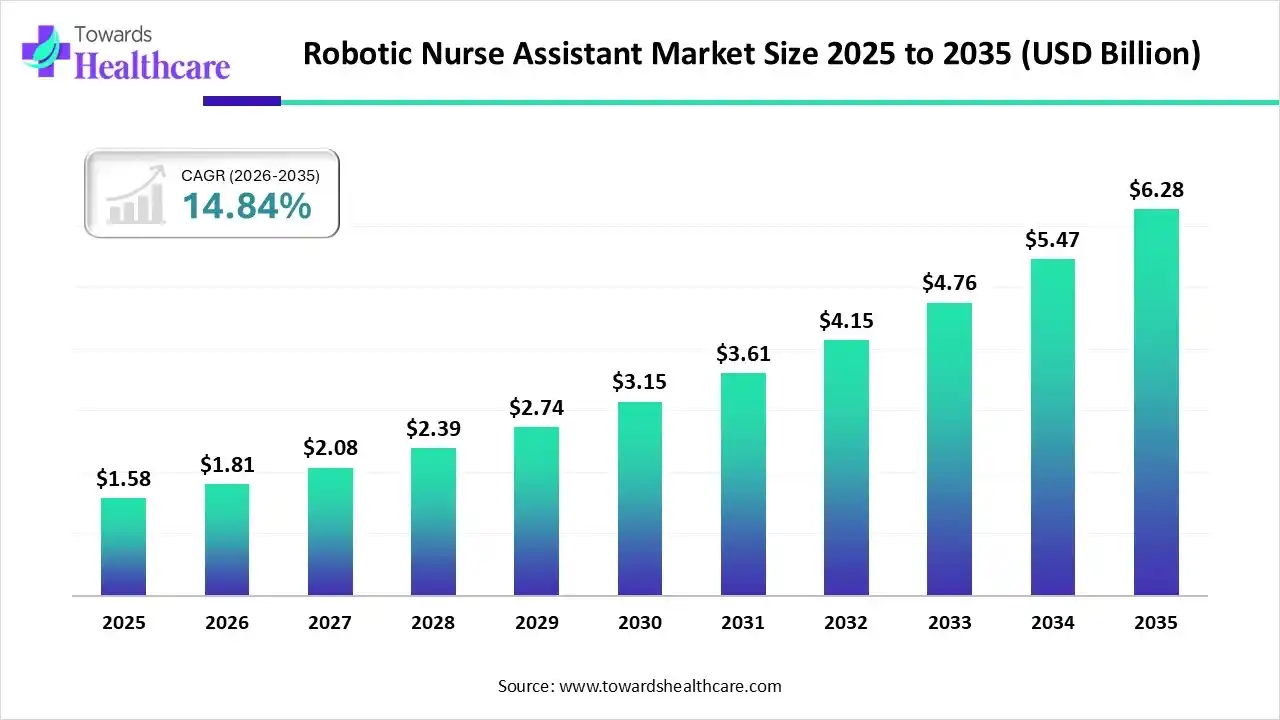
The market is gaining momentum as hospitals adopt automation to address staff shortages, improve patient care efficiency, and support routine tasks. Advances in AI and robotics are accelerating adoption across healthcare settings worldwide.
The robotic nurse assistant market is growing as healthcare facilities adopt robotic technologies to address workforce shortages and improve patient care efficiency. These robots assist with routine tasks such as delivering medications, transporting supplies, monitoring patients, and supporting elderly or physically challenged individuals with daily activities. Their ability to reduce the workload of healthcare professionals allows nurses to focus more on direct patient care. Advances in artificial intelligence, natural language processing, and autonomous navigation are improving the capabilities of robotic assistants. Rising demand for elderly care services, increasing hospital automation, and growing acceptance of assistive healthcare technologies are expected to drive further market expansion.
A robotic nurse assistant is an AI-powered healthcare robot designed to support nurses by handling routine tasks such as patient monitoring, medication reminders, mobility assistance, and workflow coordination, helping improve care efficiency and reduce staff workload. The robotic nurse assistant market is growing because healthcare systems face severe staffing shortages, rising care demands from aging populations, and the need to improve efficiency and patient outcomes. Hospitals are adopting robotics to automate routine tasks, reduce nurse burnout, enhance infection control, and support remote monitoring. Advancements in AI and robotics technology are also making these solutions more affordable and effective, driving broader adoption.
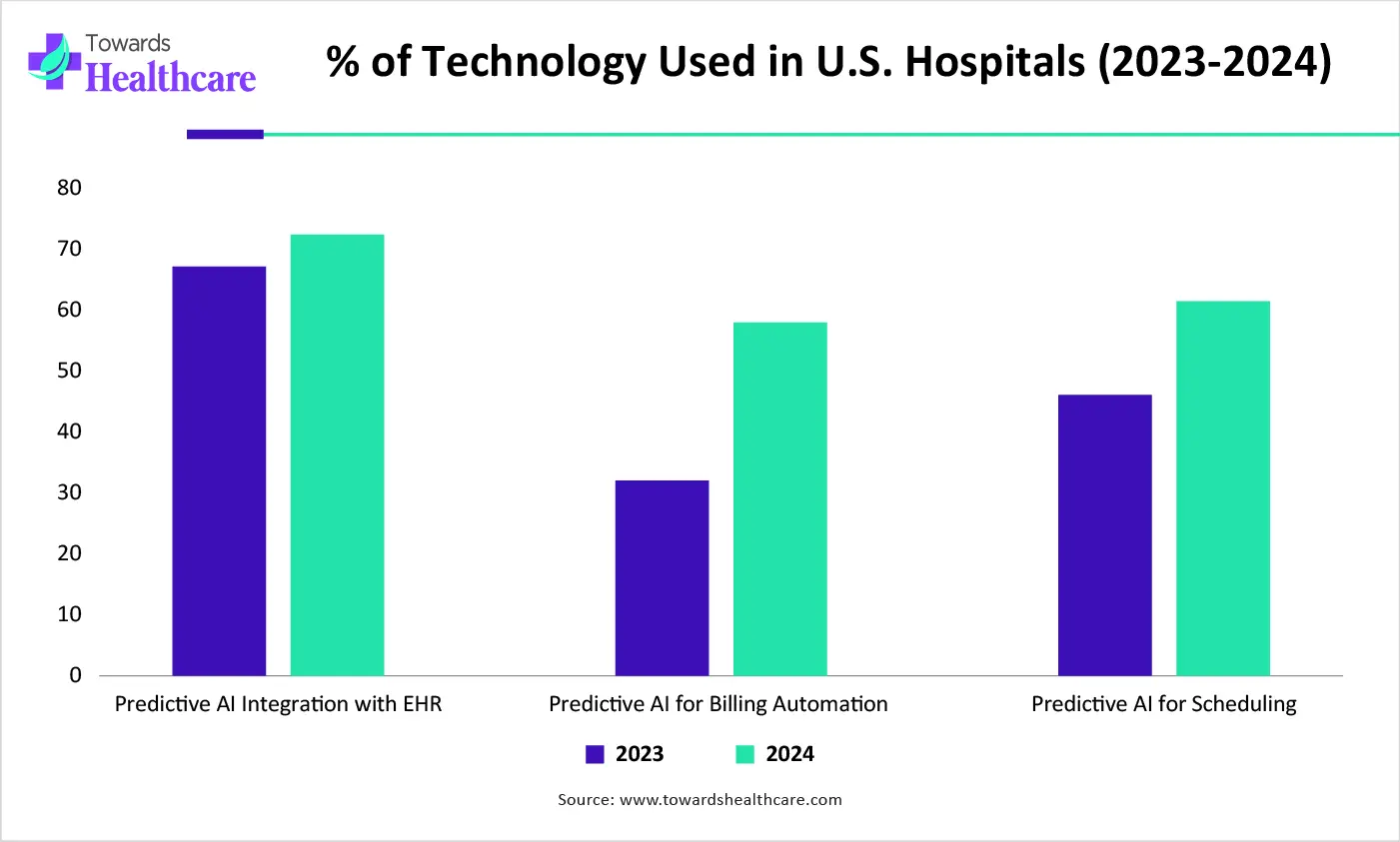
AI is significantly influencing the market by enabling smarter patient monitoring, predictive alerts, and adaptive task execution. AI-powered algorithms allow robots to analyze patient data in real time, support clinical decision-making, and personalize care. This improves efficiency, reduces nurse workload, enhances patient safety, and accelerates adoption across hospitals and long-term care facilities.
| Table | Scope |
| Market Size in 2026 | USD 1.58 Billion |
| Projected Market Size in 2035 | USD 6.28 Billion |
| CAGR (2026 - 2035) | 14.84% |
| Leading Region | North America by 40% |
| Key Applications | Patient monitoring, medication assistance, patient lifting and mobility support, hospital logistics, telepresence nursing, elderly care, rehabilitation support, infection control |
| Primary End Users | Hospitals, Long-Term Care Facilities, Nursing Homes, Rehabilitation Centers, Home Healthcare Providers |
| Key Challenges | Regulatory compliance, high implementation costs, interoperability issues, workforce acceptance, cybersecurity concerns, limited reimbursement frameworks |
| Measurable Values | USD Millions/Units/Volume |
| Market Segmentation | By Product Type, By End-use, By Region |
| Top Key Players | Hstar Technologies, Diligent Robotics, Toyota Motor Corporation, RIKEN-SRK, SoftBank Robotics, Panasonic |
| Segments | Shares % |
| Independence Support Robots | 46% |
| Daily Care & Transportation Robots | 34% |
| Pharma Automation Robots | 20% |
Why Did the Independence Support Robots Segment Dominate in the Robotic Nurse Assistant Market in 2025?
The independence support robots segment dominated the market by 46% share in 2025 due to rising demand for patient mobility assistance, daily activity support, and fall prevention. These robots address caregiver shortages, especially in elderly and rehabilitation care, while enabling patients to maintain autonomy, reduce hospital stays, and improve overall quality of care in clinical and home settings.
Daily Care & Transportation Robots
The daily care & transportation robots segment is expected to grow at the fastest CAGR because healthcare facilities are prioritizing automation of routine tasks like delivering medications, meals, and supplies. This reduces nurse workload, minimizes human contact for infection control, improves operational efficiency, and helps manage rising patient volumes, making these robots increasingly essential in both hospitals and long-term care settings during the forecast period.
| Segments | Shares % |
| Hospitals & Clinics | 52% |
| Senior Care Facilities | 30% |
| Homecare Settings | 18% |
What Made the Hospitals & Clinics Segment Dominant in the Robotic Nurse Assistant Market in 2025?
The hospitals & clinics segment dominated the market in 2025 due to high patient inflow, acute staff shortages, and the need for efficient care delivery. These settings increasingly adopted robotic assistants to support nursing workflow, manage routine patient monitoring, enhance infection control, and improve operational efficiency, making them early and large-scale adopters compared to other healthcare facilities.
Senior Care Facilities
The senior care facilities segment is expected to grow at the fastest CAGR because aging populations are increasing demand for continuous assistance, mobility support, and daily care. Robotic nurse assistants help address caregiver shortages, reduce operational costs, and improve safety and independence for elderly residents. Their ability to provide personalized support and monitor health conditions made them especially attractive in retirement homes and long-term care settings.
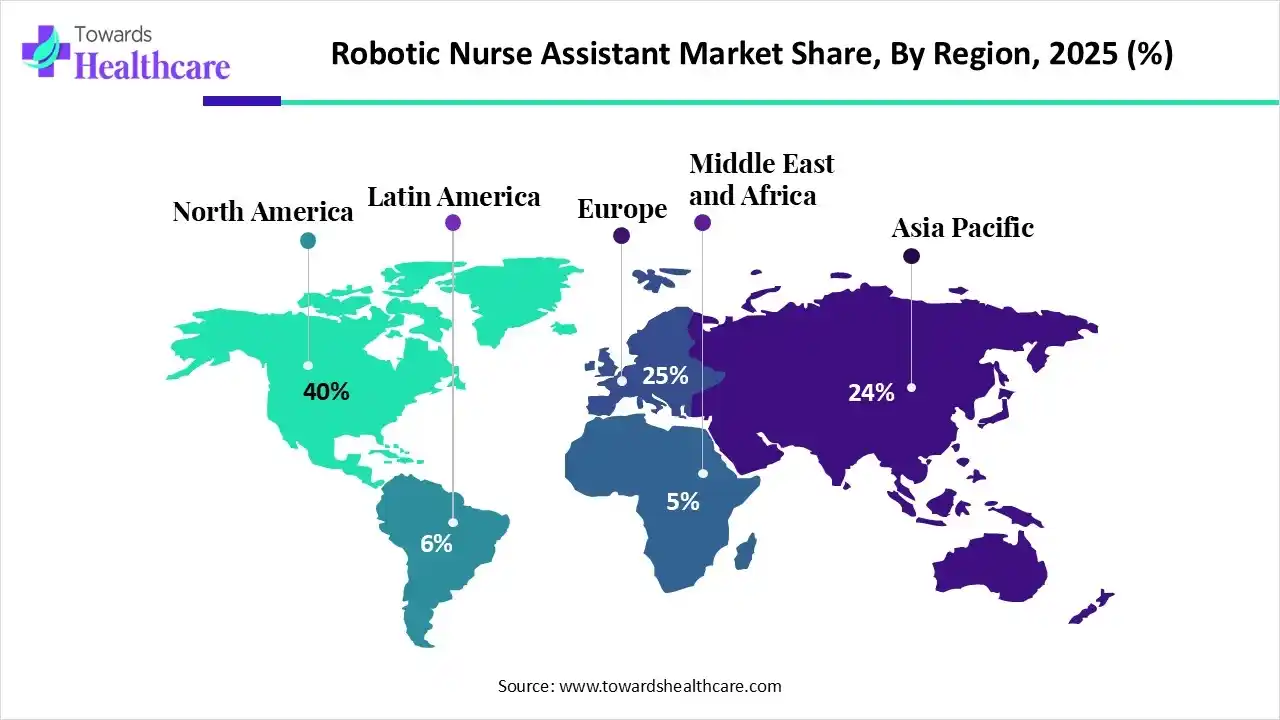
North America dominated the market by 40% share due to advanced healthcare infrastructure, early adoption of AI-driven technologies, and severe nursing workforce shortages. Strong investment in healthcare automation, favorable reimbursement policies, and the presence of major robotics and AI companies further accelerate adoption across hospitals, clinics, and senior care facilities in the region.
Why the U.S. Captured the Largest Revenue Share in 2025?
The U.S. led the robotic nurse assistant market in 2025 due to high healthcare spending, rapid adoption of advanced robotics, and acute nursing staff shortages. Strong hospital automation initiatives, early integration of AI-driven care solutions, supportive regulatory frameworks, and significant investments by healthcare providers and technology companies collectively drove higher deployment rates and revenue generation across the country.
Canada Market Trends
Canada is witnessing steady growth in the robotic nurse assistant market as healthcare providers adopt advanced technologies to improve patient care and reduce staff workload. Hospitals and long-term care facilities are using robotic assistants to support routine tasks such as patient monitoring, medicine delivery, and mobility assistance. An aging population and increasing demand for healthcare services are driving adoption. Strong investments in healthcare innovation, growing research in artificial intelligence and robotics, and collaborations between technology companies and healthcare institutions are supporting continued market development across Canada.
Asia Pacific is anticipated to grow by 24% share at the fastest CAGR in the robotic nurse assistant market during the forecast period due to rapidly aging populations, rising healthcare demand, and severe workforce shortages. Increasing investments in healthcare infrastructure, growing adoption of AI-driven technologies, government support for automation, and expanding medical tourism are accelerating the uptake of robotic nurse assistants across hospitals and senior care facilities.
India: A Rapidly Emerging Market for Robotic Nurse Assistant
India is anticipated to grow at a rapid CAGR due to rising healthcare demands, increasing patient load, and persistent nursing staff shortages. Growing investments in hospital infrastructure, expanding private healthcare facilities, government support for digital health, and rising awareness of AI-based automation are accelerating the adoption of robotic nurse assistants across hospitals and senior care settings.
China Market Trends
China is experiencing rapid growth in the robotic nurse assistant market because of rising healthcare demand and strong investments in artificial intelligence and robotics. Hospitals are introducing robotic assistants to improve patient monitoring, medication management, and routine nursing support. The growing elderly population and shortage of healthcare workers are increasing the need for automation in healthcare settings. Government support for smart healthcare initiatives, expanding domestic robotics manufacturing, and continuous technological innovation are helping robotic nurse assistants become more widely used across hospitals and care facilities.
Europe is anticipated to grow by 25% share at a notable CAGR due to an aging population, increasingly chronic diseases, and growing pressure on healthcare systems. Strong focus on patient safety, supportive regulatory frameworks, and rising adoption of AI-driven healthcare technologies across hospitals and elderly care facilities are driving demand for robotic nurse assistants throughout the region.
UK: Accelerating Adoption of Robotic Nurse Assistant Market
The UK is anticipated to grow at a rapid CAGR due to increasing pressure on the healthcare workforce, rising elderly population, and growing demand for efficient patient care. Strong adoption of digital health technologies, government initiatives supporting healthcare automation, and investments in AI-driven solutions across hospitals and care homes are accelerating market growth.
Germany Market Trends
Germany is seeing strong growth in the robotic nurse assistant market due to its advanced healthcare system and increasing focus on healthcare automation. Hospitals and elderly care centers are adopting robotic assistants to help with patient care, logistics, and routine nursing activities. Rising demand for efficient healthcare services, combined with a growing aging population, is encouraging wider adoption. Strong investments in robotics research, government support for digital healthcare, and partnerships between technology companies, research institutions, and healthcare providers are driving continuous market expansion across Germany.
| Ecosystem Segment | Key Participants | Role in Market |
| Technology Providers | NVIDIA, Intel, Qualcomm, Microsoft | AI processors, machine vision, robotics computing platforms |
| Product Manufacturers | Diligent Robotics, SoftBank Robotics, Toyota Motor Corporation, Cyberdyne, Panasonic | Development and commercialization of robotic nurse assistants and care robots |
| Service Providers | Sodexo Healthcare, Compass One Healthcare, Aramark Healthcare | Deployment support, hospital operations integration |
| Platform Providers | Microsoft Azure, AWS, Google Cloud | AI, cloud connectivity, remote monitoring platforms |
| Software Vendors | Oracle Health, Philips, GE HealthCare, Epic Systems | Healthcare workflow integration and patient management systems |
| Research Institutions | MIT, Carnegie Mellon University, Stanford University, University of Tokyo, National University of Singapore | Robotics research, AI-assisted care innovations |
| End-User Industries | Hospitals, Nursing Homes, Assisted Living Facilities, Home Care Providers | Adoption and utilization of robotic nursing assistants |
R&D
Clinical Trials
Regulatory Approvals
| Tier 1 | Tier 2 | Tier 3 | |
| Typical Market Influence | 62% | 25% | 13% |
| Tier 1 | ||||
| Company Name | Headquarters | Country | Why Relevant to This Market | Key Products/Services |
| Diligent Robotics | Austin, Texas, USA | USA | Pure-play leader focused specifically on nurse-assistant robotics deployed in hospitals | Moxi Hospital Robot |
| SoftBank Robotics | Tokyo, Japan | Japan | Global healthcare and service robotics leader with broad deployment footprint | Pepper, Whiz, Healthcare Service Robots |
| Toyota Motor Corporation | Toyota City, Aichi, Japan | Japan | Significant investment in healthcare assistance and patient support robotics | Human Support Robot (HSR), Care Assistance Robots |
| Tier 2 | ||||
| Company Name | Headquarters | Country | Why Relevant to This Market | Key Products/Services |
| Aethon Inc. | Pittsburgh, Pennsylvania, USA | USA | Hospital robotics pioneer with autonomous support systems | TUG Autonomous Mobile Robots |
| CMR Surgical | Cambridge, England, United Kingdom | UK | Expanding healthcare robotics ecosystem and hospital automation capabilities | Surgical and Hospital Robotic Platforms |
| Relay Robotics | Denver, Colorado, USA | USA | Active provider of autonomous service robots for healthcare logistics | Relay Healthcare Delivery Robots |
| Tier 3 | ||||
| Company Name | Headquarters | Country | Why Relevant to This Market | Key Products/Services |
| Labrador Systems | Mountain View, California, USA | USA | Specialized elder-care and assistive robotics innovator | Labrador Retriever Assistive Robot |
| Temi Global Ltd. | Tel Aviv, Israel | Israel | Healthcare telepresence and patient interaction robotics | Temi Healthcare Robot |
| OhmniLabs | Santa Clara, California, USA | USA | Growing telehealth and remote nursing robot provider | Ohmni Telepresence Robot |
Strengths
Weaknesses
Opportunities
Threats
In July 2025, Barry Chiang, President of Business Group B, Hon Hai Precision Industry Co., Ltd. (Foxconn), said, I am delighted that we have co-developed the nurse assistant robot 'Nurabot' with Kawasaki Heavy Industries. Our goal is to improve the harsh working environment that nurses face every day and support them in performing their duties more efficiently and safely. Through verification experiments at Taichung Veterans General Hospital, we aim to confirm how “Nurabot” can be useful in actual medical settings and continue to make further improvements. By combining Kawasaki’s advanced robotic technology with Foxconn’s software development capabilities, we are confident we can bring innovation to medical settings. We will continue to strive to contribute to reducing nurses’ burdens and improving patient services.
By Product Type
By End-use
By Region





Principal Consultant
Rohan Patil is a seasoned market research professional with over 5+ years of focused experience in the healthcare sector, bringing deep domain expertise, strategic foresight, and analytical precision to every project he undertakes.
Learn more about Rohan Patil

Reviewed By
Aditi Shivarkar is a seasoned professional with over 14 years of experience in healthcare market research. As a content reviewer, Aditi ensures the quality and accuracy of all market insights and data presented by the research team.
Learn more about Aditi Shivarkar









