


Singapore’s computational drug discovery market is an emerging, technology-intensive segment of the country’s pharmaceutical and biomedical R&D ecosystem. The market is projected to increase from USD 17.32 million in 2026 to around USD 125.37 million by 2035, expanding at a CAGR of 24.6% during 2026-2035.
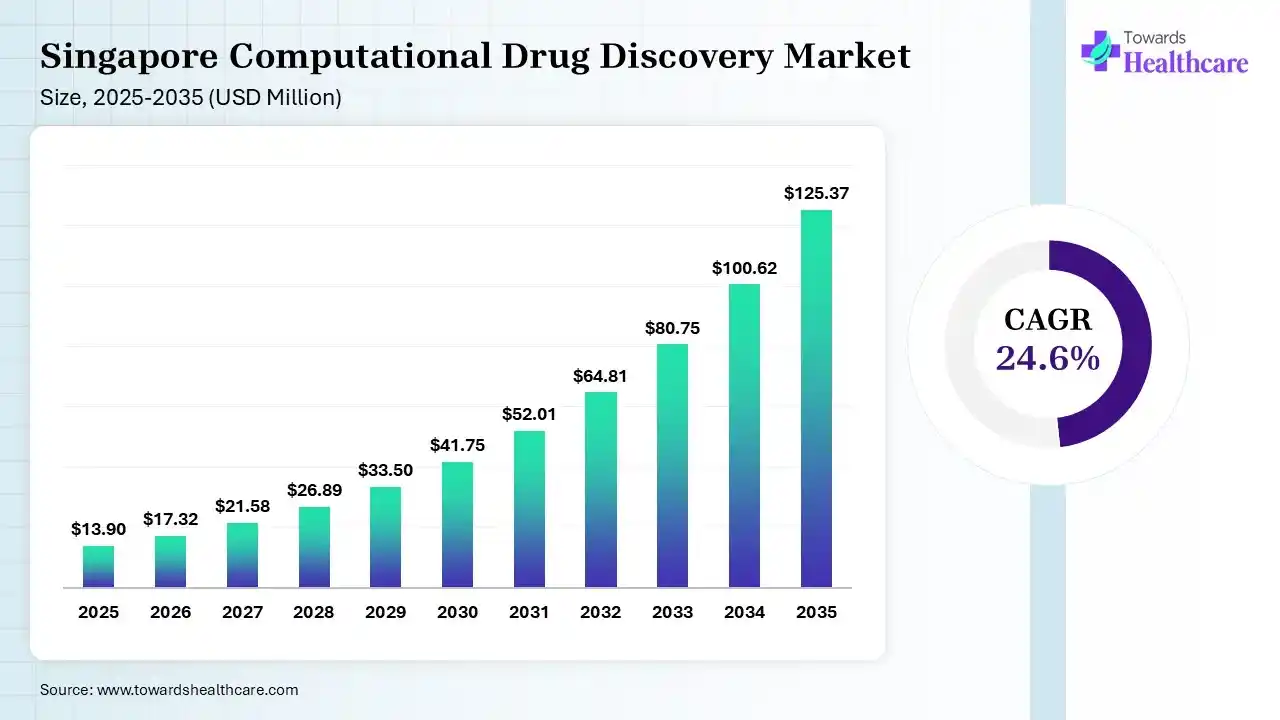
Computational drug discovery covers digital and computational methods used to identify, design, prioritize, and optimize drug candidates before or alongside laboratory experimentation. The Singapore computational drug discovery market represents the portion of drug-discovery expenditure and commercial activity associated with in-silico molecular modelling, virtual screening, molecular dynamics, structure-based drug design, AI/ML-enabled compound discovery, QSAR, cheminformatics, computational ADMET, bioinformatics and related software/services. The 2025 market estimate is aligned with the scale indicated by publicly available Singapore AI-drug-discovery market evidence and adjusted to reflect the narrower computational-drug-discovery scope rather than the broader AI-in-drug-discovery category.
Singapore's market is small in absolute value but strategically important because the country combines a dense biomedical research ecosystem, multinational pharmaceutical presence, public R&D infrastructure and increasingly sophisticated AI-for-science capabilities.
Singapore's government estimates that integrating AI into pharmaceutical R&D could reduce average drug-discovery time by more than 40% for Singapore's biotech firms. It was also reported that Singapore is investing S$120 million in "AI for Science", explicitly including biomedical and health sciences.
The principal commercial opportunity is not simply selling standalone computational software. Singapore's ecosystem favors integrated computational-to-experimental workflows, where molecular modelling, AI, structural biology, compound synthesis, screening, and translational research are connected.
The market covers computational chemistry, AI/ML-enabled drug discovery, virtual screening, molecular modelling, molecular dynamics, generative molecular design, target identification, lead optimization, and computational ADMET analysis.
By technology, the market is led by molecular modelling and molecular dynamics, which accounted for 27% of the market in 2025, followed by virtual screening at 20% and AI/ML & generative chemistry at 24%. AI/ML & generative chemistry is the fastest-growing technology segment, with a CAGR of 30.80%. Other segments include molecular docking, QSAR/predictive modelling, and cheminformatics & other methods.
By application, lead identification and virtual screening is the largest segment, with a 28% share in 2025, while de novo drug design and generative molecule design is the fastest-growing segment, with a 31.60% CAGR. Other applications include target identification and validation, lead optimization, ADMET and toxicity prediction, and drug repurposing.
By customer/end-user type, pharmaceutical companies dominate with a 42% share in 2025, supported by large R&D budgets and demand for improved discovery productivity. CROs and drug-discovery service providers are the fastest-growing group, with a 31.20% CAGR, driven by demand for specialized computational and AI capabilities without requiring customers to build extensive internal infrastructure.
By business/service model, the market includes platform/software licensing, computational drug discovery services, AI/generative drug design platforms, consulting/workflow integration, and training, support & other services. The report also identifies software licensing, computational services, discovery partnerships, co-development agreements, milestone-based arrangements, and proprietary drug development as potential commercial models.
| Technology | 2025 Share | CAGR | Growth Driver |
| Molecular Modelling & Molecular Dynamics - Dominating | 27% | 22.80% | Widely used for understanding protein–ligand interactions, molecular flexibility, and binding behavior. |
| Virtual Screening | 20% | 25.10% | Enables large compound libraries to be screened computationally before laboratory testing. |
| AI/ML & Generative Chemistry - Fastest Growing | 24% | 30.80% | Increasing use of machine learning and generative models for compound design, optimization, and prediction. |
| Molecular Docking | 13% | 22.40% | Established computational method for ranking potential ligand–target interactions. |
| QSAR/Predictive Modelling | 9% | 21.70% | Supports activity, toxicity, and physicochemical-property prediction. |
| Cheminformatics & Other Methods | 7% | 20.90% | Includes chemical databases, similarity searching, and data-management workflows. |
The market is transitioning from conventional computational chemistry toward AI-enhanced computational chemistry. Therefore, the strongest commercial opportunities are likely to occur where AI is combined with physics-based modelling, experimental validation, and automated synthesis.
| Application | 2025 Share | CAGR | Growth Driver |
| Lead Identification & Virtual Screening - Dominating | 28% | 23.10% | Computational screening reduces the number of physical compounds requiring laboratory evaluation. |
| Target Identification & Validation | 22% | 25.30% | Growing use of multi-omics, structural biology, and AI for target prioritization. |
| Lead Optimization | 20% | 24.80% | Computational prediction supports potency, selectivity, and physicochemical optimization. |
| De Novo Drug Design & Generative Molecule Design - Fastest Growing | 17% | 31.60% | Generative AI enables exploration of novel chemical structures against defined design constraints. |
| ADMET & Toxicity Prediction | 8% | 22.90% | Earlier prediction of safety and pharmacokinetic characteristics reduces downstream risk. |
| Drug Repurposing & Other Applications | 5% | 22.10% | Computational analysis identifies new therapeutic uses for existing compounds. |
Lead identification and virtual screening remain the commercial base, while de novo design represents the strongest emerging opportunity. The next phase of adoption should increasingly involve platforms capable of moving from target → virtual screening → molecule generation → computational optimization → synthesis → experimental validation. This integrated workflow can command higher-value contracts than individual software modules.
| End User | 2025 Share | CAGR | Growth Driver |
| Pharmaceutical Companies - Dominating | 42% | 22.60% | Large R&D budgets and increasing pressure to improve discovery productivity. |
| Biotechnology Companies | 25% | 29.70% | Smaller teams increasingly rely on computational platforms to extend research capacity. |
| Research & Academic Institutes | 18% | 27.90% | Public research funding supports computational biology and translational discovery. |
| CROs/Drug Discovery Service Providers - Fastest Growing | 15% | 31.20% | Outsourcing enables access to specialized computational and AI capabilities without building full internal infrastructure. |
Pharmaceutical companies remain the largest spending group, but CROs and specialized service providers offer the fastest commercial expansion opportunity. This is particularly relevant in Singapore because the country's ecosystem encourages partnerships between research institutions and industry. EDDC has already used AI-driven chemistry, computational platforms, and external technology collaborations to support drug-discovery programs.
From a commercial perspective, the market also divides into software/platform providers, computational services, AI-enabled drug-discovery companies, and integrated discovery partnerships. The latter is becoming particularly relevant as companies combine computational predictions with wet-lab validation and automated experimentation.
Singapore's market should therefore not be interpreted solely as a domestic software market. Its strategic value comes from its ability to serve regional and global pharmaceutical and biotechnology customers while leveraging Singapore's research institutions, talent, infrastructure, and government support. Consequently, market growth is expected to depend heavily on global pharma partnerships, technology commercialization, and the expansion of AI-enabled drug discovery rather than only on domestic demand.
Demand for computational drug discovery in Singapore comes primarily from pharmaceutical companies, biotechnology companies, CROs, academic institutions, and government-supported research organizations. Singapore hosts a significant pharmaceutical manufacturing and R&D ecosystem, including regional operations of major global pharmaceutical companies. This creates potential demand for computational technologies that can improve early-stage discovery and reduce experimental workload.
The Singapore Economic Development Board reports that eight of the world's ten largest biopharmaceutical companies have manufacturing facilities in Singapore, reinforcing the country's position as a high-value pharmaceutical ecosystem.
Pharmaceutical companies are increasingly interested in technologies that can identify promising targets and compounds before significant laboratory resources are committed. Biotech companies, meanwhile, may use external computational platforms or discovery partnerships because maintaining an extensive internal computational infrastructure can be expensive. CROs can also incorporate AI and computational chemistry into their service portfolios to differentiate themselves and offer integrated discovery solutions.
These indicators suggest that Singapore's opportunity is disproportionately concentrated in high-value R&D and technology-intensive discovery activities. The emergence of self-driving laboratories and AI-enabled chemistry also indicates a shift toward closed-loop discovery, where computational predictions directly determine laboratory experiments and experimental data feeds back into computational models.
The competitive landscape consists of several categories: AI-native drug-discovery companies, computational chemistry providers, software/platform companies, CROs, and research institutions. Local companies such as Engine Biosciences demonstrate Singapore's ability to develop proprietary computational drug-discovery platforms, while companies such as ChemLex illustrate the emergence of AI combined with automated laboratory experimentation. International technology and pharmaceutical companies also participate through partnerships and research collaborations.
Singapore's ecosystem is strengthened by institutions including A*STAR, the Experimental Drug Development Centre (EDDC), NUS, NTU, and Duke-NUS. EDDC is particularly important because it connects discovery research with experimental and translational drug-development capabilities. This reduces the gap between computational prediction and laboratory validation, which is one of the major challenges in AI-enabled drug discovery.
In December 2025, ChemLex announced a US$45 million financing round and the establishment of its global headquarters and self-driving AI laboratory in Singapore. The company reported more than 70 customers worldwide, including six of the world's ten largest pharmaceutical companies, and entered an MOU with EDDC for next-generation small-molecule discovery. Duke-NUS also received US$1.5 million from 65LAB in 2025 for a drug-discovery platform integrating systems genetics, AI, and emerging quantum-computing approaches for antifibrotic therapies.
The ecosystem therefore operates through a partnership model rather than a simple vendor-customer structure. A computational company may provide AI or molecular-design capabilities, while EDDC, a CRO, a university laboratory, or a pharmaceutical partner provides biological validation and development expertise.
Organizations that can combine computational modelling, proprietary biological data, experimental validation, automation and pharmaceutical partnerships have greater opportunity to differentiate. Singapore's relatively compact ecosystem can facilitate these collaborations because research institutes, hospitals, universities and corporate laboratories are geographically concentrated.
This structure gives Singapore an important role as a regional innovation and collaboration hub. However, the market remains relatively concentrated and specialized. The limited size of Singapore's domestic biotech sector means companies generally need international customers, partnerships, or licensing opportunities to achieve significant scale.
Technology development is the principal structural driver of Singapore's computational drug-discovery market. Major trends include generative AI for molecule design, foundation models for biology, protein structure prediction, virtual screening, molecular dynamics, AI-powered ADMET prediction, multi-omics analysis, and automated/self-driving laboratories.
One of the most significant developments is the integration of computational models with laboratory automation. Instead of using AI simply to make predictions, companies increasingly aim to create closed-loop systems in which AI proposes experiments, robotic systems perform them, experimental data are returned to the model, and the next experiments are automatically selected. ChemLex's Singapore self-driving laboratory illustrates this emerging direction.
Investment is increasingly coming from a combination of venture capital, strategic pharmaceutical partnerships, government funding, and institutional R&D investment. Singapore's government support for AI and biomedical sciences provides infrastructure and funding that can reduce the barriers facing emerging technology companies. At the same time, pharmaceutical partnerships can provide access to proprietary datasets, validation capabilities, and commercial channels. The US$45 million Singapore AI-for-science investment announced in 2025 provides a concrete indicator that international capital is moving toward this category.
Regulation and policy will also influence market development. Singapore's established biomedical regulatory infrastructure, emphasis on responsible AI, data governance, and research commercialization provide a relatively supportive environment. However, computational drug discovery still faces challenges involving data quality, intellectual-property ownership, model validation, explainability, cybersecurity, and regulatory acceptance of AI-generated evidence.
The principal opportunities are therefore concentrated in AI-native drug-discovery platforms, computational chemistry services, generative molecular design, AI-enabled CRO services, biologics/antibody discovery, and AI-enabled automated laboratories. Companies that combine computational capabilities with experimental validation may have an advantage over standalone software providers because drug discovery ultimately requires laboratory confirmation.
Looking toward 2030, Singapore is likely to develop primarily as an APAC computational drug-discovery and drug-development hub. The strongest growth opportunities are likely to come from international pharmaceutical partnerships, commercialization of Singapore-developed technologies, regional outsourcing, and integration of AI with automated experimental platforms.
How is Singapore’s Computational Drug Discovery Value Chain Structured, and What are the Key Activities and Participants at Each Stage?
Singapore’s computational drug discovery value chain spans the process from biological data generation and target identification through computational discovery, laboratory validation, preclinical development, and eventual clinical translation. The value chain is highly interconnected, with academic institutions, technology companies, pharmaceutical companies, CROs, and government-supported organizations participating at different stages.
The first stage involves data generation and biological research, including genomics, proteomics, disease biology, and multi-omics. Institutions such as A*STAR, NUS, NTU, and Duke-NUS contribute research capabilities, datasets, and scientific expertise. These inputs support the identification and validation of potential therapeutic targets.
The second stage is computational drug discovery, where AI/ML, computational chemistry, molecular modelling, virtual screening, molecular dynamics, and structure-based drug design are applied. Companies can use these technologies to identify promising molecules and predict their interactions with biological targets. Generative AI is increasingly being used to design novel compounds and optimize existing candidates.
The third stage involves hit identification and lead optimization. Computational systems prioritize compounds based on predicted potency, selectivity, physicochemical properties, and developability. Computational ADMET tools can also help identify potential toxicity or pharmacokinetic problems before expensive laboratory testing.
The fourth stage is experimental validation, where computational predictions are tested through biochemical, cellular, and other laboratory assays. This is a critical part of Singapore's ecosystem because organizations such as the Experimental Drug Development Centre (EDDC) provide capabilities that connect computational discovery with experimental and translational drug development.
The fifth stage involves preclinical and clinical development, including toxicology, formulation, regulatory activities, and clinical testing. Pharmaceutical companies, biotechnology firms, CROs, and healthcare institutions become increasingly important at these stages.
Overall, Singapore's value chain is characterized by strong integration between computational technologies and experimental drug development. Computational drug discovery is increasingly embedded within a broader R&D ecosystem. This integrated structure allows Singapore-based companies to combine AI and computational capabilities with scientific expertise, and access to pharmaceutical partners.
The customer base for Singapore's computational drug discovery market can be divided into pharmaceutical companies, biotechnology companies, CROs, academic and research institutions, and government-supported organizations. Each customer group has different requirements depending on its drug-development capabilities, budget, internal technology infrastructure, and stage of development. Thus, Singapore customers are likely to evaluate computational platforms less as generic IT tools and more as scientific infrastructure.
| Customer Base | Primary Requirements |
| Pharmaceutical companies | Predictive accuracy, scalability, integration, validation, IP protection, regulatory-quality data |
| Biotechnology companies | Cost efficiency, speed, access to advanced models, specialist support |
| Academic/research institutes | Reproducibility, scientific flexibility, computational access, publications and collaboration |
| CROs | Throughput, workflow automation, multi-client capability, integration and turnaround time |
| Hospitals/translational centers | Clinical relevance, data security, biomarker integration and validation |
| Drug-discovery centers | Target validation, molecular modelling, screening, ADMET and experimental integration |
Pharmaceutical companies represent an important customer group because they have significant R&D budgets and large pipelines of therapeutic programs. Their primary requirements include accurate target identification, virtual screening, molecular design, lead optimization, ADMET prediction, and integration with existing discovery workflows. Large pharmaceutical companies are generally interested in technologies that can demonstrate measurable improvements in discovery productivity, reduce experimental costs, and integrate with existing laboratory and data systems.
Biotechnology companies are another important segment. Smaller and emerging biotech companies may not have the resources to build extensive computational chemistry and AI capabilities internally. They therefore have greater potential demand for external platforms, computational services, and discovery partnerships. Their purchasing decisions are often influenced by flexibility, speed, cost, access to specialist expertise, and the ability to generate investable drug candidates.
CROs and research-service organizations can use computational drug-discovery technologies to expand their service portfolios. AI and computational capabilities allow CROs to offer integrated discovery services covering both computational design and experimental validation. This can increase their value proposition to pharmaceutical and biotech clients.
Universities and research institutions are also important users, although their purchasing models are different. They may require computational infrastructure, software licenses, cloud computing, specialized tools, and collaborative research arrangements.
Across these customer groups, key purchasing criteria include scientific accuracy, validation, scalability, data security, interoperability, ease of integration, cost, intellectual-property ownership, and demonstrated return on investment. The strongest purchasing proposition therefore combines measurable scientific outcomes such as improved hit rates, reduced screening requirements, faster lead optimization, or better candidate prioritization with integration into existing laboratory workflows.
An important characteristic of Singapore's customer landscape is its international orientation. Because the domestic market is relatively small, computational drug-discovery companies based in Singapore are likely to target multinational pharmaceutical companies and biotechnology customers across Asia-Pacific and globally. Consequently, customer acquisition depends not only on Singapore's local pharmaceutical ecosystem but also on the ability of Singapore-based providers to establish international partnerships and demonstrate successful discovery outcomes.
Several structural factors are supporting the growth of Singapore's computational drug discovery market. The most important driver is the increasing adoption of artificial intelligence in pharmaceutical R&D. AI and computational technologies can potentially accelerate target identification, compound screening, molecular design, and lead optimization while reducing the number of molecules that require physical laboratory testing.
A second driver is Singapore's strong pharmaceutical and biomedical ecosystem. The country has attracted major international pharmaceutical companies and developed substantial research infrastructure. This provides potential customers, collaboration opportunities, scientific talent, and pathways for commercialization.
A third driver is the availability of government-supported research infrastructure. Organizations such as A*STAR and EDDC provide capabilities that connect academic research with drug discovery and translational development. This ecosystem can reduce barriers for technology companies that need laboratory validation or pharmaceutical-development expertise.
Another important driver is the emergence of generative AI, foundation models, and automated laboratories. These technologies are expanding the role of computation beyond prediction toward automated design and experimentation. The combination of AI with robotics could create more efficient iterative discovery workflows.
However, several barriers remain. The main constraint is market scale. Singapore has a relatively small domestic pharmaceutical-company base compared with major drug-discovery markets. Consequently, successful computational drug-discovery businesses are likely to use Singapore as an R&D, technology-development and regional hub.
Data availability and quality are also major challenges because AI models require large quantities of reliable biological and chemical data. Proprietary pharmaceutical datasets can also be difficult to access.
The market also faces high technology and talent costs. Advanced computational chemistry requires specialized scientists, high-performance computing, quality datasets, and sophisticated software infrastructure. Singapore's relatively high operating costs can therefore affect the economics of smaller companies.
Overall, the market has strong structural drivers, but sustained growth will depend on demonstrating measurable improvements in drug-development productivity and successfully integrating computational technologies with experimental validation.
The most significant opportunities in Singapore's computational drug discovery market are concentrated in areas where AI, computational science, laboratory automation, and pharmaceutical R&D intersect. The market offers opportunities for both technology providers and companies developing proprietary therapeutic assets.
One important opportunity is AI-powered virtual screening and molecular design. Pharmaceutical and biotechnology companies can use these technologies to screen large chemical libraries and identify promising compounds more efficiently. Generative AI can further expand this opportunity by designing molecules against predefined biological and chemical criteria.
A second opportunity lies in computational ADMET and developability prediction. Predicting absorption, distribution, metabolism, excretion, and toxicity at an early stage can help companies eliminate unsuitable compounds before committing significant laboratory resources. This creates potential demand for specialized computational platforms and services.
AI-driven target discovery and validation represents another attractive area. Combining AI with genomics, proteomics, disease biology, and network analysis can help identify novel therapeutic targets and biomarkers. Singapore's strong biomedical research ecosystem provides a foundation for this type of multidisciplinary work.
A particularly emerging opportunity is AI-enabled automated or self-driving laboratories. These systems connect computational models with robotic experimentation, creating a feedback loop in which AI selects experiments based on previous results. Singapore's combination of AI expertise, pharmaceutical R&D, research infrastructure, and laboratory capabilities provides a suitable environment for this model.
There is also an opportunity in AI-enabled CRO and discovery services. Companies can provide integrated computational and experimental services to biotech and pharmaceutical customers. This can be particularly attractive for smaller biotechnology companies that lack internal computational capabilities.
Biologics and antibody discovery represent another potential growth area, particularly through protein structure prediction, protein engineering, and computational antibody design.
Geographically, the largest opportunity may extend beyond Singapore itself. Singapore can function as a regional APAC base from which companies serve pharmaceutical and biotechnology customers in other Asian markets.
Therefore, the strongest opportunities are likely to come from integrated business models combining AI/software + scientific expertise + laboratory validation + pharmaceutical partnerships. Companies offering only generic computational tools may face stronger competition, while specialized platforms that demonstrate measurable improvements in discovery outcomes may have greater differentiation.
Singapore's computational drug discovery market presents a specialized, technology-intensive opportunity within the country's broader pharmaceutical and biomedical ecosystem. Its strategic importance comes less from the size of the domestic market and more from Singapore's position as a regional hub for pharmaceutical R&D, biotechnology, AI, and scientific collaboration.
A central strategic implication is that companies should avoid treating Singapore purely as a software-sales market. The strongest opportunities are likely to involve partnerships with pharmaceutical companies, biotechnology firms, CROs, universities, and organizations such as A*STAR and EDDC. These relationships can provide access to scientific expertise, experimental capabilities, datasets, and commercial opportunities.
Business models are also important. Companies can pursue several approaches, including software licensing, computational services, discovery partnerships, co-development agreements, milestone-based arrangements, and proprietary drug development. The appropriate model depends on the company's technology maturity and ability to generate validated drug candidates.
Integration is another important strategic consideration. Computational predictions alone are insufficient to demonstrate drug-development value. Companies that combine AI with wet-lab validation, automation, and translational expertise can potentially differentiate themselves from standalone software providers.
For international companies, Singapore can serve as an APAC entry and innovation hub. Establishing a presence in Singapore can provide access to multinational pharmaceutical companies, research institutions, government-supported infrastructure, and regional markets. However, companies should develop a broader regional commercialization strategy rather than relying solely on Singaporean customers.
For investors and technology companies, particular attention should be given to generative chemistry, AI-enabled target discovery, computational ADMET, biologics design, and self-driving laboratories. These areas combine technological development with clear pharmaceutical applications.
At the same time, companies need to manage risks related to data availability, model validation, intellectual property, regulatory requirements, talent costs, and long drug-development cycles.
Overall, Singapore's strategic opportunity lies in building an integrated computational-to-experimental drug-discovery ecosystem. Companies that can connect AI and computational capabilities with high-quality biological data, automated experimentation, pharmaceutical partnerships, and translational development are positioned to participate in the market's longer-term expansion.
By Technology / Computational Method
By Application
By Therapeutic Area
By End User
By Service Model / Business Model
By Workflow Stage

Principal Consultant
Payal Rabde is a Healthcare Market Research Analyst at Towards Healthcare Research & Consulting with 4+ years of experience in pharmaceuticals, biotechnology, medical devices, and life sciences.
Learn more about Payal Rabde

Reviewed By
Aditi Shivarkar is a seasoned professional with over 14 years of experience in healthcare market research. As a content reviewer, Aditi ensures the quality and accuracy of all market insights and data presented by the research team.
Learn more about Aditi Shivarkar









