Pipeline Programs

CGT Companies Tracked

Manufacturing Facilities


The global synthetic gene circuits market size was estimated at USD 1.8 billion in 2025 and is predicted to increase from USD 2.06 billion in 2026 to approximately USD 1.8 billion by 2035, expanding at a CAGR of 14.55% from 2026 to 2035.
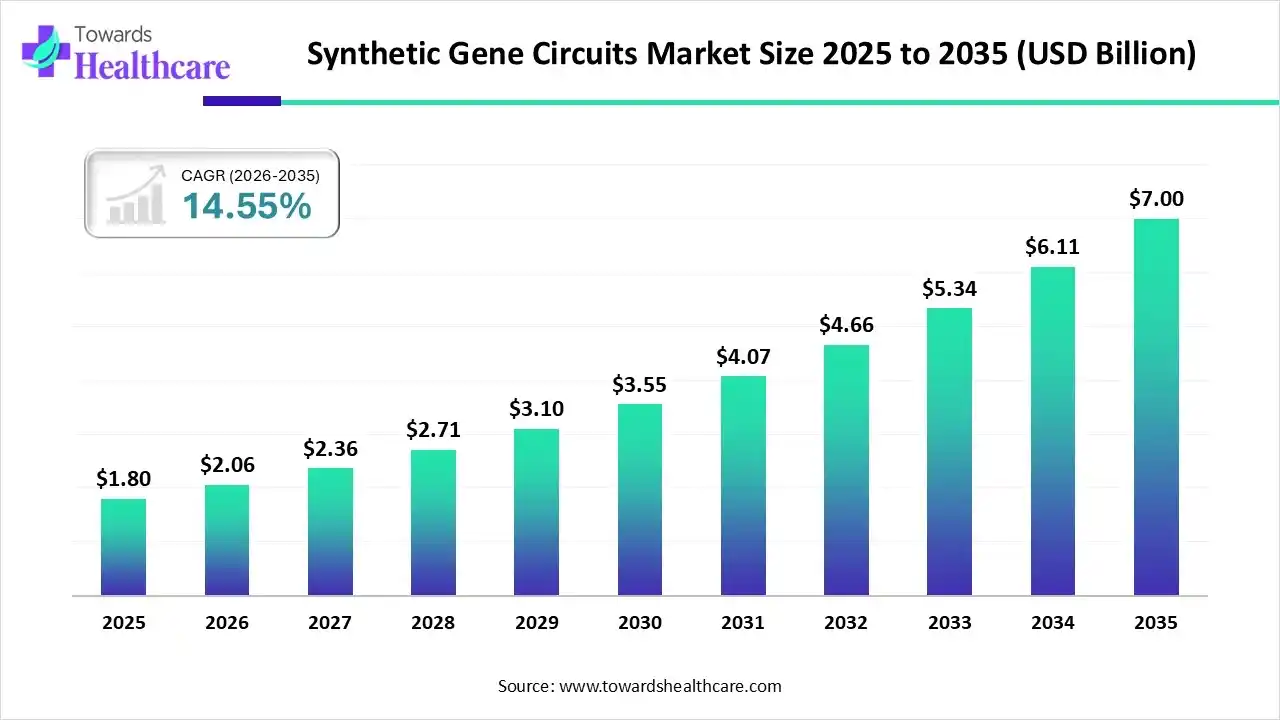
The market is growing rapidly, driven by increasing use of research, therapeutics, and industrial biotechnology. Advancements in gene editing and design technologies are accelerating adoption, fueling strong market expansion over the next decade.
A synthetic gene circuit is an engineered network of genes designed to control function and behavior in a predictable way, mimicking electronic circuits but within living cells. The synthetic gene circuits market is growing rapidly due to increasing demand in healthcare, biotechnology, and industrial applications. Advances in gene editing, synthetic biology, and computational design enable precise control of cellular functions. Rising investments in research, personalized medicine, and biologics, along with the need for innovative therapies and diagnostics, are fueling market expansion and attracting biotech companies worldwide.
Artificial intelligence can significantly accelerate the market by improving genetic design accuracy and reducing development time. AI-driven modeling and predictive analytics enable faster circuit optimization, error detection, and performance simulation. It also supports automated experimentation and data analysis, lowering research costs. By enhancing precision and scalability, AI boosts innovation, speeds commercialization, and increases adoption across healthcare, biotechnology, and industrial applications.
| Table | Scope |
| Market Size in 2026 | USD 2.06 Billion |
| Projected Market Size in 2035 | USD 7 Billion |
| CAGR (2026 - 2035) | 14.55% |
| Leading Region | North America |
| Historical Data | 2020 - 2023 |
| Base Year | 2025 |
| Forecast Period | 2026 - 2035 |
| Measurable Values | USD Millions/Units/Volume |
| Market Segmentation | By Product, By Application, By End Use, By Region |
| Top Key Players | Ginkgo Bioworks, Twist Bioscience, GenScript Biotech, Precigen, Sangamo Therapeutics |
Why Did the Circuit-Specific Synthetic Regulatory Elements Segment Dominate in the Synthetic Gene Circuits Market in 2025?
The circuit-specific synthetic regulatory elements segment dominated the market in 2025 due to its critical role in ensuring precise expression control and functional reliability. These elements enable accurate activation, repression, and modulation of genetic pathways, which is essential for therapeutic and research applications. Their versatility, scalability, and compatibility with advanced gene editing tools have increased adoption across biotechnology and pharmaceutical development.
Memory & Signal Processing Circuits
The memory & signal processing circuits segment is expected to grow notably due to rising demand for advanced cellular functions that can store information and respond dynamically to environmental stimuli. These circuits enable complex decision-making within cells, enhancing their use in smart therapeutics, biosensing, and adaptive industrial applications. Increasing research focus on programmable biological systems further supports segment expansion during the forecast period.
What Made the Research Segment Dominant in the Synthetic Gene Circuits Market in 2025?
The research segment dominated the market in 2025 due to extensive academic and institutional focus on understanding gene regulation and cellular programming. Growing funding for synthetic biology projects and increasing collaboration between universities and biotech firms accelerated experimental applications. Additionally, the need for advanced tools to study disease mechanisms and develop novel therapies significantly boosted demand within research laboratories worldwide.
Therapeutics
The therapeutics segment is expected to grow at the fastest CAGR due to increasing demand for advanced targeted treatments and next-generation biologics. Synthetic gene circuits enable precise control of cellular responses, improving treatment specifically and expanding clinical research, and growing investments in innovative therapy development are accelerating adoption, positioning therapeutics as the fastest-growing application segment.
How Does the Academic & Research Institutes Segment Dominate the Synthetic Gene Circuits Market in 2025?
The academic & research institutes segment dominated the market in 2025 due to strong funding support, extensive laboratory infrastructure, and a high volume of synthetic biology projects. Universities and research centers actively explore gene regulations, cellular engineering, and novel biological systems, driving consistent demand for advanced tools. Collaborative partnerships with biotech companies and government-backed innovation programs further strengthened their leading market position.
Biotechnology & Pharmaceutical Companies
The biotechnology & pharmaceutical companies segment is expected to grow at the fastest CAGR due to increasing focus on developing advanced therapeutics, biologics, and gene-based treatments. These companies are investing heavily in synthetic biology to accelerate drug discovery and improve treatment precision. Growing demand for innovative therapies, rising R&D spending, and expanding clinical pipelines are driving rapid adoption of synthetic gene circuits in commercial applications.
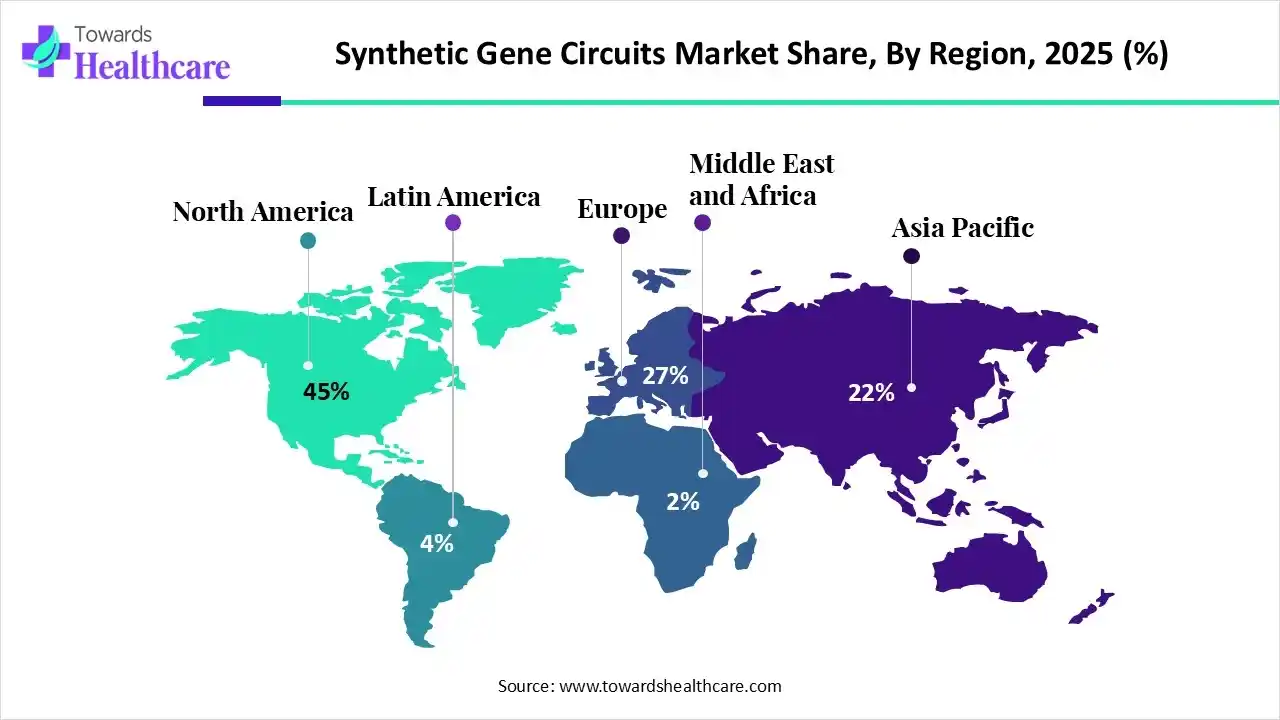
| Regions | Share 2025 (%) |
| North America | 45% |
| Europe | 27% |
| APAC | 22% |
| Latin America | 4% |
| Middle East and Africa | 2% |
North America dominated the market by 45% due to strong research infrastructure, high funding support, and early adoption of advanced biotechnologies. The region benefits from the presence of leading biotechnology and pharmaceutical companies, extensive academic collaborations, and supportive regulatory frameworks. Significant investments in synthetic biology and rising demand for precision therapeutics have further strengthened its market leadership position.
U.S. Market Trends
The U.S. synthetic gene circuits market is the leading market due to robust investment in synthetic biology research, advanced laboratory infrastructure, and strong government funding support. The presence of major biotechnology and pharmaceutical companies accelerates commercialization and innovation. Additionally, active academic-industry collaborations and a growing focus on precision medicine and gene-based therapies continue to strengthen the country’s dominant market position.
Asia Pacific is anticipated to grow at the fastest CAGR due to rising biotechnology investments, expanding research infrastructure, and increasing government support for life science innovation. Rapid growth of pharmaceutical manufacturing, improving healthcare facilities, and a large patient population are accelerating demand for advanced genetic technologies. Growing collaborations between regional institutes and global biotech firms further contributed to strong market expansion.
India Market Trends
India is anticipated to grow at the fastest CAGR due to expanding biotechnology research, increasing government funding for life sciences, and a rapidly developing pharmaceutical sector. The country’s strong talent pool, cost-effective research capabilities, and growing focus on genetic therapies and biologics are accelerating adoption. Rising collaborations with global biotech firms further support India’s strong growth potential during the forecast period.
Europe is anticipated to grow at a notable rate due to strong government support for synthetic biology research and well-established biotechnology infrastructure. The region benefits from collaborative research networks, increasing funding programs, and rising demand for advanced therapeutics. Growing emphasis on innovation, regulatory clarity, and expansion of biopharmaceutical development activities are further contributing to steady market growth during the forecast period.
UK Market Trends
The UK is anticipated to grow at a significant CAGR due to strong government backing for life sciences, advanced research universities, and vibrant biotechnology ecosystems. Increasing investment in synthetic biology programs, expanding clinical research activities, and supportive innovation policies are driving market expansion. Strategic collaboration between academic institutions and biotech firms further strengthened the UK's growth prospects during the forecast period.
| Companies | Headquarters | Offerings |
| Ginkgo Bioworks | Massachusetts, USA | Provides organism engineering platforms that enable large-scale cell programming and custom genetic circuit development for pharmaceutical, industrial, and agricultural applications. |
| Twist Bioscience | California, USA | Specializes in high-precision synthetic DNA manufacturing used for constructing and optimizing gene circuits for research and therapeutic use. |
| GenScript Biotech | Nanjing, China | Offers gene synthesis, molecular biology services, and genome engineering solutions supporting the design and validation of synthetic genetic systems |
| Precigen | Maryland, USA | Develops engineered cellular therapies using advanced gene control systems, particularly in oncology and rare diseases. |
| Sangamo Therapeutics | California, USA | Focuses on gene regulation and editing platforms that can be integrated into programmable therapeutic genetic circuits |
By Product
By Application
By End Use
By Region





Principal Consultant
Shivani Zoting is a dedicated research analyst specializing in the healthcare industry. With a strong academic foundation, a B.Sc. in Biotechnology and an MBA in Pharmabiotechnology, she brings a unique blend of scientific understanding and strategy.
Learn more about Shivani Zoting
Reviewed By
Aditi Shivarkar is a seasoned professional with over 14 years of experience in healthcare market research. As a content reviewer, Aditi ensures the quality and accuracy of all market insights and data presented by the research team.
Learn more about Aditi Shivarkar