




 Request Consultation
An external party appointed by pharmaceutical, biotechnology, and medical device companies is known as a Contract Research Organization (CRO). They generally support managing & implementing research studies & clinical trials. Moreover, CROs serve as specialized extensions of pharma leaders, who control the complex logistics of drug development, & eliminates the need for the development of internal departments by sponsors.
CRO Industry by the Numbers: Key Statistics Shaping Pharmaceutical Research in 2026
- Approximately 70–75% of Phase I–IV clinical trials globally are managed by CROs, reflecting the pharmaceutical industry's growing reliance on outsourced research expertise.
- AI-powered patient recruitment technologies can reduce enrollment timelines by up to 20%, improving trial efficiency and accelerating study initiation.
- IQVIA supports more than 500 decentralized clinical trials across 75+ countries and 30+ therapeutic areas, highlighting the expansion of remote and hybrid trial models.
- More than 43,000 new clinical studies are registered annually worldwide, demonstrating sustained growth in clinical research activity.
- The global clinical research ecosystem includes over 570,000 registered studies across 225+ countries and territories, driving demand for CRO services in regulatory support, patient recruitment, data management, and advanced analytics.
Across the pharma sector, CROs are widely offering various prominent services, including:
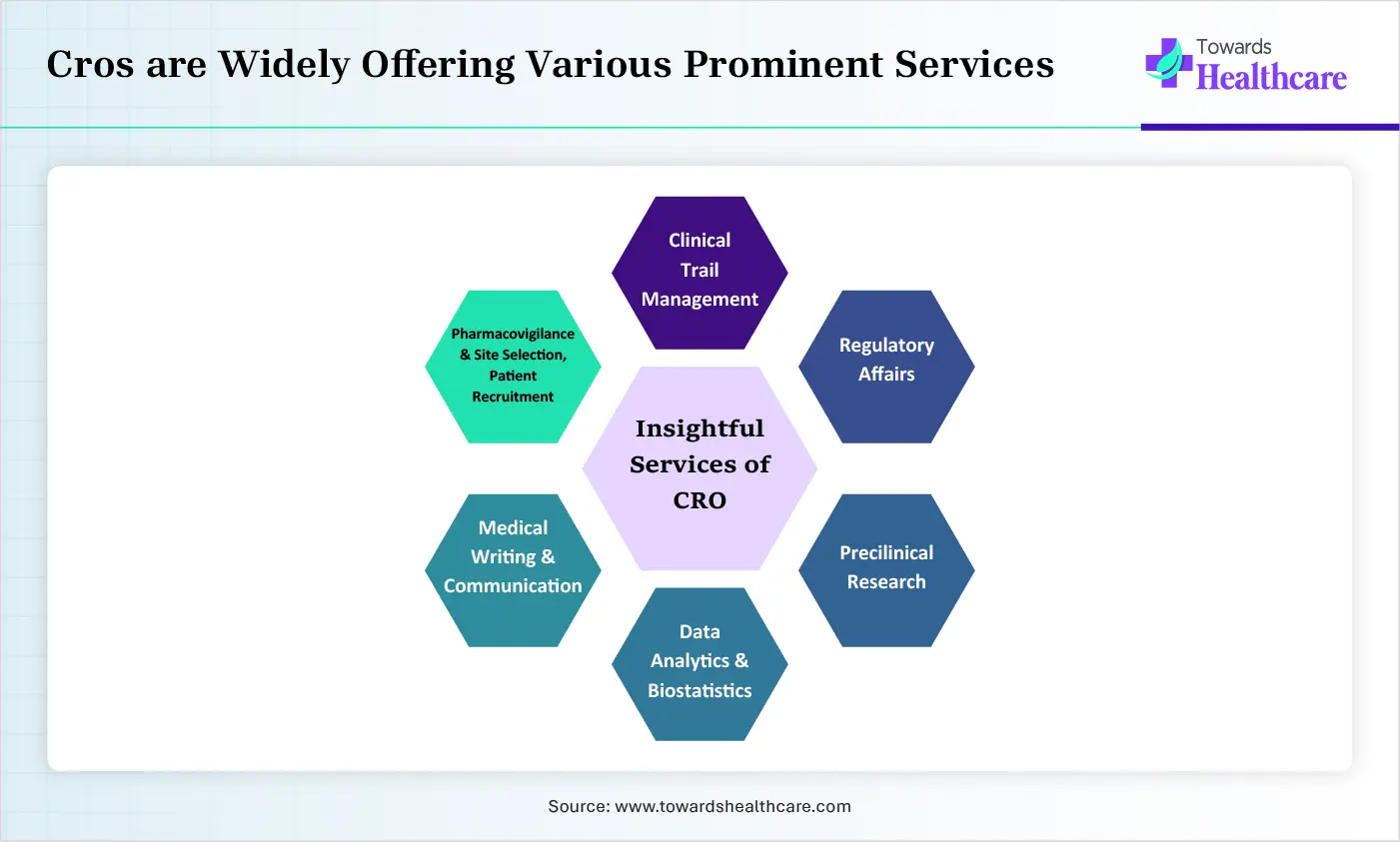
- In the case of preclinical research, CROs facilitate pharmacology & toxicology, with biological assay development, & finally, formulation & stability.
- Furthermore, in clinical trial management, CROs assist in site selection & activation, patient recruitment & retention, clinical monitoring, and project management.
- On the next stage of product development, CROs push the preparation of the submission and also provide regulatory consulting services.
- After this, highly generated data from clinical trials helps CROs in database design, statistical analysis, & medical writing.
- At the end, CROs play a vital role in drug safety by monitoring, investigating, & reporting any adverse side effects.
Total Revenue of Top CROs in 2025 & Their Offerings
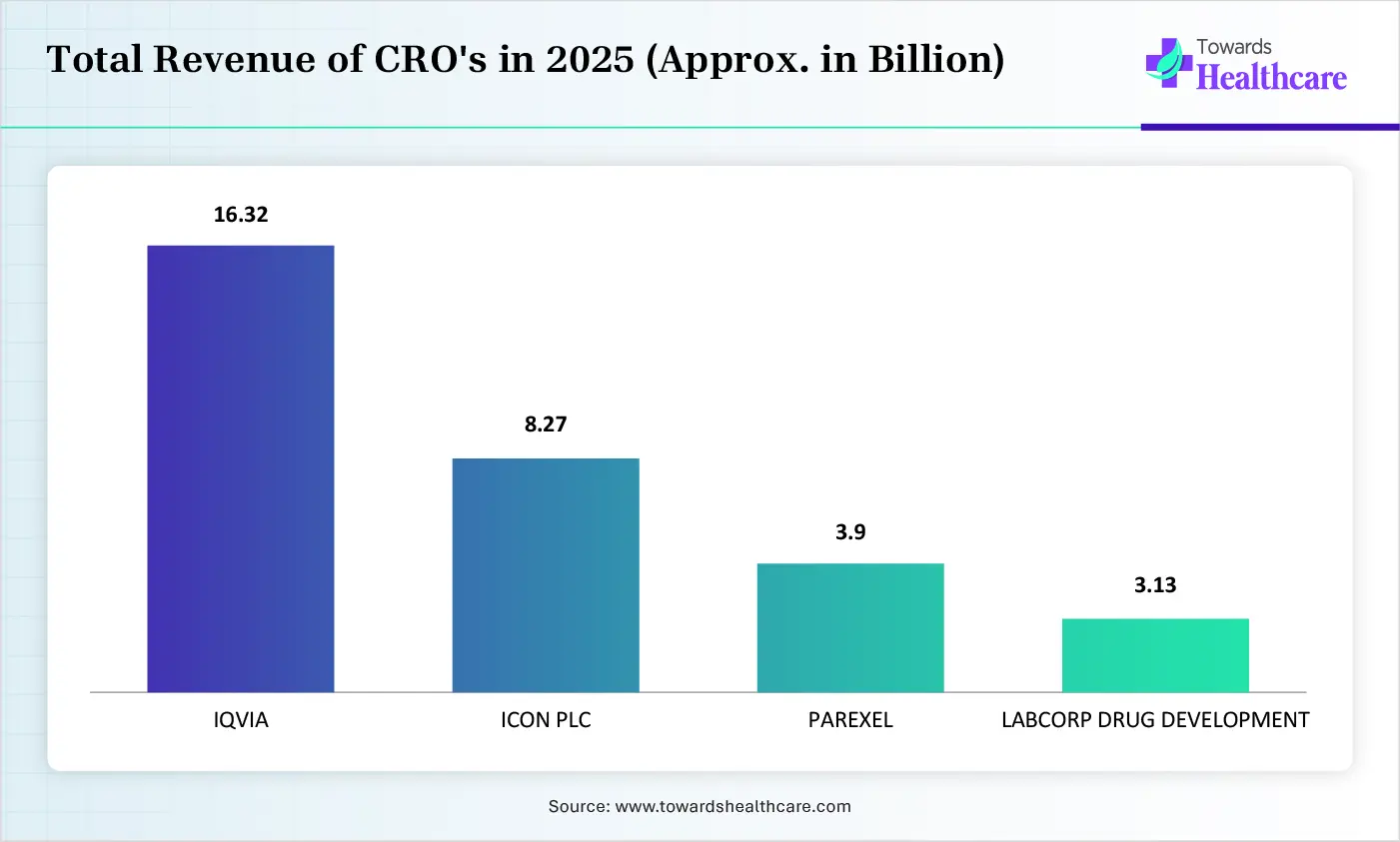
IQVIA: This player mainly provides integration of clinical trial execution with healthcare data analytics & AI. Alongside, it focuses on end-to-end support across the drug development lifecycle, from early-phase trials to post-market surveillance, with simplifying patient recruitment & enhancing clinical strategies. Expanding the IQVIA AI Patient Experience Platform to enhance patient engagement, recruitment, and retention across clinical trials while showcasing advanced digital health and analytics technologies at the TechIQ conference. This initiative is expected to improve trial efficiency and support decentralized research models.
ICON plc: A firm significantly supports several of the pharma, biotech, and medical device industries by handling clinical research studies & spurring product development from ‘molecule to medicine. Expanding global health intelligence datasets and advanced analytics capabilities to improve clinical trial planning, patient recruitment, and execution from Phase I through post-marketing studies. These efforts support data-driven decision-making and enhance trial success rates across therapeutic areas.
Parexel: Its key offerings cover clinical trial management & operations, regulatory consulting, therapeutic specialization, technology & data analytics, & clinical supply chain. Launching ParexelAI to streamline clinical development processes and enhancing pharmacovigilance capabilities through the acquisition of Vitrana. The company aims to improve operational efficiency, accelerate regulatory compliance, and optimize safety monitoring throughout the drug development lifecycle.
Labcorp Drug Development: They usually explore comprehensive nonclinical studies, like toxicology, pharmacology, & laboratory testing, along with central laboratory services. Advancing the deployment of Labcorp Plasma Detect, a tumor-informed whole-genome sequencing solution, while strengthening real-world data and evidence-generation capabilities through cloud-based infrastructure on AWS. These developments support precision medicine, oncology research, and biomarker-driven clinical studies
Current Trends of CROs for the Pharmaceutical Leaders Across the Globe Include
Day by day, CROs are highly transitioning to AI algorithms to raise core infrastructure, by specifically leveraging gen AI & natural language processing for a major reduction in patient screening times, improving protocol design, & fostering risk-based monitoring.
Additionally, an eventual expansion of CROs is fueled by the wider adoption of virtual & hybrid trial models to lower the stress on patients. Also, they focus on increased use of wearables & digital data-capturing software that enables remote monitoring, higher enhancement in patient recruitment & retention rates.
However, CROs are experiencing dominance of full-service models, which are increasingly employed in numerous pharmaceutical firms. Especially, flexible & hybrid FSP models are enabling sponsors to internalize core trial operations, with perfect outsourcing of specific, specialized functions, such as biostatistics, safety monitoring, or regulatory affairs, to CROs.
The era is advancing with immersive integration of fragmented systems into integrated, real-time dashboards to offer rapid decision-making by CROs. CROs are emphasizing patient-centricity & transparent digital patient portals to bolster diversity in clinical trials.
Latest Collaborations & Rollouts Among CROs & Pharma Leaders to Revolutionize Breakthroughs Across the Respective Sector:
- In June 2026, DaltonTx joined with Sygnature Discovery to leverage the Dalton platform to further empower its AI-driven drug discovery capabilities & speed up medicinal chemistry decision-making while safeguarding customer data.
- In May 2026, Parexel launched ParexelAI, a proprietary suite of human-led AI services to spur clinical development operations.
- In May 2026, Veristat, a global clinical research organization (CRO) & consultancy specializing in complex studies, launched InStat, the clinical research industry’s first zero-code & fully automated biostatistics solution.
- In April 2026, RyghtAI unveiled a search engine to facilitate drug developers & contract research organizations' access to a complete database of clinical research sites.
- In March 2026, Lunit & CellCarta, a key global contract research organization (CRO) laboratory to the biopharmaceutical industry, partnered to speed up the adoption of AI-powered digital pathology workflows across translational research, clinical trials & companion diagnostic (CDx) programs.
- In December 2025, Avetra, a next-generation Contract Research Organization (CRO), officially introduced a modern, site-centric operating model to restructure the relationship between sponsors, CROs, & investigative sites.
Highlighting Ongoing Pipelines of CROs for Pharma Players in Various Regions in 2026
North America
North America remains a leading region for CRO-driven pharmaceutical research, supported by advanced healthcare infrastructure and strong biopharmaceutical investments. The U.S. continues to dominate early-stage (Phase I/II) clinical trials for cell and gene therapies, synthetic mRNA platforms, immuno-oncology treatments, and rare disease programs. Regulatory incentives for orphan drugs and accelerated approval pathways are further strengthening CRO pipelines. Canada is expanding research activities in precision medicine, biologics, and decentralized clinical trials, while Mexico is attracting multinational studies through diverse patient populations and cost-effective operations. Together, these countries are advancing innovative, data-driven, and patient-centric drug development pipelines in 2026.
Asia-Pacific (APAC)
Asia-Pacific continues to emerge as a major destination for CRO-led pharmaceutical research, driven by large patient populations, cost advantages, and expanding clinical infrastructure. India, supported by the government’s PRIP Scheme, is advancing pipelines for cell and gene therapies, including CAR-T treatments, through companies such as Syngene and Veeda Clinical Research. China is strengthening its position in oncology, biologics, and innovative drug development, while Japan and South Korea are investing heavily in precision medicine and regenerative therapies. Australia remains a preferred location for early-phase studies. Collectively, APAC CROs are supporting large-scale Phase III trials, faster patient recruitment, and global drug development programs.
Europe
Europe remains a strategic center for CRO operations, supported by harmonized regulatory frameworks and strong pharmaceutical innovation. The implementation of the EU Clinical Trials Regulation is enabling more efficient cross-border studies, reducing administrative complexities and accelerating trial initiation. Countries such as Germany, France, the United Kingdom, Spain, Italy, and the Netherlands are expanding pipelines in oncology, rare diseases, neurology, and advanced biologics. CROs are increasingly integrating decentralized clinical trial models through digital health technologies, local pharmacies, and home healthcare networks. These initiatives facilitate remote patient monitoring, digital biomarker collection, and improved patient engagement, strengthening Europe’s position in global clinical research.
Latin America & Rest of the World (RoW)
Latin America is gaining importance in global pharmaceutical research due to its diverse patient populations, treatment-naïve participants, and growing clinical trial capabilities. Countries including Brazil, Mexico, Argentina, Chile, and Colombia are attracting multinational studies in oncology, infectious diseases, and metabolic disorders. Beyond Latin America, nations across the Middle East, Africa, and Southeast Asia are expanding CRO pipelines for vaccines, biosimilars, and tropical disease treatments. Saudi Arabia, the United Arab Emirates, South Africa, Singapore, and Thailand are increasing investments in research infrastructure and regulatory modernization, enabling broader participation in international clinical development programs during 2026.
Upcoming Focuses by Leading CROs in the Pharmaceutical Industry in 2026
Conclusion:
The worldwide progression of CROs for pharmaceutical companies is mainly propelled by the surging complexity of clinical trials and rising advanced biologic & oncology pipelines, with a substantial need for localized regulatory expertise. Whereas these CROs are rapidly moving from simple outsourced vendors to planned, intelligence-driven co-developers. Prospective efforts are seeking a combination of remote patient monitoring technologies, wearables, & synthetic control arms, along with a prominent eye on Functional Service Provider (FSP) relationships.