




 Request Consultation
Currently, behavior analysts & therapy providers are increasingly facing higher administrative responsibilities, with the delivery of quality care to children & adults with autism spectrum disorder (ASD). In these cases, Applied Behavior Analysis (ABA) remains one of the most evidence-based interventions for autism, while clinicians often spend notable time documenting sessions, aggregating behavioral data, scheduling appointments, handling insurance requirements, & preparing reports. A surging intricacy of healthcare documentation has elevated demand for software that streamlines rather than complicates clinical workflows. The emergence of modern ABA practice management platforms is transitioning from feature-heavy interfaces toward intuitive designs that clinicians can learn quickly without lengthy onboarding programs.
Nowadays, ease of use has become one of the most robust purchasing factors for ABA organizations. Whereas practices are highly preferring solutions that enable Registered Behavior Technicians (RBTs), Board Certified Behavior Analysts (BCBAs), & administrative staff to begin leveraging the platform within days, rather than weeks. A gradually rising global autism therapy ecosystem is pushing software vendors for massive investment in user experience (UX), automation, cloud accessibility, mobile applications, & simplified documentation pathways.
Executive Summary
Today’s digital revolution of behavioral healthcare is accelerating because of increasing autism prevalence, rising insurance reimbursement requirements, workforce shortages, & the need for standardized clinical documentation. The unveiling of user-friendly ABA software has become necessary for providers looking to lower administrative burden while maintaining compliance & enhancing patient results. The global market dynamics are fueling adoption, including growing prevalence of autism spectrum disorder, rising demand for evidence-based behavioral interventions, & growth of private ABA clinics and multidisciplinary therapy centers. Additionally, the market is driven by a shift towards cloud-based clinical practice management, surging use of mobile documentation, demand for minimal clinician burnout, & ongoing unification of scheduling, billing, telehealth, & reporting into integrated platforms. However, software with intuitive interfaces is providing measurable benefits, such as rapid onboarding, lower training expenses, optimized documentation accuracy, increased clinician satisfaction, & immense productivity.
Understanding ABA Solutions
Advanced Applied Behavior Analysis (ABA) comprises digital platforms developed to spur behavioral therapy providers across the clinical & administrative lifecycle. Regardless of depending on spreadsheets, paper documentation, or disconnected applications, clinicians can employ centralized systems to control daily operations. General functionality covers session documentation, behavior tracking, data visualization, treatment strategy, goal monitoring, appointment scheduling, caregiver communication, insurance documentation, billing management, electronic signatures, compliance reporting, with telehealth support & mobile data collection. The latest generation of ABA solutions is focusing on simplicity & allow clinicians to complete these tasks with fewer clicks & minimized cognitive stress.
Why User-Friendly Interfaces Matter More Than Ever?
Earlier healthcare software prioritized compliance over usability, while these systems recorded comprehensive information, & they frequently developed major documentation burdens. Moreover, behavior analysts usually work in spectacular circumstances, such as homes, schools, clinics, & community settings where efficient documentation is essential. Execution of an intuitive interface allows clinicians to capture behavioral observations more rapidly, decrease after-hours paperwork, spend more time with patients, reduce documentation mistakes, improve treatment consistency, & boost staff satisfaction. This also shortens onboarding for new hires. To expedite progression for organizations, lowering training time can further reduce operational expenditures & speed up workforce productivity.
Market At a Glance
Along with sustained expansion over the past few years, the ABA software market is considered a part of the expansive behavioral health information technology ecosystem. For this growth, there are many factors contributing to their role, including.
- Increasing Autism Diagnoses: Globally, well-developed healthcare agencies are persistently reporting surged identification of autism spectrum disorder. Alongside, widened awareness, advanced screening programs, & enhanced diagnostic criteria have drastically elevated demand for behavioral therapy services. Gradually, several therapy providers necessitate scalable digital infrastructure that assists in accelerating patient populations.
- Expansion of Independent ABA Practices: Currently, private behavioral health entities are continuously strengthening their facilities/offerings across North America, Europe, Asia-Pacific, & the Middle East. On the other hand, numerous new practices prefer cloud-native platforms that need minimal technical expertise & lower execution effort.
- Rising Insurance Documentation: Nowadays, insurance reimbursement increasingly requires detailed documentation of treatment strategies, session notes, behavioral progress, goal attainment, caregiver training, & clinical outcomes. At the same time, the implementation of user-friendly systems reduces documentation complexity while maintaining compliance.
- Workforce Shortages: Across many regions, they are facing notable limitations of experienced BCBAs & RBTs. Alongside, organizations cannot afford lengthy onboarding programs, & here, software requires only a few hours of orientation that offer substantial operational advantages.
Global Market Size
Even though software showcases a specialized healthcare technology segment, it benefits from wider expansion across digital behavioral healthcare.
The global behavioral health market size is calculated at US$ 173.35 billion in 2024, grew to US$ 185.03 billion in 2025, and is projected to reach around US$ 332.77 billion by 2034. The market is expanding at a CAGR of 6.74% between 2025 and 2034.
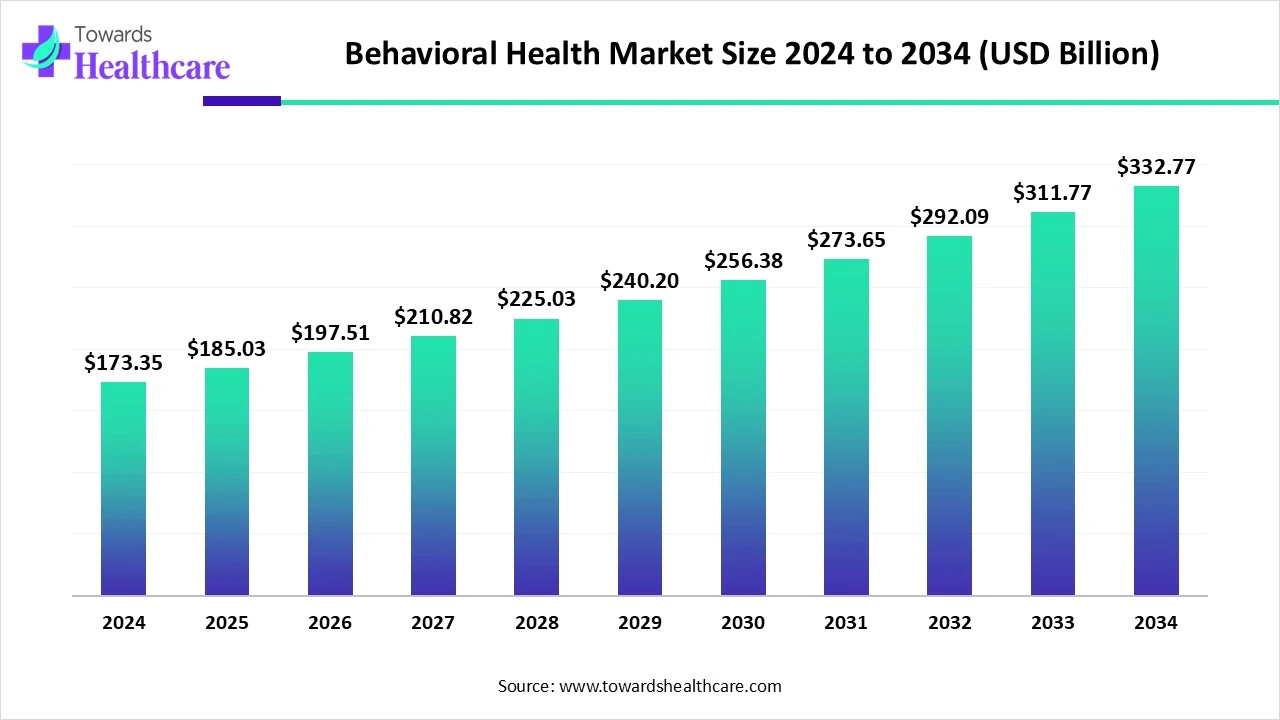
According to my research, industry estimates represent:
| Market Indicator | Estimated Value |
| Global Behavioral Health Software Market (2025) | Approx. USD 5.5-6.0 billion |
| Projected Market (2035) | Approx. USD 15-17 billion |
| CAGR (2026-2035) | 10-12% |
From the above statistics, ABA-specific practice management software indicates one of the fastest-growing specialty segments. Besides this, cloud-based deployment holds the majority of new implementations, & Subscription (SaaS) licensing dominates new purchases, while mobile-enabled platforms continue capturing market share.
Estimated ABA Software Market Share by Deployment
- Cloud-based: 78%
- Hybrid: 14%
- On-premise: 8%
These shares show cloud deployment consistently transforming due to providers widely requiring remote access, automatic updates, lower IT expenses, secure backups, & multi-location support.
Practice Size Distribution
- Small Practices (1-20 clinicians): 46%
- Mid-sized Organizations: 34%
- Enterprise Networks: 20%
Shares highlight that small practices generally prioritize inexpensive, ease of implementation, & intuitive workflows over comprehensive customization.
Mobile Documentation Adoption
Mobile-first documentation is known as one of the most crucial technological transitions. Moreover, predicted clinician utilization covers
- Tablet: 42%
- Smartphone: 28%
- Desktop: 24%
- Paper: 6%
These technological approaches foster mobile documentation & allow therapists to capture data during or immediately after sessions, which enhances accuracy & lowers administrative delays.
Why Do Straightforward Interfaces Improve Adoption?
The worldwide adoption of straightforward interfaces provides ease of use that directly influences whether clinicians continuously employ software. However, ongoing research activities across healthcare IT constantly show that systems with intuitive navigation receive increased user satisfaction & continued engagement. Key & common characteristics include minimal navigation layers, which means significant clinical tasks should be accessible within two or three clicks, with logical screen organization, i.e. relevant functions are clustered & lower time spent searching for tools. Another prominent characteristic is vast touch-friendly buttons that are necessary for therapists during documenting sessions on tablets at the moment of active treatment. Meanwhile, guided documentation executes step-by-step workflows that support clinicians in completing required fields without broad instruction. The unveiling of visual progress indicators, where dashboards display treatment goals, completed sessions, & pending documentation, reduces administrative oversight. Modern automated data entry features, like templates, auto-fill, often appointments, & reusable treatment plans, lower recurring manual work.
Quantifying the Value of Simplicity
In this era, firms are demonstrating user-friendly ABA platforms that commonly report measurable operational optimizations.
| Performance Metric | Typical Improvement |
| Documentation Time | 20-40% reduction |
| Administrative Workload | 25-35% reduction |
| New Employee Training Time | 30-60% reduction |
| Documentation Errors | 15-30% reduction |
| Therapist Productivity | 10-20% improvement |
Respective improvements convert into more time available for direct patient care & minimized operational expenditures.
Major Industry Statistics
Togetherness of evolution of ABA software & expansive digital health trends showcases certain notable indicators, such as > 80% of recently implemented health software solutions are cloud-based. Alongside, today mobile access is referred to as a standard requirement by many therapy organizations. Automation of scheduling, reminders, & billing continues to lower human administrative operations, & unification with electronic health records (EHRs) & revenue cycle management is increasingly anticipated across the market. User experience (UX) has become a foremost differentiator among software vendors, coupled with compliance & security.
The Evolution of ABA Technology
Firstly, the use of the first generation of ABA software mainly aimed at replacing paper records with digital documentation. In terms of functionality, these systems were often characterized by complex interfaces & needed comprehensive staff training. Furthermore, the second generation rolled out cloud computing, which allows multi-site access, automatic updates, & centralized data storage. Along with this, many platforms still reflected the complexity of legacy electronic health record systems.
In 2026, an emerging third generation is focused on clinician experience, which specifically prioritizes clean layouts, guided workflows, mobile responsiveness, customizable dashboards, & automation. With fewer clicks, streamlined navigation, & embedding intelligent prompts, this generation of solutions allows therapists to emphasize less software & more patient care.
This evolution mirrors an expansive trend across healthcare technology, as successful platforms are no longer judged solely by the many features they provide, but by how effectively clinicians can apply features in real-world practice.
Core Features, User Experience Design, Mobile Accessibility, Integration, AI, ROI, & Real-World Impact
Despite modern ABA software & its ability to aggregate behavioral data, nowadays, clinicians, clinic owners, & therapy leaders are demanding platforms that simplify daily work, lower administrative burden, & require reduced training. With the accelerating competition among software vendors, usability has become a vital differentiator. This part showcases the features, technologies, & measurable outcomes that are propelling the adoption of intuitive ABA solutions globally.
What Clinicians Actually Need from ABA Software?
Especially, behavior analysts spend a substantial portion of their day outside direct therapy, where documentation, scheduling, insurance compliance, caregiver communication & reporting consume more time. Meanwhile, a robust ABA platform lowers these administrative tasks while pushing evidence-based clinical practice.
The most often employed features consist of:
| Features | Daily Usage Frequency |
| Session Notes | 98% |
| Behavioral Data Collection | 95% |
| Appointment Scheduling | 91% |
| Treatment Goal Tracking | 89% |
| Caregiver Communication | 77% |
| Billing Documentation | 74% |
| Progress Reports | 71% |
| Telehealth Support | 42% |
The premium features are those accessed multiple times during every clinical session, which makes intuitive navigation essential.
Key Characteristics of a Straightforward User Interface
- Clean Dashboard Design: The adoption of an efficient dashboard indicates only the most related information, such as today's appointment, excellent documentation, client alerts, treatment goal summaries, recent behavioral trends, billing status, & staff schedules. By minimizing visual clutter, it supports clinicians in finding priorities rapidly without navigating multiple menus.
- Simplified Navigation: Another characteristic covers the organization of information according to clinical workflows rather than software architecture by using intuitive systems. Regardless of the patient module, documentation module, or reporting module, sophisticated systems guide users through starting a session, collecting data, completing notes, achieving signature, & submitting documentation. This further shows the natural sequence of clinical activities.
- Consistent Screen Layouts: The exploration of consistency lowers cognitive effort. Designing best practices covers fixed navigation menus, benchmarked button replacement, uniform color coding, predictable workflows & reusable templates. These elements enable new users to become proficient more expeditiously.
- Mobile Enhancement: As numerous ABA sessions are conducted in homes, schools, & community environments, clinicians are widely depending on tablets & smartphones instead of desktop computers. More effective interfaces are automatically adapting to diverse screen sizes while protecting usability.
User Experience (UX) Metrics
Common performance standards include;
| UX Metric | Industry Target |
| Time to Create Session Note | Under 5 minutes |
| Clicks to Record Behavior | Fewer than 3 |
| Average Training Time | < 8 hours |
| Documentation Completion Rate | > 95% |
| Mobile App Availability | 100% |
| System Uptime | >99.9% |
This primarily dictates lowering unnecessary clicks & streamlining workflows directly enhances clinician satisfaction.
Mobile-First ABA Platforms
The latest approaches to mobile accessibility have revolutionized ABA service delivery; rather than recording observations on paper & entering them later, therapists can document behavior in real-time leveraging tablets or smartphones. These kinds of platforms provide instant data capture, optimized accuracy, rapid report generation, minimal documentation capabilities, & offline documentation capabilities, and also automatic synchronization with cloud databases.
Estimated device usage among ABA professionals
- Tablets: 46%
- Smartphones: 31%
- Desktop Computers: 19%
- Laptops: 4%
Broadened tablet use continues to expand as touch interfaces align well with active therapy sessions.
Cloud-Based Solutions Continue to Dominate
Today, cloud computing has become a popular deployment model across healthcare software because of lower infrastructure expenses & increased flexibility. These solutions have a wide range of benefits, such as automatic software updates, secure encrypted backups, remote access, multi-location assistance, quick implementation, lowered IT maintenance, & subscription-based pricing. Day by day, organizations can often initiate utilizing cloud platforms within days instead of weeks or months.
Cloud VS On-Premise Comparison
| Category | Cloud-Based | On-Premise |
| Initial Cost | Lower | Higher |
| Implementation Time | Days | Weeks to Months |
| Maintenance | Vendor Managed | Internal IT Team |
| Accessibility | Anywhere with Internet | Limited to Organization Network |
| Updates | Automatic | Manual |
| Scalability | High | Moderate |
| Disaster Recovery | Included | Organization Managed |
Along with this, cloud solutions are especially attractive for small & mid-sized ABA practices that face restricted promising IT resources.
Integration with Electronic Health Records (EHRs)
Currently, behavioral healthcare providers are widely operating within unified healthcare ecosystems. This leads to ABA software being expected to exchange information with electronic health record systems. Immersive integration capabilities include patient demographics, referral information, progress notes, treatment plans, insurance eligibility, appointment harmonization, and clinical documentation. Moreover, these integrated solutions lower duplicate data entry & enhance continuity of care.
Revenue Cycle & Billing Integration
Exploration of insurance reimbursement is continuing as one of the most intricate administrative functions for ABA providers. Gradually, the use of integrated billing solutions mainly comprises electronic claims submission, CPT code selection, eligibility verification, claims tracking, payment reconciliation, accounts receivable reporting, & denial management. Ongoing emergence of automation decreases manual processing & improves revenue aggregation.
Estimated Administrative Time Allocation
- Clinical Documentation: 11 hours
- Scheduling: 4 hours
- Billing Activities: 6 hours
- Reporting: 5 hours
- Compliance Tasks: 4 hours
Establishing automated workflows can drastically lower time consumed on repetitive administrative processes.
Artificial Intelligence & Automation in ABA Solutions
The modern era has been extensively focusing on the execution of artificial intelligence, which improves ABA software, even though adoption remains in its early stages. The latest implementations are aiming at supporting clinicians instead of substituting clinical judgment. Developing capabilities cover suggested documentation based on session data, automated progress summaries, natural language processing (NLP) for note drafting, & intelligent scheduling recommendations. Moreover, AI also explores predictive reminders for expiring authorizations & data quality checks to determine incomplete documentation. These advanced tools focus on lowering recurring work while securing clinician supervision.
Workflow Automation
In 2026, automation across various sectors, including ABA practices, will support the elimination of regular manual tasks that contribute to administrative burden. Certain key examples of automation encompass appointment reminders, recurring therapy schedules, automatic treatment strategy templates, digital consent forms, electronic signatures, report generation, billing notifications, & compliance alerts. By streamlining these tasks, automation assists consistency while reducing the likelihood of missed tasks.
Documentation Efficiency
As documentation is considered one of the major administrative responsibilities for ABA clinicians, modern software bolsters effectiveness through smart templates, where reusable note structures minimize frequent typing. Auto-populated information covers client demographics, treatment goals, & therapist details that are automatically visible in documentation. Additionally, one-tap collection includes behavior frequencies, durations, & interval recording that can be recorded with lowered interaction. Besides this, advanced voice dictation via some platforms assists speech-to-text documentation, pushing therapists to complete notes more rapidly.
Let’s have a look at documentation time comparison:
- Paper Documentation: 22 minutes
- Legacy Digital Systems: 16 minutes
- Modern Digital Systems: 10 to 12 minutes
Throughout numerous daily sessions, these time savings can substantially reduce administrative workload.
Return on Investment (ROI)
Despite the need for financial investment in software implementation, organizations often address returns through operational efficiencies. Potential benefits of ROI comprise elevated therapist productivity, rapid clinician onboarding, reduced administrative staffing requirements, minimal billing mistakes, optimized reimbursement timelines, outstanding documentation compliance, & increased clinician retention due to lowered burnout.
Predicted operational improvements after implementation indicate:
- Therapist Productivity: 12-20%
- Documentation Completion Time: 25-40% Faster
- Billing Accuracy: 15-25% Improvement
- Claim Denial: 10-18% Reduction
- Scheduling Efficiency: 20-30% Improvement
- Staff Satisfaction: 15-22% Improvement
Furthermore, these improvements contribute to both financial performance & clinician well-being.
Cost Considerations
By relying on organization size, deployment model, & feature set, pricing for ABA software shows diversity. Popular pricing models consist of a monthly subscription per clinician, a monthly subscription per client, organization-wide enterprise licensing, tiered pricing based on features, & custom contracts for multi-location providers. Along with subscription costs, entities should investigate implementation services, data transfer, training requirements, unification spending, & continuous support. The rollout of platforms with intuitive interfaces often lowers training expenses because clinicians gain proficiency more rapidly.
Implementation Best Practices
The widespread successful adoption relies not only on software selection but also on implementation planning. Most recommended practices consist of mapping current clinical & administrative workflows before implementation, configuring templates to present existing documentation benchmarks, & facilitating role-centered training for clinicians, supervisors, & administrative staff. In addition to this, piloting the platform with a small group before organization-wide deployment, monitoring adoption metrics like documentation completion rates & user satisfaction, coupled with collecting clinician feedback routinely & refining workflows based on real-world application, are fostering best practices. However, organizations that involve clinicians early in the implementation process are experiencing seamless shifts & robust long-term adoption.
Real-World Impact: A Typical Mid-Sized ABA Practice
To understand better, consider a clinic with 30 clinicians, 350 active clients, and nearly 1,000 therapy sessions/week. So, before the implementation of an intuitive ABA platform, session documentation averaged 18 minutes, and administrative staff invested major time correcting incomplete records. Prospective operations involve new employees who needed many weeks to become comfortable with the software, while billing delays were common due to documentation discrepancies. Whereas a shift towards a modern, user-friendly system shows average documentation time lower at around 11 minutes, along with standardized templates improving documentation consistency. Also, this means supervisors spent less time reviewing incomplete records. In addition, clinicians reported expanded satisfaction with mobile documentation during home & school visits. Moreover, administrative workflows became more simplified, resulting in faster billing cycles & boosted operational efficiency. As results change by organization, this example indicates how intuitive software can influence both clinical workflows & business performance.
Competitive Landscape, Market Shares, Regional Analysis, Buying Guide, Challenges, & Forecast Outlook
Competitive Landscape
With an emphasis on this section, the ABA software market remains moderately fragmented, with many established vendors serving behavioral health organizations of various sizes. Meanwhile, certain platforms aim at enterprise organizations with multiple clinic locations, while others accommodate small & medium-sized practices looking for cost-efficient & ease of implementation. Furthermore, the industry also encompasses expansive behavioral health & EHR vendors that facilitate ABA-specific modules, coupled with solutions for mental health, occupational therapy, speech therapy, & physical therapy. Arising competition is mainly fueled by user interface simplicity, mobile documentation capabilities, practice management features, scheduling automation, billing & RCM, telehealth functionality, alongside clinical reporting & analytics, customer onboarding & support, system reliability and security.
Prominent Categories of ABA Software Providers
| Category | Features |
| Comprehensive Practice Management Platforms | Platforms are increasingly unifying clinical documentation, scheduling, billing, reporting, caregiver communication, & business analytics into a combined solution. These platforms' customers are multi-site ABA providers, surging therapy organizations, private equity-backed clinics, & enterprise healthcare networks. |
| Clinical Documentation Platforms | These platforms are focusing on behavioral data collection, treatment strategies, & progress monitoring while combining with external billing or EHR systems. Platforms are highly appealing to firms looking for specialized clinical functionality without replacing present administrative infrastructure. |
| Enterprise Behavioral Health Systems | Specifically, large behavioral health organizations are often deploying enterprise EHR platforms that assist multiple specialties, like ABA services. Key advantages are centralized patient records, cross-specialty synchronization, enterprise security, sophisticated analytics, & integrated financial management. |
| Emerging Cloud-Native Platforms | In this era, new vendors are developing cloud-first solutions created around clinician workflows instead of legacy healthcare software architecture. Major characteristics are reduced training requirements, modern interfaces, mobile-first design, subscription pricing, faster implementation, & recurring software updates. |
Market Shares
Market Share by Deployment Model
| Deployment Model | Estimated Global Market Share (2025) |
| Cloud-Based SaaS | 79% |
| Hybrid | 13% |
| On-premise | 8% |
An analysis shows that cloud adoption is projected to exceed 90% of newer installations by 2030, especially among independent ABA practices.
Market Share by Organization Size
| Customer Segment | Share of Software Spending |
| Enterprise Providers | 39% |
| Mid-Sized Organizations | 36% |
| Small Practices | 25% |
Even though enterprise organizations account for a dominant share of spending, small & mid-sized providers illustrate the fastest-growing customer base due to the continued expansion of autism therapy services.
Feature Adoption Across ABA Organizations
| Feature | Estimated Adoption Rate |
| Electronic Documentation | 97% |
| Appointment Scheduling | 94% |
| Billing Integration | 88% |
| Progress Reporting | 85% |
| Mobile Applications | 81% |
| Caregiver Portals | 67% |
| Telehealth Capabilities | 54% |
| Business Intelligence Dashboards | 49% |
| AI-Enhanced Documentation | 21% |
From these shares, AI-powered features remain in the early stage of adoption but are anticipated to grow substantially during the forecast period.
Purchasing Criteria for ABA Organizations
- Ease of Use: The ability for clinicians to become productive quickly remains a major priority, while platforms with intuitive interfaces decrease onboarding time & lowering workflow disturbances.
- Implementation Timelines: Nowadays, organizations are highly seeking solutions that can be configured & allocated within days or weeks rather than months.
- Compliance Support: The latest software should offer documentation that coordinates with payer requirements, accreditation standards, & privacy regulations.
- Scalability: The worldwide surging practices demand systems capable of supporting additional clinicians, clients, & clinic sites without significant infrastructure modifications.
- Customer Support: The emergence of responsive technical assistance, ongoing training resources, & regular software updates results in long-term satisfaction.
- Total Cost of Ownership: Beyond subscription fees, organizations examine implementation expenditures, data migration spending, training requirements, unification expenses, and maintenance & support fees.
Vendor Evaluation Framework
| Evaluation Factor | Relative Importance |
| Ease of Use | 25% |
| Clinical Functionality | 20% |
| Billing & Revenue Cycle | 15% |
| Reporting & Analytics | 10% |
| Integration Capabilities | 10% |
| Customer Support | 10% |
| Pricing | 10% |
The respective landscape represents the increasing focus on usability with functionality.
Challenges in ABA Software Adoption
- Resistance to Change: Clinicians are accustomed to paper documentation or legacy systems that may create a hurdle to employing new workflows. Alongside, successful implementations generally cover hands-on demonstrations, incremental launches, peer champions, & consistent training.
- Data Migration: Transfer of historical client records into an innovative system can be time-consuming, specifically when data originates from multiple legacy platforms. Hence, major considerations are data accuracy, record completeness, duplicate removal, & validation processes.
- Integration Complexity: As several organizations often utilize separate systems for accounting, human resources, payroll, electronic health records, & insurance billing, ensuring perfect interconnectivity is highlighted as a vital implementation objective.
- Staff Training: Although intuitive software necessitates orientation, best practices consist of role-specific training sessions, video tutorials, knowledge bases, ongoing support, & refresher workshops.
- Cybersecurity: Specifically, many behavioral health providers are managing highly sensitive patient information. For this, sophisticated ABA platforms highly use multi-factor authentication, data encryption, audit logs, role-based permissions, automated backups, & continuous security monitoring. Thus, the exploration of security capabilities has become a vital purchasing consideration as cyber threats targeting healthcare entities continue to rise.
Regional Market Analysis
| Region | Market Share |
| North America | 57% |
| Europe | 20% |
| Asia-Pacific | 15% |
| Latin America | 5% |
| Middle East & Africa | 3% |
North America
The region accounts for a dominant share of the market for ABA software, which is mainly led by broad autism awareness, advanced insurance reimbursement, a massive number of ABA providers, established digital healthcare infrastructure, & robust adoption of cloud technologies. Whereas the United States registers the majority of global ABA software spending because of its comprehensive network of autism therapy providers.
Europe
With the second-largest share, European adoption is rising notably as behavioral health services continue to digitize. Regional growth catalysts are modernization of EHR, elevated autism diagnosis rates, government investments in digital healthcare, & progression of multidisciplinary therapy centers. Moreover, nations such as the United Kingdom (UK), Germany, France, & the Netherlands are expanding in regional adoption.
Asia-Pacific
Asia-Pacific is anticipated to grow at a rapid CAGR during 2026-2035. This growth is driven by strengthening healthcare infrastructure, increasing awareness of autism spectrum disorder, rising private healthcare investments, growing demand for behavioral therapy services, & faster adoption of cloud technology. Especially, Australia, Japan, China, India, South Korea, & Singapore are expanding as major growth markets.
Latin America
A lucrative share of this region across the market shows limited adoption of ABA software, coupled with investment in digital behavioral healthcare, which consistently rises. Respective regional expansion is primarily propelled by growth of private therapy centers, higher healthcare digitization, enhanced internet connectivity, & surging awareness of developmental disorders.
Middle East & Africa
As a developing region, regional governments are pushing investments in healthcare modernization & autism services. Immersive cloud-based deployment facilitates opportunities for providers looking for scalable digital infrastructure without significant IT investments.
Future Technology Trends
The upcoming generation of ABA software is predicted to bolster clinician efficiency & data-driven decision-making. This will broadly foster.
- Intelligent Documentation: In the future, vast significances of artificial intelligence will highly support clinicians by developing draft session summaries based on collected behavioral data, lowering repetitive administrative work while leaving final review & approval to the clinician.
- Predictive Analytics: Along with AI algorithms, machine learning models may assist organizations in identifying missed appointments, therapy adherence patterns, authorization renewal needs, staffing requirements, & capacity planning opportunities. Furthermore, these insights can foster operational decision-making by omitting replacement of clinical judgment.
- Voice-Based Documentation: Spectacular breakthroughs in speech recognition are projected to make voice-enabled note creation more accurate & enable clinicians to document sessions effectively while maintaining emphasis on patient interactions.
- Broadened Mobile Functionality: Prospective market technological trends will also spotlight mobile applications that include offline documentation with automatic coordination, secure messaging, improved caregiver alliance, and real-time clinical dashboards, with integrated scheduling & notifications.
- Interoperability: Immersive advances with greater adoption of standardized healthcare data exchange protocols will enhance connectivity between ABA platforms & EHR, laboratory systems, pharmacy systems, hospital information systems, & revenue cycle platforms. Therefore, optimized integration can lower duplicate documentation & simplify coordinated care.
Market Forecast Through 2035
During 2026-2035, the ABA market is anticipated to witness lucrative growth as providers continuously invest in the digital revolution. The overall market expansion is supported by several prominent drivers, such as surging autism prevalence, growth of therapy providers, accelerating therapy providers, & rising insurance documentation requirements. Along with this, emerging workforce shortages, widespread adoption of cloud computing, automation of administrative workflows, mobile-first clinical documentation, & constant improvements in UX impact the market development.
Estimated Market Evolution
| Market Indicator | 2025 | 2030 | 2035 |
| Cloud Adoption | 79% | 90% | 95% |
| Mobile Documentation Usage | 73% | 84% | 91% |
| AI-Assisted Documentation | 21% | 46% | 68% |
| Integrated Billing Platforms | 88% | 93% | 97% |
| Organizations Using Business Analytics | 49% | 66% | 82% |
The above estimations suggest that usability, automation, & interoperability will consistently transform purchasing decisions across the ABA software market.
Strategic recommendations for Buyers
Organizations assessing ABA software should go through the following priorities, such as:
- Focus on usability with functionality
- Evaluate long-term scalability
- Examine unification capabilities
- Review security & compliance features
- Measure total cost of ownership
- Pilot before complete deployment
Recent Launches Across the ABA Software Market in 2026
- In June 2026, Operant Systems Inc. unveiled its ABA Data Collection Software to deliver clinics, autism schools, early intervention programs, and residential facilities, simplifying workflows, minimizing administrative burden, & allowing staff to dedicate more time to the clients they serve.
- In June 2026, Action Behavior Centers (ABC) launched the 2026 ABC Design Standard across their 400+ ABA therapy locations nationwide, which brings clinically informed environmental advances to every center in the ABC network.
- In March 2026, Center for Social Dynamics (CSD) introduced the CSD Starship Caregiver App (Starship), a proprietary app created to reinforce the connection between therapy and daily life, delivering families the tools, clarity, and confidence to help their child's development in the everyday moments that matter most.
- In March 2026, rethink Behavioral Health rolled out an AI Dashboard for clinicians and administrators to offer instant visibility into the operational, clinical & compliance health of their practice.
Expert Insights, Future Outlook, FAQs, & Conclusion
Expert Insights: Why is User Experience (UX) Becoming a Competitive Advantage?
From the overall research efforts, healthcare software has traditionally aimed at documentation requirements, billing processes, and regulatory compliance. As these capabilities are essential, organizations now address that clinician experience directly impacts productivity, retention, & patient care. Diverse factors are revolutionizing software purchasing decisions, such as rising clinician workloads, increasing documentation requirements, workforce limitations, multi-location clinic expansion, escalating demand for real-time behavioral data, & greater expectations for digital experiences. On the other hand, software vendors heavily investing in user-focused design are outstandingly positioned to help providers expecting sustainable operational enhancements.
Future Outlook: Developing Innovations Framing the Prospective Era
Along with a substantial progression of the ABA software industry, organizations will promote AI applications to support various administrative tasks, like drafting session summaries, finding incomplete documentation, suggesting treatment note templates, syncing behavioral data, and creating progress reports. As a clinical assistant, AI will assist human oversight & that will remain essential for clinical decision-making.
Additionally, ongoing developments in voice-driven documentation and speech recognition technologies may enable clinicians to describe session notes, capture behavioral observations verbally, & evolve structured documentation automatically. This could further decrease documentation time while optimizing workflow effectiveness.
Day by day, rising launches of predictive analytics may support entities in estimating staffing requirements, client attendance trends, authorization renewal timelines, caseload distribution, & operational performance indicators. The emergence of these advances can spur strategic planning & resource allocation.
Nowadays, many healthcare systems are becoming highly connected; ABA platforms are predicted to exchange information more perfectly with EHRs, practice management systems, billing solutions, telehealth applications, & patient engagement portals. So, continuously optimized interoperability can lower duplicate data entry & improve care coordination.
Frequently Asked Questions (FAQs)
What is ABA software?
The latest generation of ABA software is a digital platform that supports Applied Behavior Analysis providers with clinical documentation, behavioral data collection, scheduling, billing, reporting, & practice management.
Why is a simple user interface crucial?
Implementation of an intuitive interface decreases training time, reduces documentation mistakes, enhances clinician satisfaction, & allows therapists to invest more time offering care.
How long does it typically take to learn modern ABA software?
Globally advancing numerous cloud-based platforms are helping clinicians become comfortable with core workflows after several hours of guided training, even though proficiency relies on system complexity & organizational processes.
How does intuitive software affect reimbursement?
Continuous documentation & unified billing workflows can assist in lowering administrative errors & support timely insurance claim submission.
What security features should organizations seek?
To adopt secure, advanced software, organizations should look for encryption, role-based access controls, multi-factor authorization, audit logs, automatic backups, & compliance with applicable privacy regulations.
What is the future of ABA software?
In the coming years, ABA software is predicted to promote greater automation, robust integration, improved analytics, voice-based documentation, & highly intuitive user experiences that encourage clinicians instead of adding administrative intricacy.