


Access Vascular Inc (AVI) and Medline have announced a multi-year agreement to accelerate the rollout of AVI's next-generation catheters, HydroMID and HydroPICC, which have received anti-thrombotic approval from the US Food and Drug Administration (FDA).
Millions of peripherally inserted central catheter (PICC) and midline catheters are placed yearly in acute care settings, supporting a market of uses US$600 million. Additionally, the category remains anchored in established polyurethane-driven catheter technologies, with restricted recent advancement.
The organization shares that AVI's HydroMID and HydroPICC catheters characterize a proprietary hydrogel material with anti-thrombogenic characteristics to support addressing catheter-associated complications like thrombosis and occlusion, significant sources of morbidity, readmissions, and expenses for health systems. Tackling these challenges positions AVI and Medline to meet a presently underserved requirement for suppliers.
Co-branded, co-developed products are expected to be available via Medline starting in late 2026, combined into fully assembled, customisable technology kits delivered to health technology nationwide.
By integrating AVI's proprietary biomaterial technology with Medline's kitting and supply chain abilities, the agreement supports delivering "streamlined, procedure-ready services intended to support improved efficiency, support consistency in care and strengthen supply resiliency".
"Reducing infection risk and improving catheter performance in vascular access has been a priority in our practice for years. Innovations that address those challenges, particularly without relying on chemical additives, are worth paying attention to," said Matthew Ostroff (St Joseph's Health, Paterson, USA).
He continued: "Solutions that can be scaled through broad distribution networks have the potential to set a new standard for performance and patient care, and that matters at the bedside every day. Collaborations like this have the potential to drive meaningful progress, giving clinicians the tools to reduce complications, improve efficiency, and consistently elevate the quality of care they deliver. That's the kind of advancement our field needs."
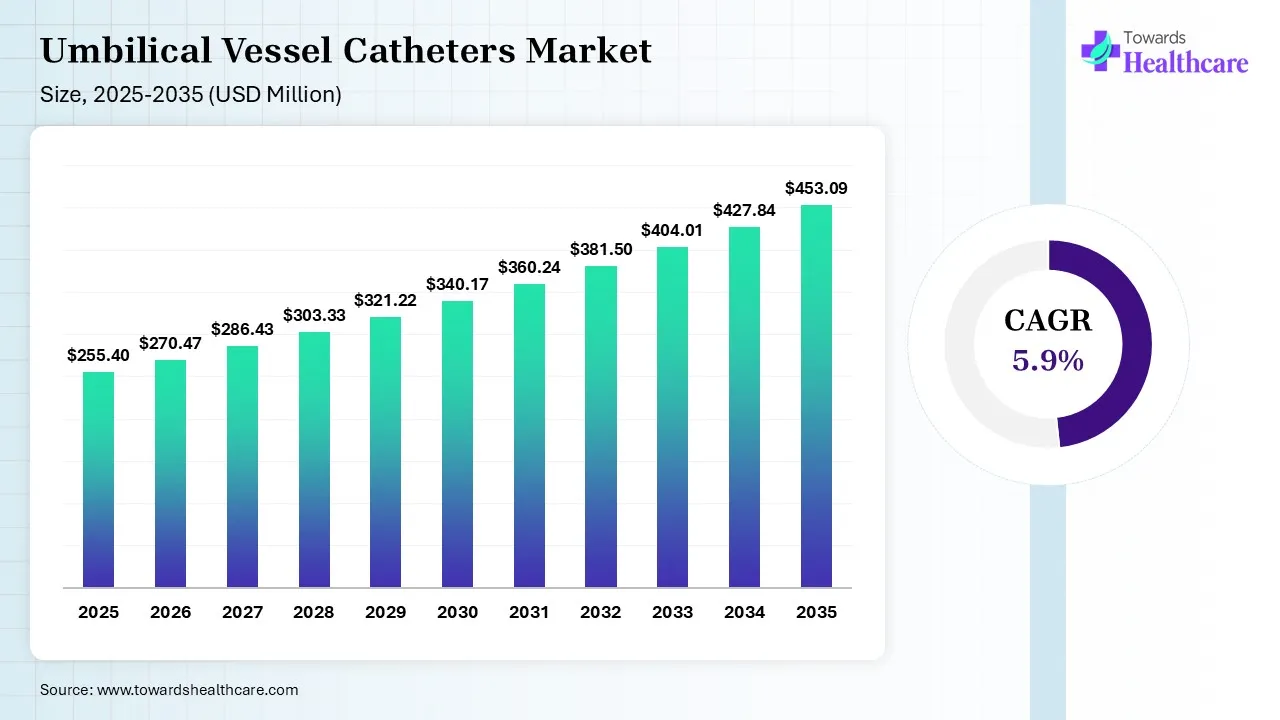
According to Towards Healthcare, the umbilical vessel catheters market is projected to experience significant growth, with estimates suggesting the market size will increase from USD 270.47 million in 2026 to approximately USD 453.09 million by 2035, representing a compound annual growth rate (CAGR) of 5.9% from 2026 to 2035, driven by, umbilical arterial catheterization involves incessant blood pressure monitoring, precise blood gas and recurrent blood samplings. Umbilical vessel catheters offer rapid, reliable central vascular access in newborns, remove the pain of frequent needle sticks, and enable continuous blood pressure monitoring.
They are usually categorized into umbilical venous catheters (UVCs) and umbilical arterial catheters (UACs), each providing distinct healthcare benefits over traditional peripheral intravenous (IV) lines. It enables safe administration of hypertonic services and total parenteral nutrition (TPN), which would otherwise irritate peripheral veins. The significant indications for umbilical artery catheterization include recurrent arterial blood gas measurements, blood sampling, or continuous blood pressure monitoring in extremely low-birthweight infants or severely ill neonates. Umbilical arterial catheterization provides direct access to the arterial system, allowing arterial blood sampling and continuous systemic blood pressure monitoring.
Access Vascular, Inc. (AVI) is a medical device company, founded in 2015 by James Biggins, that is focused on tackling the most common and expensive complications related to intravenous (IV) therapy, like thrombosis, infection, and phlebitis. The organization operates on a business-to-business (B2B) model within the healthcare sector, supplying its products to hospitals and clinics. The inspiration for the organization came after Biggins, who has a background in plastics engineering and an MBA, saw firsthand the healthcare challenges and delays in patient care caused by catheter-associated complications. This experience, integrating with his expertise in hydrogels and a strategic career path via R&D, marketing, and sales roles at organizations such as Boston Scientific and Medtronic, led to the establishment of Access Vascular.
A recent report by Towards Healthcare highlights that the umbilical vessel catheters market is growing as umbilical vein catheterization uses the exposed umbilical stump in a neonate as a site for emergency central venous admittance up to 14 days old. Umbilical vein catheterization offers a safe and efficient route for intravenous delivery of therapeutics and fluids during resuscitation. Umbilical artery catheterization affords direct access to the arterial blood supply and enables precise measurement of arterial blood pressure, serves as a source of arterial blood sampling, and offers intravascular access for fluids and therapeutics. Umbilical artery catheterization is a general procedure in the neonatal intensive care unit (NICU) and has become the standard of care for arterial access in newborns.


