


As optimism grows around the scale-up and sustainability strength of plant cell fermentation in the food and nutraceuticals companies, a novel R&D hub has been launched in India, backed by multinational supplements producer Herbalife.
The Herbalife/IIT Madras Centre of Excellence (CoE), which opened in Chennai in June, it offer scientists, startups, academia, and industry access to specialised infrastructure, downstream technology, and well-developed analytics.
It is planned to provide technical mentorship, advancement support, and collaborative research opportunities with IIT Madras faculty and investigators.
"The CoE is designed as a translational innovation hub for plant cell-based biomanufacturing rather than a conventional research laboratory," said Professor Smita Srivastava, head of the CoE.
"Its objective is to support the complete innovation pipeline - from early discovery to pilot-scale validation before proceeding to commercialisation."
In 2025, the plant cell culture ingredient market reached $843 million, supported by demand in the healthcare, cosmetics, and food and beverage fields.
Increasing interest in plant cell fermentation reflects a broader market transformation.
"The nutraceutical, functional food, and botanical ingredient industries are undergoing a major shift toward sustainable and traceable ingredient production," said Dr Sarayu Murali, business development officer at the CoE.
Plant cell fermentation provides stable, contaminant-free manufacturing, while conserving natural habitats. Manufacturing can be established anywhere, lessening the complexity and carbon footprint of supply chains.
"It is particularly valuable for producing rare, endemic, high-quality ingredients from medicinal plants where field-cultivation is difficult, environmentally sensitive, or economically inefficient," said Dr Babu Ramu, senior scientific officer at the CoE.
"It offers a sustainable and scalable route for the year-round production of high-quality plant bioactives. At the same time, advances in bioprocess engineering and analytical technologies have made commercial deployment increasingly feasible."
Putting India at the forefront of sustainable biotechnology
The launch of the CoE is in step with Indian regulatory policymaking.
In 2024, the government launched the BioE3 policy, a drive to make equity and sustainability via the convergence of biotechnology, digitization, and engineering.
Such transformation makes sense in a country with rich biodiversity and an equally rich tradition of natural medicine and plant-driven health and wellness.
The CoE is envisioned as a platform to "strengthen India's potential role as a global biomanufacturing hub in shaping the emerging market, services and manufacturing of plant- and fermentation-derived products", said Srivastava during a panel discussion at the centre's launch.
In particular, plant cell fermentation allows access to pharmaceutically significant herbs that are endangered or endemic to particular geographic regions, involving the thousands growing in India for which there is no capacity to cultivate on a large scale for commercial uses.
"There is only one technology that can do that," Dr UV Babu, director of R&D at Himalaya Wellness Company, said at the launch. "This is going to be a very important technology to the world."
Commercial landscape for plant cell fermentation shifts towards mainstream
While there is an emphasis in India to put the country at the front of the organization, facilities such as the CoE also have the potential to make much-needed linkages in the industry, academia, and startup culture on a worldwide level, driving progress by breaking down silos.
Some worldwide drivers, sustainability commitments, biodiversity conservation, concerns about supply chain resilience, and customers' demand for traceable natural ingredients are driving worldwide spending in plant cell fermentation.
"Plant cell culture was a bit siloed until a few years ago, but now people are coming together - there's great momentum building in the ecosystem," Dr Philippe Jutras, founder of UK-based R&D organisation the Plant Cell Institute, said at the CoE launch.
"It's a very young, thriving tech, and it's great to see this much interest and the sorts of conversations that we're now having at a global level," added Prithvi Kodialbail, head of partnerships at Extracellular, a UK-based bioengineering company.
"Talking to people who are pioneers in this field across the globe is how we drive that progress towards plant cell culture."
According to Towards Healthcare, the cell culture supplements market is projected to grow significantly, with estimates indicating the market size will increase from USD 3.15 billion in 2026 to approximately USD 9.71 billion by 2035, expanding at a CAGR of 13.32% from 2026 to 2035. Cell culture supplements allow labs to modify and augment media preparations to suit particular cell culture applications like protein production, hybridoma manufacturing, CHO cell applications, various serum-free workflows, and more. The cell culture and insect cell culture-tested supplements collected here have undergone application testing for suitability in cell culture technology. This testing prevents the need for labs to screen these supplements prior to use in cell culture.
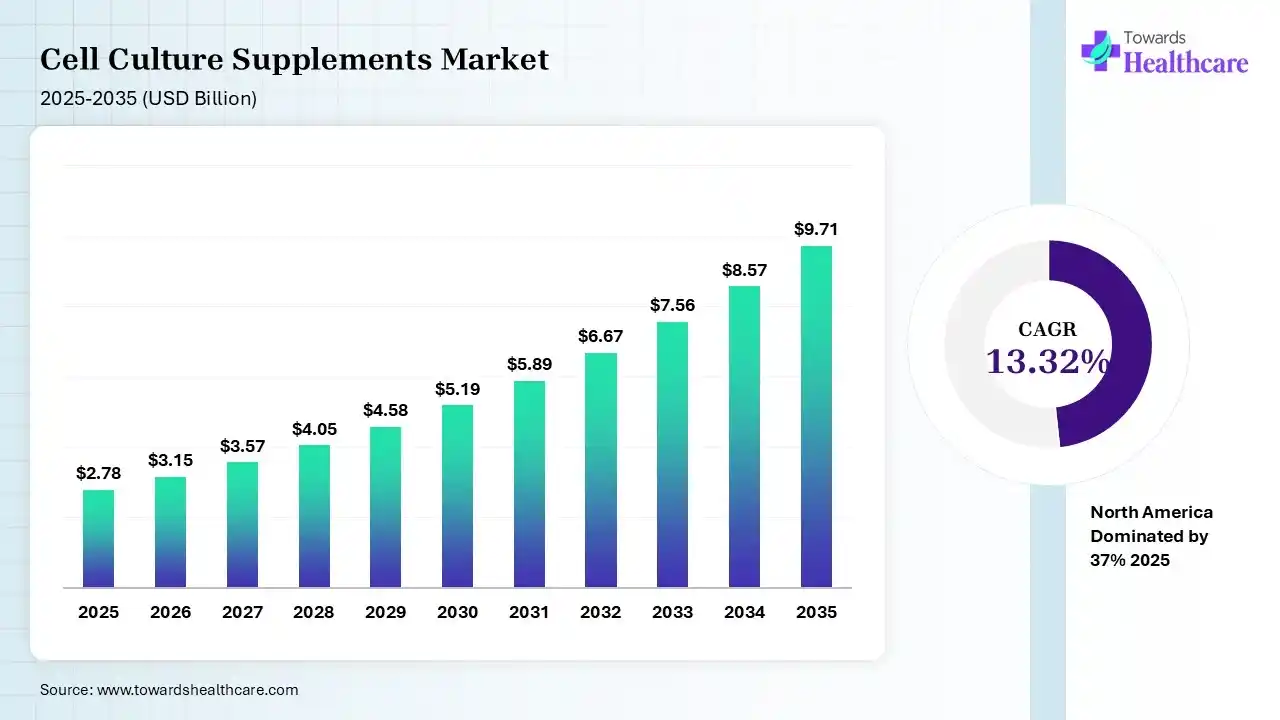
A recent report by Towards Healthcare highlights that the cell culture supplements market is growing, as there are significant benefits of using cell culture supplements, including customizing the growth conditions of cells, enhancing cell viability and growth, and keeping cells healthier longer. Cell culture media supplements support the reliability and consistency of cell culture and research results. Proper supplementation of cell culture media with antibiotics can protect your cells from contamination. In addition, certain selection antibiotics are used for stable transfection and the development of cell lines.


