


The global Middle East liquid biopsy market size was estimated at USD 212.4 million in 2025 and is predicted to increase from USD 244.68 million in 2026 to approximately USD 874.34 million by 2035, expanding at a CAGR of 15.20% from 2026 to 2035. The market is witnessing steady growth, driven by the increasing prevalence of cancer, rising adoption of precision oncology, and expanding use of non-invasive molecular diagnostic technologies. Growing investments in healthcare infrastructure, next-generation sequencing (NGS), and government initiatives supporting early cancer detection are further accelerating market expansion across the region.
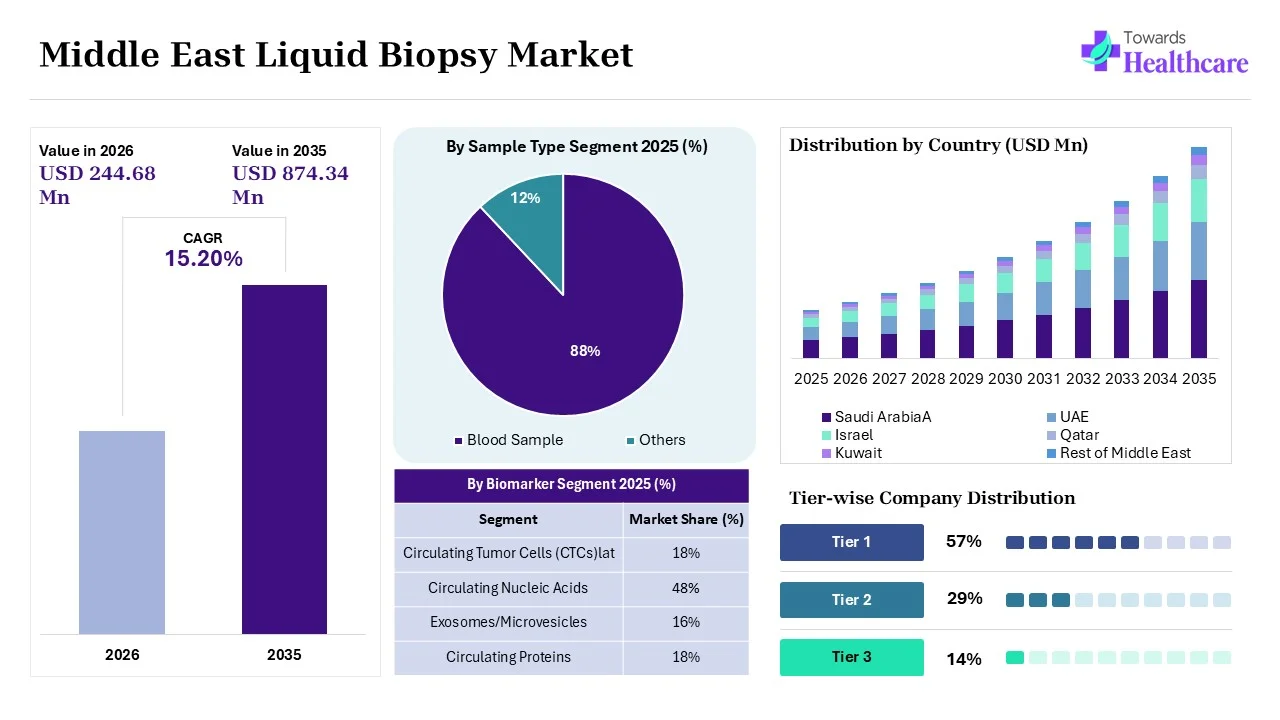
Liquid biopsy is a minimally invasive diagnostic test that detects cancer-related biomarkers, such as circulating tumor DNA (ctDNA) and circulating tumor cells (CTDs), from blood or other body fluids to support cancer diagnosis, treatment monitoring, and precision medicine. The Middle East liquid biopsy market is growing due to the rising burden of cancer, increasing demand for minimally invasive diagnostic solutions, and expanding adoption of precision oncology. Growing investments in molecular diagnostics, wider use of next-generation sequencing (NGS), and improving healthcare infrastructure are supporting market expansion. In addition, government-led cancer screening initiatives and increasing awareness of personalized medicine are further accelerating market growth across the region.
Future Opportunitites in the market are driven by the expanding adoption of precision oncology, increasing investments in genomic medicine, and growing demand for non-invasive cancer diagnostics. Advances in next-generation sequencing (NGS), AI-enabled biomarker analysis, and personalized treatment approaches are creating new growth avenues. In addition, supportive government initiatives, expanding molecular diagnostic infrastructure, and increasing collaborations between healthcare providers and biotechnology companies are expected to accelerate market expansion across the region.
Recent Initiatives
| Government Indicators | Data (Cancer Cases) |
| Saudi Arabia | 28000+ |
| UAE | 4800+ |
| Israel | 33000+ |
| Qatar | 1800+ |
| Oman | 2700+ |
The increasing number of cancers across the major Middle Eastern countries highlights the growing need for early and accurate cancer diagnosis. The rising disease burden is accelerating the adoption of liquid biopsy technologies, supported by expanding precision oncology programs, improved molecular diagnostic capabilities, and government efforts to strengthen cancer care and screening services across the region.
Why did the Blood Sample segment lead the Middle East Liquid Biopsy Market in 2025?
The blood sample segment dominated the market with a share of 88% in 2025 due to its minimally invasive nature, ease of collection, and broad clinical applicability. Blood samples enable efficient detection of circulating tumor DNA (ctDNA), circulating tumor cells ( CTCs), and other cancer biomarkers, supporting early diagnosis, treatment monitoring, and recurrence detection. High patient acceptance, cost-effectiveness, and compatibility with advanced molecular diagnostic technologies further strengthened the segment’s leadership.
The circulating nucleic acids segment held a dominant share of 48% in 2025 due to its high accuracy in detecting tumor-derived biomarkers such as circulating tumor DNA (ctDNA) and cell-free DNA (cfDNA). These biomarkers support early cancer detection, treatment selection, and disease monitoring. Their strong compatibility with next-generation sequencing (NGS) and PCR technologies, along with increasing clinical adoption, reinforced the segment’s market leadership.
The multi-gene parallel analysis segment led the market with a share of 61% in 2025 due to its ability to detect multiple genetic alterations simultaneously with high sensitivity and accuracy. It enables comprehensive genomic profiling for personalized cancer treatment, early diagnosis, and disease monitoring. Increasing adoption of precision oncology, advancements in sequencing technologies, and expanding molecular diagnostics capabilities further strengthened the segment’s market leadership.
The cancer segment dominated the market with a share of 81% in 2025 due to the rising incidence of cancer, increasing demand for early and accurate diagnostics, and growing adoption of precision oncology. Liquid biopsy enables minimally invasive detection of tumor biomarkers, treatment monitoring, and recurrence assessment. Expanding cancer screening programs, advancements in molecular diagnostics, and increasing awareness of personalized medicine further strengthened the segment’s market leadership.
The hospitals & laboratories segment dominated the market with a share of 56% in 2025 due to the availability of advanced molecular diagnostic infrastructure, skilled healthcare professionals, and high patient volumes. These facilities are the primary centers for cancer diagnosis, genomic testing, and treatment monitoring. Growing investments in laboratory modernization, expanding precision oncology services, and increasing adoption of next-generation sequencing (NGS) further strengthened the segment’s leading position.
Medical imaging is supporting the Middle East liquid biopsy market by enabling comprehensive cancer assessment alongside molecular diagnostics. Combining imaging techniques with liquid biopsy improves tumor localization, evaluates treatment effectiveness, and enhances disease surveillance. Increasing adoption og hybrid diagnostic approaches, digital imaging technologies, and multidisciplinary cancer care is encouraging integrated clinical decision-making, thereby strengthening the role of liquid biopsy in modern oncology practice across the region.
Top Companies in the Middle East Liquid Biopsy Market
Leading companies in the market include F. Hoffmann-La Roche Ltd., Illumina, Inc., Thermo Fisher Scientific Inc., QIAGEN N.V., Guardant Health, Inc., Bio-Rad Laboratories, Inc., M42 (UAE), and SOPHiA GENETICS. These organizations are driving market growth through continuous advancements in liquid biopsy assays, next-generation sequencing (NGS), digital PCR, circulating tumor DNA (ctDNA) analysis, and precision oncology solutions. Ongoing investments in molecular diagnostics, AI-enabled genomic platforms, strategic collaborations, and regional cancer genomics initiatives are further strengthening their presence across the Middle East healthcare ecosystem.
By Sample Type
By Biomarker
By Technology
By Application
By Clinical Application
By Product
By End-Use
By Region


