


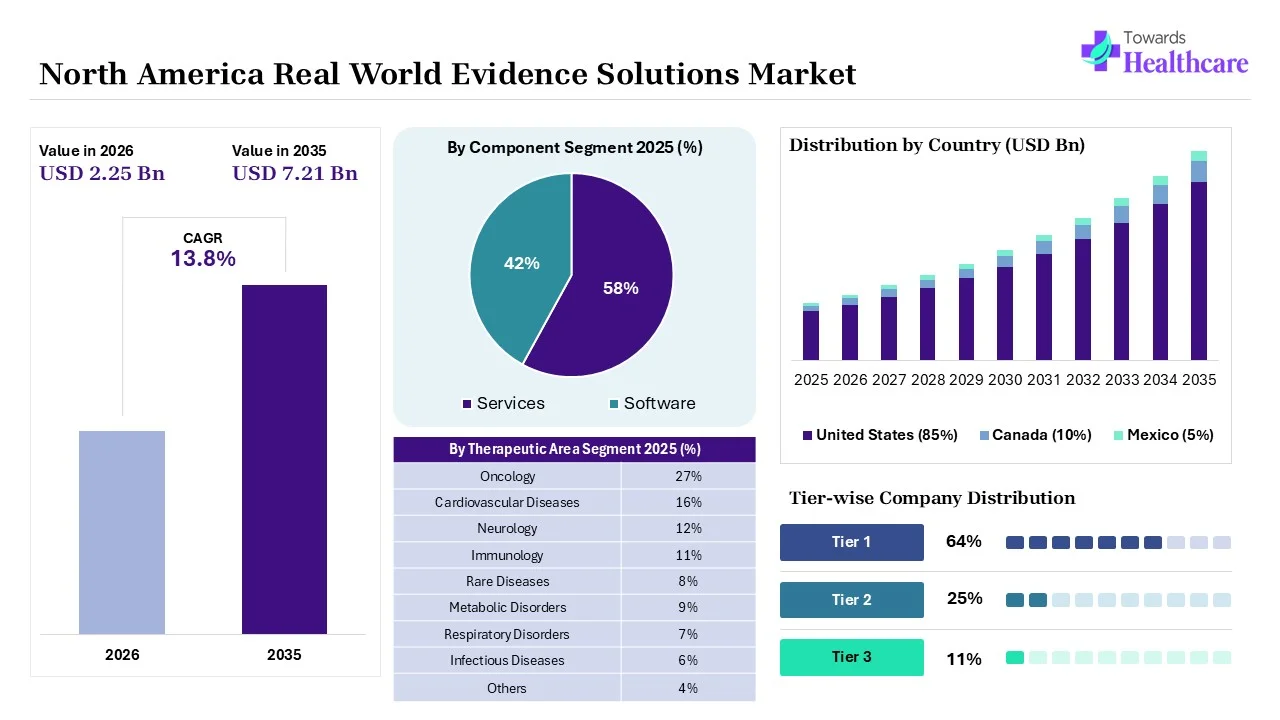
The North America real world evidence solutions market size stood at US$ 1.98 billion in 2025, grew to US$ 2.25 billion in 2026, and is forecast to reach US$ 7.21 billion by 2035, expanding at a CAGR of 13.8% from 2026 to 2035. RWE supports inclusion/exclusion criteria primarily in the clinical trial planning phase by assisting in identifying suitable patient populations and applying RWE sources that drive market growth.
Real-world evidence is healthcare evidence related to the use and potential advantages or challenges of a healthcare product, derived from analysis of RWD. This supports healthcare advancement, reduces healthcare challenges, improves patient satisfaction, and satisfies payer and regulatory requirements. Real-world evidence is altered, analysed, and interpreted before being used as a basis for RWE, which is used to inform policy, payer, healthcare, or other standards. RWE uses historical or external controls to enhance output from single-arm experiments. It makes it possible to find external control arms for a more precise comparison with patients receiving active management. RWE supports companies in satisfying supervisory standards by simplifying timely and informed decision-making, which is advantageous for drug approval. This evidence offers significant insights and advances knowledge of patient experiences and outcomes.
Privacy-preserving tokenization (PPT) renovates sensitive patient identifiers in real-world evidence (RWE) into irreversible, non-meaningful tokens. Tokenization allows scientists to securely connect clinical trial data with real-world data sources like EHRs, claims data, and registries, offering a more inclusive interpretation of patient journeys without compromising privacy. Tokenization enables scientists to connect clinical trial data with external sources such as electronic health records (EHRs) and their trove of potential insights. Tokenization substitutes sensitive data with non-sensitive tokens, providing advanced protection against breaches, lowering compliance obligations, and increasing operational flexibility. This technology enables investigators to connect disjointed clinical, claims, and registry datasets in a longitudinal patient journey, while keeping the fundamental characteristics precisely hidden.
By component, the services segment contributed the largest market share of 58% in 2025, as improving product credibility, subsidiary market access, notifying targeted approaches, endorsing patient-driven marketing, consolidating safety communication, leveraging digital platforms, and driving innovation, RWE delivers an inclusive foundation for efficient medical care services. RWE offers insights complementary to traditional clinical trials and supports generating advanced hypotheses about the safety and effectiveness of treatments.
By deployment mode, the cloud-based segment contributed the largest North America real world evidence solutions market share of 72%, as cloud-driven applications allow file sharing, real-time editing, and communication remotely. Cloud computing is considered in various solution models, based on the level of control and management of the business’s needs. Cloud computing is used in different industries to improve effectiveness, lower expenses, and increase innovation.
By data source, the electronic health records (EHRs) segment held a significant share of 34% in the market, as EHRs pointedly enhance the precision and usability of records. Computerized records are often simpler to read than a surgeon's handwriting and are more standardized. With an EHR, healthcare and office staff avoid wasting time sorting through cumbersome paper records.
By application, the drug development & clinical research segment contributed the largest North America real world evidence solutions market share of 29%, as RWE has evolved as an important element in improving understanding and application of health treatments. The incorporation of real-world evidence (RWE) in early advantages assessments potentially supports expedited drug approvals by providing critical data that supplements traditional clinical trial processes.
By end user, the pharmaceutical & biotechnology companies segment contributed the largest market share of 41%, as RWD has revolutionized the strategic planning of clinical trials, reducing pharmaceutical industry R&D costs. RWD can play a crucial role in enhancing drug discovery, clinical development, post-approval studies, and supporting the use of medicines and vaccines. With the emergence of novel technologies and the commercialization of a wide range of data sources.
By therapeutic area, the oncology segment contributed the largest North America real world evidence solutions market share of 27%, as the applications of RWE in cancer treatment it supports to increasing efficiency and enhanced patient health status. Use of real-world evidence (RWE) plays a significant role in oncology care by offering evidence to balance the data collected in randomized controlled trials (RCTs).
The United States segment contributed the largest market share of 85%, as the presence of the majority of U.S. hospitals and health systems utilizes progressive EHR technology. This extensive digitization creates a continuous, massive influx of longitudinal healthcare data. The U.S. features the highest level of pharmaceutical and biomedical R&D investment, which drives the growth of the market.
Leading companies in the North America real world evidence solutions market, such as IQVIA, Optum Life Sciences, Flatiron Health, and Aetion. Meanwhile, IQVIA offers comprehensive data incorporation in the claims, clinical, genomics, and drugstore datasets. Optum Life Sciences offers evidence-based insights and value demonstrations in the significant therapeutic areas. Flatiron Health, this organization focuses deeply on cancer, consolidating clinical and EHR data to implement prospective real-world research. Aetion provides purpose-built software platforms and analytics that turn real-world data into regulator-grade evidence.
By Component
By Deployment Mode
By Data Source
By Applications
By End User
By Therapeutic Area
By Region


