


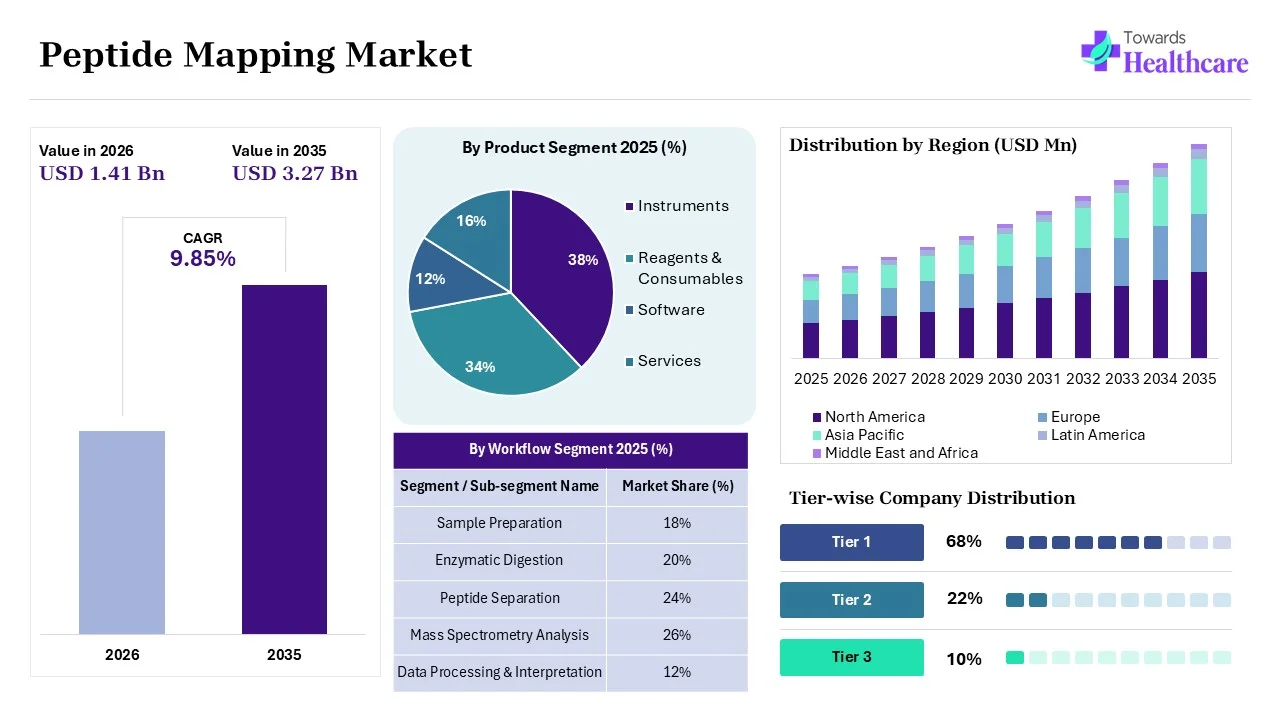
The global peptide mapping market size was estimated at USD 1.28 billion in 2025 and is predicted to increase from USD 1.41 billion in 2026 to approximately USD 3.27 billion by 2035, expanding at a CAGR of 9.85% from 2026 to 2035. The market is growing due to increasing biologics and biosimilars development, along with rising demand for accurate protein characterization and regulatory compliance. Advancements in mass spectroscopy, chromatography, and AI-enabled analytical workflows are further supporting market expansion.
Peptide mapping is an analytical technique used to identify, characterize, and verify the amino acid sequence and structural integrity of proteins and peptides. The peptide mapping market is growing due to the increasing development of biologics, biosimilars, and protein-based therapeutics that require precise structural characterization. Rising regulatory expectations for product quality, expanding proteomics research, and greater adoption of advanced analytical technologies such as LC-MS are driving demand. In addition, increasing outsourcing to CROs and CDMOs is further supporting market growth.
The peptide mapping market is expected to witness strong growth with increasing adoption of AI-enabled data analysis, automated sample preparation, and next-generation mass spectroscopy platforms. Rising biologics and biosimilars development, expanding precision medicine research, and growing regulatory focus on comprehensive protein characterization will continue to drive demand, while collaborations between technology providers and biopharmaceutical companies will further accelerate market innovation.
| Parameter | Value |
| Novel drugs approved | 46 |
| Human medicine recommended for marketing authorization | 104 |
| Human medicines with new active substances are recommended | 38 |
| New biological product approvals | 25+ |
The increasing number of novel drugs and biologics approvals in 2025 highlights the growing demand for advanced analytical techniques such as peptide mapping. These approaches require comprehensive protein characterization, sequence verification, and quality assessment to meet regulatory standards, reinforcing the importance of peptide mapping throughout biologics and biosimilars development.
The instruments segment held a dominant share of 38% in 2025 due to the widespread adoption of advanced mass spectrometry and chromatography systems for accurate protein characterization. These instruments provide high sensitivity, reproducibility, and reliable detection of peptide sequence and post-translational modifications. Growing investment in biopharmaceutical research, increasing biologics development, and continuous technological advancements have further strengthened the segment’s leading market position.
The mass spectrometry analysis segment dominated the market with a share of 26% in 2025 and is expected to grow at the fastest CAGR of 10.40% in the market during the forecast period due to exceptional sensitivity, accuracy, and ability to identify peptide sequence and post-translational modification. Growing adoption of high-resolution LC-MS platforms, increasing biologics development, and rising demand for precise protein characterization and regulatory compliance are driving continued growth in this segment.
The biopharmaceutical characterization segment led the market with a share of 42% in 2025 and is expected to grow at the fastest CAGR of 10.70% in the market during the forecast period, increasing the development of biologics, biosimilars, and monoclonal antibodies. Peptide mapping plays a critical role in confirming protein structure, identifying post-translational modifications, and ensuring regulatory compliance. Rising investments in biopharmaceutical R&D and stringent quality standards continue to accelerate demand for this application.
The pharmaceutical & biotechnology companies segment dominated the market with a share of 46% in 2025 due to increasing investment in biologics, biosimilars, and protein-based drug development. This organization relies on peptide mapping for protein characterization, quality control, and regulatory compliance through the drug development lifecycle. Growing R&D activities, expanding biologics pipelines, and the adoption of advanced analytical technologies continue to strengthen the segment’s market leadership.
The LC-MS-Based peptide mapping segment dominated the market with a share of 62% in 2025 and is expected to grow at the fastest CAGR of 10.50% in the market during the forecast period due to its superior sensitivity, accuracy, and ability to comprehensively characterize complex proteins. It enables precise peptide sequencing, detection of post-translational modifications, and impurity analysis. Increasing adoption in biologics development, regulatory testing, and quality control, along with continuous technological advancements, is driving sustained market growth.
North America dominated the peptide mapping market with a share of 42% in 2025 due to its strong biopharmaceutical industry, extensive biologics research, and widespread adoption of advanced analytical technologies. The region benefits from significant investments in pharmaceutical R&D, the presence of leading life science companies, and stringent regulatory requirements for protein characterization. Increasing development of biologics and biosimilars further supports the region’s dominant market position.
Asia Pacific held 22% share of the market in 2025 and is expected to grow at the fastest CAGR of 11.40% in the market during the forecast period due to expanding biopharmaceutical manufacturing, increasing investments in life sciences research, and rising biologics and biosimilars production. Growing pharmaceutical outsourcing, improving analytical infrastructure, and supportive government initiatives are accelerating the adoption of peptide mapping technologies across research, development, and quality control applications.
Leading companies in the peptide mapping market include Thermo Fisher Scientific, Agilent Technologies, Waters Corporation, Bruker Corporation, Shimadzu Corporation, Danaher Corporation, Merck KGaA, and Bio-Rad Laboratories. These companies are driving market growth through continuous advancements in mass spectrometry platforms, chromatography systems, peptide mapping software, analytical reagents, and automated protein characterization workflows. Ongoing investments in AI-enabled data analysis, high-resolution analytical technologies, and biopharmaceutical research solutions are further strengthening their market position across pharmaceutical, biotechnology, and research laboratories.
By Product
By Workflow
By Application
By End User
By Technology
By Region


