


The UK AI in life science market size accounted at USD 210 million in 2025 and is predicted to increase from USD 249.9 million in 2026 to approximately USD 1195.88 million by 2035, expanding at a CAGR of 19% from 2026 to 2035. Growth in the demand for affordable drug discovery and development, increasing government funding, growing R&D activities, increasing healthcare investments, expanding AI startups, and growing chronic disease burden are promoting the market growth.
The UK AI in life science refers to the use of artificial technologies for processing large scientific datasets, automating research, and supporting decision-making. It offers faster data processing, research, automation, and improved accuracy. This drives their use for cancer diagnosis, drug development, protein structure prediction, drug safety monitoring, and virtual assistance.
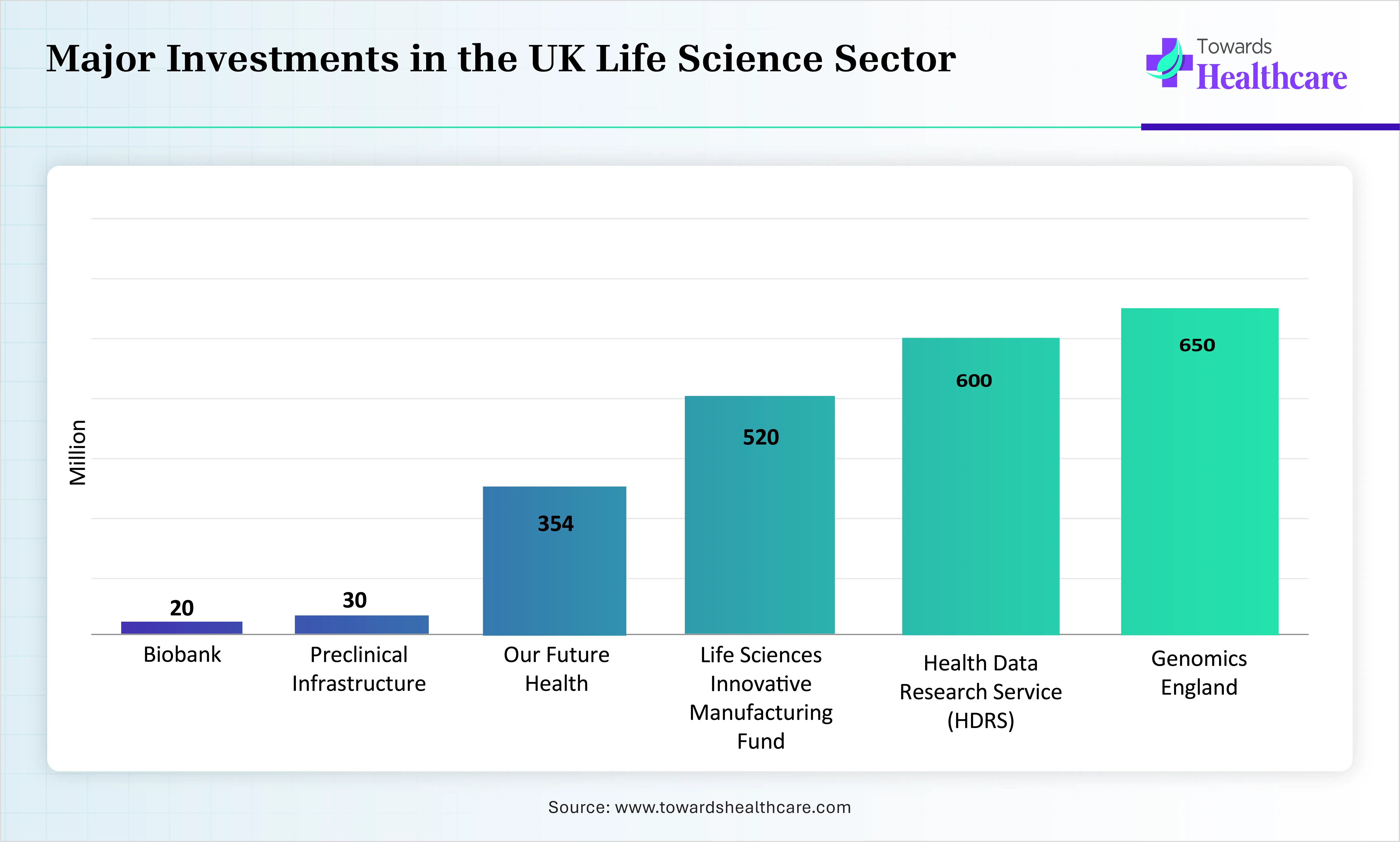
The graph represents the total number of investments in the UK life science sector. It indicates that there will be a rise in investments to enhance the life science economy of the UK, which will drive the innovations and adoption of new AI-powered solutions. This, in turn, will increase the adoption of AI platforms for a wide range of applications across the life sciences sector, which will ultimately promote market growth.
By component type, the software segment held the highest revenue share of 48% of the UK AI in life science market in 2025, due to high demand for data analytics and bioinformatics platforms. Their easy scalability and frequent software updates also increased their adoption. They also offered automation and remote access, which increased their use.
By technology type, the machine learning segment accounted for a major revenue share of 38% of the UK AI in life science market in 2025, due to its high accuracy and faster processing features. This increased their use for analysis of large healthcare data, drug safety, and disease progression. They were also used for drug discovery and clinical trials optimization.
By application type, the drug discovery & development segment contributed the biggest revenue share of 31% of the UK AI in life science market in 2025, driven by growth in the demand for faster drug discovery and development. Growth in investments also increased the adoption of various AI platforms for R&D activities. They were also used to improve the bioinformatics ecosystem and clinical trial outcomes.
By end user, the pharmaceutical companies segment held the largest revenue share of 34% of the UK AI in life science market in 2025, due to growth in the R&D activities and clinical data. Increased investments and government funding have also increased the use of AI for faster drug development and clinical trials. Growth in collaboration with AI startups also supported their adoption.
By therapeutic area type, the oncology segment led the UK AI in life science market with 29% share in 2025, driven by growth in cancer cases in the UK. This increased the use of AI platforms for their R&D, personalized medication development, and clinical trial optimization. They were also used for their accurate detection, monitoring treatment outcomes, where the government supported and encouraged their adoption.
UK AI in life science market showed notable growth in 2025 and is expected to show lucrative growth during the predicted time, due to the presence of robust life science industries and AI startups. The growth in the demand for faster drug development, precision medicine, advanced genomics, and medical imaging has also increased their use. Expansion of telemedicine platforms, cloud computing, and clinical trials also increased their adoption, where government support also enhanced the market growth.
Isomorphic Labs dominated the market with its AlphaFold 3 Architecture, where Exscientia (Oxford) was its closest competitor, which offered a Patient-First AI platform. BenevolentAI also maintained its position by providing the Benevolent Platform, where Causaly also contributed to the market growth with its Causaly Cloud Enterprise Platform.
By Component
By Technology
By Application
By End User
By Therapeutic Area
By Deployment Mode
By Data Type


