Pipeline Programs

CGT Companies Tracked

Manufacturing Facilities


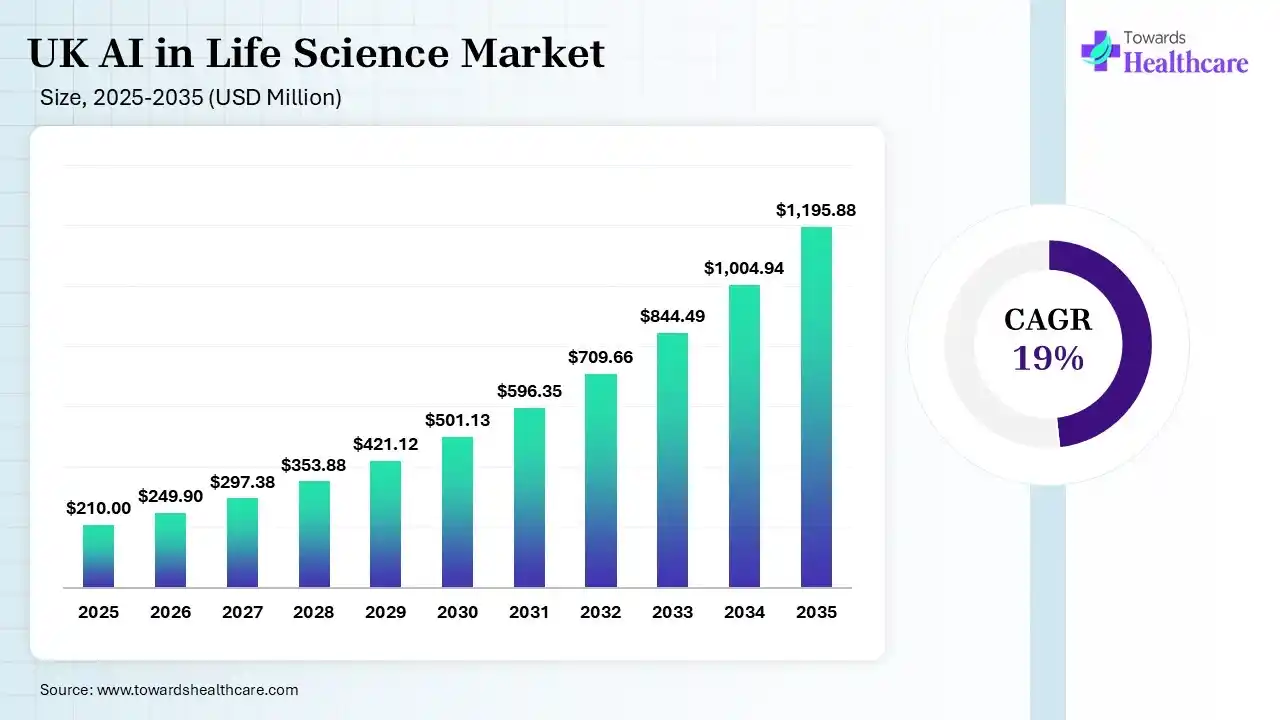
The UK AI in life science market size was estimated at USD 210 million in 2025 and is predicted to increase from USD 249.9 million in 2026 to approximately USD 1195.88 million by 2035, expanding at a CAGR of 19% from 2026 to 2035. Growing R&D activities across the UK are increasing the use of AI in the life sciences sector. Increasing healthcare investments, chronic disease burden, AI startups, and new platform launches are also enhancing the market growth.
The UK AI in life science market is driven by growth in the demand for affordable drug discovery and development, and increasing government funding. The UK AI in life science encompasses artificial technologies used across the UK life sciences sector for analysis of healthcare data, diagnosis of diseases, and improving research outcomes. It is also used for drug discovery, personalized treatment planning, process optimization, pharmacovigilance, and regulatory submission.
Escalating Drug Discoveries
Increasing R&D activities across the UK are driving the adoption of AI platforms in life science industries. They are being used for the identification of drug targets, molecule screening, protein prediction, biomarker discovery, and precision medicine development.
Growing Investments
A rise in investments in AI startups and life science industries is promoting innovations and the adoption of new platforms. AI solutions for drug discovery, clinical research, medical imaging, manufacturing, and medical writing are also being developed.
Technology Breakthrough
Growing government support and a shift towards AI integration are expanding their life sciences applications. This is driving the development of AI-powered robotics, chatbots, diagnostics, and cloud-based platforms.
| Table | Scope |
| Market Size in 2026 | USD 249.9 Million |
| Projected Market Size in 2035 | USD 1195.88 Million |
| CAGR (2026 - 2035) | 19% |
| Historical Data | 2020 - 2023 |
| Base Year | 2025 |
| Forecast Period | 2026 - 2035 |
| Measurable Values | USD Millions/Units/Volume |
| Market Segmentation | By Component, By Technology, By Application, By End User, By Therapeutic Area, By Deployment Mode, By Data Type |
| Top Key Players | Isomorphic Labs, Lifebit, Exscientia, Latent Labs, BenevolentAI, Owkin, Healx, Optibrium, Causaly, CHARM Therapeutics |
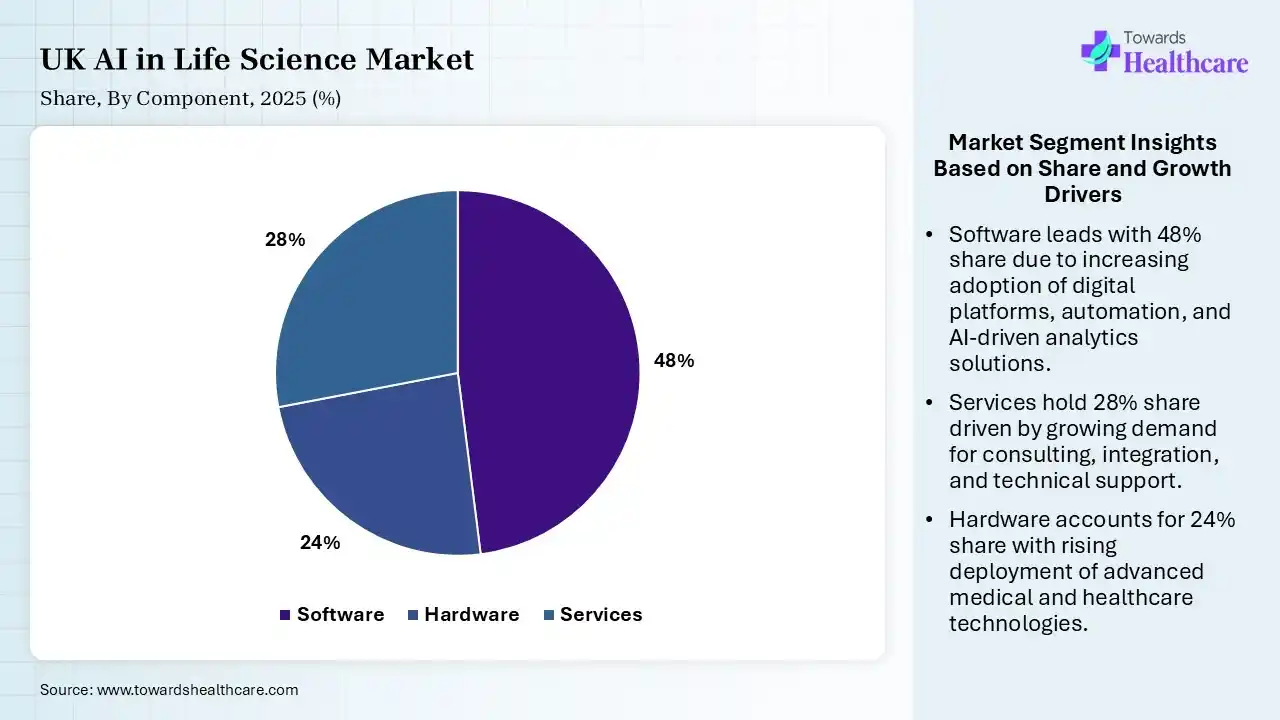
| Segment | Share 2025 (%) |
| Software | 48% |
| Hardware | 24% |
| Services | 28% |
The Software Segment Dominated the Market With 48% in 2025
The software segment led the UK AI in life science market with 48% share in 2025, as they accelerate drug discovery workflows across UK biotech firms. Growth in the integration of predictive analytics also supported faster clinical decision-making. Demand for scalable AI algorithms also continued their adoption across genomic research.
The services segment held the second-largest share of 28% of the market in 2025 and is expected to witness the fastest growth with a CAGR during the forecast period, due to pharmaceutical companies increasingly outsourcing AI deployment and integration projects. Growing consulting demand as firms modernize digital R&D operations. Managed services also improve operational efficiency and regulatory compliance.
The hardware segment held 24% of the UK AI in life science market share in 2025, due to growing deployment of GPU infrastructure, which supports high-volume life science computations. Research laboratories also invest in AI-ready computing systems for molecular simulations. Expansion of data-intensive diagnostics also drives hardware demand.
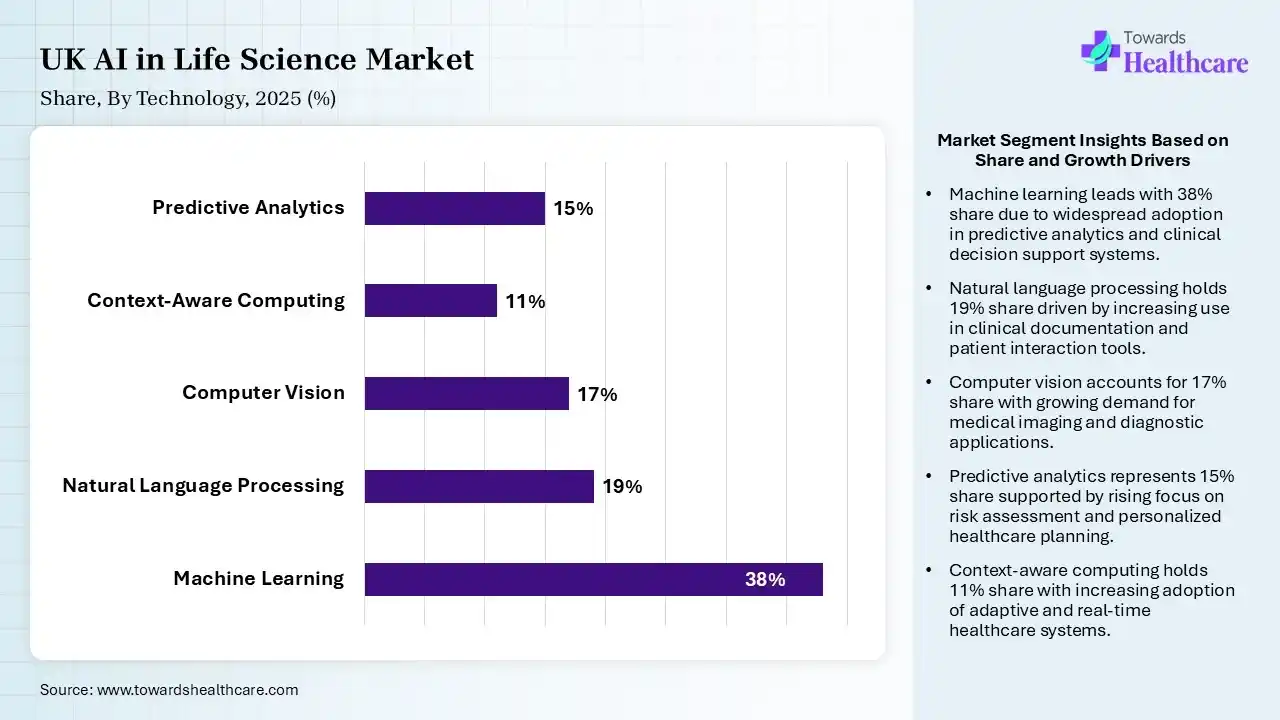
| Segment | Share 2025 (%) |
| Machine Learning | 38% |
| Natural Language Processing | 19% |
| Computer Vision | 17% |
| Context-Aware Computing | 11% |
| Predictive Analytics | 15% |
The Machine Learning Segment Dominated the Market With 38% in 2025
The machine learning segment accounted for the highest revenue share of 38% of the UK AI in life science market in 2025, due to its improved molecule identification and predictive toxicology. Expansion of AI-driven biomarker analysis initiatives by the UK pharmaceutical firms also increased their use. The growth in healthcare datasets has also increased their demand.
The natural language processing segment held the second-largest share of 19% of the market in 2025, due to automated extraction of insights from clinical documents and literature. Healthcare organizations also improve patient data interpretation using AI text analytics. Growing demand for automated medical documentation solutions also drives their use.
The computer vision segment held 17% of the UK AI in life science market share in 2025, driven by AI imaging systems, enhancing the precision of pathology and radiology diagnostics. The UK hospitals and laboratories are also increasing the use of Digital pathology. Computer vision also improves early disease detection capabilities.
The predictive analytics segment held 15% of the market share in 2025 and is expected to show the highest growth during the forecast period, as they improve clinical trial outcomes and patient risk forecasting. Pharma companies also use analytics to reduce drug development failures. Growing demand for preventive healthcare also supports their adoption.
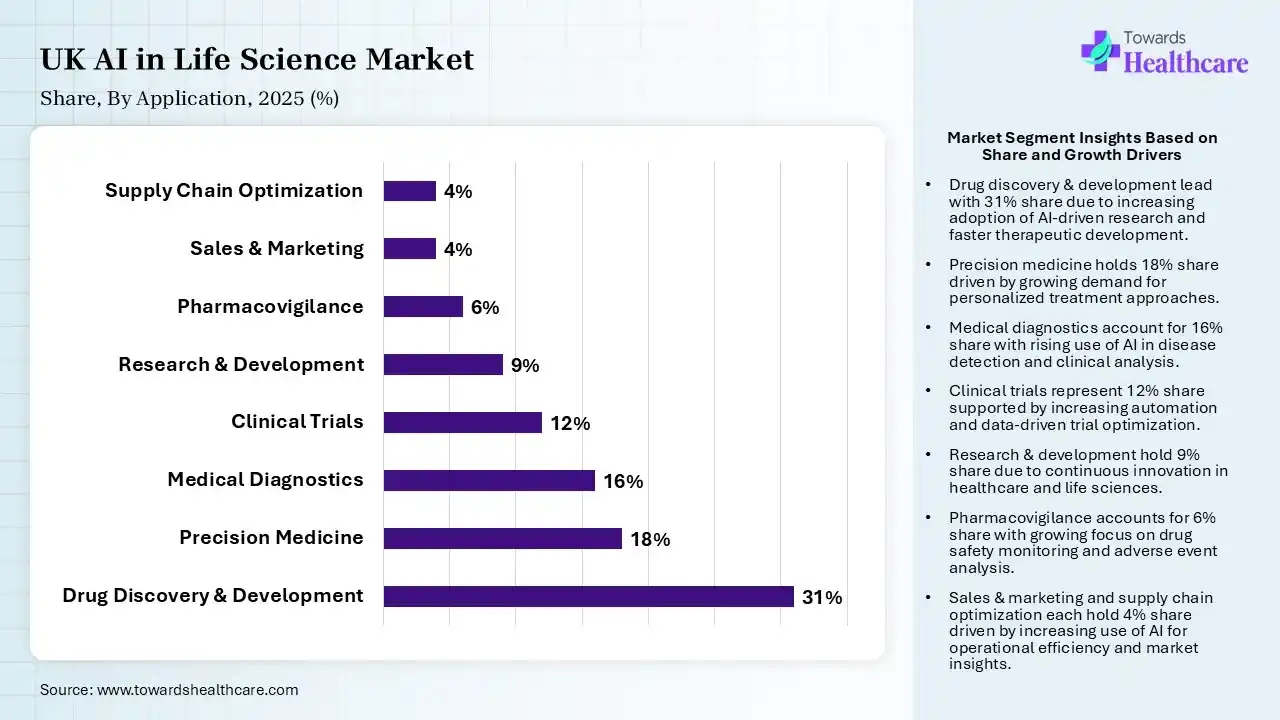
| Segment | Share 2025 (%) |
| Drug Discovery & Development | 31% |
| Precision Medicine | 18% |
| Medical Diagnostics | 16% |
| Clinical Trials | 12% |
| Research & Development | 9% |
| Pharmacovigilance | 6% |
| Sales & Marketing | 4% |
| Supply Chain Optimization | 4% |
The Drug Discovery & Development Segment Dominated the Market With 31% in 2025
The drug discovery & development segment held a major revenue share of 31% of the UK AI in life science market in 2025, as AI significantly reduced the time required for target identification and compound screening. UK biotech startups also heavily invested in AI-powered drug pipelines. Pharmaceutical firms prioritize cost-efficient discovery platforms, which have increased their adoption rates.
The precision medicine segment held the second-largest share of 18% of the market in 2025, due to genomic sequencing adoption, which strengthens personalized treatment planning initiatives. AI enhances biomarker discovery and patient stratification processes. Precision healthcare programs receive increased public and private funding, which encourages AI adoption.
The medical diagnostics segment held 16% of the UK AI in life science market share in 2025, due to AI-enabled diagnostics improving accuracy in imaging and pathology interpretation. Healthcare providers also adopt automation to reduce diagnostic turnaround time. Rising chronic disease prevalence also supports demand for smart diagnostics.
The supply chain optimization segment held 4% of the market share in 2025 and is expected to expand rapidly during the forecast period, due to AI improving pharmaceutical inventory forecasting and logistics management. Life science firms also strengthen resilient supply chains using predictive systems. Increasing biologics distribution complexity also drives AI deployment.
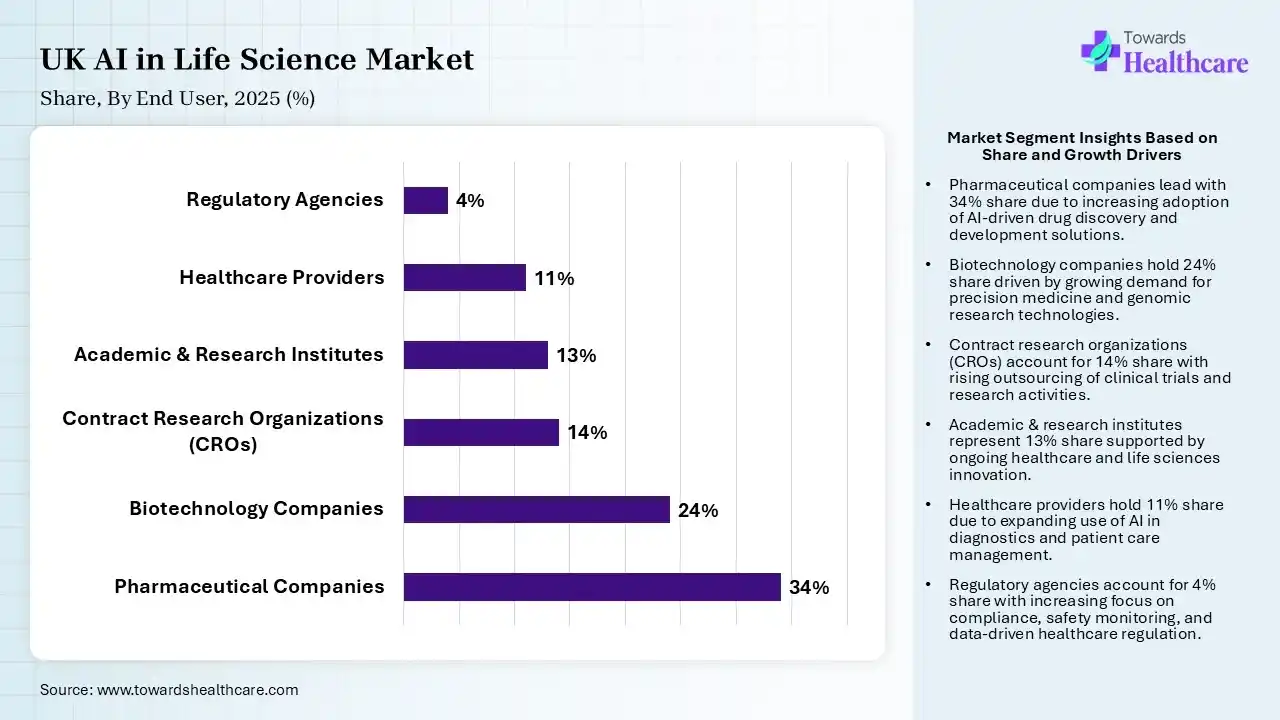
| Segment | Share 2025 (%) |
| Pharmaceutical Companies | 34% |
| Biotechnology Companies | 24% |
| Contract Research Organizations (CROs) | 14% |
| Academic & Research Institutes | 13% |
| Healthcare Providers | 11% |
| Regulatory Agencies | 4% |
The Pharmaceutical Companies Segment Dominated the Market With 34% in 2025
The pharmaceutical companies segment contributed the biggest revenue share of 34% of the UK AI in life science market in 2025, due to expansion in AI investments to accelerate drug commercialization timelines. AI also helped in improving clinical success rates and R&D productivity. Competitive pressure also increased the adoption of advanced analytics platforms.
The biotechnology companies segment held the second-largest share of 24% of the market in 2025 and is expected to gain the highest share during the forecast period, due to startups increasingly integrating AI into genomic and molecular research. Venture capital funding also accelerates AI innovation in biotechnology. Small firms also use AI to reduce development costs.
The contract research organizations (CROs) segment held 14% of the UK AI in life science market share in 2025, due to CROs adopting AI tools to optimize clinical trial management services. Outsourcing demand also strengthens digital transformation initiatives. AI also improves operational efficiency and client delivery speed.
The academic & research institutes segment held 13% of the market share in 2025, as universities expand AI-driven life science research collaborations across the UK. Public funding also supports computational biology advancements. Research institutes also leverage AI for data-intensive projects.
| Segment | Share 2025 (%) |
| Oncology | 29% |
| Neurology | 15% |
| Cardiology | 13% |
| Immunology | 12% |
| Infectious Diseases | 11% |
| Rare Diseases | 9% |
| Metabolic Disorders | 11% |
The Oncology Segment Dominated the Market With 29% in 2025
The oncology segment held the largest revenue share of 29% of the UK AI in life science market in 2025, driven by growth in the use of AI to accelerate cancer biomarker identification and precision oncology development. The rise in cancer prevalence also increased demand for advanced diagnostics. Pharmaceutical firms also prioritized oncology-focused AI research programs.
The neurology segment held the second-largest share of 15% of the market in 2025, as AI supports early diagnosis of neurodegenerative disorders using imaging analytics. Research investments are increasing their use in brain disorder therapeutics. Predictive models also improve neurological disease management.
The cardiology segment held 13% of the UK AI in life science market share in 2025, due to increasing use of AI-enabled diagnostics to improve cardiovascular risk prediction and monitoring. Healthcare providers are also integrating predictive tools into cardiac care pathways. Growing chronic disease burden also supports their adoption.
The rare diseases segment held 9% of the market share in 2025 and is expected to grow with the fastest CAGR during the forecast period, as AI improves the identification of rare disease biomarkers and patient populations. Genomics-driven research also accelerates orphan drug development. Government incentives also support innovation in rare disease therapies.
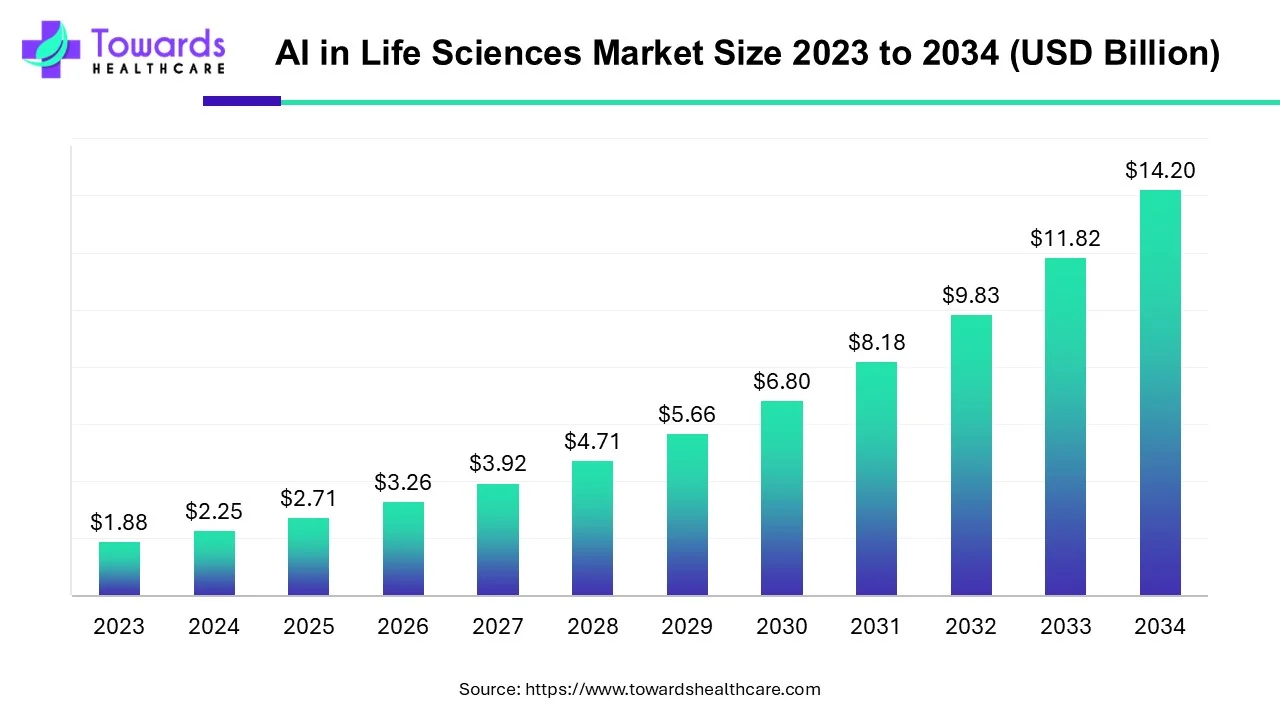
The global artificial intelligence in life sciences market size was calculated at USD 2.71 billion in 2025, to reach USD 3.26 billion in 2026 is expected to be worth USD 17.08 billion by 2035, expanding at a CAGR of 20.21% from 2026 to 2035.
UK AI in life science market considerable share in 2025 and is expected to show significant growth during the forecast period, due to the presence of robust pharmaceutical and biotechnology industries. Growth in the healthcare investments and government support also increased the adoption and innovations of AI to offer various life science applications. Expansion of the telehealth platforms also increased their use, which contributed to the market growth.
| Companies | Headquarters | UK AI in Life Science Solutions |
| Isomorphic Labs | London, UK | AlphaFold 3 Architecture/Next-Gen Drug Design Engine |
| Lifebit | London, UK | Federated AI Platform and Lifebit CloudOS |
| Exscientia | Oxford, UK | Patient-First AI Platform and Centaur Biologist |
| Latent Labs | London, UK | Simon |
| BenevolentAI | London, UK | Benevolent Platform |
| Owkin | London, UK | MOSAIC/Federated Learning Network |
| Healx | Cambridge, UK | HealNet |
| Optibrium | Cambridge, UK | Cerella/StarDrop |
| Causaly | London, UK | Causaly Cloud Enterprise Platform |
| CHARM Therapeutics | London, UK | DragonFold |
Strengths
Weaknesses
Opportunities
Threats
By Component
By Technology
By Application
By End User
By Therapeutic Area
By Deployment Mode
By Data Type









Principal Consultant
Shivani Zoting is a dedicated research analyst specializing in the healthcare industry. With a strong academic foundation, a B.Sc. in Biotechnology and an MBA in Pharmabiotechnology, she brings a unique blend of scientific understanding and strategy.
Learn more about Shivani Zoting
Reviewed By
Aditi Shivarkar is a seasoned professional with over 14 years of experience in healthcare market research. As a content reviewer, Aditi ensures the quality and accuracy of all market insights and data presented by the research team.
Learn more about Aditi Shivarkar