The growth in unstructured healthcare data, the urgent need to reduce the administrative burden, expanding healthcare digitalization, increasing R&D activities, rising demand for precision medicine, growing clinical trials, the shift towards telemedicine platforms, and technological advancements are promoting the market growth.
Decoding the Clinical Intelligence: Exploring the U.S. Clinical NLP Market Landscape
Clinical NLP is the natural language processing technology utilized to extract, analyze, read, interpret, and understand clinical data, medical data, and healthcare documents. It is used for the conversion of unstructured data into structured data, diagnosis of diseases, automation of medical coding and billing, identification of drug adverse effects, documentation, patient recruitment for clinical trials, and patient monitoring. This drives their use for EHR processing, clinical decision support, drug safety identification, medical research, and clinical trials.
Global Market Growth
The global clinical NLP market size was estimated at USD 4.8 billion in 2025 and is predicted to increase from USD 5.78 billion in 2026 to approximately USD 30.73 billion by 2035, expanding at a CAGR of 20.4% from 2026 to 2035.
Forecasting Future: Unlocking the Emerging Trends
- Rapid digital transformation across the healthcare sector is increasing the adoption of clinical NLP platforms across the U.S.
- Growing demand for value-based care models is also increasing the use of these platforms to track patient outcomes.
- Increasing advancements in precision medicine are also increasing their use to extract specific information from patients' health data.
- Expanding drug discovery and clinical trials are also increasing their use for data analysis, drug side effect detection, and patient recruitment.
- Growing use of telemedicine and chatbots is also increasing the use of clinical NLP solutions for documentation and remote consultations.
- Increasing collaborations and R&D investments are also increasing the advancements of these platforms.
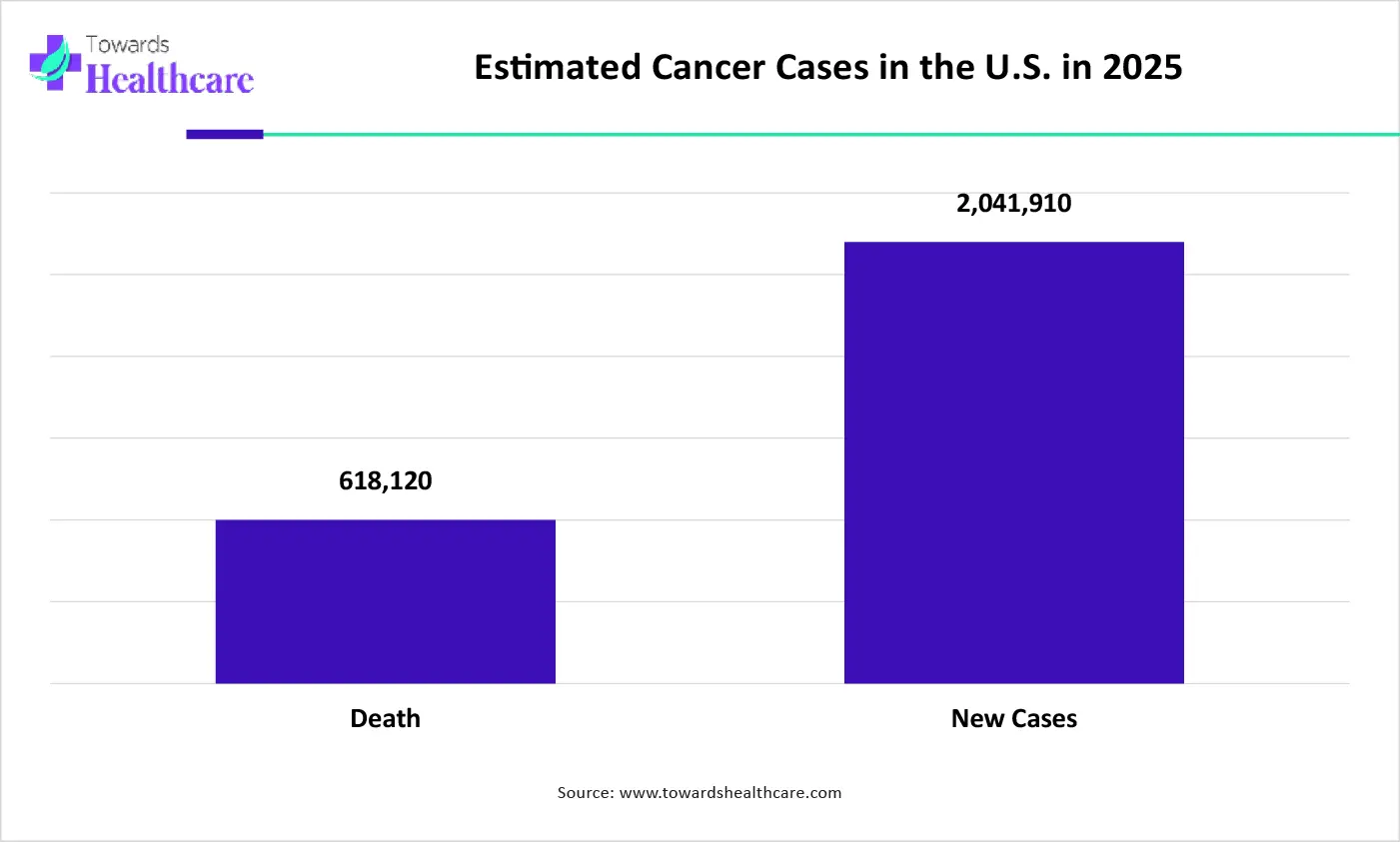
The graph represents the estimated number of cancer deaths and new cases in the U.S. for the year 2026. It indicates that there will be a rise in cancer burden, which will drive the demand for effective diagnosis and treatment options, promoting R&D activities. This, in turn, will increase the adoption of clinical NLP for faster drug development, clinical trials, and the development of personalized treatment options, which will ultimately promote the market growth.
Market Segmentation Overview
- By type, the speech recognition segment accounted for the highest revenue share of 40% of the U.S. clinical NLP market in 2025, due to its increased use in documentation, which helped in minimizing the doctors' workload. It was also used for real-time transcription, which increased its use for the conversion of conversations into medical texts. Their enhanced accuracy also increased their use with EHR systems as well as in emergency conditions.
- By application type, the clinical documentation segment contributed the biggest revenue share of 50% of the U.S. clinical NLP market in 2025, due to growth in the volume of medical documentation. This increased the adoption of the clinical NLP platforms, which helped in reducing documentation time, where their consistency and accuracy also promoted their use. They were also used to support EHR processing, medical billing, and medical coding.
- By end-user, the healthcare providers segment held a major revenue share of 45% of the U.S clinical NLP market in 2025, due to high clinical data, which increased the adoption of the clinical NLP solutions to develop medical records and reports. They also helped in offering faster and more accurate clinical decisions, which helped in enhancing patient care. Their growing use in EHR systems also decreased the administrative workload, which protected their adoption rates.
Regional Analysis
The U.S. clinical NLP market held share and is expected to show notable growth during the forecast period, due to the presence of a well-developed healthcare system. The presence of advanced AI and healthcare technology companies has also increased the advancements of the clinical NLP solutions, where faster regulatory approvals have also encouraged their innovations. Expansion of the R&D activities and clinical trials also increased the adoption of these platforms for a wide range of applications, which enhanced the market growth.
The Tech Titans: Spotlight on the Top U.S. Clinical NLP Companies
The market was dominated by Microsoft (Nuance) with its DAX Copilot and Dragon Medical One products, where Google Cloud was its closest competitor, which provided Healthcare NLP API and Vertex AI. Amazon Web Services (AWS) also maintained its position by offering Amazon Comprehend Medical and AWS HealthLake, where IQVIA also contributed to the market growth with its Linguamatics I2E.
Segments Covered in the Report
By Type
- Speech Recognition
- Natural Language Understanding (NLU)
- Text Analytics
- Sentiment Analysis
- Named Entity Recognition (NER)
- Clinical Decision Support
- Diagnosis Support
- Treatment Recommendation
By Application
- Clinical Documentation
- Electronic Health Record (HER)
- Medical Transcription
- Healthcare Data Management
- Data Extraction
- Clinical Coding
- Clinical Research
- Drug Discovery
- Disease Surveillance
By End-user
- Healthcare Providers
- Healthcare Payers
- Insurance Providers
- Third-Party Administrators (TPAs)
- Pharmaceuticals and Life Sciences
- Drug Manufacturers
- Research Institutes




