The global clinical NLP market size was estimated at USD 4.8 billion in 2025 and is predicted to increase from USD 5.78 billion in 2026 to approximately USD 30.73 billion by 2035, expanding at a CAGR of 20.4% from 2026 to 2035. The growth in healthcare digitalization is increasing the adoption of clinical NLP platforms. A rise in R&D activities, clinical trials, precision medicine, telemedicine platforms, technological advancements, and the launch of new products are also enhancing the market growth.
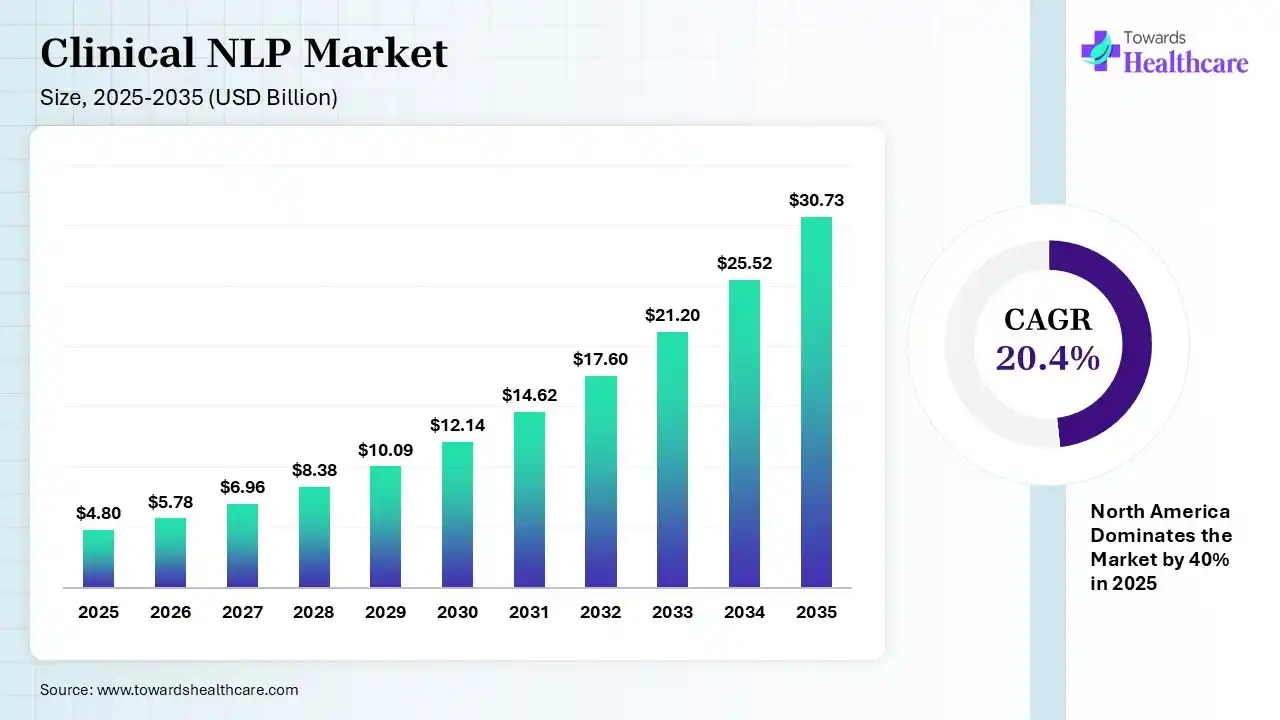
The clinical NLP market is driven by growth in unstructured healthcare data and the urgent need to reduce the administrative burden. Clinical NLP refers to the natural language processing technology used for understanding, analysis, and extraction of information from clinical and medical data. It is used for the diagnosis of diseases, detection of symptoms, automated documentation, clinical decision support, medical research, drug safety monitoring, and to support EHR processing.
Clinical Natural Language Processing (Clinical NLP) is an artificial intelligence technology that extracts, interprets, and analyzes unstructured clinical data from electronic health records, physician notes, medical reports, and other healthcare documents to generate actionable insights. The clinical NLP market is expanding due to increasing digitalization of healthcare, rising adoption of electronic health records, and growing demand for data-driven clinical decision support. Advancements in generative AI, transformer-based language models, cloud computing, and multilingual NLP platforms are improving the accuracy and scalability of clinical data analysis. A key trend is the integration of Clinical NLP with population health management, revenue cycle optimization, and real-world evidence generation. Future opportunities lie in AI-powered clinical documentation, predictive analytics, automated medical coding, and precision medicine applications, supported by expanding healthcare IT investments and the growing need for interoperable health data solutions.
Growing Demand for Better Patient Care
A rise in the demand for better patient care is driving the adoption of clinical NLP platforms across the healthcare sector. It is being used for faster and more accurate diagnosis of the disease, for decision support by extracting relevant information from the datasets, and in the development of personalized treatment plans by analyzing patients’ health records.
Blooming Applications
Expanding applications of clinical NLP are increasing their use for a wide range of healthcare applications. They are being used for clinical documentation & coding, clinical trials matching, drug discovery, population health management, pharmacovigiliance, virtual assistance, and telemedicine platforms.
Expanding Technological Innovations
Growing technological advancements are driving the innovations of the clinical NLP platforms. Companies are developing new platforms with enhanced accuracy, real-time processing, predictive analytics, better integration, enhanced scalability, and improved data security.
Clinical Natural Language Processing (Clinical NLP) is an artificial intelligence technology that interprets, extracts, and analyzes unstructured clinical data from electronic health records (EHRs), physician notes, discharge summaries, pathology reports, and other medical documents. It converts complex medical text into structured, actionable information to improve clinical decision-making, research, and healthcare operations.
The clinical NLP market is growing due to the rapid digitalization of healthcare, increasing adoption of electronic health records, and rising demand for data-driven clinical insights. Key trends include generative AI integration, cloud-based NLP platforms, and multilingual healthcare language models. Technological advancements in deep learning, large language models (LLMs), and speech recognition are enhancing data accuracy and workflow efficiency. Future opportunities lie in precision medicine, real-world evidence generation, automated regulatory documentation, and population health analytics, supported by expanding investments in AI-enabled healthcare infrastructure and digital transformation.
| Table | Scope |
| Market Size in 2026 | USD 5.78 Billion |
| Projected Market Size in 2035 | USD 30.73 Billion |
| CAGR (2026 - 2035) | 20.4% |
| Leading Region | North America by 40% |
| Key Applications | Clinical Documentation, Medical Transcription, EHR Data Extraction, Clinical Decision Support, Drug Discovery, Clinical Research, Population Health Management, Pharmacovigilance |
| Primary End Users | Hospitals, Health Systems, Healthcare Providers, Payers, Pharmaceutical Companies, CROs, Research Institutions |
| Key Growth Drivers | Healthcare digitalization, EHR adoption, AI-powered clinical workflows, precision medicine, clinical research automation, physician burnout reduction |
| Measurable Values | USD Millions/Units/Volume |
| Market Segmentation | By Type, By Application, By End-user, By Region |
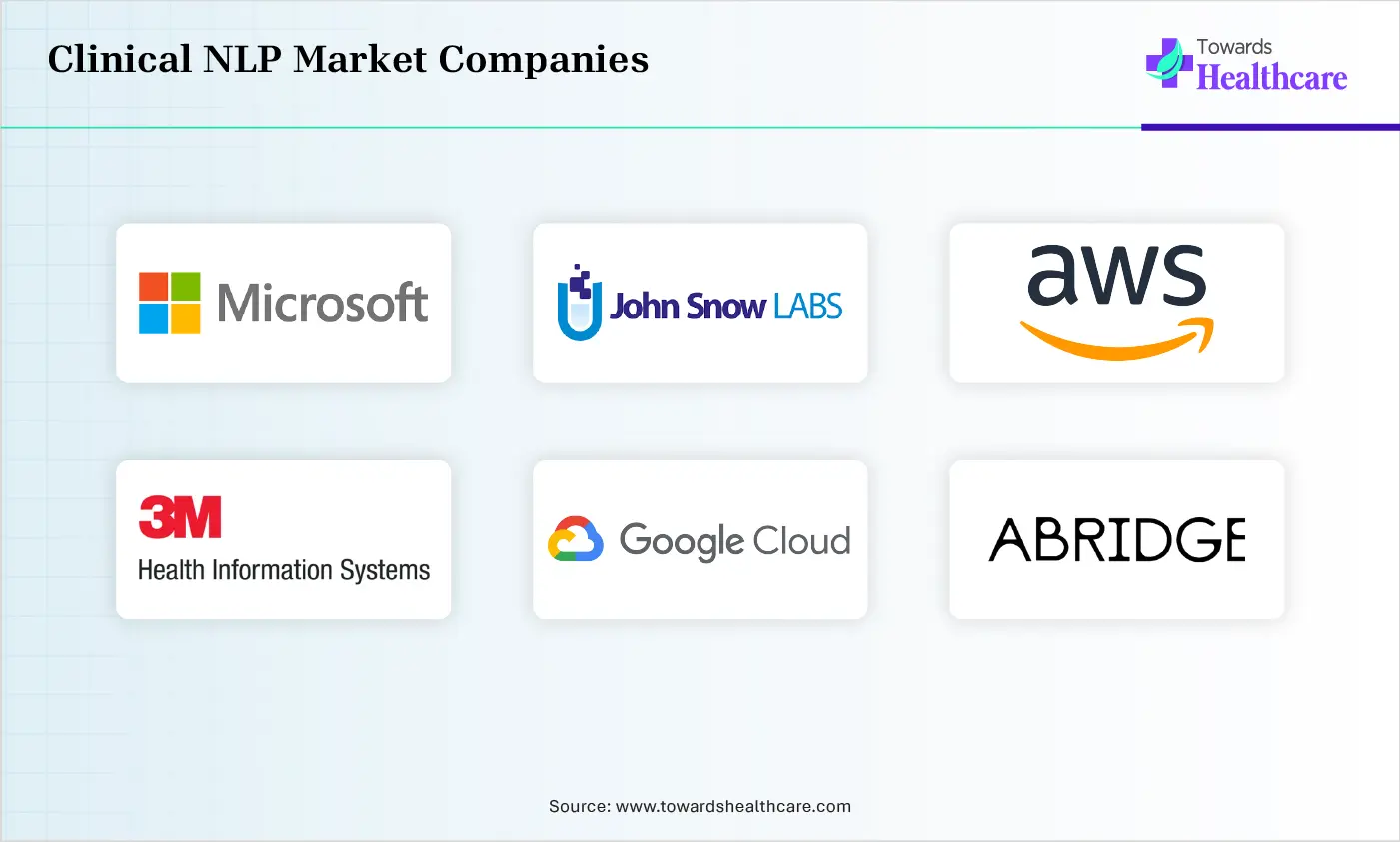
| Top Key Players | Microsoft (Nuance), John Snow Labs, Amazon Web Services (AWS), 3M Health Information, Google Cloud, Abridge, IBM, Suki, IQVIA, Oracle (Cerner) |
| Segment | Share 2025 (%) |
| Speech Recognition | 40% |
| Text Analytics | 35% |
| Clinical Decision Support | 25% |
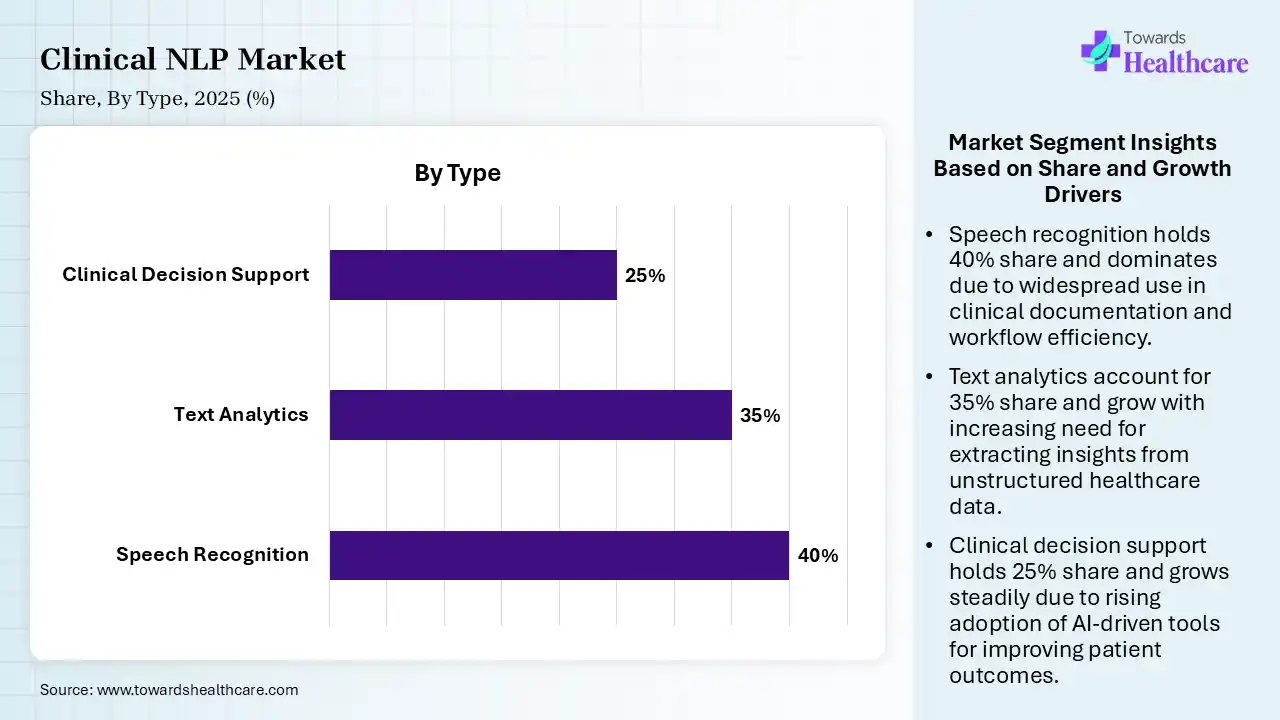
The Speech Recognition Segment Dominated the Market With 40% in 2025
The speech recognition segment led the clinical NLP market with 40% share in 2025, and is expected to witness the fastest CAGR growth during the forecast period, due to increased demand for accurate transcription and voice commands in healthcare. They were also used to reduce documentation time and to enhance workflow efficiency. They were also used across the emergency room, where the growth in voice assistants also increased their adoption rates.
The text analytics segment held the second-largest share of 35% of the market in 2025, due to the rising adoption of text-based insights for patient data analysis. This is promoting the adoption of clinical NLP due to its actionable insights and improved decision support. Their automated manual reviewing, text analysis, enhanced understanding, and faster interpretations are also encouraging their use.
The clinical decision support segment held 25% of the clinical NLP market share in 2025, due to a surge in demand for AI to assist in clinical decision-making processes. This, in turn, is increasing the use of clinical NLP solutions for improved diagnosis, real-time assistance, and decision support. Their faster processes, reduced errors, and seamless integration with EHR systems are also increasing their demand.
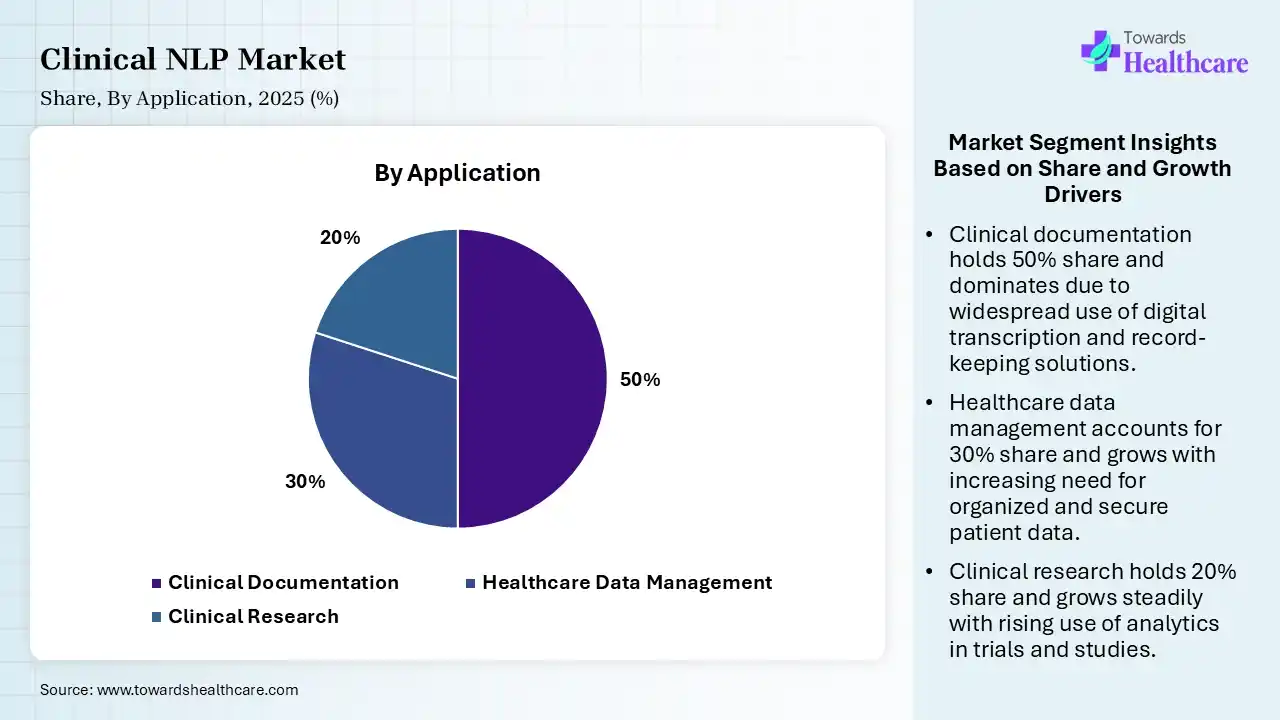
| Segment | Share 2025 (%) |
| Clinical Documentation | 50% |
| Healthcare Data Management | 30% |
| Clinical Research | 20% |
The Clinical Documentation Segment Dominated the Market With 50% in 2025
The clinical documentation segment accounted for the highest revenue share of 50% of the clinical NLP market in 2025, due to widespread adoption of EHR systems and the need for accurate clinical documentation. Their enhanced accuracy, consistency, and faster processing also increased their adoption rates. They were also used for the medical billing and coding process due to their enhanced accuracy.
The healthcare data management segment held the second-largest share of 30% of market share in 2025, due to the data explosion in healthcare requiring efficient management and processing. This drives the demand for clinical NLP for the development of structured data and predictive analytics. Their interoperability, affordability, and regulatory compliance also increase their use.
The clinical research segment held 20% of the clinical NLP market share in 2025, and is expected to show the highest CAGR growth during the forecast period, due to rising research activity and demand for NLP to expedite drug discovery processes. They are being used for the development of clinical notes, research papers, and the identification of new drug targets. This accelerates the drug development and clinical trial, reducing the time, cost, manual efforts, and errors during the clinical research.
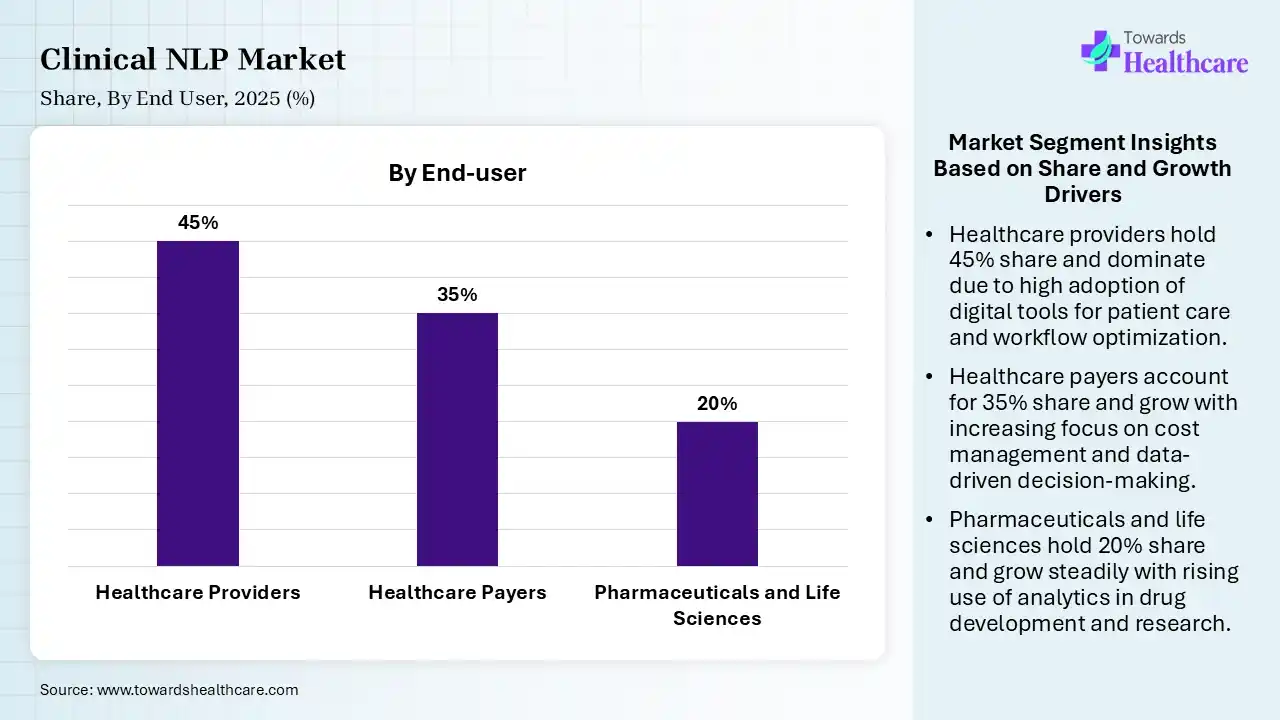
| Segment | Share 2025 (%) |
| Healthcare Providers | 45% |
| Healthcare Payers | 35% |
| Pharmaceuticals and Life Sciences | 20% |
The Healthcare Providers Segment Dominated the Market With 45% in 2025
The healthcare providers segment contributed the biggest revenue share of 45% of the clinical NLP market in 2025, due to expanding EHR use in hospitals, clinics, and other healthcare settings. The clinical NLP platforms were also used for the development of new medical reports and records, which in turn enhanced the documentation efficiency. They were also used for disease diagnosis, treatment planning, and identification of high-risk populations.
The healthcare payers segment held the second-largest share of 35% of the market in 2025 and is expected to gain the highest CAGR growth during the forecast period, due to the growing volume of insurance claims. This is increasing the adoption of NLP for automation of claims processing and fraud detection. Their faster claim processing and improved risk assessment are also promoting their use, where the growing digital transformation is also driving their adoption.
The pharmaceuticals and life sciences segment held 20% of the clinical NLP market share in 2025, and is expected to be the fastest-growing segment during the forecast period, due to increasing research into disease management and drug development. This, in turn, is increasing the adoption of clinical NLP for the development of structured data from the unstructured literature and identification of adverse drug reactions. The growing demand for precision medicine and increasing R&D activities are also increasing their use for the identification of patient-specific information and regulatory compliance.
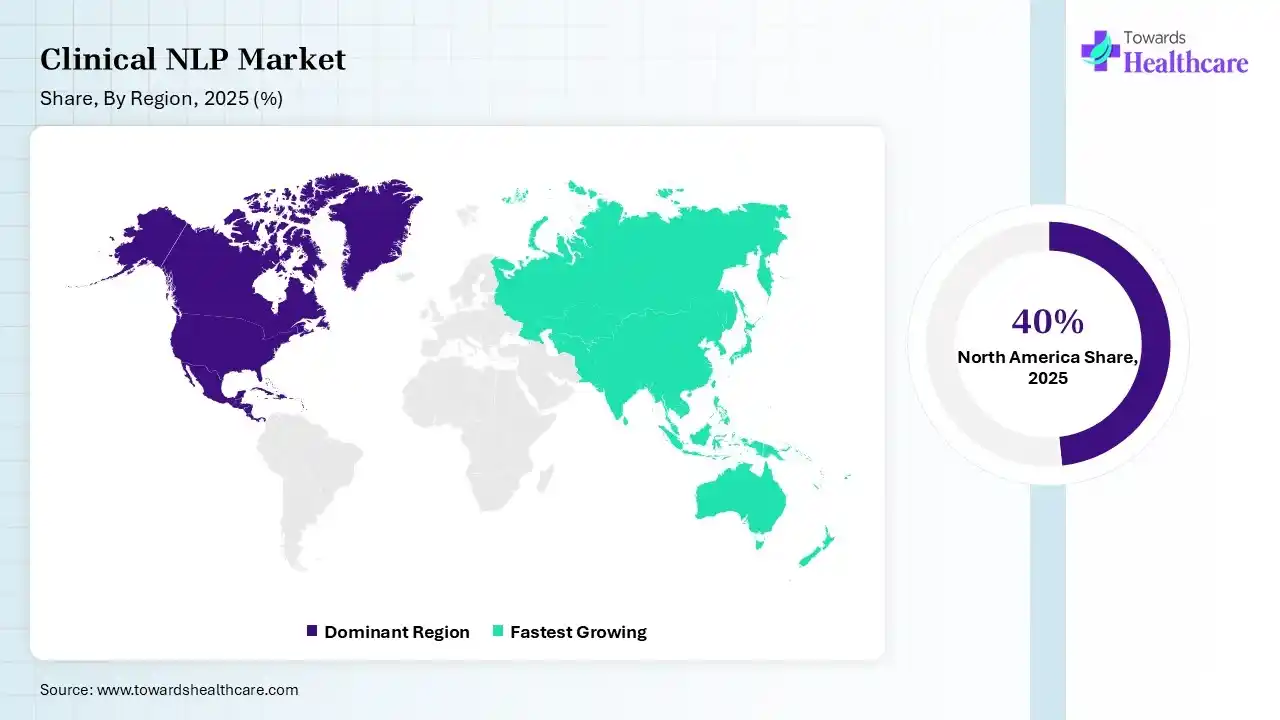
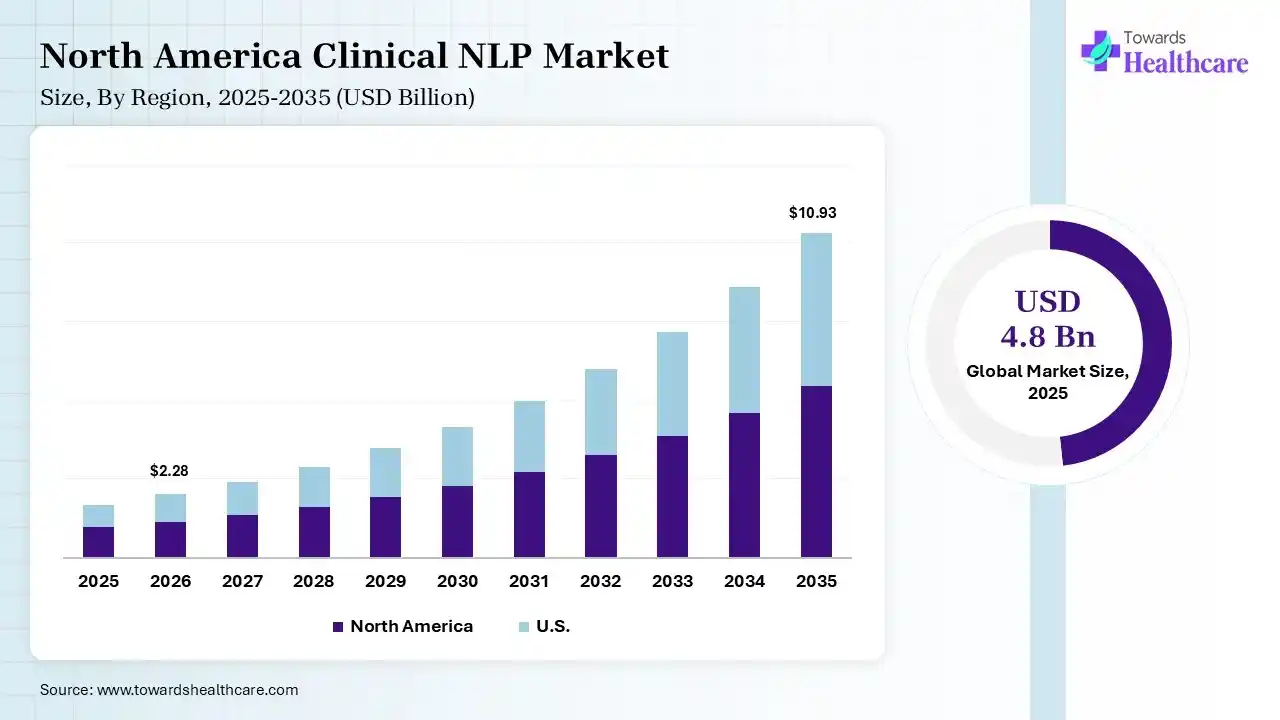
North America dominated the clinical NLP market with 40% in 2025, due to strong healthcare infrastructure and rapid AI adoption. The growth in the adoption of EHR and expanding technological ecosystems has also increased the adoption of clinical NLP platforms. A rise in healthcare spending also increased their adoption, which contributed to the market growth.
U.S. Market Trends
Regulatory mandates and the increasing use of AI-driven healthcare solutions across the U.S. are increasing the adoption of clinical NLP platforms. Expanding healthcare digitalization and the adoption of advanced technologies are also increasing their use and innovations. Growing clinical trials are also increasing their demand.
Canada Accelerates Growth in the Clinical NLP Market
The Canada clinical MLP market is growing due to increasing adoption of electronic health records (EHR), rising investments in AI-powered healthcare technologies, and expanding digital health initiatives. Growing demand for automated clinical documentation, improved healthcare data analytics, and clinical decision support solutions is driving and supporting government initiatives, which are further accelerating the adoption of clinical NLP across healthcare systems.
Asia Pacific held 20% share of the clinical NLP market in 2025 and is expected to grow at the fastest CAGR during the forecast period, due to rapid digitalization in healthcare in emerging economies. The presence of a large patient population and a rise in R&D activities are also increasing the adoption of clinical NLP platforms. Expanding government initiatives and technological advancements are also enhancing the market growth.
China Advances AI-Driven Clinical NLP Innovation
The China clinical NLP market is growing due to rapid healthcare digitization, increasing adoption of artificial intelligence in clinical workflows, and expanding electronic health records (EHR), systems. Rising investments in healthcare AI, growing demand for automated medical documentation, and advancements in natural language processing technologies are driving market growth. Strong government support for digital healthcare transformation is further accelerating the adoption of clinical NLP solutions.
India Market Trends
High demand for healthcare innovation and digital data management across India is increasing the adoption of clinical NLP platforms. Expanding healthcare, R&D activities, and telemedicine platforms are also increasing their adoption and accessibility. Moreover, growing innovations and a shift towards digital health tools are also increasing their use.
Europe is expected to grow significantly in the clinical NLP market during the forecast period, due to stringent government regulations and expanding healthcare digitalization. Increasing R&D activities and the presence of robust industries and institutions are also increasing the use of clinical NLP platforms. Growing healthcare investments are also promoting the market growth.
UK Market Trends
Increasing focus on enhancing EHR and NLP adoption for clinical documentation is driving the market expansion in the UK. Rapid healthcare digitalization and expanding research ecosystems are also increasing their innovations. Growing collaboration and government support are also increasing the adoption of clinical NLP solutions.
| Ecosystem Segment | Key Participants | Role in Market |
| Technology Providers | Microsoft, Google Cloud, AWS, Oracle Health, IBM | Provide AI infrastructure, NLP models, cloud platforms, healthcare AI services |
| Product Manufacturers | Nuance, 3M Health Information Systems, Suki, Abridge | Develop clinical documentation and speech recognition solutions |
| Service Providers | IQVIA, Optum, Wolters Kluwer | Deliver healthcare analytics, implementation, and consulting services |
| Platform Providers | Oracle Health, AWS, Google Cloud, Microsoft Azure | Provide cloud-based healthcare NLP deployment platforms |
| CROs | IQVIA, ICON plc, Parexel | Utilize NLP for clinical trials, patient identification, and data extraction |
| Software Vendors | John Snow Labs, Linguamatics (IQVIA), Abridge, Suki | Deliver specialized healthcare NLP software solutions |
| Research Institutions | Mayo Clinic, Stanford Medicine, Cleveland Clinic, NIH | Drive innovation, validation, and adoption of clinical NLP technologies |
| End-User Industries | Healthcare Providers, Healthcare Payers, Pharmaceutical & Life Sciences | Deploy NLP for operational efficiency and clinical intelligence |
| Tier 1 | Tier 2 | Tier 3 | |
| Typical Market Influence | 63% | 27% | 10% |
| Tier 1 | ||||
| Company Name | Headquarters | Country | Why Relevant to This Market | Key Products/Services |
| Microsoft (Nuance Communications) | Redmond, Washington, USA | USA | Global leader in clinical speech recognition and ambient documentation | Dragon Medical One, DAX Copilot |
| Oracle Health | Austin, Texas, USA | USA | Large EHR ecosystem integrating clinical NLP workflows | Oracle Health EHR, Clinical AI Solutions |
| Amazon Web Services (AWS) | Seattle, Washington, USA | USA | Major provider of healthcare NLP cloud infrastructure | Amazon Comprehend Medical |
| Tier 2 | ||||
| Company Name | Headquarters | Country | Why Relevant to This Market | Key Products/Services |
| IQVIA | Durham, North Carolina, USA | USA | Leading life sciences analytics and NLP provider | Linguamatics NLP Platform |
| 3M Health Information Systems | Salt Lake City, Utah, USA | USA | Established clinical documentation and coding provider | 3M M*Modal |
| John Snow Labs | Lewes, Delaware, USA | USA | Specialized healthcare NLP and healthcare LLM provider | Spark NLP for Healthcare |
| Tier 3 | ||||
| Company Name | Headquarters | Country | Why Relevant to This Market | Key Products/Services |
| Abridge | Pittsburgh, Pennsylvania, USA | USA | Fast-growing clinical conversation intelligence company | Abridge Clinical Documentation Platform |
| Suki | Redwood City, California, USA | USA | Healthcare-focused AI assistant provider | Suki Assistant |
| Augmedix | San Francisco, California, USA | USA | AI-enabled medical documentation specialist | Augmedix Go |
Strengths
Weaknesses
Opportunities
Threats
By Type
By Application
By End-user
By Region








Principal Consultant
Payal Rabde is a Healthcare Market Research Analyst at Towards Healthcare Research & Consulting with 4+ years of experience in pharmaceuticals, biotechnology, medical devices, and life sciences.
Learn more about Payal Rabde

Reviewed By
Aditi Shivarkar is a seasoned professional with over 14 years of experience in healthcare market research. As a content reviewer, Aditi ensures the quality and accuracy of all market insights and data presented by the research team.
Learn more about Aditi Shivarkar