The growing chronic disease burden, advancements in oncology, increasing demand for personalized medicines, expanding clinical laboratory automation, growing data-driven pathology, increasing biomarker discoveries, expanding companion diagnostics advancements, and increasing technological innovations are promoting the market growth.
Market at a Glance: Mapping the U.S. Multiple Immunohistochemistry Landscape
Multiple immunohistochemistry is a technique used to visualize and detect multiple biomarkers or proteins simultaneously in a single tissue section. They are used for cancer diagnosis, tumor microenvironment analysis, biomarker discovery, and personalized medicine development. They are also being used for research purposes focused on autoimmune diseases, neurological diseases, and infectious diseases.
Global Market Growth
The global multiple immunohistochemistry market size was estimated at USD 3.84 billion in 2025 and is predicted to increase from USD 4.29 billion in 2026 to approximately USD 11.72 billion by 2035, expanding at a CAGR of 11.8% from 2026 to 2035.
Unlocking Growth: Emerging Opportunities in Multiple Immunohistochemistry
- The growth in cancer incidences in the U.S. is increasing the use of multiple immunohistochemistry tests for early cancer detection and immunotherapy selection.
- Increasing demand for personalized and precision medicine is also increasing their adoption rates.
- Expansion for companion diagnostics for the development of targeted treatment options is also driving their use.
- Growing drug discoveries, biomarker discoveries, and clinical trials are also increasing the use of multiple immunohistochemistry techniques.
- Its expanding applications across infectious, autoimmune, and neurological diseases are also driving their adoption.
- Increasing technological advancements are also accelerating their innovations.
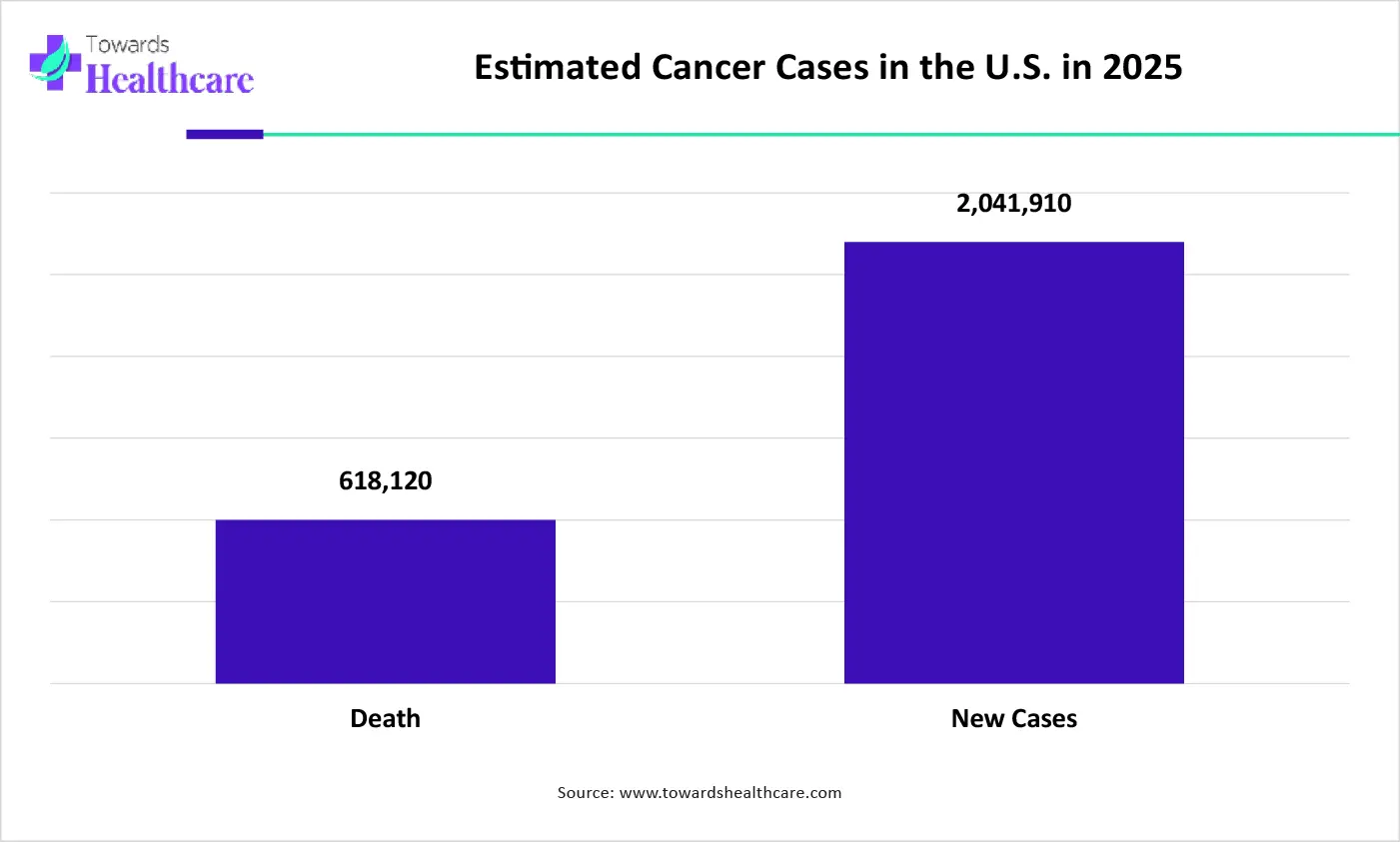
The graph represents the estimated number of U.S. cancer deaths and new cases in the year 2026. It indicates that there will be a growth in the cancer burden in the U.S., which will drive the demand for its accurate diagnostic and effective treatment options. This, in turn, will drive the adoption of multiple immunohistochemistry solutions for the development of new diagnostic and targeted treatment options for multiple cancer types, which will ultimately promote market growth.
Market Segmentation Overview
- By product & reagent type, the antibodies segment accounted for the highest revenue share of 38% of the U.S. multiple immunohistochemistry market in 2025, as they were essential for specific protein biomarker detection. Their high specificity and binding affinity also increased their use. They were also used for tumor profiling and biomarker-based personalized medicine development.
- By technology type, the fluorescence-based multiplex IHC segment held a major revenue share of 42% of the U.S. multiple immunohistochemistry market in 2025, driven by its simultaneous biomarker detection. Its high sensitivity and resolution have also increased its use. Its quantitative and reproducible results also promoted their adoption.
- By application type, the oncology segment contributed the biggest revenue share of 52% of the U.S. multiple immunohistochemistry market in 2025, due to growth in its incidence rates. This increased the use of multiple immunohistochemistry techniques for tumor profiling, immunotherapy research, and cancer diagnosis. They were also used for targeted and personalized treatment development.
- By end user, the pharmaceutical & biotechnology companies segment contributed the biggest revenue share of 34% of the U.S. multiple immunohistochemistry market in 2025, driven by growth in the drug discovery, companion diagnostic, and precision medicine. This increased the use of multiple immunohistochemistry for biomarker identification and drug efficacy evaluation. They were also used for multiple tissue analyses.
- By imaging system type, the slide scanners segment led the U.S. multiple immunohistochemistry market with 31% share in 2025, due to high-throughput whole tissue slide scanning. Their high-quality and high-resolution digital images also increased their use. They also supported analysis of chromogenic or multiplex fluorescent stain and offered reproducible results.
Regional Analysis
The U.S. multiple immunohistochemistry market held a 31% share in 2025 and is expected to show considerable growth during the forecast period, due to the growth in cancer cases. The presence of advanced healthcare infrastructure and major industries also increased the adoption and innovations of multiple immunohistochemistry systems. The rise in the demand for precision medicine and biomarker-based companion diagnostics also contributed to the market growth.
The Power Players: Spotlight on the U.S. Leading Companies
F. Hoffmann-La Roche Ltd. dominated the market with its VENTANA DISCOVERY ULTRA and VENTANA BenchMark Ultra, DISCOVERY Chromogens, where Danaher Corporation (Lecia Biosystems) was its closest competitor, which offered BOND RX, BOND Polymer Refine Detection kits, and Aper io VERSA software. Akoys Biosciences, Inc. also sustained its position by offering Opal Multiplex IHC kits, where Thermo Fisher Scientific Inc. also contributed to the market growth by providing Lab Vision Antibodies, Alexa, Fluor, and SuperBoost TSA kits.
Segments Covered in the Report
By Product & Reagent
- Antibodies
- Primary Antibodies
- Monoclonal Antibodies
- Polyclonal Antibodies
- Secondary Antibodies
- Recombinant Antibodies
- Detection Kits
- Chromogenic Detection Kits
- Fluorescent Detection Kits
- Tyramide Signal Amplification Kits
- Buffers & Reagents
- Blocking Reagents
- Antigen Retrieval Reagents
- Mounting Media
- Wash Buffers
- Consumables
- Slides
- Coverslips
- Tissue Microarrays
- Software & Image Analysis Tools
- AI-based Image Analysis
- Quantification Software
- Cloud-based Analytics Platforms
By Technology
- Fluorescence-based Multiplex IHC
- Cyclic Immunofluorescence
- Spectral Imaging
- Quantum Dot-based Detection
- Chromogenic Multiplex IHC
- Brightfield Multiplexing
- Sequential Chromogenic Staining
- Mass Spectrometry-based IHC
- Imaging Mass Cytometry
- MIBI Technology
- Digital Spatial Profiling
- AI-integrated Multiplex Imaging
By Application
- Oncology
- Breast Cancer
- Lung Cancer
- Colorectal Cancer
- Melanoma
- Hematologic Malignancies
- Immunology
- Autoimmune Disorders
- Inflammatory Diseases
- Neuroscience
- Infectious Diseases
- Stem Cell Research
- Drug Discovery & Companion Diagnostics
By End User
- Pharmaceutical & Biotechnology Companies
- Drug Development Laboratories
- Translational Research Units
- Academic & Research Institutes
- Universities
- Government Research Centers
- Hospitals & Diagnostic Laboratories
- Pathology Laboratories
- Reference Laboratories
- Contract Research Organizations (CROs)
- Clinical Research Organizations
By Imaging System
- Slide Scanners
- Whole Slide Imaging
- High-throughput Scanners
- Confocal Microscopes
- Multispectral Imaging Systems
- Digital Pathology Systems
- Mass Cytometry Imaging Systems
By Workflow
- Manual Workflow
- Semi-automated Workflow
- Fully Automated Workflow
By Panel Size
- Low-Plex Panels (2–5 Markers)
- Mid-Plex Panels (6–15 Markers)
- High-Plex Panels (16–40 Markers)
- Ultra-High Plex Panels (40+ Markers)




