


Profound Medical Corp. is pleased to announce that its MRI-driven, AI-based, robotically driven and incisionless TULSA procedure will be highlighted in some presentations by leading doctors at the upcoming Society of Robotic Surgery ("SRS") annual meeting to be held in Fort Lauderdale, FL.
Dr. Meng commented, "UT Southwestern has helped pioneer the TULSA Procedure for prostate cancer, having reached the 100th procedure milestone back in 2022, well before the CPT Category 1 codes became effective in January 2025. I am honored by this opportunity to share my experience, both as a surgeon and a researcher, at SRS2026."
The SIS, which held its inaugural board meeting in March 2026, will begin its activities as a chapter of SRS by spotlighting a select group of organizations shaping the future of surgery, practical medicine, and intelligent operating housings. Based on SIS, its upcoming plenary session is intended not only to showcase skill, but also to highlight a wider vision for the future of operation, one in which energy-driven management, image guidance, robotics, artificial intelligence, and healthcare data platforms work together to enhance results and increase what is possible for consumers and physicians alike.
Profound is honored to have been selected as one of only eight organizations to be highlighted during the SIS plenary session at SRS2026:
Dr. Y. Mark Hong, Medical Director of Integrative Urology in Phoenix, Arizona, is an innovator in MRI-driven, incisionless management of prostate disease and globally recognized for his focus on precision, anatomy-based therapy, and personalized patient care.
"Profound's TULSA-PRO represents a fundamentally different approach to traditional robotic surgery," said Dr. Hong. "By combining real-time MRI guidance, artificial intelligence, and supervised robotic autonomy, the platform enables surgeons to deliver highly personalized treatment based on each patient's unique anatomy and disease.
TULSA allows doctors to tailor management in a continuum of prostate disease, from whole-gland ablation to significantly targeted focal therapy and the whole thing in between. That flexibility enables targeted care while conserving quality of life whenever clinically suitable. TULSA's AI-driven approach has smoothed the learning curve and broader acceptance while maintaining excellent results with growing autonomy.
I believe this represents the future of prostate disease treatment, and I am honored to share that vision with the distinguished researchers and clinicians attending SRS2026. I also thank the Society of Incisionless Surgery for the opportunity to participate in this important discussion on the future of robotic and image-guided surgery."
Furthermore, before the start of the authorized SRS2025 clinical program, on July 22, 2026, Profound's management team participated in an Investor Session moderated by well-regarded medtech equity investment analysts, Rick Wise, Managing Director at Stifel Financial, and Larry Biegelsen, Managing Director at Wells Fargo:
Observing on Profound's first-time participation in the Investor Session, Dr. Menawat said, "SRS2026 is a significant worldwide organization event which covers all surgical specialties and robotic technologies, associating top surgeons, scientists, engineers, and economic investors to accelerate robotic-assisted surgery. We are looking forward to sharing our story there."
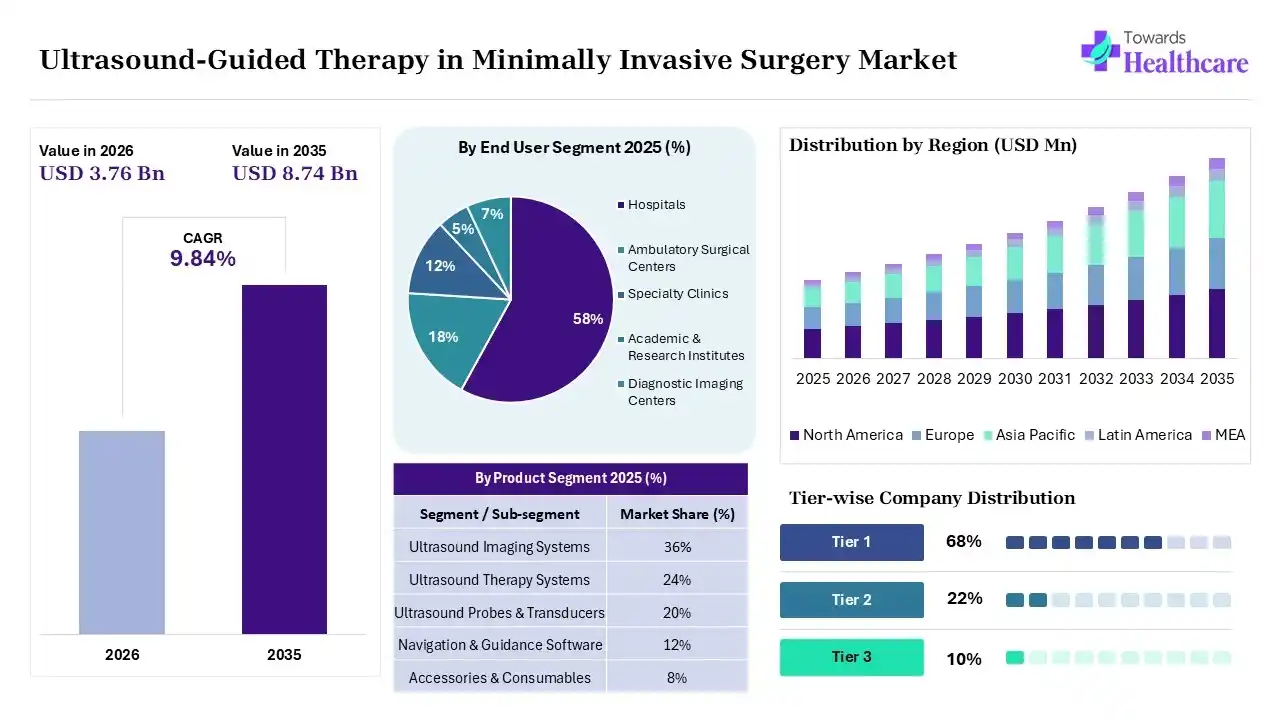
According to Towards Healthcare, the ultrasound-guided therapy in minimally invasive surgery market is projected to experience significant growth, with estimates suggesting the market size will increase from USD 3.76 billion in 2026 to approximately USD 8.74 billion by 2035, representing a compound annual growth rate (CAGR) of 9.84% from 2026 to 2035, driven by ultrasound-guided surgery lessening the pain and discomfort related to traditional blind injections. The doctor applies the ultrasound machine to find the most accessible place to insert the needle and guide it with great precision, making it less likely the needle hits a nerve or other sensitive structure. An ultrasound-guided procedure is a healthcare procedure that uses ultrasound imaging to guide the insertion of a needle in the body. The procedure includes using an ultrasound machine that emits high-frequency sound waves that reflect off the body's inner structures and make an image on a screen.
Profound is a commercial-stage healthcare device organization and an innovator in interventional MRI (iMRI) processes. The organization's flagship platform, TULSA-PRO, allows MRI-driven, incision-free prostate ablation. Doctors use the TULSA Procedure to see, ablate, and ensure therapy in real time, helping targeted treatment approaches in the continuum of prostate care from whole-gland to subtotal, hemi, multifocal, and focal management. This strategy allows personalized care using prostate tissue ablation, while reducing the strength for adverse effects that are generally related to surgery or radiation, like urinary incontinence and erectile dysfunction.
A recent report by Towards Healthcare highlights that the ultrasound-guided therapy in the minimally invasive surgery market is growing, as ultrasound guidance enables doctors to protect sensitive structures like blood vessels, organs, and nerves. With the real-time imaging offered by the ultrasound machine, the doctor guides the needle with precision, preventing accidental punctures or harm to surrounding tissue.


