Towards Healthcare
AI in Medical Scheduling Software Market to Grow at 28.14% CAGR till 2035

AI in Medical Scheduling Software Market Gains With Remote Care

According to market projections, the AI in medical scheduling software sector is expected to grow from USD 204.79 million in 2025 to USD 2444.35 million by 2035, reflecting a CAGR of 28.14%.The increasing number of hospital admissions and the growing demand for telemedicine drive the global market. North America dominated the global market due to a robust healthcare infrastructure and favorable regulatory support.

Category: Healthcare IT Insight Code: 6474 Format: PDF / PPT / Excel
next-arrow
Revenue, 2025
204.79 Million
next-arrow
Forecast, 2035
2444.35 Million
next-arrow
CAGR, 2026 – 2035
28.14%
next-arrow
Report Coverage
Global

AI in Medical Scheduling Software Market Size, Dynamics with Forecast amd Key Players

The global AI in medical scheduling software market size is calculated at USD 204.79 million in 2025, grew to USD 262.42 million in 2026, and is projected to reach around USD 2444.35 million by 2035. The market is expanding at a CAGR of 28.14% between 2026 and 2035.
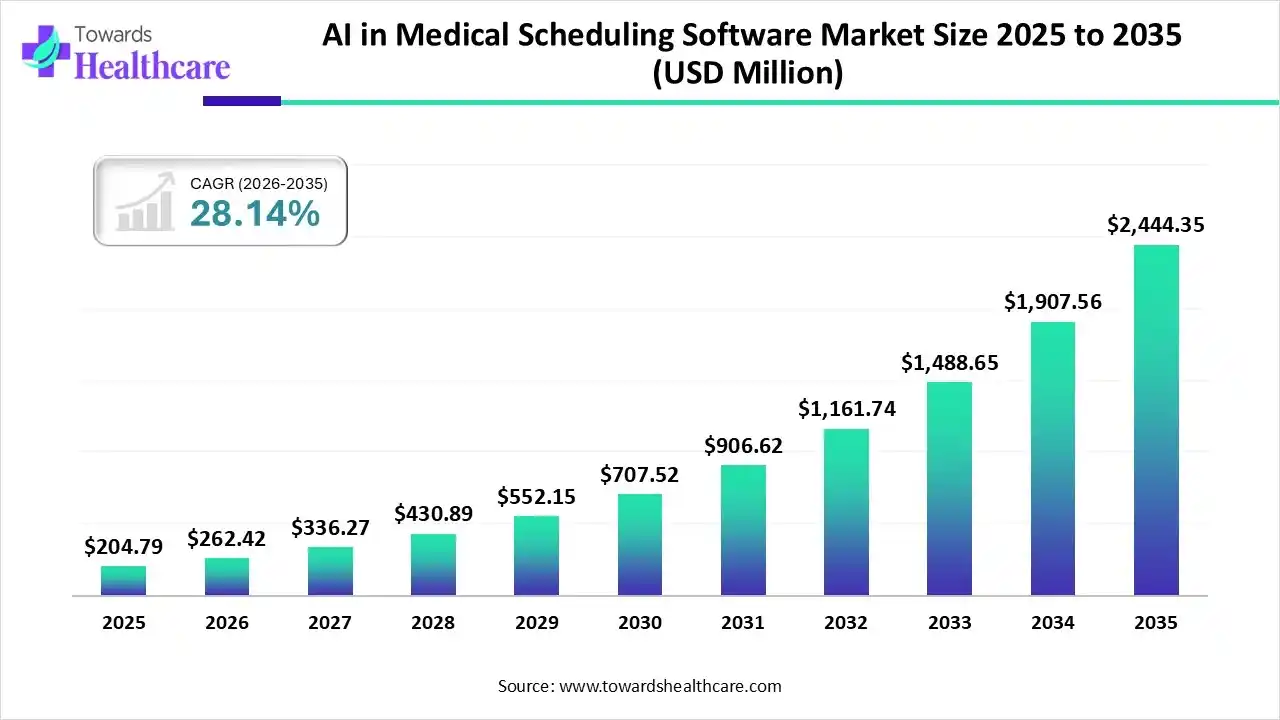
AI in Medical Scheduling Software Market Trends and Growth (2026)

Key Takeaways

  • The AI in medical scheduling software market will likely exceed USD 262.42 million by 2026.
  • Valuation is projected to hit USD 2444.35 million by 2035.
  • Estimated to grow at a CAGR of 28.14% starting from 2026 to 2035.
  • North America held a major revenue share of the market in 2024.
  • Asia-Pacific is expected to be the fastest-growing region during the forecast period.
  • By product type, the patient scheduling segment accounted for the highest revenue share of the market in 2024.
  • By product type, the care provider scheduling segment is expected to expand rapidly in the AI in medical scheduling software market in the coming years.
  • By deployment model, the cloud-based segment led the market in 2024 and is expected to grow at the fastest CAGR during the forecast period.
  • By deployment model, the on-premises segment is expected to grow at a significant CAGR in the market during the forecast period.
  • By end-use, the hospitals segment held a dominant revenue share of the market in 2024.
  • By end-use, the clinics segment is expected to witness the fastest growth in the market over the forecast period.

Quick Facts Table

Key Elements Scope
Market Size in 2026 USD 262.42 Million
Projected Market Size in 2035 USD 2444.35 Million
CAGR (2026 - 2035) 28.14%
Leading Region North America
Market Segmentation By Product Type, By Deployment Model, By End-Use, By Region
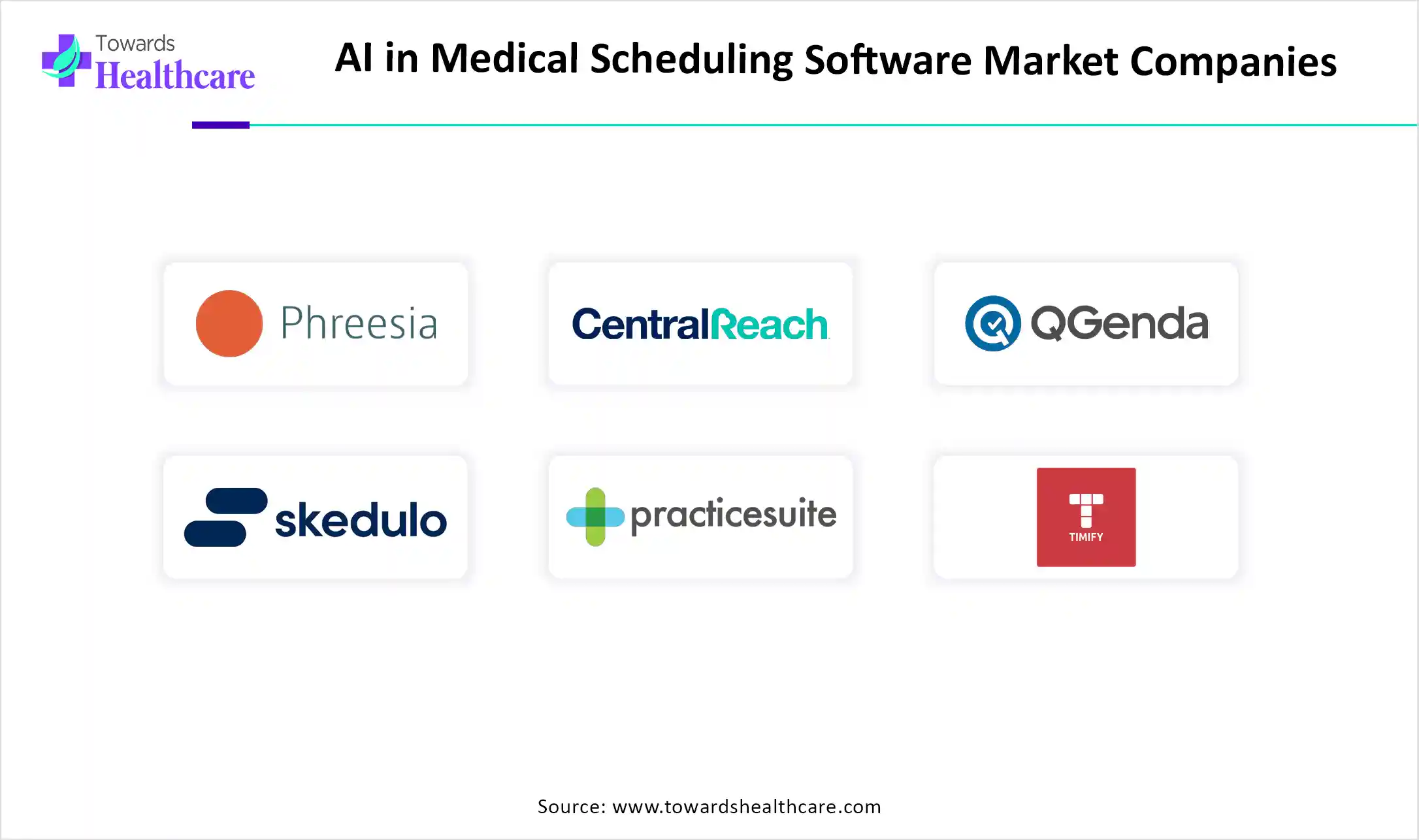
Top Key Players Phreesia, CentralReach, QGenda, RXNT, Skedulo, PracticeSuite, Doctor Connect, TIMIFY, Clearwave, WellSky

The AI in medical scheduling software market is primarily driven by the increasing patient population and the shortage of healthcare professionals. Artificial intelligence (AI) automates scheduling medical staff and patients, enhancing efficiency and accuracy. Regulatory agencies authorize the use of medical scheduling software, enabling high-quality, personalized outcomes. The increasing integration with electronic health records (EHRs) and electronic medical records (EMRs) presents future opportunities for the market.

The AI in medical scheduling software market is experiencing robust growth, driven by the increasing adoption of advanced technologies, growing demand for personalized care, and the rising awareness of remote monitoring and telemedicine. It encompasses the development and deployment of AI-based software for medical scheduling. Medical scheduling software is a suite of digital tools that help healthcare organizations schedule patients and medical staff faster. It reduces administrative tasks by checking in patients, conducting outreach, and billing for care.

AI in Medical Scheduling Software Market Outlook

  • Industry Growth Overview: The market is expected to accelerate in the coming years, driven by the increasing integration of EMRs/EHRs and the growing patient population. AI-driven automation and predictive analytics enhance operational efficiency and provide personalized experiences.
  • Global Expansion: Key players collaborate to deliver advanced, proprietary software across diverse patient populations in the world. Medical scheduling software benefits patients by connecting them with healthcare professionals from different geographical locations.
  • Startup Ecosystem: The startup ecosystem is booming, with the development of novel software tools embedded with personalized features. NextPatient, Float, Skedda, and Calendly are among the emerging startups specializing in scheduling software.

Segmental Insights

Which Product Type Segment Dominated the AI in Medical Scheduling Software Market?

Patient Scheduling

The patient scheduling segment held a dominant position in the market in 2024, due to the need for timely patient care, resource optimization, and the increasing hospital admissions. As of March 2025, over 8.9 crore hospital admissions were authorized under the Ayushman Bharat – Pradhan Mantri Jan Aarogya Yojana scheme by the Indian government. Patient scheduling software plays a vital role in coordinating consultations, follow-ups, and medical procedures. It helps healthcare professionals to streamline administrative tasks, such as appointment reminders and confirmations, to improve patient adherence.

Care Provider Scheduling

The care provider scheduling segment is expected to grow at the fastest CAGR in the AI in medical scheduling software market during the forecast period. The shortage of healthcare professionals in various nations necessitates them to use AI-based software to treat multiple patients. The Association of American Medical Colleges (AAMC) estimated that the U.S. will face a physician shortage of up to 86,000 physicians by 2036. Care provider scheduling software allows providers to collect primary health information to ensure better care delivery. 

Nurse Scheduling

The nurse scheduling segment is expected to grow in the coming years, due to major advantages for nurses, such as flexible workdays, more per diem options, and steady workflow. Nurse scheduling software facilitates scheduling nurses for various functions, such as outpatient, surgery, educators, managers, and case managers. It addresses the potential challenges of the nurse shortage.

Why Did the Cloud-based Segment Dominate the AI in Medical Scheduling Software Market?

Cloud-based

The cloud-based segment held the largest revenue share of the market in 2024 and is expected to grow at the fastest CAGR during the forecast period, due to high scalability and flexibility. Cloud-based software can store vast amounts of data and can be accessed from anywhere and at any time. It eliminates the need for a specialized infrastructure to install patient scheduling devices, saving extra costs for maintenance. It offers much better security and backup facilities for easier and faster data recovery.

On-Premises

The on-premises segment is expected to grow at a significant CAGR in the AI in medical scheduling software market during the studied years. On-premises tool provides complete control over medical scheduling, eliminating the need for internet connectivity. It is not available on a subscription basis, and the data is easily portable. Since on-premises tools are not based on internet connectivity, they offer enhanced security. They are mostly used in large enterprises as they have suitable infrastructure for their installation.


How the Hospitals Segment Dominated the AI in Medical Scheduling Software Market?

Hospitals

The hospitals segment contributed the biggest revenue share of the market in 2024, due to the availability of favorable infrastructure and suitable capital investments. Hospitals witness the highest number of patient admissions, potentiating the need for managing providers’ and patients’ scheduling. Patients prefer visiting hospitals due to the presence of multidisciplinary expertise and favorable reimbursement policies. Hospitals are encouraged to use advanced software tools by regulatory agencies.

Clinics

The clinics segment is expected to expand rapidly in the AI in medical scheduling software market in the coming years. The increasing number of specialized clinics and the presence of skilled professionals favor the segment’s growth. Scheduling software is essential for outpatient clinics to enhance efficiency and timely access to healthcare services. It improves patient experience, attracts more patients, and increases clinic productivity.
 

Regional Analysis

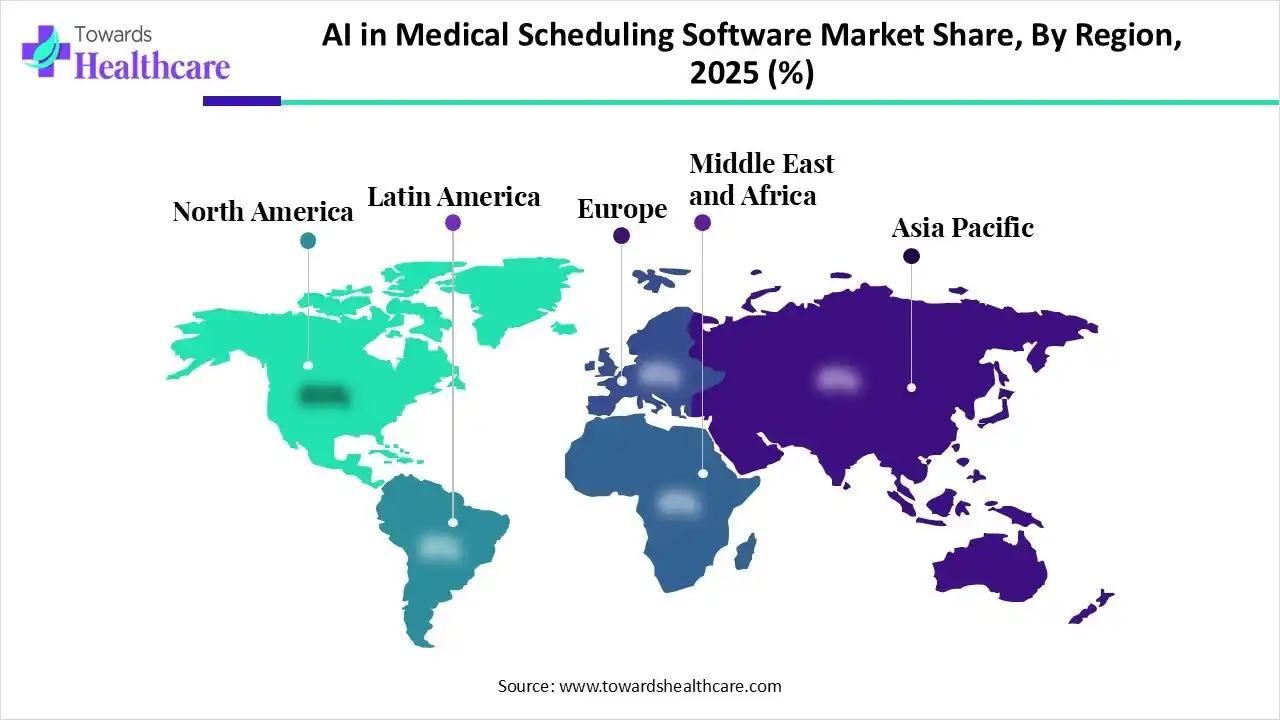
AI in Medical Scheduling Software Market Share, By Region, 2025 (%)

  • North America dominated the global market in 2024.
  • Asia-Pacific is expected to grow at the fastest CAGR in the market during the forecast period.
  • Europe is expected to grow at a considerable CAGR in the upcoming period.
  • The global market is gaining significant traction across South America.
  • The Middle East and Africa (MEA) region is experiencing a notable surge in digital health modernization.

North America dominated the global market in 2024. The availability of a robust healthcare infrastructure, the presence of key players, and favorable regulatory support are the major factors that contribute to market growth in North America. The increasing number of hospital admissions and the rising adoption of advanced technologies propel the market.

Key Players Contribute to the U.S. Dominance

Key players, such as AdvancedMD, NextGen Healthcare Information Systems, LLC, and Veradigm, Inc., are major contributors to the market in the U.S. Medical scheduling software in the U.S. must comply with HIPAA guidelines to ensure data encryption and access controls, protecting patient confidentiality and meeting legal requirements.

Asia-Pacific is expected to grow at the fastest CAGR in the market during the forecast period. Government organizations provide funding and launch initiatives to adopt advanced technologies, streamlining workflows. The increasing patient population and the growing geriatric population enable healthcare professionals to provide personalized care. Countries like China, India, and Japan face a shortage of doctors owing to the increasing population.

Increasing Hospital Admissions Fuels China’s Growth

In 2023, China witnessed over 301 million hospital admissions, representing a staggering 21.4% of its population. This means that for every 100 Chinese people, more than 21 hospital admissions occurred. In China, more than 16,000 hospitals have adopted EHRs. moCal, Healthray, and eHospital Systems are major healthcare scheduling solutions in China.

Europe is expected to grow at a considerable CAGR in the upcoming period. The burgeoning healthcare sector, favorable government support, and evolving regulatory landscapes boost the market. Increasing investments and public-private partnerships augment the market. The European Commission allocated €1.3 billion as part of the “Digital Europe Programme” from 2025 to 2027 to support the deployment of AI by businesses and public administration.

Favorable Government Support to Drive the UK

Medesk, e-clinic, Systematic, and AspireCRM provide high-quality medical scheduling software. The UK government makes constant efforts to encourage the use of AI in hospitals to improve patient care while protecting patient data and privacy. NHS clinicians will be supported to use AI tools to free up staff time and deliver better care to patients.

The AI in medical scheduling software market is gaining significant traction across South America. Healthcare providers are rapidly adopting these solutions to optimize staff allocation, reduce patient wait times, and drastically enhance operational efficiency. This digital shift supports improved overall patient access and care coordination.

Brazil Leading Adoption Charge

Brazil stands out as the frontrunner in Latin America for healthcare AI adoption. Government and private sector investments are strongly backing AI development agendas. The integration of advanced AI platforms for rapid medical record analysis demonstrates a serious commitment to modernizing healthcare delivery.

The Middle East and Africa (MEA) region is experiencing a notable surge in digital health modernization. GCC countries in particular are anchoring a major portion of this spend with large enterprise AI suite deployments. Smart hospital projects and rising health information technology investments are key drivers across this area.

GCC Countries Prioritize Investment

Gulf Cooperation Council nations are heavily investing in AI for improved patient outcomes and care delivery productivity. AI-driven tools are providing solutions to automate various administrative tasks like initial assessments and resource allocation. This strategic approach aims to supercharge the entire healthcare ecosystem.

Top Companies & Their Offerings in the AI in Medical Scheduling Software Market

Companies Headquarters Offerings
NexHealth California, United States It offers patient scheduler software resources to streamline healthcare scheduling, optimize appointments, and enhance patient care.
AdvancedMD Utah, United States AdvancedScheduling software is flexible for solo & multiple providers, as well as practices with complex front office staff.
NextGen Healthcare Information Systems, LLC Georgia, United States It offers medical practice registration and scheduling to automate eligibility verification, customize functionality, and optimize utilization of appointment times.
Ops Labs Texas, United States OSP develops customized healthcare scheduling systems for hospitals to optimize human resources management and reduce staff burnout due to overtime.
Veradigm, Inc. Illinois, United States It offers practice management software to effortlessly manage front-office and back-office operations for easy scheduling, billing, and claims processing.

Which Companies Are Leading the AI in Medical Scheduling Software Market?

AI in Medical Scheduling Software Market Companies

  • Phreesia
  • CentralReach
  • QGenda
  • RXNT
  • Skedulo
  • PracticeSuite
  • Doctor Connect
  • TIMIFY
  • Clearwave
  • WellSky

Corporate Information

  • Headquarters: Atlanta, Georgia, U.S.
  • Year Founded: 2006
  • Ownership Type: Privately held (backed by Vista Equity Partners)

History and Background

  • Began by focusing on physician scheduling to address inefficiencies and burnout.
  • Expanded into broader workforce and capacity management, including call coverage, room scheduling, and on-call scheduling optimization using AI/ML algorithms.

Key Milestones/Timeline:

  • 2006: Launched physician scheduling solution.
  • 2018: Received significant investment from Vista Equity Partners.
  • 2022: Expanded AI functionality for predictive capacity management.
  • 2024: Reported serving over 4,000 healthcare organizations globally.

Business Overview

Provides enterprise-wide solutions for automated, optimized physician and staff scheduling, and resource management. Its core AI function optimizes complex rules, availability, and labor laws.

Business Segments/Divisions

  • QGenda Provider Scheduling: Core solution for physician and advanced practice provider (APP) rostering.
  • QGenda Capacity: Resource scheduling for ORs, infusion centers, and equipment.
  • QGenda On-Call: Automated communication and call center management.

Geographic Presence

Primarily North America (U.S., Canada), with growing presence in Europe and Australia.

Key Offerings

  • AI-Powered Scheduling: ML algorithms generate and optimize schedules based on fairness, resource capacity, and staff preferences, dramatically reducing manual administrative time (reportedly up to 80%).
  • Enterprise Resource Management: Optimizes the use of highly utilized assets like operating rooms and imaging equipment.

End-Use Industries Served

Large hospital systems and health networks, academic medical centers, specialty groups, and ambulatory centers.

Key Developments and Strategic Initiatives (2024-2025)

  • Mergers & Acquisitions: Actively consolidating the market. Acquired Intrigma (2024) to enhance its patient-facing scheduling capabilities, and Patagonia Health’s scheduling assets (2025) to expand into public health.
  • Partnerships & Collaborations: Deepening integration with major EHR systems (Epic, Oracle Health, MEDITECH) to provide the "last mile" of optimized, rules-based scheduling.
  • Product Launches/Innovations: Launched QGenda Core Scheduling AI (2025), a new ML engine for predicting future staffing needs based on historical demand and provider availability.
  • Capacity Expansions/Investments: Significant investment by ownership in cloud infrastructure and machine learning talent to scale its proprietary optimization engine.
  • Distribution channel strategy: Direct enterprise sales model targeting C-suite leaders responsible for operational efficiency and provider satisfaction.

Technological Capabilities/R&D Focus

  • Core Technologies/Patents: Proprietary AI/ML optimization engine specializing in complex healthcare scheduling constraints (fairness algorithms, union rules, duty hour restrictions).
  • Research & Development Infrastructure: Cloud-native platform supporting large-scale, enterprise-wide deployments. R&D heavily focused on predictive modeling and Generative AI for staff communication.
  • Innovation Focus Areas: Predictive Capacity Planning (forecasting demand for optimal staffing levels) and Conversational AI (streamlining schedule swaps/requests via natural language).

Competitive Positioning

  • Strengths & Differentiators: Market leader in Provider and Staff Scheduling with a highly sophisticated, rules-based AI engine. Strong track record of ROI through reduced labor costs and improved provider satisfaction.
  • Market presence & ecosystem role: Essential integration partner for major EHRs, dominating the complex scheduling optimization layer in large health systems.

Recent News and Updates (2024-2025)

  • Press Releases: Announced strategic acquisition to bolster patient access features (Q1 2024). Highlighted new AI-driven features reducing nurse burnout (Q4 2024).
  • Industry Recognitions/Awards: Consistently recognized by KLAS Research for Staff/Resource Scheduling in 2024 and 2025.

Corporate Information

  • Headquarters: Verona, Wisconsin, U.S.
  • Year Founded: 1979
  • Ownership Type: Privately held

History and Background

Epic's core philosophy is a fully integrated EHR platform from a single database. Its Cadence module was foundational, integrating patient scheduling directly with the clinical and financial systems.

Key Milestones/Timeline

  • 1983: Launched Cadence (Enterprise Scheduling).
  • 2001: Launched MyChart, enabling patient self-scheduling.
  • 2024: Deployed Generative AI features across its platform, including scheduling-related functions.

Business Overview

Provides the integrated Electronic Health Record (EHR) platform, of which Cadence is the core AI-enhanced appointment, resource, and patient self-scheduling solution.

Business Segments/Divisions

EpicCare (Clinicals), Resolute (Billing/Revenue Cycle), and Access/Cadence (Scheduling, Registration, Patient Engagement).

Geographic Presence

Largest market share in U.S. acute care hospitals (over 40%); strong global presence in Canada, Europe, Middle East, and Australia.

Key Offerings

  • Cadence Scheduling: Enterprise scheduling for providers, rooms, and resources, fully integrated with patient records.
  • MyChart Self-Scheduling AI: Uses AI to guide patients through booking, triage their needs, and determine optimal appointment slots based on availability and patient history. 

End-Use Industries Served

Large integrated delivery networks (IDNs), academic medical centers (AMCs), major children's hospitals, and multi-specialty clinics.

Key Developments and Strategic Initiatives (2024-2025)

  • Mergers & Acquisitions: Continues to focus on organic development; no major M&A activity reported in the given timeframe.
  • Partnerships & Collaborations: Partnering with Google Cloud to leverage Generative AI for clinical and administrative efficiency, directly impacting scheduling support.
  • Product Launches/Innovations: Introduced MyChart AI Assistant (2025), a conversational AI tool that automates complex scheduling inquiries and follow-up appointment booking, drastically cutting call center volume.
  • Capacity Expansions/Investments: Continuous investment in Cosmos, its shared research data platform, to feed its AI models for better predictive scheduling analytics.
  • Regulatory Approvals: Continually ensures ONC certification compliance and interoperability standards (TEFCA) to facilitate scheduling data exchange.
  • Distribution channel strategy: Direct sales model with a focus on comprehensive, highly customized enterprise deployments and high customer retention.

Technological Capabilities/R&D Focus

  • Core Technologies/Patents: Proprietary Chronicles database; core focus on a unified, single-database architecture for seamless data flow between scheduling, clinical, and billing (revenue cycle).
  • Innovation Focus Areas: Generative AI (for patient communication and drafting complex scheduling rules), Predictive No-Show Analytics, and AI-Assisted Triage (directing patients to the correct care setting, including virtual vs. in-person appointments).

Competitive Positioning

  • Strengths & Differentiators: Unmatched integration of scheduling with the EHR, driving high patient and provider data accuracy. Dominant U.S. market presence provides significant network effects. Market leader in patient-facing self-scheduling.
  • Market presence & ecosystem role: Serves as the central IT backbone for the largest health systems, making its integrated scheduling a default solution for millions of patients.

Recent News and Updates (2024-2025)

  • Press Releases: Highlighted the successful pilot of its AI-powered appointment triage reducing misdirected patient bookings by 10% (Q2 2025).
  • Industry Recognitions/Awards: Consistently rated highly in the EHR and Patient Portal categories by KLAS, directly influencing the adoption of its integrated Cadence scheduling solution.

Recent Developments in the AI in Medical Scheduling Software Market

  • In August 2025, Epic Systems announced the development of new AI models through a collaboration with Microsoft. The new tools include Art for Clinicians, Emmie, and Penny. These tools are designed to improve provider operations, increase patient engagement, and reduce administrative burdens for clinicians.
  • In June 2025, researchers from Stanford Medicine developed ChatEHR, a new AI-based software, to help clinicians interact with a patient’s medical records. The software can ask questions about a patient’s medical history, automatically summarize charts, and perform other tasks.

Segments Covered in the Report

By Product Type

  • Patient Scheduling
  • Care Provider Scheduling
  • Nurse Scheduling
  • Others

By Deployment Model

  • Cloud-based
  • On-premises

By End-Use

  • Hospitals
  • Clinics
  • Others

By Region

  • North America
    • U.S.
    • Canada
    • Mexico
    • Rest of North America
  • South America
    • Brazil
    • Argentina
    • Rest of South America
  • Europe
    • Western Europe
      • Germany
      • Italy
      • France
      • Netherlands
      • Spain
      • Portugal
      • Belgium
      • Ireland
      • UK
      • Iceland
      • Switzerland
      • Poland
      • Rest of Western Europe
  • Eastern Europe
    • Austria
    • Russia & Belarus
    • Turkiye
    • Albania
    • Rest of Eastern Europe
  • Asia Pacific (APAC)
    • China
    • Taiwan
    • India
    • Japan
    • Australia & New Zealand
    • ASEAN Countries (Singapore, Malaysia)
    • South Korea
    • Rest of APAC
  • Middle East and Africa (MEA)
    • GCC Countries
    • Saudi Arabia
    • United Arab Emirates (UAE)
    • Qatar
    • Kuwait
    • Oman
    • Bahrain
  • South Africa
  • Egypt
  • Rest of MEA
FAQ's

The AI in medical scheduling software market stands at USD 262.42 million in 2026 and is expected to reach USD 2444.35 million by 2035, growing at a CAGR of 28.14% from 2026 to 2035.

North America is leading the AI in medical scheduling software market due to the presence of a robust healthcare infrastructure and favorable regulatory support.

Some key players include AdvancedMD, CentralReach, and Veradigm, Inc.

Key trends include the increasing hospital admissions, rising adoption of advanced technologies, and growing investments.

Association of American Medical Colleges, European Commission, GOV.UK

Tags

Meet the Team

Shivani Zoting is a dedicated research analyst specializing in the healthcare industry. With a strong academic foundation, a B.Sc. in Biotechnology and an MBA in Pharmabiotechnology, she brings a unique blend of scientific understanding and strategy.

Learn more about Shivani Zoting

Aditi Shivarkar is a seasoned professional with over 14 years of experience in healthcare market research. As a content reviewer, Aditi ensures the quality and accuracy of all market insights and data presented by the research team.

Learn more about Aditi Shivarkar

Related Reports