Pipeline Programs

CGT Companies Tracked

Manufacturing Facilities


The U.S. automated cell counting market size was estimated at USD 1.42 billion in 2025 and is predicted to increase from USD 1.62 billion in 2026 to approximately USD 5.38 billion by 2035, expanding at a CAGR of 14.24% from 2026 to 2035.
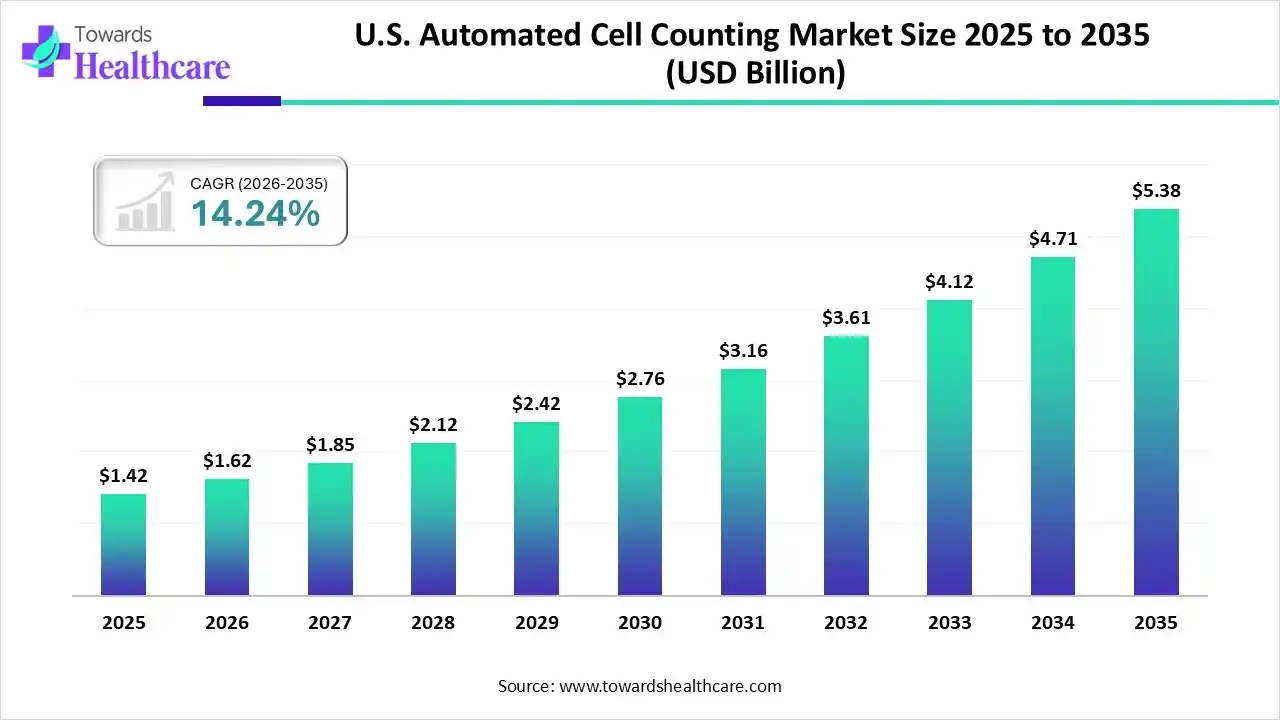
The market is growing due to increasing biotechnology research, expanding pharmaceutical development, and strong laboratory infrastructure. Rising demand for precise and rapid cell analysis in research and clinical laboratories is encouraging the adoption of automated cell counting technologies.
The market refers to the industry focused on instruments and technologies used to automatically measure and analyze cell numbers and viability in laboratories across the United States for research, diagnostics, and biopharmaceutical applications. The U.S. automated cell counting market is growing due to increasing investments in biotechnology, pharmaceutical development, and cell-based research. Laboratories require accurate and rapid cell analysis to support drug discovery, biologics production, and clinical studies. Automated cell counting systems help improve efficiency, reduce manual workload, and ensure consistent results. In addition, the presence of advanced research infrastructure and rising demand for reliable laboratory technologies further support market growth.
The U.S. automated cell counting market is expanding due to widespread laboratory adoption of high-throughput screening tools. This growth is heavily supported by massive capital injections from private equity firms into early-stage biotechnology start-ups. Additionally, federal funding through National Institutes of Health grants is driving academic research centers to upgrade from manual hemocytometers to automated platforms.
Technologically, the industry is transitioning toward artificial intelligence and deep-learning software integration. These digital systems eliminate human bias, optimize focus algorithms, and accurately identify irregular cell morphology or debris clusters. Furthermore, the rising production of complex biologics, personalized cell therapies, and mRNA vaccines requires continuous, automated viability monitoring to ensure strict compliance with federal manufacturing safety protocols.
Artificial intelligence can enhance the market by improving the precision and efficiency of cell analysis. Advanced data processing tools help laboratories quickly interpret large volumes of cell imaging data, enabling faster research outcomes. These technologies can also streamline laboratory workflows, support consistent results, and assist researchers in identifying complex cell patterns, which strengthens their role in biotechnology, pharmaceutical research, and clinical laboratories across the United States.
| Table | Scope |
| Market Size in 2026 | USD 1.62 Billion |
| Projected Market Size in 2035 | USD 5.38 Billion |
| CAGR (2026 - 2035) | 14.24% |
| Key Applications | Cell culture monitoring, cell therapy manufacturing, bioprocessing, drug discovery, cancer research, stem cell research, immunology, clinical diagnostics |
| Primary End Users | Biotechnology companies, pharmaceutical companies, academic research institutions, CROs, CDMOs, hospitals, clinical laboratories |
| Key Growth Drivers | Expansion of cell & gene therapy, growth in biopharmaceutical manufacturing, laboratory automation adoption, increasing R&D spending, demand for reproducible cell analysis |
| Measurable Values | USD Millions/Units/Volume |
| Market Segmentation | By-Product, By Application, By End Use |
| Top Key Players | Thermo Fisher Scientific, DeNovix, Abbott Laboratories, Bio-Rad Laboratories, HORIBA, Danaher Corporation, F. Hoffmann-La Roche Ltd |
Why Did the Consumables & Accessories Segment Dominate in the U.S. Automated Cell Counting Market in 2025?
The consumables & accessories segment dominated the market in 2025 due to their frequent and repeated use in laboratory workflows. Items such as counting slides, reagents, and sample preparation materials must be regularly replaced, creating consistent demand. Growing research activities in biotechnology and pharmaceutical laboratories also increase the consumption of these products, supporting the segment’s leading market share.
Instruments
The instruments segment is expected to grow at the fastest CAGR in the market due to increasing adoption of advanced laboratory equipment in biotechnology and pharmaceutical research. Research institutions are investing in modern automated systems to improve efficiency, accuracy, and workflow productivity. In addition, continuous technological improvements and the growing need for high-performance cell analysis tools are encouraging laboratories to upgrade to advanced automated cell counting instruments.
What Made the Cell Line Development Segment Dominant in the U.S. Automated Cell Counting Market in 2025?
The cell line development segment dominated the market in 2025 due to the increasing use of cultured cells in biologics production, vaccine research, and therapeutics development. Accurate monitoring of cell growth, viability, and concentration is essential during cell line optimization. Automated cell counting systems help researchers obtain reliable and consistent data, making them widely used in biotechnology and pharmaceutical laboratories involved in cell-based product development.
In January 2024, Abzena introduced a new cell line development platform named AbZelectPRO. The platform is designed to accelerate the creation of cell lines used in producing recombinant proteins and antibodies, helping improve efficiency in biopharmaceutical manufacturing.
Stem Cell Research
The stem cell research segment is expected to grow at the fastest CAGR in the market due to an increasing focus on regenerative medicine and advanced therapeutic development. Stem cell studies require precise monitoring of cell concentration and viability during experiments. Automated cell counting systems provide accurate and consistent measurements, which help researchers maintain quality and efficiency in stem cell culture, expansion, and clinical research applications.
How Does the Pharmaceutical & Biotechnology Companies Segment Dominate the U.S. Automated Cell Counting Market in 2025?
The pharmaceutical & biotechnology companies segment dominated the market in 2025 due to the extensive use of cell analysis in drug discovery, biologics production, and vaccine development. These companies require precise monitoring of cell growth and viability during the research and manufacturing process. Automated cell counting systems help improve accuracy, efficiency, and consistency in laboratory workflows, making them essential tools in pharmaceutical and biotechnology research facilities.
Hospitals & Diagnostic Laboratories
The hospitals & diagnostic laboratories segment is expected to grow at the fastest CAGR due to increased demand for accurate and rapid laboratory testing. Growing patient volumes and the need for efficient diagnostic procedures encourage healthcare facilities to adopt automated technologies. Automated cell counting systems help improve testing efficiency, reduce manual errors, and support reliable cell analysis in clinical diagnostic and routine laboratory workflows.
The U.S. automated cell counting market is experiencing rapid growth, driven by increasing adoption in biopharma, oncology research, and clinical diagnostics, which demand higher accuracy, speed, and standardization.
California Market Trends
California's market thrives due to a high concentration of biotech firms and research institutions in the Bay Area. Robust funding for cell-based research, particularly in stem cells and oncology, drives the adoption of automated imaging systems for faster, more accurate cell viability, enhancing laboratory efficiency, and reducing reliance on manual counting.
Massachusetts
The Massachusetts market is growing rapidly, supported by the Boston area's extensive biotech, pharma, and academic research presence. Increased investment in cell therapy, gene therapy, and bioprocessing requires precise, high-throughput automated cell counters for quality control, propelling demand for sophisticated imaging, AI-based analytics, and associated consumables
| Ecosystem Segment | Key Participants | Role in Market |
| Technology Providers | Thermo Fisher Scientific, Danaher (Beckman Coulter), Agilent Technologies | Develop imaging, optical analysis, automation, and analytical technologies |
| Product Manufacturers | Thermo Fisher Scientific, Bio-Rad Laboratories, Revvity, Logos Biosystems, Nexcelom | Manufacture automated cell counters and associated consumables |
| Service Providers | Labcorp, Charles River Laboratories, IQVIA | Provide laboratory testing and cell analysis services |
| Platform Providers | Danaher, Thermo Fisher Scientific, Revvity | Integrated laboratory workflow and automation platforms |
| CROs/CDMOs | Charles River Laboratories, Lonza, Catalent | Cell therapy development and manufacturing requiring cell counting workflows |
| Software Vendors | Revvity, Agilent Technologies, Bio-Rad Laboratories | Cell imaging analytics, data management, and automation software |
| Research Institutions | NIH, Broad Institute, Stanford University, Harvard Medical School | Development and adoption of advanced cell analysis technologies |
| End-User Industries | Biopharma, Cell & Gene Therapy, Academic Research, Diagnostics, Regenerative Medicine | Primary consumers of automated cell counting systems |
R&D
Clinical Trials
Serialization
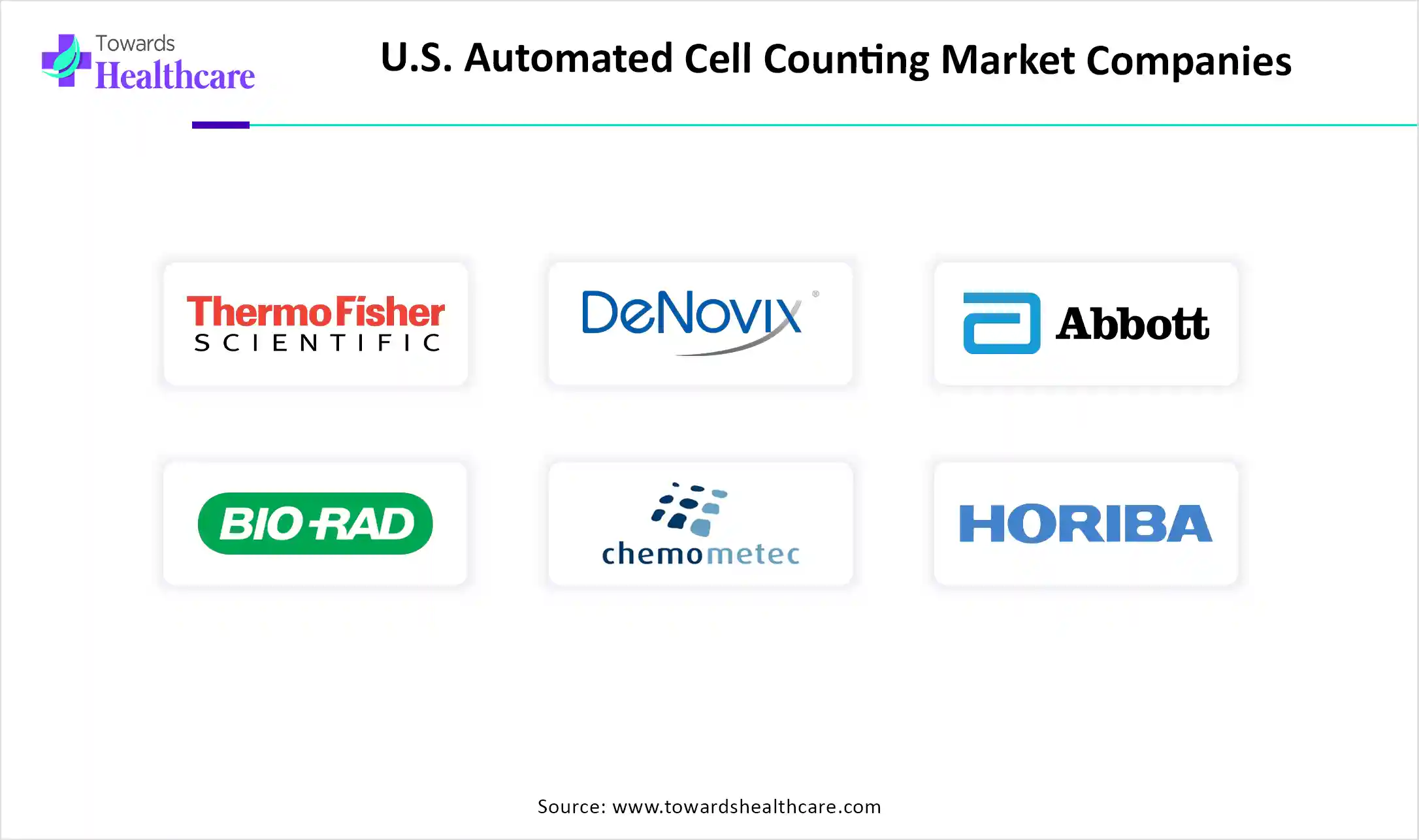
| Tier 1 | Tier 2 | Tier 3 | |
| Typical Market Influence | 72% | 20% | 8% |
| Tier 1 | ||||
| Company Name | Headquarters | Country | Why Relevant to This Market | Key Products/Services |
| Thermo Fisher Scientific | Waltham, Massachusetts, USA | USA | Market leader in life science tools and cell analysis workflows | Countess Automated Cell Counters |
| Danaher Corporation (Beckman Coulter Life Sciences) | Washington, D.C., USA | USA | Major player in cell analysis and laboratory automation | Vi-CELL BLU, Vi-CELL MetaFLEX |
| Bio-Rad Laboratories | Hercules, California, USA | USA | Strong position in cell biology and cell counting instruments | TC20 Automated Cell Counter |
| Tier 2 | ||||
| Company Name | Headquarters | Country | Why Relevant to This Market | Key Products/Services |
| Logos Biosystems | Anyang-si, Gyeonggi-do | South Korea | Leading automated imaging-based cell counter provider | LUNA Series Cell Counters |
| DeNovix Inc. | Wilmington, Delaware, USA | USA | Strong niche position in automated cell counting | CellDrop Automated Cell Counter |
| Eppendorf SE | Hamburg | Germany | Broad laboratory instrumentation portfolio | BioSpectrometer and cell analysis solutions |
| Tier 3 | ||||
| Company Name | Headquarters | Country | Why Relevant to This Market | Key Products/Services |
| ChemoMetec A/S | Allerød | Denmark | Specialized automated cell counting company | NucleoCounter Series |
| NanoEnTek Inc. | Seoul | South Korea | Growing provider of cell counting technologies | EVE Automated Cell Counters |
| Cytena GmbH | Freiburg im Breisgau | Germany | Single-cell analysis and cell handling specialist | C.STATION Cell Analysis Platform |
Strengths
Weaknesses
Opportunities
Threats
By-Product
By Application
By End Use



Principal Consultant
Rohan Patil is a seasoned market research professional with over 5+ years of focused experience in the healthcare sector, bringing deep domain expertise, strategic foresight, and analytical precision to every project he undertakes.
Learn more about Rohan Patil

Reviewed By
Aditi Shivarkar is a seasoned professional with over 14 years of experience in healthcare market research. As a content reviewer, Aditi ensures the quality and accuracy of all market insights and data presented by the research team.
Learn more about Aditi Shivarkar