


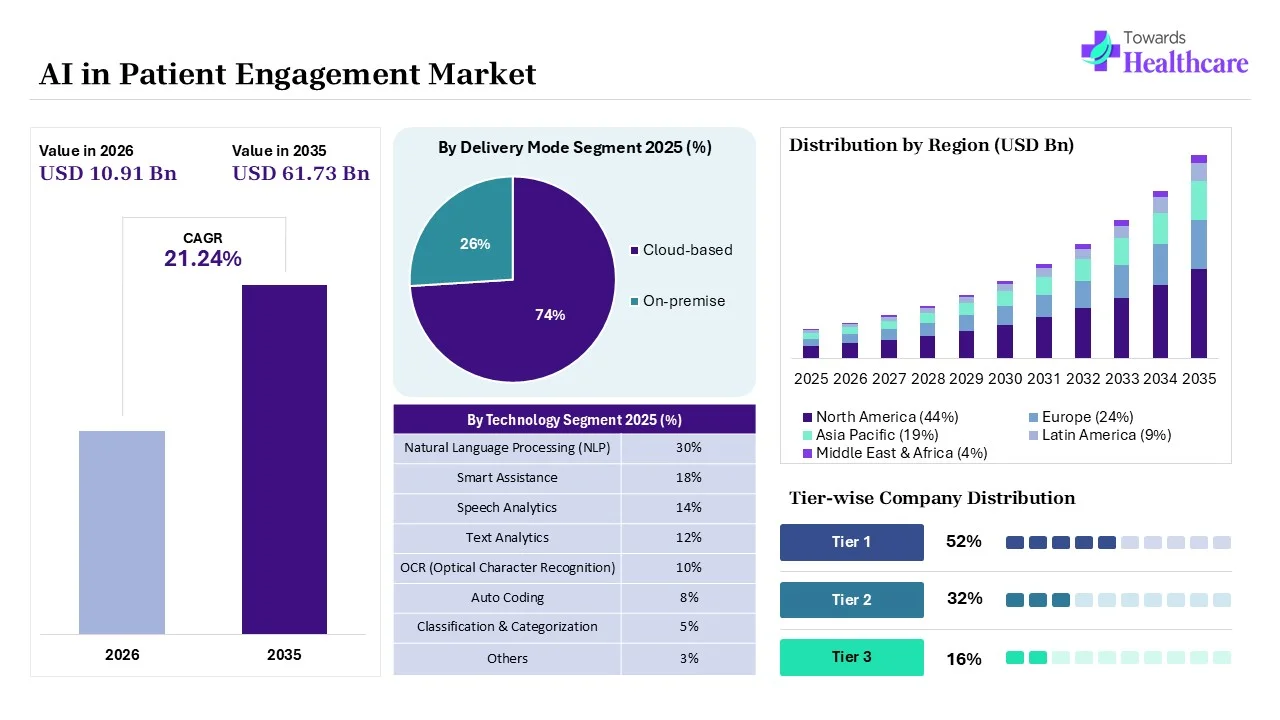
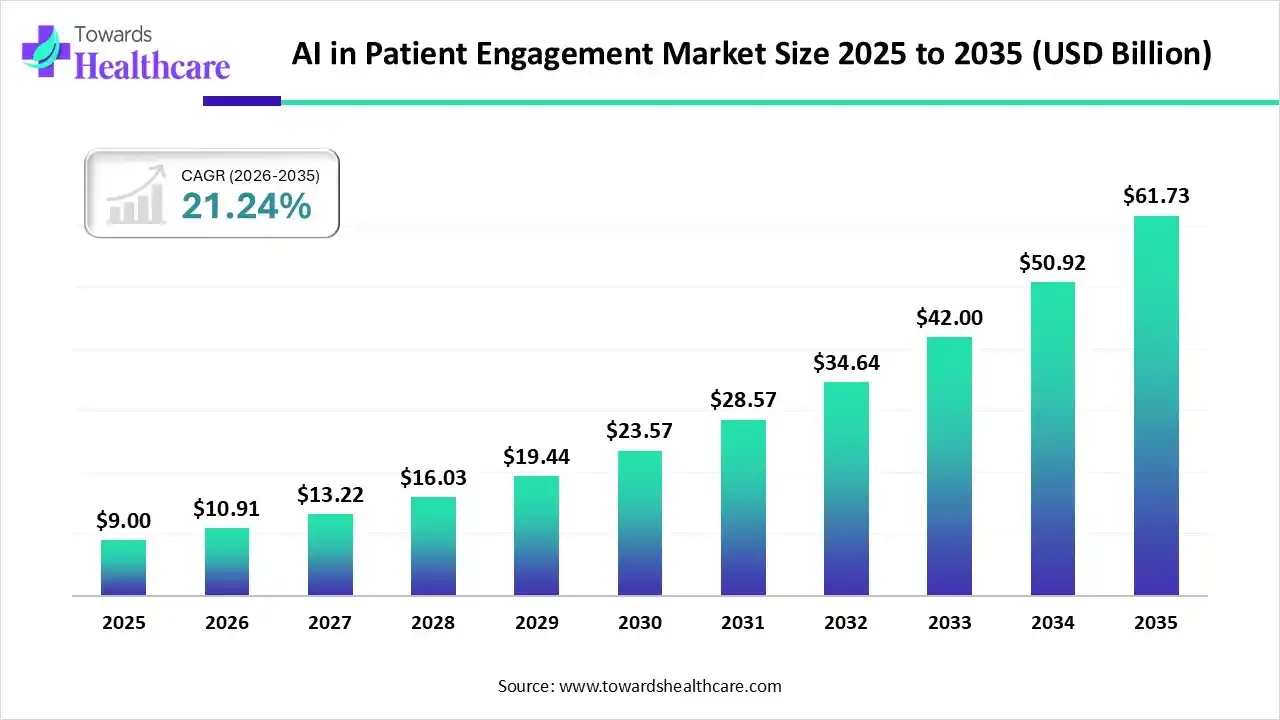
The global AI in patient engagement market size was estimated at USD 9 billion in 2025 and is predicted to increase from USD 10.91 billion in 2026 to approximately USD 61.73 billion by 2035, expanding at a CAGR of 21.24% from 2026 to 2035. The growing healthcare digitalization is increasing the use of various AI-powered health tools to enhance patient outcomes. Growing chronic diseases and technological advancements, leading to new launches, are also fueling the market growth.
The AI in patient engagement market is driven by a combination of the shift towards value-based care and the integration of generative AI. The AI in patient engagement encompasses artificial intelligence technologies used for patient interaction and guidance to help improve their health outcomes, treatment adherence, and satisfaction. These technologies help in the patient data analysis, their communication, health reminders, education, and personalized guidance.
The market is bolstered by the emergence of advanced conversational interfaces and voice agents that serve as 24/7 companions, where patients can utilize them to check symptoms, schedule/reschedule appointments, receive medication reminders, & navigate complex billing. Besides this, AI advances are pushing consistent streams of physiological data from the latest wearables, that develops important insights and automated alerts for both the patient & the care coordinator. In addition, evolving machine learning algorithms by leading firms are supporting the analysis of past behavior, age groups, & real-time data to recognize early indicators of missed doses or omitted appointments.
AI in patient engagement refers to the use of artificial intelligence technologies, including machine learning, natural language processing (NLP), predictive analytics, and conversational AI, to enhance patient communication, education, care coordination, and treatment adherence. The AI in patient engagement market is expanding due to the increasing demand for personalized healthcare experiences, rising adoption of digital health solutions, and growing emphasis on value-based care. Technological advancements such as AI-powered virtual assistants, intelligent chatbots, remote patient monitoring platforms, and real-time health analytics are transforming patient interactions. Key trends include seamless integration with electronic health records (EHRs), telehealth platforms, and mobile health applications. Future opportunities are driven by generative AI, predictive patient journey management, and automated care coordination. Increasing investments in healthcare AI and digital transformation initiatives continue to accelerate market growth while improving clinical outcomes, patient satisfaction, and healthcare efficiency.
Healthcare Digitalization
Due to growing digital transformation in healthcare, the use of new AI platforms to enhance patient engagement is increasing, where they are being utilized in telehealth platforms and EHR systems.
Shift Towards Remote Care
The growing health awareness and increasing technological advancements are driving the demand for remote healthcare and personalized patient treatment tools, increasing the use of AI for virtual care, wellness coaching, tailored reminders, and remote patient monitoring.
Emerging Opportunities
The growing AI applications in the healthcare sector are increasing the integration of conventional AI, predictive analytics, language learning models, and advanced chatbots to offer automated messaging, predictive health behaviour insights, and many other applications.
| Table | Scope |
| Market Size in 2026 | USD 10.91Billion |
| Projected Market Size in 2035 | USD 61.73 Billion |
| CAGR (2026 - 2035) | 21.24% |
| Leading Region | North America by 44% |
| Key Applications | AI chatbots, virtual assistants, patient education, appointment management, medication adherence, symptom checking, remote patient monitoring, personalized health recommendations, patient communication automation, clinical navigation |
| Primary End Users | Hospitals, health systems, pharmaceutical companies, payers, healthcare providers, digital health companies, clinical research organizations |
| Key Growth Drivers | Increasing digital healthcare adoption, demand for personalized care, shortage of healthcare workforce, rising chronic disease burden, healthcare automation, improved AI capabilities |
| Measurable Values | USD Millions/Units/Volume |
| Market Segmentation | By Delivery Mode, By Functionality, By Technology, By Therapeutic Area, By End Use, By Region |
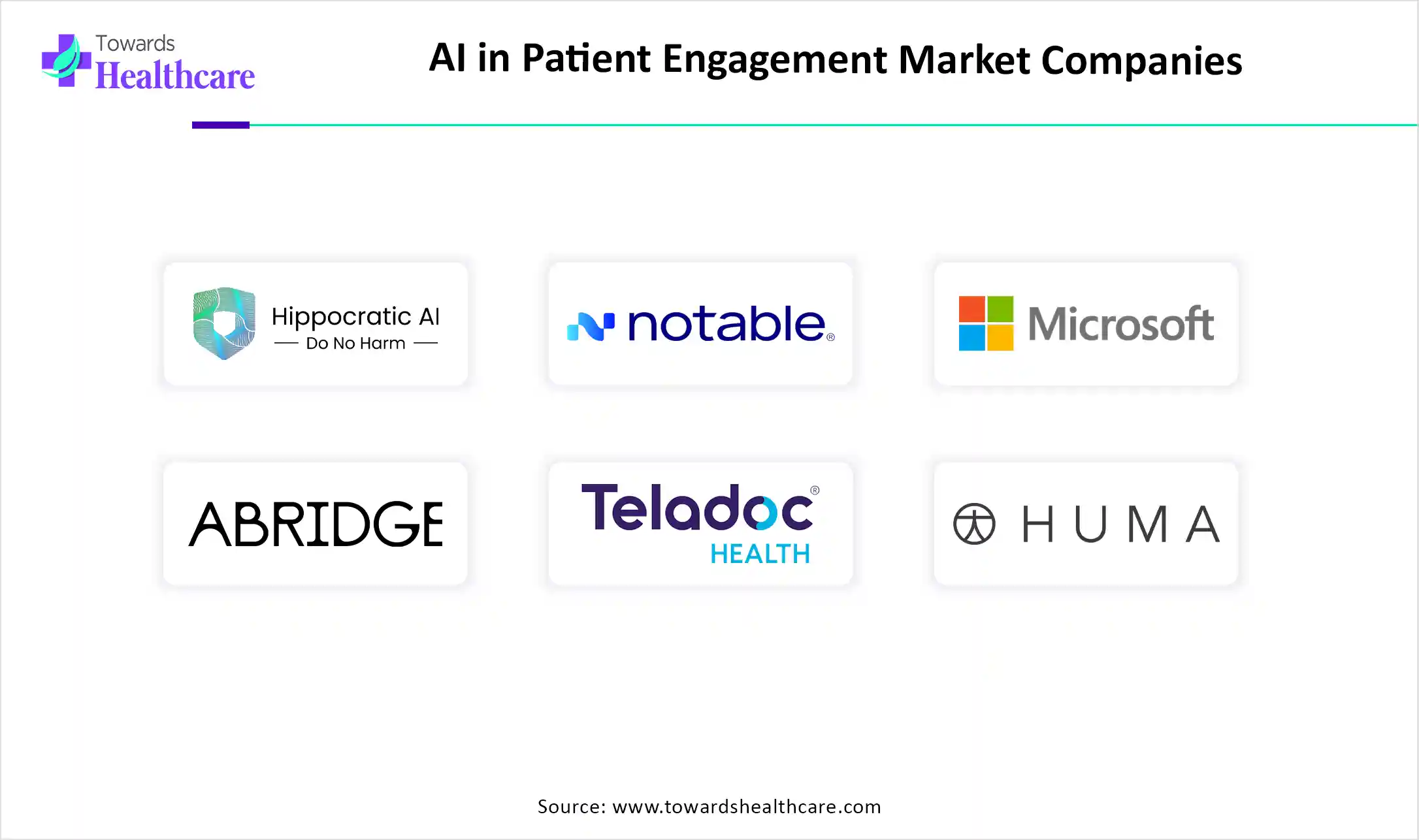
| Top Key Players | Hippocratic AI, Notable Health, Microsoft (Nuance), Abridge, Teladoc Health, Innovaccer, Huma, Voiceoc, Luma Health, Phreesia |
| Segments | Shares % |
| Cloud-based | 74% |
| On-premise | 26% |
Why Did the Cloud-based Segment Dominate in the Market in 2025?
The cloud-based segment led the AI in patient engagement market by 74% share in 2025 and is expected to show the fastest growth rate during the predicted time, due to its easy integration and scalability. Their affordability and remote accessibility also increased their demand, and their regular updates also encouraged their use.
On-premise
The on-premise segment is expected to show lucrative growth during the upcoming period, due to its data control and customization flexibility. At the same time, their cooperation with the regulatory standards is also increasing their acceptance rates, where their less dependence on the internet is also driving their adoption across limited infrastructure healthcare facilities.
| Segments | Shares % |
| Enhanced Communication | 28% |
| Patient Education | 18% |
| Administrative & Streamlined Operations | 17% |
| Predictive Analytics | 15% |
| Chatbots & Virtual Health Assistants | 14% |
| Others | 8% |
Which Functionality Type Segment Held the Dominating Share of the Market in 2025?
The enhanced communication segment held the dominating share of the AI in patient engagement market in 2025, driven by better patient data analysis, promoting personalized communications. The AI also provided 24/7 services, alerts, and follow-up reminders, which increased their adoption and enhanced patient experiences.
Chatbots and Virtual Health Assistants
The chatbots and virtual health assistants segment to witness the fastest growth during the upcoming period, due to their 24/7 availability and enhanced remote accessibility. Their personalized intervention and affordability are also increasing the patient experiences, where their easy deployment and automation are reducing the administrative burden.
| Segments | Shares % |
| Natural Language Processing (NLP) | 30% |
| Smart Assistance | 18% |
| Speech Analytics | 14% |
| Text Analytics | 12% |
| OCR (Optical Character Recognition) | 10% |
| Auto Coding | 8% |
| Classification & Categorization | 5% |
| Others | 3% |
How Natural Language Processing (NLP) Segment Dominated the Market in 2025?
The natural language processing (NLP) segment led the AI in patient engagement market in 2025 by 30% share, as it was the core technology for communication with the patient. It helped in the interpretation of the text and speech to offer usable insights. Moreover, it was also used in the extraction of important information and the maintenance of the documents.
| Segments | Shares % |
| Chronic Disease Management | 62% |
| Health & Wellness | 38% |
What Made Chronic Disease Management the Dominant Segment in the Market in 2025?
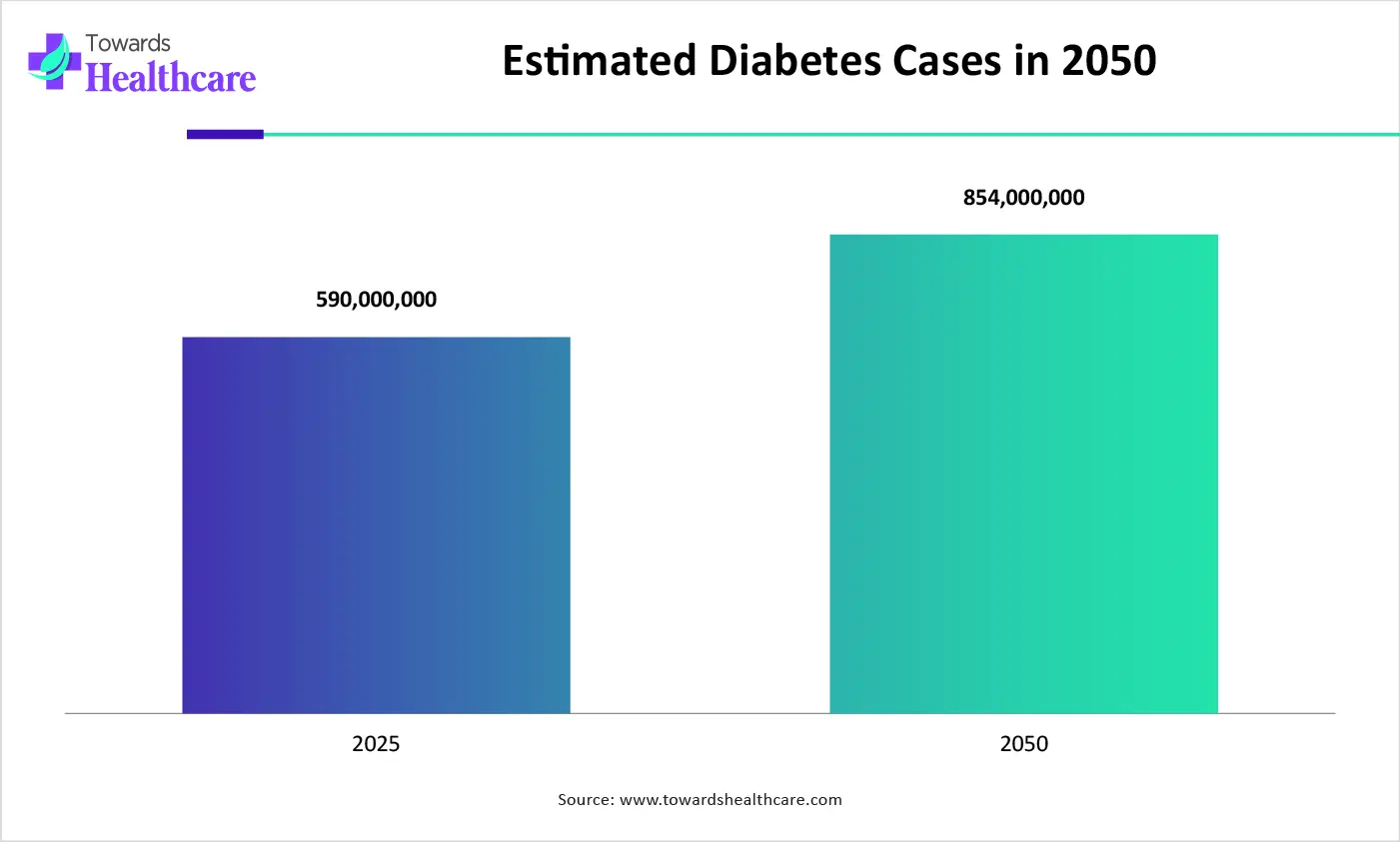
The chronic disease management segment held the largest share of the AI in patient engagement market by 62% share in 2025, due to growth in their incidence rates, which increased the demand for AI in patient engagement. It helped in continuous patient monitoring and tracking treatment adherence, which significantly reduced the risk of further complications.
Health & Wellness
The health & wellness segment is expected to expand rapidly during the predicted timeframe, due to growing self-care trends. The growing focus on preventive care is also increasing the adoption of various AI solutions. Similarly, for personalized and remote healthcare, new AI platforms are also being developed.
| Segments | Shares % |
| Healthcare Providers | 58% |
| Healthcare Payers | 27% |
| Others (Pharmaceutical Companies, Pharmacy) | 15% |
Why Healthcare Providers Segment Dominated the Market?
The healthcare providers segment registered its dominance over the AI in patient engagement market by 58% share in 2025, due to growth in the patient volume, which increased the demand for AI platforms for direct patient interactions. They were also utilized to improve patient outcomes, satisfaction, and reduce administrative burden.
Healthcare Payers
The healthcare payers segment is expected to show the highest growth during the predicted timeframe, as AI solutions are being utilized to deliver personalized health information and guidance. Its predictive analytics help in identifying high risk member, automation enhance operation efficiency, and investments are driving their adoption rates.
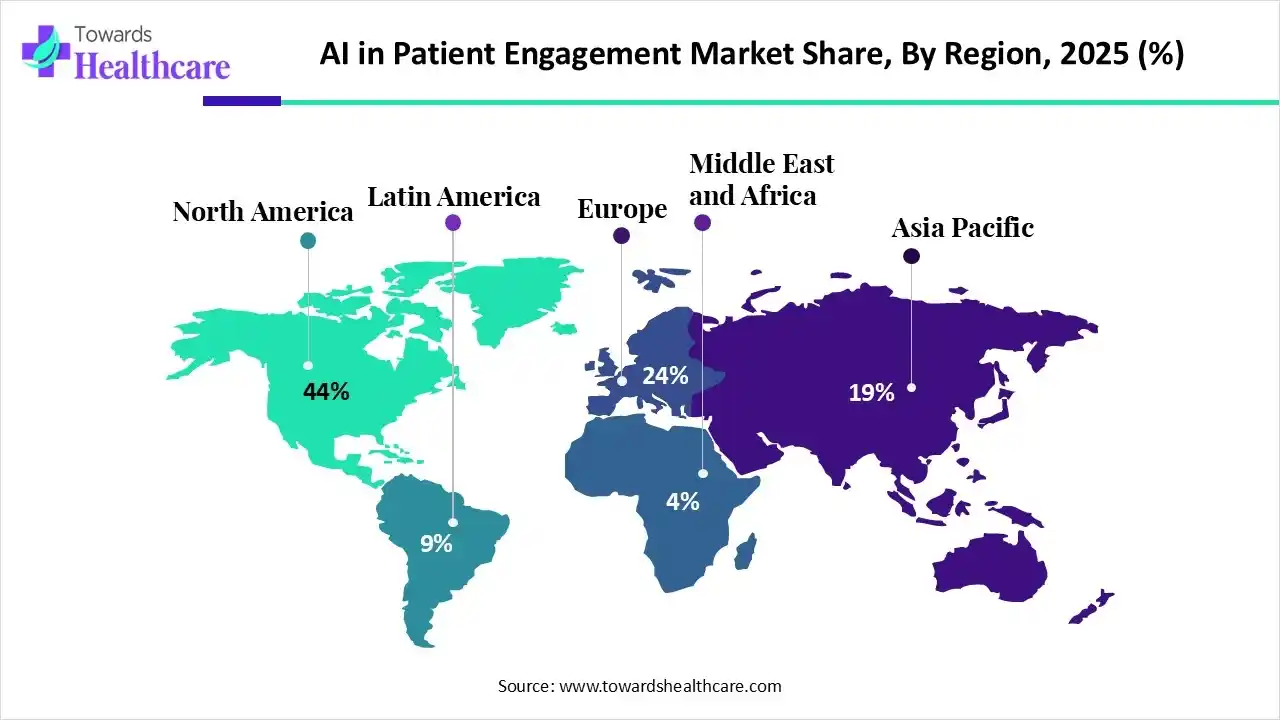
North America dominated the AI in patient engagement market by 44% share in 2025, due to the presence of advanced healthcare infrastructure, which increased the early adoption of various AI solutions for improved patient engagement. The growth in healthcare investments and demand for patient-centered care also increased their innovations, which contributed to the market growth.
U.S. Market Trends
The U.S. consists of an advanced healthcare system, which is increasing the early adoption of advanced AI-driven technologies. The growing focus on value-based care, chronic disease management, and preventive care is also increasing the use of these AI solutions to enhance patient outcomes and satisfaction.
Canada Experiences Significant Growth in the AI in Patient Engagement Market
Canada is experiencing significant growth in the AI in patient engagement market due to its expanding digital health ecosystem, increasing adoption of telehealth services, and strong government support for healthcare digitalization. Rising demand for personalized patient care, growing integration of AI with electronic health records (EHRs), and increased investments in virtual care platforms are enhancing patient engagement. The country's advanced healthcare infrastructure and focus on value-based care further drive market expansion.
Asia Pacific is expected to host the fastest-growing AI in patient engagement market by 19% share during the forecast period, due to growing healthcare digitalization, which is increasing the use of AI solutions for chronic disease management. The expanding healthcare, large patient volume, and government initiatives are also increasing their adoption, enhancing the market growth.
China Market Trends
The rapid expansion of the healthcare sector in China is increasing the demand for advanced technology, driving the use of AI to manage large patient populations. The growing government health policies, investments, technological innovations, and chronic diseases are also increasing their adoption and advancements.
India Emerges as a High-Growth AI in Patient Engagement Market
India is witnessing significant growth in the AI in patient engagement market due to rapid digital healthcare adoption, increasing smartphone and internet penetration, and expanding telemedicine services. Government initiatives such as the Ayushman Bharat Digital Mission (ABDM), growing investments in health technology, and rising demand for AI-powered virtual assistants and remote patient monitoring are accelerating adoption. Increasing chronic disease prevalence and improved healthcare access further support market growth.
Europe is expected to grow significantly in the AI in patient engagement market by 24% share during the forecast period, due to stringent regulations, which increased the demand for secure AI technologies for enhanced patient engagement. The presence of a well-developed healthcare system, growing investments, and increasing technological advancements are also promoting the market growth.
UK Market Trends
The presence of a robust healthcare system in the UK is increasing the adoption of AI technologies to enhance various healthcare applications and patient experiences. The growing personalization trends and stringent regulations are increasing the demand for secure AI tools, as well as promoting their innovations.
Germany Experiences Significant Growth in the AI in Patient Engagement Market
Germany is experiencing significant growth in the AI in patient engagement market due to its advanced healthcare infrastructure, rapid adoption of digital health technologies, and strong government support for healthcare digitalization. Increasing implementation of electronic health records (EHRs), expansion of telemedicine services, and rising investments in AI-powered healthcare solutions are improving patient engagement. The country's focus on precision medicine, chronic disease management, and healthcare innovation further accelerates market growth.
South America has a notable contribution to the growth of the market. Healthcare providers across South America are heavily adopting Generative AI and machine learning for clinical documentation, automated reminders, and basic patient queries to reduce heavy administrative workloads. The shortage of personalized medical personnel in the region is leading to higher adoption of AI tools such as virtual assistants, conversational chatbots, and telehealth platforms, helping to expand healthcare access and further fueling the market’s growth.
Brazil Market Trends
Brazil is known as the primary leader in the growth of the AI in patient engagement market. The growth of the market in the country is mainly driven by rapid smartphone penetration, a large population base, and a dual public-private healthcare model. The growing prevalence of health issues such as diabetes, hypertension, obesity, and cardiovascular disease in the regions, straining traditional in-person treatment methods, is also fueling the growth of the market. Brazilian healthcare providers increasingly rely on AI-assisted care pathways, remote patient monitoring (RPM), and app-based tools to track patients outside hospitals. Automated and AI-driven platforms proactively flag medication adherence issues, abnormal health readings, or early follow-up risks, reducing avoidable in-person visits and further fueling the market’s growth.
Argentina Market Trends
Argentina primarily contributes to the growth of the market as a regional technology and software-engineering hub in Latin America, driven by strong growth in conversational AI, cloud adoption, and a cost-competitive tech workforce. Argentina features a mature software development ecosystem and a tech-savvy workforce, making it a preferred location for multinational tech vendors and local startups building machine learning, automation, and natural language processing (NLP) applications.
Middle East and Africa have a steady contribution to the growth of the market. The cloud-based delivery segment of the market enables scalable deployment across regional clinics and hospitals. The AI-driven tools represent a leading revenue driver, which is further powered by virtual assistants, predictive analytics, and automated messaging.
Saudi Arabia Market Trends
Saudi Arabia is actively accelerating the growth of AI in patient engagement and digital health through top-down government strategy, massive infrastructure investments, and high public adoption rates. The region’s strategic pivot is anchored by Saudi Vision 2030 and spearheaded by the Saudi Data and AI Authority (SDAIA) and the Ministry of Health (MOH), which mandate digital transformation, cloud integration, and intelligent automation across public and private healthcare networks.
South Africa Market Trends
South Africa contributes to the growth of the AI-driven patient engagement and healthcare market through local digital innovations, smartphone-driven telemedicine, and public-private sector investments aimed at solving systemic resource and workforce constraints. Innovations like the University of Johannesburg's e-mutakalo leverage AI to analyze remote patient vitals and bridge urban-rural care gaps, further fueling the market’s growth.
| Category | Market Role |
| Technology Providers | Companies developing AI models, NLP systems, machine learning infrastructure, and healthcare AI capabilities that power engagement solutions. |
| Product Manufacturers | Digital health companies creating AI-based patient engagement products such as virtual assistants and monitoring platforms. |
| Service Providers | Healthcare technology providers offering implementation, consulting, integration, and managed patient engagement services. |
| Platform Providers | Companies offering scalable patient communication, CRM, remote care, and engagement platforms integrated with AI. |
| CROs/CDMOs | Limited direct involvement; some CROs use AI engagement tools for clinical trial recruitment and participant communication. |
| Software Vendors | Healthcare software companies integrating AI into patient portals, communication systems, and healthcare workflows. |
| Research Institutions | Universities, healthcare innovation centers, and AI research organizations developing healthcare AI applications. |
| End-User Industries | Hospitals, pharmaceutical firms, insurers, telehealth providers, and healthcare networks. |
| Tier 1 | Tier 2 | Tier 3 | |
| Typical Market Influence | 52% | 32% | 16% |
| Tier 1 | ||||
| Company Name | Headquarters | Country | Why Relevant to This Market | Key Products/Services |
| Microsoft | Redmond, Washington, USA | USA | Major healthcare AI ecosystem provider through cloud AI, healthcare data platforms, and conversational AI capabilities. | Azure AI Healthcare, healthcare cloud solutions, AI assistants |
| Oracle | Austin, Texas, USA | USA | Strong healthcare IT presence with AI-enabled patient communication and healthcare workflow platforms. | Oracle Health, AI-powered healthcare applications |
| Philips | Amsterdam, Netherlands | Netherlands | Global healthcare technology leader offering connected care and AI-enabled patient monitoring solutions. | Patient monitoring, connected care platforms, digital health solutions |
| Tier 2 | ||||
| Company Name | Headquarters | Country | Why Relevant to This Market | Key Products/Services |
| Welltok | Denver, Colorado, USA | USA | Specialized healthcare engagement company using AI and analytics for personalized patient interactions. | Patient engagement platform, personalized healthcare communications |
| Buoy Health | Boston, Massachusetts, USA | USA | AI-powered symptom assessment and healthcare navigation platform. | AI symptom checker, patient navigation |
| Infermedica | Wroclaw, Poland | Poland | Provides AI clinical reasoning technology used for patient triage and digital engagement. | AI symptom checker, virtual health assistant |
| Tier 3 | ||||
| Company Name | Headquarters | Country | Why Relevant to This Market | Key Products/Services |
| Hyro | New York, USA | USA | Healthcare conversational AI provider helping automate patient communication. | AI healthcare assistants, voice/chat automation |
| Notable | San Mateo, California, USA | USA | AI automation company improving patient access and engagement workflows. | AI patient communication automation |
| Aiva Health | Los Angeles, California, USA | USA | AI voice assistant technology for hospitals and patient interaction. | Voice-based patient assistants |
In March 2026, AI Med Consult & 4th Dimension EMR announced an official alliance during the American Academy of Cosmetic Surgery (AACS) Annual Scientific Meeting in Tampa to optimize patient engagement, operational efficiency, & data-driven decision-making for aesthetic & cosmetic medical practices. Benjamin Stover, Co-Founder and Chief Commercial Officer of AI Med Consult, replied that ‘We’re excited about the ability to increase operational efficiency by passing the data we capture from patient engagement directly into the EMR. In turn, the EMR can provide ROI insights from patient actions and treatment data, allowing us to continuously improve engagement strategies as practices grow.’
Strengths
Weaknesses
Opportunities
Threats
By Delivery Mode
By Functionality
By Technology
By Therapeutic Area
By End Use
By Region






Principal Consultant
Payal Rabde is a Healthcare Market Research Analyst at Towards Healthcare Research & Consulting with 4+ years of experience in pharmaceuticals, biotechnology, medical devices, and life sciences.
Learn more about Payal Rabde

Reviewed By
Aditi Shivarkar is a seasoned professional with over 14 years of experience in healthcare market research. As a content reviewer, Aditi ensures the quality and accuracy of all market insights and data presented by the research team.
Learn more about Aditi Shivarkar









