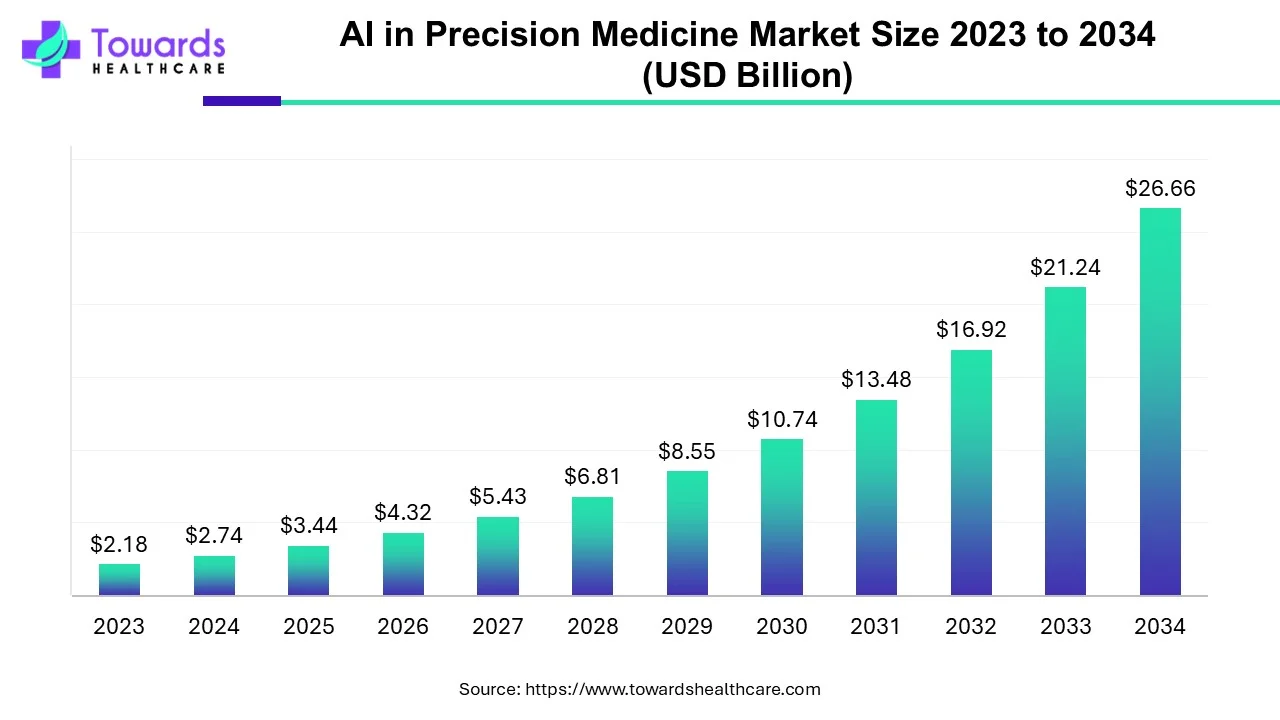
The global Artificial Intelligence (AI) in precision medicine market size is estimated to grow from USD 3.44 billion in 2025 to surpass around USD 33.45 billion by 2035, registered at a CAGR of 25.54% between 2026 and 2035, as a result of the rising prevalence of cancer and rising demand for personalized care.
"The imperative for Early Cancer Detection Drives Surge in Precision Medicine Market Fueled by AI advancement, with 609,820 Deaths in 2023 Reported By National Cancer Society, Spotlighting Urgent Need for advanced Solutions"
The intersection of artificial intelligence (AI) and precision medicine holds the potential to transform healthcare significantly. Precision medicine techniques aim to identify specific patient phenotypes with uncommon responses to treatment or distinct healthcare requirements. AI plays a pivotal role by employing advanced computational processes and interference, allowing the system to derive valuable Insight, enhance reasoning capacity, and facilitate continuous learning. This, in turn, empowers healthcare practitioners in their decision-making processes through augmented intelligence. Recent literature underscores the importance of translation research in exploring the convergence of AI in Precision medicine, particularly those involving the interplay of non-genomic and genomic determinants. Integrating diverse data sources, including patient symptoms, clinical history and lifestyle, will streamline personalized diagnosis and prognostication.
The incorporation of AI in precise medicine contributes to a notable market increase. AI's enhanced capability optimizes treatment approaches and paves the way for more targeted and personalized healthcare solutions, positively impacting the overall market dynamics.
AI has seen significant growth and acceptance in various domains in the past ten decades, notably within healthcare. AI offers opportunities for intelligent product design, novel services and new business models, yet it also poses social and ethical security, privacy, and human rights challenges. In precise medication, AI technologies range from virtual applications like deep-learning-based health information management systems to cyber-physical implementation, such as robotic assistants in surgeries and targeted nanorobots for drug delivery. Ai's ability to recognize complex patterns has led to image-based detection and diagnostic systems performing better than clinicians. AI-enabled clinical decision support systems can reduce diagnostic errors, enhance decision-making intelligence, and assist in Electronic Health Record (EHR) data extraction.
Precision medicine, notably genotype-guided treatment, has revolutionized healthcare by using genetic information to determine optimal drug dosages, such as warfarin. The Clinical Pharmacogenetics Implementation Consortium provides guidelines for clinicians, enhancing drug therapy through genetic test results. Genomic profiling of tumours aids in tailoring targeted therapies for breast and lung cancer patients. Integrated into healthcare, precision medicine offers precise diagnoses, predicts disease risk preemptively, and designs personalized treatment plans for optimal safety and efficiency. Globally, the trend extends beyond the United States, with initiatives like the UK Biobank, BigBank Japan, and the Australian Genomics Health Alliance showcasing the global impact of changing attitudes towards precision medicine.
The invention of mathematical models that allow AI systems to analyse data, spot pattern and make prediction more accurately and efficiently is a key component of machine learning algorithm advancements. Developments in deep learning architectures, optimization methods, and algorithmic efficiency are frequently included in these improvements. AI is essential to precision medicine because it allows for the customization of medical interventions based on patient characteristics.
The following are some ways that AI advances the field of precision medicine:
| Advances | Description |
| Personalised treatment Plans | To generate personalized treatment plans, artificial intelligence (AI) algorithms can examine enormous volumes of patient data, including genetic data, lifestyle variables, and medical history. This makes it possible for medical professionals to provide tailored treatments depending on the particulars of each patient. |
| Drug Discovery and Development | AI makes the process of finding new drugs faster by identifying possible drug candidates more quickly through the analysis of biological data. This may result in the creation of specific drugs that are more matched to the unique characteristics of each patient. |
| Diagnostic Precision | Through the interpretation of intricate medical imaging data and genetic information, machine learning algorithms can improve diagnostic accuracy. This accuracy facilitates earlier disease detection and more potent intervention techniques. |
| Clinical Decision Support | AI helps with clinical decision-making, giving medical professionals insightful information. This entails forecasting the course of the disease, making recommendations for the best course of action, and spotting possible dangers or side effects. |
| Real-Time Monitoring | AI-driven monitoring systems have the ability to continuously evaluate patient data in real time, sending out alerts in a timely manner for possible health problems. Preventive and customized healthcare are aided by this proactive approach. |
In addition, Artificial Intelligence (AI) has the potential to transform the precision medicine industry due to its capacity to analyse a wide range of datasets and its constant refinement of machine learning algorithms. Consequently, this fosters the expansion of artificial intelligence applications that offer more efficient, customized, and focused healthcare solutions.
For Instance,
The hurdle of Fairness and Bias in AI for Precision Medicine has Contributed Significantly to Decreased Market Adoption
The inherent biases present in health data, arising from issues such as limited diversity in sampling, missing values, and imputation methods, pose a substantial challenge. When AI models are trained on biased data, they can amplify existing biases, making unfavourable decisions for specific demographic groups based on factors like age, gender, race, geography, or economic status. This bias compromises the clinical applicability of AI models and raises concerns about the overall quality of healthcare outcomes. Patients from underrepresented groups may experience disparities in diagnosis, treatment recommendations, or risk predictions, exacerbating existing inequalities in healthcare. As a result, potential users, including healthcare providers and institutions, may become hesitant to adopt AI solutions due to ethical concerns and the fear of perpetuating or exacerbating biases in patient care. This hesitancy leads to a decrease in the market for AI in precision medicine.
Additionally, addressing fairness and bias in AI models requires concerted efforts, including improving data diversity, implementing bias-mitigation techniques proposed by AI communities, and utilizing tools like IBM's AI Fairness 360 toolkit. Despite these solutions, the nuanced nature of fairness and protected attributes in healthcare necessitates ongoing research and collaboration within the AI and biomedical communities.
Furthermore, weakening stakeholder confidence in these systems and the perceived ethical risks of biased AI models also make stakeholders less willing to invest in and use AI for precision medicine. As a result, it will be difficult for The market for AI in Healthcare to be widely adopted and used.
The Synergy of Technological Advancements and Innovation Propels AI’s Growth
Artificial intelligence (AI) in precision medicine, particularly genome-informed prescribing, marks a groundbreaking innovation with significant market opportunities. The power of precision medicine at scale is exemplified in the developing of machine learning algorithms predicting patients' medication needs based on genomic information. Real-time recommendations and personalized dosages rely on genotyping patients in advance. Deep learning techniques, such as those highlighted by Zou and colleagues, contribute to efficient genome interpretation, aiding in identifying genomic variations related to disease presentation, therapeutic success, and prognosis.
In the case of medulloblastoma, AI-mediated analysis has unveiled discrete molecular subgroups, enabling customized treatments for pediatric patients. Precision genomics, steering away from conventional multimodal treatments, allows for targeted chemotherapy, reducing the necessity for radiation. This precision in treatment improves efficacy and minimizes potential neurocognitive sequelae and secondary cancers, presenting a substantial market opportunity.
The integration of AI into imaging recognition has given rise to radio genomics. This novel field links cancer imaging features with gene expression to predict the risk of toxicity after radiotherapy. AI is covering radiogenomic associations in breast, liver, and colorectal cancer. While limited data availability remains a challenge, the growing opportunities in the market for AI in radiogenomics are evident. These findings empower clinicians to select treatments with higher efficacy, presenting additional market opportunities in the evolving landscape of AI-driven precision medicine.
Collaboration and Innovation
Cardiovascular medicine's embrace of predictive modelling, considering factors like gender, genetics, lifestyle, and environment, has led to promising developments. Artificial intelligence, particularly in predictive modelling and combining electronic health records (EHR) with genetic data, offers opportunities to enhance disease prediction and diagnosis. Innovations such as AI-enabled recognition of phenotype features and rapid whole-genome sequencing contribute to faster and more accurate diagnoses, especially in cases of suspected genetic diseases in seriously ill infants.
These innovations drive the global increase in the AI market for precise medicine, providing a more nuanced and practical approach to healthcare by integrating diverse data sources and advanced technologies.
In precision medicine, hardware advancements play a crucial role in AI by providing increased computational power for complex data analysis. Specialized hardware accelerators, such as Graphical Processing Units (GPUs) and Tensor Processing Units (TPUs), enable faster processing of vast datasets, facilitating more accurate diagnostics and personalized treatment recommendations.
This fusion of components has fueled the expansion of AI in precise medicine, resulting in improved diagnostic accuracy and personalized treatment approaches, ultimately contributing to the market's overall growth.
| Key Elements | Scope |
| Market Size in 2026 | USD 4.32 Billion |
| Projected Market Size in 2035 | USD 33.45 Billion |
| CAGR (2026 - 2035) | 25.54% |
| Leading Region | North America |
| Historical Data | 2020 - 2023 |
| Base Year | 2025 |
| Forecast Period | 2026 - 2035 |
| Measurable Values | USD Millions/Units/Volume |
| Market Segmentation | By Technology, By Component, By Therapeutic Application, By Geography |
| Top Key Players | IBM, Microsoft, Google, NVIDIA, Illumina, Roche, Johnson & Johnson, GE Healthcare, Intel Corporation, AstraZeneca, Sanofi, Tempus |
Which Technology Segment Dominated the AI in Precision Medicine Market?
By technology, the deep learning segment dominated the market in 2025. Deep learning (DL) is widely utilized to categorize patients according to the type of disease and based on its severity. The most common deep learning method is convolutional neural network (CNN), which is useful for image segmentation, detection, and classification. DL can predict gene expression from genotype data to identify links among genomic variation and disease presentation, therapeutic success, and prognosis. Hence, it is a widely preferred tool for deriving precision medicine.
By technology, the natural language processing segment is estimated to grow fastest in the market during the forecast period. Natural language processing (NLP) is the field of AI that deals with processing textual data. NLP can process all clinical notes regarding a patient and assist doctors in deciding the most effective treatment plan. This enables faster decision-making.
How the Software Segment Dominated the AI in Precision Medicine Market?
By component, the software segment held a dominant presence in the market in 2025. Several organizations are developing software to analyze complex genetic data and medication interactions quickly. The advent of cloud-based systems favors the segment’s growth owing to enhanced collaborations and the provision of analyzing large amounts of global data.
By component, the service segment is projected to expand rapidly in the market in the coming years. Services are useful for organizations that lack trained professionals. Also, services save a lot of time for researchers, eliminating the need to perform the entire procedure. Services can provide accurate and faster data to the researchers.
Why Did the Oncology Segment Dominate the AI in Precision Medicine Market?
By therapeutic application, the oncology segment held the largest share of the market in 2025. The rising incidences and mortality of cancer, favorable government policies for early detection and effective treatment of cancer, and increasing investments & collaborations augment the segment’s growth. The increasing population and changing demographics demand the development of precision medicines for cancer due to its complexity.
By therapeutic application, the neurology segment is anticipated to grow with the highest CAGR in the market during the studied years. The development of precision medicines is widely required due to the complexity of neurological disorders. Novel drug discovery or medical devices and new drug delivery systems are investigated to tailor individual patient needs. The complex pathophysiology of several neurological disorders is examined using AI tools.
North America dominated the AI in the precision medicine market. This region boasts a robust ecosystem of research institutes and healthcare providers collaborating to leverage AI for more accurate Diagnostics, personalized treatment strategies, and improved patient outcomes. Johnson and Johnson, Google, IBM Watson, and NVIDIA. A suitable regulatory framework and increasing investments will favor the development of precision medicine in the region. The US government recently announced an additional $54 million of investment for the Precision Medicine Initiative. In 2023, the US Food and Drug Administration approved 28 new personalized treatments, including 17 cancer drugs and 11 for other diseases.
In Asia-Pacific, the multi-country GenomeAsia100K initiative aims to "sequence and analyze the genomes of 100,000 Asian individuals to help accelerate Asian Population-specific medical advances and precision medicine." All discoveries and outcomes will be disseminated to the larger scientific community to distribute the accountability for advancing the sector through R&D among other like-minded establishments and associations. The market is driven by favorable government policies in the respective countries. China supports the largest precision medicine initiative globally. In the five-year plan (2021-2025), China announced an investment of approximately $9.2 billion over the five years. India recently launched its IndiaAI Mission through public-private partnerships with an investment of $1.25 billion to boost the AI ecosystem.
For instance,
Europe is a notably growing region in the AI in precision medicine market due to strong government support, substantial funding for healthcare innovation, and robust regulatory frameworks. The region boasts advanced healthcare infrastructure, increasing adoption of digital health technologies, and a high prevalence of chronic diseases, driving demand for personalized treatment. Collaborative research initiatives and active participation from leading biotech firms further accelerate AI integration in precision medicine across Europe.
French Market Trends
The French government launched the “2025 France Genomic Medicine Initiative”, a national plan, to introduce precision medicine into the care pathway and develop a national framework. It aims to establish the genomic medicine instruments required and respond and adapt to the increasing scope of the system with technological and regulatory changes.
The Middle East & Africa are expected to grow at a notable CAGR in the foreseeable future. The rising adoption of advanced technologies and evolving regulatory landscapes bolster market growth. Government bodies are launching initiatives to introduce digitization in the healthcare sector. They also encourage the general public to undergo screening and diagnostic tests for detecting genetic diseases at an early stage.
UAE Market Trends
In April 2025, a groundbreaking “Declaration on Longevity and Precision Medicine” was launched at Abu Dhabi Global Health Week. This aims to drive the adoption of personalized care and promote research into extending healthy lifespans. The UAE is also making efforts to become a regional and global leader in the longevity market, driven by pioneering regulatory frameworks and investments in precision medicine.
Latin America is considered to be a significantly growing area, due to the growing awareness of personalized medicines and favorable government support. The increasing prevalence of genetic disorders encourages researchers to develop innovative precision medicine to serve the local population. Countries like Brazil, Argentina, and Chile attract foreign investors to invest in their booming healthcare and biotech research sectors.
Brazil Market Trends
Brazil has been formalizing medical genetics as a recognized medical specialty and implementing a new health policy by the Ministry of Health for comprehensive care for rare diseases. Most comprehensive genetic services are concentrated in large urban centers in the South and Southeast regions of Brazil. In addition, the number of medical geneticists increased by 103% in a decade.
Strengths
Weaknesses
Opportunities
Threats
AI in precise medicine improves diagnosis by analyzing vast datasets, customizing treatment plans based on individual patient characteristics, and speeding up drug discovery through data-driven insight. Leading Companies like IBM, Microsoft, Google, and NVIDIA actively engaged in innovation, contributing to the expansion of AI in the precise medicine market. Notably, AI examined data from thousands of patients in cancer research in partnership with the Cancer Genome Atlas. Genetic anomalies—such as mutation or overexpressed proteins—were discovered through this collaboration, providing novel therapeutic targets for precision medications. These discoveries make creating highly specialized medicines catered to specific patients possible.
Jan Witkowski, co-founder and CEO of Ataraxis, commented on the launch of its novel Ataraxis Breast that modern AI could transform a completely new category of tests that will phase out molecular diagnostics, transitioning the industry to AI precision medicine. He also added that this approach is more accurate, efficient, and cost-effective, with the potential to save countless more lives.
By Technology
By Component
By Therapeutic Application
By Geography


Principal Consultant
Payal Rabde is a Healthcare Market Research Analyst at Towards Healthcare Research & Consulting with 4+ years of experience in pharmaceuticals, biotechnology, medical devices, and life sciences.
Learn more about Payal Rabde

Reviewed By
Aditi Shivarkar is a seasoned professional with over 14 years of experience in healthcare market research. As a content reviewer, Aditi ensures the quality and accuracy of all market insights and data presented by the research team.
Learn more about Aditi Shivarkar